

The Infinite Banking Concept (IBC) empowers individuals to become their own banker through specially designed participating whole life insurance policies. R. Nelson Nash created this Infinite Banking strategy in the 1980s to help people replace traditional banking institutions with their own personal credit systems powered by Infinite Banking mechanics. IBC Financial specializes in implementing this proven Infinite Banking methodology, helping clients take control of their financial destinies while building tax-advantaged wealth through Infinite Banking principles.
This comprehensive guide covers the foundational principles, operational mechanics, and implementation requirements of the Infinite Banking strategy. You’ll learn about the Infinite Banking benefits, tax advantages, costs, risks, and timeline expectations. We explain Infinite Banking policy design essentials and help you determine whether this Infinite Banking approach aligns with your financial objectives.
Infinite Banking is a financial independence strategy that uses dividend-paying whole life insurance policies as personal banking systems rooted in Infinite Banking principles. The Infinite Banking Concept allows policyholders to accumulate cash value, borrow against their policies, and recapture interest that would otherwise flow to traditional lending institutions—the core foundation of the Infinite Banking model. R. Nelson Nash pioneered this Infinite Banking approach in the 1980s, positioning permanent life insurance as the cornerstone of personal finance management through Infinite Banking mechanics.
The Infinite Banking system operates through participating whole life insurance contracts issued by mutual insurance companies. These Infinite Banking policies contain two necessary components: accumulated cash value and guaranteed death benefits. Through Infinite Banking, policyholders pay regular premiums that build liquid capital reserves. The cash value grows through contractually guaranteed interest rates plus dividend participation from the insurance carrier’s profitable operations—essential features of authentic Infinite Banking.
The IBC Expert Jose Salloum and his team at IBC Financial will review everything you need to know about Infinite Banking strategy. We examine the Infinite Banking process, steps, benefits, drawbacks, and implementation considerations that make Infinite Banking an effective financial strategy.
How does Infinite Banking work?
The Infinite Banking cash value grows at guaranteed rates between 3-4% annually while simultaneously earning dividend distributions typically adding 1-2% supplemental growth through Infinite Banking mechanics. Once your Infinite Banking policy’s cash value reaches sufficient thresholds—typically $10,000 to $25,000 within 2-4 years—you can borrow against these accumulated reserves using Infinite Banking loan features. The insurance company grants policy loans using your cash value as automatic collateral. This Infinite Banking borrowing process requires no credit checks, no approval delays, and no restrictive loan covenants.
Your entire cash value balance continues earning guaranteed interest plus dividend participation even while you’ve borrowed substantial amounts through Infinite Banking policy loans. You repay Infinite Banking policy loans on flexible schedules that accommodate your cash flow patterns. The insurance carrier charges interest on borrowed amounts, typically 4-6% annually. However, through Infinite Banking, you control the repayment terms completely, facing zero prepayment penalties or mandatory monthly payment requirements—distinguishing features of the Infinite Banking system.

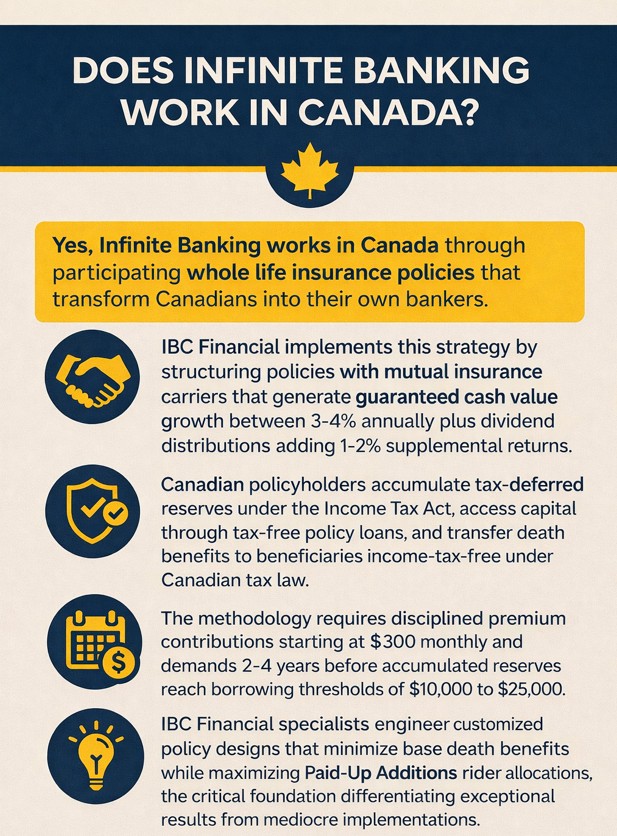
Yes, Infinite Banking works in Canada through participating whole life insurance policies that transform Canadians into their own bankers. IBC Financial implements this strategy by structuring policies with mutual insurance carriers that generate guaranteed cash value growth between 3-4% annually plus dividend distributions adding 1-2% supplemental returns. Canadian policyholders accumulate tax-deferred reserves under the Income Tax Act, access capital through tax-free policy loans, and transfer death benefits to beneficiaries income-tax-free under Canadian tax law. The methodology requires disciplined premium contributions starting at $300 monthly and demands 2-4 years before accumulated reserves reach borrowing thresholds of $10,000 to $25,000. IBC Financial specialists engineer customized policy designs that minimize base death benefits while maximizing Paid-Up Additions rider allocations, the critical foundation differentiating exceptional results from mediocre implementations.
R. Nelson Nash created the Infinite Banking Concept during the 1980s after discovering how participating whole life insurance could replace traditional banking institutions in personal finance management. Nash, an American economist and financial educator, published his groundbreaking book “Becoming Your Own Banker: The Infinite Banking Concept” in 2000, establishing the foundational framework for modern Infinite Banking practice. He recognized that conventional lending institutions extract enormous wealth from borrowers through interest charges, restrictive terms, and controlling approval processes. Nash engineered the Infinite Banking solution that reversed this dynamic, positioning policyholders as their own lending sources through Infinite Banking strategies.
The benefits of Infinite Banking and becoming your own banker include achieving financial independence from traditional lending institutions, immediate liquidity access through Infinite Banking policy loans, tax-advantaged wealth accumulation via Infinite Banking structures, and asset protection from creditors. Infinite Banking delivers benefits that extend beyond conventional financial strategies, offering comprehensive control over your personal banking system.
Implementing Infinite Banking empowers you to eliminate banking intermediaries while maintaining complete control over capital deployment. The Infinite Banking approach provides reliable funding sources when you need them most, without restrictive underwriting or approval delays inherent to traditional lenders.

The tax advantages of Infinite Banking include tax-deferred cash value growth, tax-free policy loans, and tax-free death benefits to beneficiaries under Canadian tax law—making Infinite Banking a powerful tax-efficient wealth-building vehicle.
Cash value accumulation within participating whole life insurance grows completely tax-deferred under the Income Tax Act (Canada), a key feature distinguishing Infinite Banking from taxable investments. Your Infinite Banking policy earns guaranteed interest at 3-4% annually plus dividend participation without generating taxable income during accumulation years. The Canada Revenue Agency (CRA) exempts life insurance policies from annual accrual taxation as long as they remain within prescribed limits—a tax advantage central to Infinite Banking effectiveness.
Policy loans through Infinite Banking create no taxable income recognition as long as the borrowed amount does not exceed your policy’s Adjusted Cost Basis (ACB) and the policy remains in force. The CRA treats this Infinite Banking transaction as a loan rather than a distribution, generating zero tax liability. This extraordinary tax treatment, unique to Infinite Banking, enables you to access substantial capital without increasing your taxable income or affecting your marginal tax rate.
Death benefits pass to beneficiaries completely income-tax-free under current Canadian tax law—an estate planning advantage that strengthens the Infinite Banking strategy’s long-term wealth-building potential. Your heirs receive the full death benefit amount without federal income taxation. Unlike Registered Retirement Savings Plans (RRSPs) or Registered Retirement Income Funds (RRIFs) that require beneficiaries to pay income taxes on inherited distributions, Infinite Banking death benefits transfer tax-free to your designated beneficiaries.
You transition into private banking status through systematic Infinite Banking Concept (IBC) implementation. Once you establish your personal banking system, you permanently eliminate dependency on conventional money lending institutions. According to Katia Iervasi of Nerdwallet in the comprehensive analysis titled “Infinite Banking: Using Life Insurance as a Source of Liquidity,” the Infinite Banking framework empowers individuals to capitalize on accumulated wealth while completely bypassing traditional banks and commercial lenders charging 6-12% interest rates.
When you generate income streams—monthly, bimonthly, or through alternative frequencies—regardless of source origins, you can fundamentally allocate capital across four primary channels: saving, investing, charitable giving, or consumption spending. When you surrender financial flexibility to traditional banking institutions, you sacrifice guaranteed growth potential and relinquish control over capital deployment timing. However, when you establish your personal bank through IBC methodology, you’re contractually guaranteed to earn dividend distributions, realize guaranteed tax-free growth compounding annually, and secure protection through permanent death benefit coverage protecting beneficiaries.
What are the Costs and Fees Associated with Infinite Banking?
The costs and fees associated with Infinite Banking include premium payments, administrative expenses, mortality and expense risk fees, potential surrender charges, and policy loan interest—all important factors when evaluating the total cost of your Infinite Banking strategy.
| Cost Component | Typical Range | Purpose | Payment Frequency |
| Premium Payments | $3,600-$60,000+ annually | Fund death benefit and cash value growth | Monthly, quarterly, or annual |
| Administrative Fees | $50-$200 annually | Policy management and recordkeeping | Annual assessment |
| Mortality & Expense Charges | Varies by age/health | Cover death benefit insurance costs | Built into premiums |
| Surrender Charges | 10-35% of cash value | Penalty for early termination (years 1-15) | Only if policy surrendered |
| Policy Loan Interest | 4-6% annually | Cost of borrowed capital | Accrues on outstanding loans |
Premium payments represent your primary financial commitment to establishing your Infinite Banking system. Minimum effective premiums typically start at $300 monthly ($3,600 annually) for foundational Infinite Banking implementation. Administrative fees typically range from $50-$200 annually. Mortality and expense risk fees compensate insurance carriers for providing guaranteed death benefit protection essential to Infinite Banking operations. Early policy termination triggers substantial surrender charges, typically 10-35% of accumulated cash value during the first 15 policy years—a consideration affecting Infinite Banking long-term planning. Borrowing against cash value through Infinite Banking incurs interest charges, typically 4-6% annually on outstanding loan balances.
The disadvantages and risks of Infinite Banking include long-term commitment requirements, complexity demanding thorough understanding of Infinite Banking mechanics, opportunity costs, and the necessity for financial discipline to optimize Infinite Banking effectiveness.
Long-Term Commitment: The Infinite Banking strategy requires 5-10 years before substantial cash value accumulation enables meaningful borrowing capacity through Infinite Banking. Individuals seeking immediate financial solutions within 12-24 months will find this Infinite Banking timeline frustrating. The long-term nature of Infinite Banking distinguishes it from short-term financing solutions.
Strategy Complexity: The Infinite Banking Concept involves substantial complexity spanning insurance policy mechanics, dividend crediting methodologies specific to Infinite Banking policies, tax implications, and strategic capital deployment principles underlying Infinite Banking success. You must thoroughly understand Infinite Banking policy loan dynamics and optimal borrowing strategies to optimize effectiveness. Complexity in Infinite Banking implementation often necessitates working with specialists experienced in Infinite Banking design.
Financial Discipline: You need unwavering discipline maintaining premium payment schedules and implementing effective Infinite Banking loan repayment practices. Missing premium payments jeopardizes Infinite Banking policy performance and cash value accumulation. Undisciplined borrowing through Infinite Banking without structured repayment significantly diminishes your Infinite Banking cash value accumulation potential.
Opportunity Cost: Committing $10,000-$50,000 annually toward whole life insurance premiums prevents allocation toward alternative investment vehicles. Stock market index funds historically return 8-10% annually, while real estate investments generate 12-15% returns in favorable markets. However, Infinite Banking provides unique tax advantages and control features that alternative investments cannot replicate.
Reduced Death Benefit: Unpaid Infinite Banking loan balances reduce death benefits paid to beneficiaries by the outstanding loan amount plus accrued interest—an important consideration in Infinite Banking estate planning.
You need a participating whole life insurance policy from a mutual insurance company to implement Infinite Banking successfully. This specific participating whole life policy type provides the required features for authentic Infinite Banking: guaranteed cash value accumulation, dividend participation enabling Infinite Banking, policy loan privileges essential to Infinite Banking mechanics, and permanent death benefit protection.
Participating whole life insurance differs fundamentally from term life insurance and universal life insurance alternatives—critical distinctions for implementing genuine Infinite Banking. Term policies provide temporary death benefit coverage without any cash value component, making them incompatible with Infinite Banking objectives. Universal life insurance offers flexible premiums and investment options but lacks the guaranteed growth stability and dividend predictability that participating whole life policies deliver for Infinite Banking purposes.
The “participating” designation means your policy earns annual dividend distributions from the mutual insurance company’s profitable operations—a key feature differentiating Infinite Banking policies. Your policy must originate from a reputable mutual insurance company demonstrating consistent dividend payment history spanning 30-50+ years, essential for reliable Infinite Banking performance. Northwestern Mutual, MassMutual, Penn Mutual, Guardian Life, and New York Life represent carriers meeting these Infinite Banking criteria.
| Policy Type | Cash Value Growth | Dividend Participation | IBC Suitability | Key Limitation |
| Participating Whole Life | Guaranteed 3-4% + dividends | Yes, from mutual company profits | Excellent – primary choice | Higher premiums required |
| Universal Life | Variable, market-dependent | No, investment-based returns | Poor – lacks guarantees | Growth uncertainty |
| Term Life Insurance | None – no cash value | No dividends | Incompatible | Expires after term period |
| Indexed Universal Life | Capped market returns | No dividends | Poor – complexity issues | Fee structure concerns |
You set up a whole life insurance policy for Infinite Banking by partnering with specialized advisors who engineer Infinite Banking policy designs optimizing cash value accumulation through strategic rider incorporation and premium structuring aligned with Infinite Banking principles.
IBC Financial analyzes your income patterns, existing debt obligations, monthly cash flow availability, and long-term financial goals to determine your optimal Infinite Banking structure. This assessment determines your optimal premium contribution level—typically 10% of gross income or minimum $300 monthly—appropriate for sustainable Infinite Banking implementation.
Policy design engineering represents the critical success factor differentiating effective Infinite Banking from mediocre implementations. Standard whole life policies emphasize death benefit maximization, which hampers the cash value growth velocity essential to Infinite Banking success. Infinite Banking policies require minimized base death benefit combined with maximized Paid-Up Additions (PUA) rider allocations optimized for Infinite Banking performance.
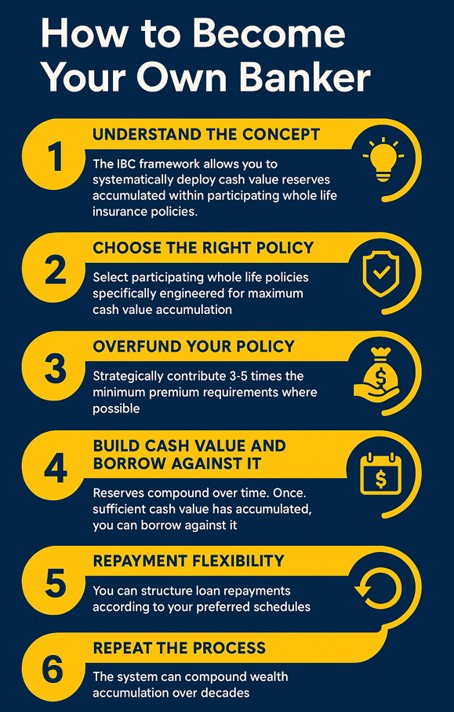
The PUA rider—critical to Infinite Banking strategy—allows you to purchase additional fully-paid permanent insurance coverage that immediately begins earning dividends. Allocating 40-60% of your total premium toward PUA riders accelerates your accessible Infinite Banking cash value by 5-7 years. Overfunding strategies amplify Infinite Banking results dramatically. Contributing 3-5 times the minimum required premium accelerates Infinite Banking cash value accumulation by 40-60%.
The steps to get started with Infinite Banking involve five sequential phases designed to systematically establish and optimize your personal banking system:
Assessment Phase: IBC Financial specialists evaluate your financial situation, income stability, and debt obligations to determine Infinite Banking suitability and optimal premium funding levels for your Infinite Banking strategy.
Policy Design Phase: Experienced advisors engineer your customized Infinite Banking policy structure, determining base death benefit and PUA rider allocation that maximizes Infinite Banking cash value accumulation while maintaining affordable premiums.
Implementation Phase: Your Infinite Banking policy is issued by a mutual insurance company, establishing your personal banking system. Premium payments commence according to your Infinite Banking funding schedule.
Accumulation Phase: Your Infinite Banking policy builds cash value through guaranteed interest and dividend participation. This phase typically spans 2-10 years before substantial Infinite Banking borrowing capacity is available.
Utilization Phase: Once cash value reaches predetermined thresholds, you begin accessing capital through Infinite Banking policy loans, deploying funds according to your financial objectives while maintaining your Infinite Banking system’s growth trajectory.
You borrow against your policy’s cash value with Infinite Banking by submitting a policy loan request form to your insurance carrier managing your Infinite Banking arrangement. The company grants Infinite Banking loans within 3-7 business days without credit checks, approval processes, or usage restrictions—a significant advantage of Infinite Banking accessibility.
Your cash value serves as automatic collateral securing the Infinite Banking loan transaction. Policy loan interest rates through Infinite Banking typically range between 4-6% annually. Your entire cash value balance continues earning guaranteed interest at 3-4% annually plus dividend participation even while substantial Infinite Banking loan amounts remain outstanding—a unique feature enabling continuous Infinite Banking wealth building.
You maintain complete repayment flexibility with Infinite Banking policy loans. The insurance company imposes no mandatory monthly payments, no prepayment penalties, and no restrictive repayment schedules on your Infinite Banking borrowing. Outstanding Infinite Banking loan balances reduce your death benefit by the loan amount plus accrued interest if you die before full repayment.
It takes 2-4 years to build sufficient cash value with Infinite Banking when implementing aggressive overfunding strategies, though standard premium schedules require 5-10 years before accumulated Infinite Banking reserves reach meaningful borrowing thresholds.
The timeline varies dramatically based on premium funding levels and Infinite Banking policy design engineering choices. Minimum premium contributions require 7-10 years before Infinite Banking cash value exceeds $50,000. Contributing 3-5 times the minimum required premium accelerates Infinite Banking cash value accumulation by 40-60%, enabling you to access $25,000-$50,000+ within 2-4 years through your Infinite Banking system.
The first 3-5 policy years present the greatest accumulation challenges in Infinite Banking implementation. Insurance companies recover policy acquisition costs during initial years, reducing net Infinite Banking cash value growth. After the initial 5-7 year period, Infinite Banking cash value growth accelerates dramatically as acquisition costs are recovered and dividend participation increases.
Policy design with Infinite Banking is the strategic engineering of participating whole life insurance contracts that optimize cash value accumulation velocity through optimal Paid-Up Additions rider allocation, minimized base death benefit structuring, and premium funding levels that balance affordability with wealth-building acceleration—the technical foundation of successful Infinite Banking.
Proper policy design represents the critical differentiator between mediocre Infinite Banking results and exceptional wealth accumulation through Infinite Banking implementation. Standard whole life insurance policies emphasize death benefit maximization, delaying accessible cash value growth essential to Infinite Banking success. Infinite Banking policy design minimizes base death benefit while maximizing Paid-Up Additions (PUA) rider contributions aligned with Infinite Banking objectives.
The PUA rider—essential to Infinite Banking strategy—allows each purchase to add permanent insurance coverage that immediately increases your Infinite Banking cash value balance. These Infinite Banking additions earn dividends proportionally, creating compound growth effects that accelerate wealth building. Term insurance riders provide affordable death benefit supplementation while freeing premium dollars for Infinite Banking PUA purchases. IBC Financial maintains relationships with carriers demonstrating design flexibility and competitive dividend performance necessary for superior Infinite Banking results.
Infinite Banking helps with retirement planning by providing tax-advantaged capital access during retirement years without triggering taxable income events or market volatility exposure—a distinct advantage of Infinite Banking-based retirement strategies.
Traditional retirement planning relies on Registered Retirement Savings Plans (RRSPs), Tax-Free Savings Accounts (TFSAs), and taxable investment portfolios that face significant disadvantages during distribution years. RRSP withdrawals trigger ordinary income taxation at your highest marginal rates. Infinite Banking eliminates these vulnerabilities through policy loan mechanics. You access accumulated cash value through tax-free policy loans rather than taxable Infinite Banking distributions.
Your Infinite Banking cash value continues growing throughout retirement even while substantial loans remain outstanding. This stands in stark contrast to traditional retirement portfolios requiring systematic liquidation. The Infinite Banking death benefit provides additional retirement planning advantages. If you die before exhausting Infinite Banking policy loans, your beneficiaries receive the remaining death benefit tax-free—leveraging Infinite Banking for intergenerational wealth transfer.
Yes, Infinite Banking can build generational wealth by accumulating substantial cash value during your lifetime while simultaneously maintaining permanent death benefit protection that passes tax-free to beneficiaries—the cornerstone advantage of Infinite Banking for multigenerational planning.
Generational wealth building through Infinite Banking operates through two distinct mechanisms. You accumulate significant liquid capital—potentially $500,000 to $5,000,000+ depending on premium funding levels—that provides financial flexibility during your lifetime and to subsequent generations. Permanent Infinite Banking death benefits ensure wealth transfers to subsequent generations completely income-tax-free, a powerful wealth multiplication advantage.
The tax-free Infinite Banking death benefit represents the most powerful generational wealth component. Traditional investment portfolios face capital gains recognition upon heir inheritance, and registered account distributions to beneficiaries trigger income taxation. Infinite Banking death benefits bypass these wealth-eroding taxes entirely. Strategic policy ownership structures amplify generational Infinite Banking benefits. Establishing trusts can help optimize estate planning and wealth transfer to subsequent generations while minimizing tax obligations under Canadian tax law through your Infinite Banking structure.
The Infinite Banking strategy suits high-income professionals, business owners, real estate investors, and wealth-conscious families seeking financial independence from traditional banking institutions who can commit $300-$5,000+ monthly toward premium funding for 10-30+ year timeframes. Infinite Banking implementation typically requires consistent financial commitment and discipline.
Ideal Candidates for Infinite Banking:
Poor Fit for Infinite Banking:
The Infinite Banking Concept empowers you to achieve genuine financial sovereignty by transforming participating whole life insurance into a personal banking system under your complete control. Infinite Banking provides the framework for escaping traditional banking dependency while building reliable, tax-advantaged wealth.
Schedule your complimentary consultation with IBC Financial today. Learn how becoming your own banker through Infinite Banking can transform your financial destiny, eliminate traditional banking dependency, and build lasting wealth benefiting your family for generations to come. Our Infinite Banking specialists will evaluate your financial situation and design a customized Infinite Banking strategy aligned with your objectives.

Take the First Step to Financial Freedom!
We use cookies for analytics & functionality. Manage preferences.
Manage your cookie preferences below:
Essential cookies enable basic functions and are necessary for the proper function of the website.
Google reCAPTCHA helps protect websites from spam and abuse by verifying user interactions through challenges.
Statistics cookies collect information anonymously. This information helps us understand how visitors use our website.
Google Analytics is a powerful tool that tracks and analyzes website traffic for informed marketing decisions.
Service URL: policies.google.com (opens in a new window)
Marketing cookies are used to follow visitors to websites. The intention is to show ads that are relevant and engaging to the individual user.
Google Maps is a web mapping service providing satellite imagery, real-time navigation, and location-based information.
Service URL: policies.google.com (opens in a new window)
You can find more information in our Cookie Policy and Privacy Policy.