

Becoming a Client
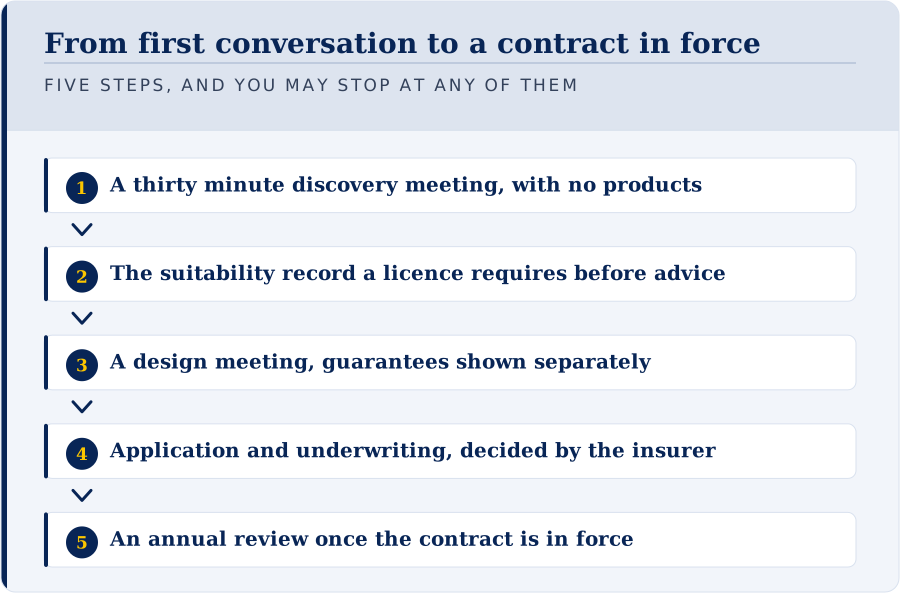
Five steps: a thirty-minute discovery meeting, a suitability record, a design meeting, an application the insurer decides on, and annual service afterwards. You can stop at any of them, and at three of them stopping is a common and correct outcome. Nothing is charged at any stage, because the practice is paid a commission by the insurer if a policy is issued, which is disclosed here rather than buried.
A thirty-minute discovery meeting
A first conversation establishes whether this fits. No illustration is prepared and nothing is arranged.
Often the answer is no, and you will hear it during the call rather than in a proposal afterwards.
This form reaches Canadian Wealth Creation Centre Inc. Any meeting, any advice and any insurance product is provided by Canadian Wealth Creation Centre Inc., through its representatives who are licensed in the client's province. IBC Financial is the company's educational website: it distributes no product and no financial service, and it gives no individualised advice.
Most people meet this process one step at a time and never see the shape of it. Here it is whole, including the parts where the answer is no. Before any of it, check whether you are ready.
Welcome. Before you write to us or book, take two minutes for this check.
Are you ready to become a client? Check yourself first.
This approach is built with your own money, year after year. The kindest thing we can do is let you see, before you contact us, whether today is the right time. Read each line and answer it honestly for yourself. Nobody else sees your answers.
You cannot finance tomorrow with money you do not save today.
Your money
- You save today. A steady amount goes aside most months, and you hold savings on the side that can help fund a policy calmly, for years, without strain.
- You have a cushion first. An emergency reserve for a few months of expenses is already in place, separate from any money you would put into a policy.
- You carry no expensive debt from month to month. Credit card balances and similar debts come first. Paying them off is usually the wiser first step.
- You could keep paying in an ordinary year. The amount you have in mind fits a normal year, not only a good one, and would survive a slower season.
You and the insurer
- You currently reside in Canada. Contracts of this kind are issued to people living here.
- Your record is clear: no criminal record, and a valid driver's licence. Insurers look closely at both.
- You have a lasting need for life insurance. Someone depends on your income, or your estate or business will need the coverage. The insurer decides on your health, not us, and it will ask you to answer its questions fully.
Your understanding
- You have done the reading. The guide, this page, and the pages below.
- You think in decades. You know that the early years cost more than they build, that this is life insurance and not an investment, and that an advance from the insurer carries interest.
How to read your answers. Every line is true: you are ready, and we look forward to hearing from you. One or two lines are "not yet": start there, and come back when they are true. Unsure about a line: you are welcome to book, and please name that line in your message, so the thirty minutes are spent on it.
Not there yet? That is a good place to start, not a closed door. Every one of these is within your reach. Set a fixed amount aside each month, build a cushion of savings, read, and then come back. The conversation will keep, and it will be worth far more when you arrive ready.
Read before you book: the cornerstone guide to the concept, The Eight Rules of Infinite Banking, the real costs and the risks and how it fails.
Step one: The discovery meeting
Thirty minutes, online, no products. You describe your situation and get answers in plain language. If this does not fit, you are told so in that meeting rather than sent a proposal.
Nothing is prepared in advance. No illustration is produced, because a document projecting values decades out, written before anyone knows what the money is for, answers a question nobody has asked and tends to become the conversation instead of informing it.
The four things established are what the money is for, whether the cash flow is durable in a normal year rather than a good one, whether the plan survives a disability or a job loss, and whether this suits you at all. Frequently it does not. Someone without an emergency reserve, or carrying expensive consumer debt, or without stable surplus income, is usually better served dealing with those first, and will be told so.
Step two: Your Financial DNA
The one piece of work asked of you: the suitability record a licensed advisor must complete before recommending anything. Not a sales form, and you decide what you share.
This is a regulatory obligation rather than a preference. An advisor who recommends an insurance product without establishing your needs, your financial situation and your tolerance for a long commitment has not met the standard the licence requires. It exists to protect you from being sold something unsuitable, which is the commonest problem in this field.
You can decline to answer anything. What follows is that some options cannot be recommended, because a recommendation without the underlying facts is not a recommendation.
Step three: The design meeting
More than one route, walked through in plain language, with what the contract guarantees shown separately from what it does not. Deciding not to proceed is a complete answer.
The separation matters more than anything else on this page. A participating whole life contract has guaranteed values set at issue, and it may also receive dividends, which are declared annually at the insurer's discretion and are never guaranteed. Any illustration showing both must show which is which. If you are ever shown a single blended number, ask for the guaranteed column on its own.
A contract is designed at issue for a purpose and most of that design cannot be redone afterwards. One built to accumulate value quickly looks different from one built to maximise the eventual death benefit. That is why the purpose is established in step one and not here.
Step four: Application and underwriting
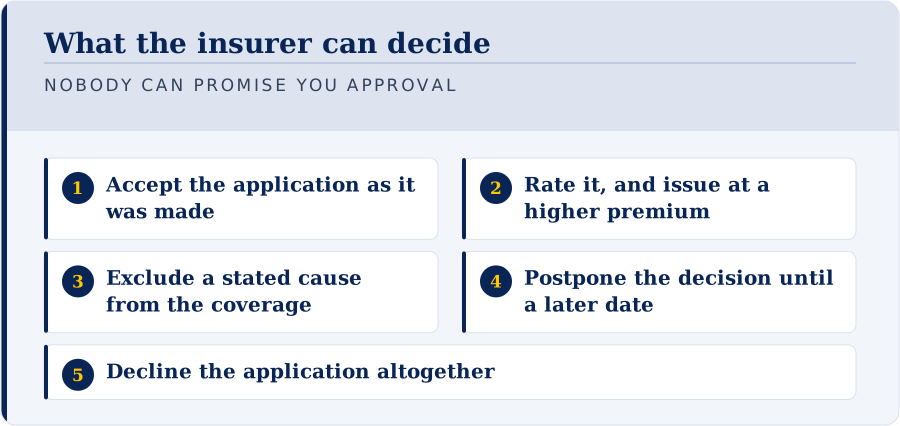
The insurer decides, not the advisor. An application can be accepted, rated, excluded, postponed or declined. Nobody can promise you approval before underwriting.
Underwriting usually involves a medical questionnaire, sometimes a paramedical visit, and sometimes a request for records from your physician. It takes weeks rather than days. A rating means the insurer will issue at a higher premium because of a health or occupational factor. An exclusion means a specific cause is not covered. A postponement means they will look again later.
None of these outcomes is unusual, and none of them is the advisor's decision to make or to promise. Anyone who tells you approval is certain before an insurer has underwritten the file is telling you something they cannot know.
The whole process is set out step by step on life insurance underwriting, and what each of the three outcomes other than acceptance actually means is on rated, postponed or declined. One point is worth carrying into the meeting: the answers given on the form can be tested years later, which is why an error on an application is corrected immediately rather than left.
Book the meetingThirty minutes, online, with no products.
Step five: After the policy is in force
Reviewed with you every year, and available between reviews. Policy loans, repayment, a change in the participation scale, a house, a business, a child's education.
The annual review exists because the contract is long and your circumstances are not fixed. A policy loan is a contractual right, and it is a loan, which means it carries interest and reduces the death benefit until it is repaid. A change in the dividend scale changes what the non-guaranteed part of the contract does, and that is the moment to look at the plan again rather than the moment to worry.
How long the whole thing takes
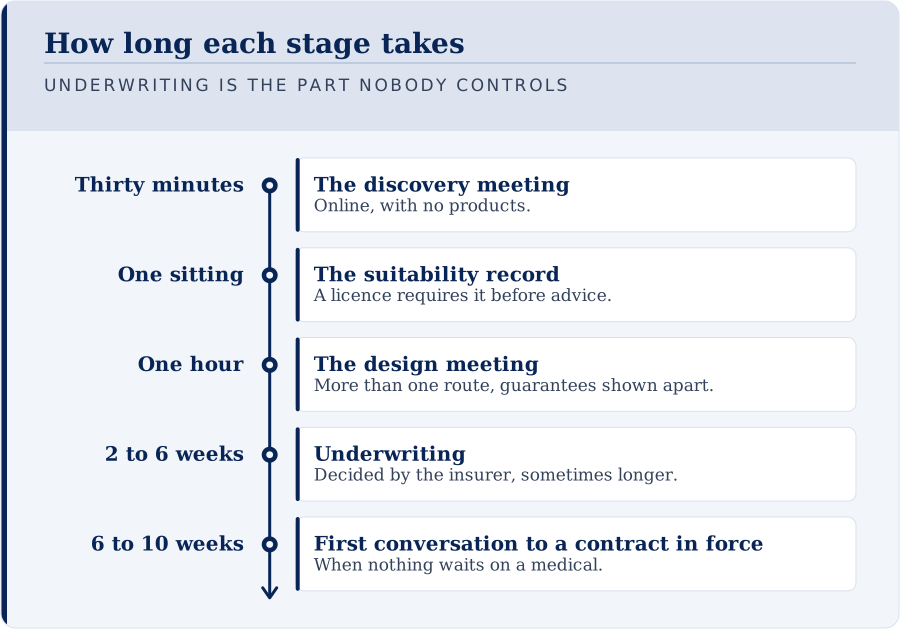
The discovery meeting is thirty minutes. The suitability record is usually one sitting. The design meeting is an hour or so, and there is often a gap before it while the design is prepared properly.
Underwriting is the long part and the part nobody controls: two to six weeks is ordinary, longer if records are requested from a physician. From first conversation to a policy in force, six to ten weeks is a reasonable expectation, and anyone promising materially faster is describing the paperwork rather than the underwriting.
There is no advantage to hurrying. A contract designed in a rush is designed once and lived with for decades.
Where this can stop, and what it costs
You can stop at any step. At steps one, three and four, stopping is a common outcome and not a failure of the process.
Nothing is charged at any stage. The practice is paid a commission by the insurer if a policy is issued, weighted heavily toward the first years. That is a conflict of interest, it is disclosed here rather than at the end, and it is the reason the suitability record in step two is not optional.
Nothing on this page is personalised financial, insurance, tax or legal advice, and reading it creates no professional relationship.
What the practice needs from you, and when
At the discovery meeting: nothing. No documents, no figures, no statements. Thirty minutes of conversation, and you can end it having supplied nothing at all.
Before a design meeting: the suitability record. A licensed advisor may not recommend anything without one, and it is the only piece of work asked of you in the whole process. Income, obligations, what is already in place, what you are trying to do, and over what period. You decide what you share, and a refusal to answer a question is an answer the record can carry.
At application: what the insurer asks for, not what the advisor asks for. Medical history, and sometimes a paramedical appointment arranged at the insurer's cost. The insurer sets that list, and it varies with the amount of coverage and your age.
After the policy is in force: an hour a year. The annual review is where a change in the participation scale, a change in your circumstances, or a question about an advance gets dealt with while it is still small.
What happens if you stop
Before an application is signed, nothing happens. No file is opened, no fee is charged, and nothing is reported anywhere. Most first conversations end here and that is the normal outcome rather than a failure of the process.
After a policy is issued, the contract is yours. It can be surrendered, and early surrender can return less than was paid, which is the single most expensive way to discover that a contract was arranged for the wrong reason. That is why the suitability work happens before the application rather than after it.
A contract you cannot fund is worse than no contract. If the premium depends on income that is not durable, the honest answer at the design meeting is a smaller contract or none, and it is given at that meeting rather than discovered three years later.
There is one more thing worth saying about stopping, and it is the part people find hardest to believe until they have seen it. Nobody at the firm is compensated for talking a household out of a decision it has already reached. The commission on a policy that lapses in year four is largely recovered by the insurer, so a contract sold to somebody who cannot sustain it is worse than no contract at all, for them and for the practice. The incentives point the same way as the advice, which is not true everywhere and is worth checking wherever you are.
A last word on the shape of the relationship itself. The work does not end at issue and it is not meant to: the annual review is where a contract is kept aligned with a household that keeps changing. Incomes move, children arrive, businesses are sold, marriages end and begin. A contract designed around one set of facts and never revisited will still pay its death benefit, but it will not be doing the other things it was arranged to do.
If you already hold a policy somewhere else
A household that already owns a contract is not starting from nothing, and the first question at a discovery meeting is usually whether the existing coverage still fits rather than whether to replace it. Replacing an in-force contract resets the years during which acquisition costs are recovered, and a contract surrendered inside that window can return less than was paid into it. That cost has to be weighed against whatever the replacement is meant to fix, and weighing it honestly means reading the existing policy first rather than starting from a new proposal.
There are cases where replacement is the right answer: a contract that no longer matches the purpose it was bought for, a design that has drifted from what was intended, or a household whose circumstances have changed enough that the original coverage amount no longer makes sense. There are also cases where the better answer is to leave the existing contract exactly as it is and build around it, adding coverage rather than replacing what already works. Neither answer is assumed in advance. The suitability record in step two is completed with the existing contract in hand, not instead of it, so the comparison is made on the actual numbers in your own file rather than on a general argument about one approach against another.
What to bring, and what not to worry about
Nothing needs to be prepared before the discovery meeting, but a household that already owns a policy gets more out of that first conversation by bringing the most recent annual statement and, where it still exists, the illustration produced when the contract was issued. Neither is required, and their absence does not delay anything: a request to the insurer for a current in-force illustration takes a written request and a few weeks, and this practice can make that request on your behalf once you are a client. What matters most at the first meeting is not the paperwork but a plain description of what the money is for and over what period, since every step that follows is built on that answer rather than on any document.
What a first meeting does not do
It does not price anything, because a design depends on age, health, cash flow and what the contract is for, and none of those is settled in half an hour.
It does not commit you to a second meeting. Most first conversations end with a reading list rather than a proposal, and a good number end with the answer that this is not the right use of your money at present.
It does not replace your accountant or your lawyer. Where a question is theirs, the meeting says so and stops, which is the shortest honest answer available and the one this practice is bound to give.
Common questions
How do I know if I am ready to become a client?
Why choose this practice?
What does the practice need from me, and when?
Is there a charge for any of this?
How long does the whole process take?
What is the suitability record, and do I have to complete it?
Can the insurer turn me down?
Can I change my mind partway through?
What happens if I cannot keep paying the premium?
Book the meeting The guide, about eighty pages, is sent to you as a PDF free of charge before the meeting.