

The Real Costs
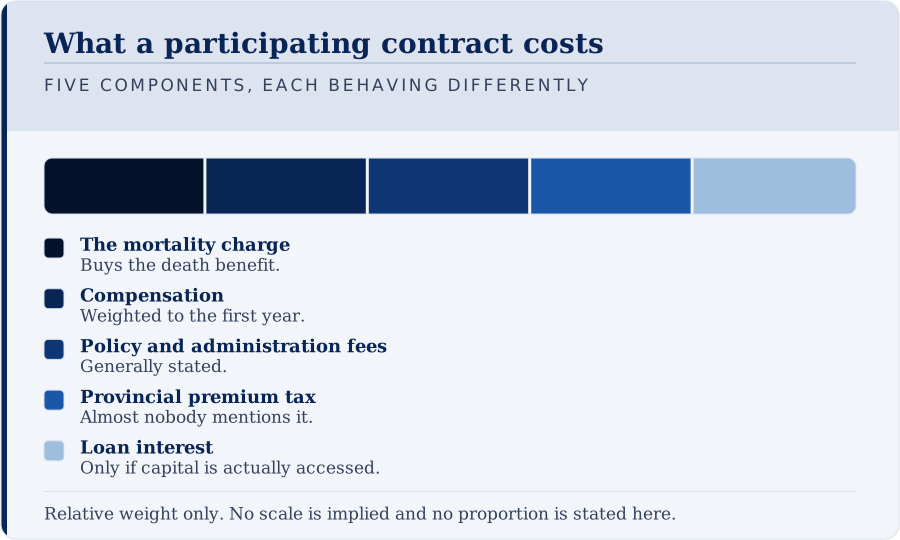
You pay for the insurance itself, the insurer's costs of issuing and running the contract, the representative's commission, provincial taxes that depend on your province, and interest if you take a policy loan. None of it is itemised the way a fund's management expense ratio is, which is a fair criticism. You can still measure what matters: set the guaranteed net cash surrender value beside everything you have paid at years 1, 3, 5 and 10 of your own illustration.
Ask what a specially designed, high-cash-value, participating whole life insurance policy costs and you are owed a figure, not a speech about value. Here is the plain answer. Your premium pays for the insurance itself, the insurer's costs of issuing and running the contract, the commission of the representative who arranged it, provincial tax on premiums where your province levies one, and a reserve that becomes the guaranteed cash value. If you later take a policy loan, the interest is a further cost, owed to and paid to the insurer. What you cannot get is a single published percentage, the way a fund publishes its management expense ratio. That is a fair criticism, and it stands.
You can still measure the cost that matters to you. Take the illustration you were shown, and at years 1, 3, 5, 10 and 20 set everything you will have paid beside the guaranteed net cash surrender value: what the insurer would pay if you ended the contract that year, after any charge and any loan. The gap tells you what leaving would cost at each date. It does not itemise the insurer's expenses, and it is not the price of the coverage, because the premium also bought a death benefit for every one of those years. Read both facts together and you know what you are committing to.
The wider case against the approach, including the parts critics get right, is set out in the honest case against. What follows stays with money: what leaves your household, where it goes, and how to see it on paper before you sign.
Why can't you see the costs the way you see a fund's fees?
Because a participating contract does not separate them. A mutual fund or an exchange-traded fund publishes a management expense ratio: one standardised number, deducted each year, that lets you compare one fund with another in seconds. A participating whole life contract publishes nothing like it. The cost of the insurance, the insurer's expenses, the compensation and the margin the insurer holds against its guarantees are absorbed into the premium and into the participating account. The Autorité des marchés financiers lists what that account pays for: issuing policies, managing them, investing the amounts, death benefits, and the cash surrender values of people who cancel. Mortality, expenses and investment results are pooled, and what is left over is shared through participations, the policy dividends the insurer's board declares, which are not guaranteed. None of it is itemised for you.
That criticism is correct. Anyone who answers it by saying the costs are built into the guaranteed values is describing the problem, not solving it. A household comparing a product that publishes a figure with one that does not has been handed the harder task, and the industry gains from the difficulty.
The cost is also front-loaded, and the buyer carries that risk. Compensation and the costs of putting a contract in force fall mainly in the early years. A contract funded and then surrendered early returns materially less than was paid into it, and the shortfall is largest when a buyer is most likely to change their mind. The structure puts the cost of an early exit on the person least able to price it in advance.
"It is not a fee, it is a transfer of value" is a rhetorical move, not an answer. The premium does buy a death benefit, and that matters. Money still leaves your household. The question is how much, against what, and over which period, and the answer should be a figure rather than a reframing.
What would settle the criticism is a published expense ratio, calculated the same way by every insurer. It does not exist in the Canadian market, because mortality, expenses and investment results are pooled rather than itemised. Until that changes, the guaranteed schedule in your contract is the substitute: a worse tool for comparing two insurers, and a better one for knowing exactly what one contract owes you.
What does the premium actually pay for?
Several things, and they behave differently. Some are paid once, some every year, some only if you use a feature. The table sorts them by who receives the money and where, if anywhere, you can see it.
| Component | How it is charged | Who receives it | Where you can see it |
|---|---|---|---|
| The insurance itself | Priced into a level premium, rather than rising each year as renewable term does | The insurer, to pay death claims across the pool | Not itemised; reflected in the premium and the guaranteed values |
| Underwriting and issue | Incurred once, when the contract is put in force, whether or not it lasts | The insurer, to cover its costs | Not itemised |
| Commission and distribution | Paid by the insurer to the representative and the distributor, weighted to the early years | The representative and the firms that distribute the policy | Not on the illustration; ask for it |
| Administration and contract charges | Ongoing, for as long as the contract runs; some contracts state a policy fee | The insurer | A stated fee appears in the contract; the rest is absorbed |
| Provincial tax on premiums | Depends on the province | The province | Not a separate line on an individual policy |
| Reserve behind the guarantees | Built into the pricing, so the guarantees hold in poor years | Held by the insurer against its promises | Reflected in how low the guaranteed column starts |
| Deduction from extra deposits | On contracts with a paid-up additions option, a percentage can be taken from each extra deposit before it buys anything | Covers items such as compensation, tax and administration, depending on the contract | Ask what your contract deducts, and what it covers |
| Loan interest, if you borrow | Charged by the insurer on any policy loan, at a rate the insurer sets and may change | The insurer | Only in a borrowing scenario, if you ask for one |
The insurance itself is the part that buys the death benefit. On a participating whole life contract it is not deducted as a visible monthly charge, the way the cost of insurance is on a universal life policy. It is priced into a level premium that stays the same for life, which means the early premiums pay more than the insurance costs in those years and the later premiums pay less.
Premium tax deserves a sentence of care, because it is easy to overstate. Insurers pay provincial tax on the premiums they receive, and the rules differ by province. In Ontario, the Ministry of Finance says that insurance companies operating through a permanent establishment in Ontario generally pay insurance premium tax under section 74 of the Corporations Tax Act, at 2% for life insurance (page updated 29 April 2026). Quebec's own tax on insurance premiums does not apply to an individual policy for insurance of persons: Revenu Québec lists it among the exemptions. On an individual policy none of this appears as a line on your bill; like the insurer's other costs, it is part of what the premium has to cover. In another province, ask the insurer which provincial taxes apply to your contract.
Loan interest is the one cost you control completely, because it arises only if you take a policy loan. It is a cost of using the policy, not of owning it, and it has its own section below. For how a published fee looks on the other side of any comparison, see the principles this site measures money by.
How is the advisor paid, and what can you ask?
the cheapest coverage, for a while
What term life insurance does and does not do
- 01Coverage for a fixed period, usually ten to thirty years
- 02It pays if the insured dies within the term
- 03It pays nothing if the insured does not
- 04It has no cash value at any point
- 05It costs a fraction of permanent coverage
The insurer pays the representative who arranges the policy by commission, if a policy is bought. The weight of it falls in the first policy year, with smaller amounts after that depending on the insurer's schedule. It is not billed to you as a separate fee. It is not free either: the premium funds the contract and its costs, and distribution is one of them. How much compensation a policy generates can depend on how much premium the design calls for, extra deposits included, under the insurer's own schedule.
That gives the representative a financial interest in whether you buy and how much you commit. Knowing it is not a reason to distrust a recommendation. It is a reason to test one. So ask how the advisor is paid on this contract: not whether, but how, when, and how much on the policy recommended to you. Ask whether anyone is paid if a loan from an outside lender is arranged alongside the policy. A clear answer, given readily, is part of what you are evaluating.
Written disclosure rules differ by province, and the page on legitimacy sets out what the Quebec texts require. Ask which rules apply where you live, and ask for a copy of any written disclosure. Reading costs nothing; the firm behind this site is paid by insurer commission if a policy is bought through it, which is exactly why the question is worth asking of us too.
Why are the early values so far below what you paid?
Because the guaranteed cash value table is built around the costs of the early years, so it starts low. The Autorité des marchés financiers notes that there is often no cash surrender value in the initial years, and that the method and table used to determine it must be included in the insurance policy. So the figures are not hidden. They are in your contract, year by year, from the day it is issued.
A low early value is not the same thing as a surrender charge. A surrender charge is a separate deduction some contracts make if you end the policy during an initial period, with its own schedule. Many participating whole life contracts have none; their early values are low because the guaranteed table starts low, as the cash surrender value guide explains. So do not assume a charge exists that will fall away and lift your value on a set date. Ask the insurer one question in writing: "Does my policy have a surrender charge and, if so, what is its schedule?"
Four figures travel under similar names, and mixing them up changes your answer.
| Figure | What it means | Why it matters to cost |
|---|---|---|
| Cash value | What has built up inside the contract, including paid-up additions | Not the amount you would receive |
| Cash surrender value | What the contract provides on surrender after any surrender charge, before loans are deducted | The figure the Income Tax Act and many statements start from |
| Net cash surrender value | The cash surrender value less any policy loan and unpaid interest | The cheque you would actually receive |
| Loanable value | The most the insurer will advance, under its own rules | Not the same as the cash value; ask how the insurer calculates it |
Illustrative example, with assumptions shown. Say you have paid $40,000 in total by the end of year three, and your illustration shows a guaranteed net cash surrender value of $25,000 at that date. Leaving then would return $15,000 less than you paid: $40,000 minus $25,000. That $15,000 is your exit shortfall. It is not $15,000 of itemised fees, it is not a tax figure, and it says nothing about the three years of death benefit your premiums also bought. The numbers are invented to show the subtraction; they come from no policy.
How do you read the cost on your own illustration?
name the alternative, or there is none
The comparison that is actually honest
- 01The usual case compares an advance to an outside loan
- 02That holds only if you would have borrowed anyway
- 03If you would not have, compare it against paying cash
- 04Interest on an advance is paid to the insurer
- 05A comparison is incomplete until the alternative is named
Your illustration already holds the figures. They are simply not arranged as the headline. Write them down for each year you might realistically leave: 1, 3, 5, 10 and 20.
| Figure to write down | Where to find it |
|---|---|
| Everything you will have paid, extra deposits included | The premium schedule, plus any deposit option |
| Guaranteed cash surrender value of the base policy | The guaranteed column |
| Guaranteed value of the paid-up additions your extra deposits buy | Ask whether the guaranteed column includes them; if not, ask for a version that shows both, each on its own line |
| Any surrender charge | The contract; ask the insurer in writing |
| Value on the current dividend scale | The illustrated column, with the date of the scale |
| Value on the insurer's reduced scale | A separate column or a separate illustration |
| Guaranteed and projected death benefit | The death benefit columns |
| Adjusted cost basis | Ask the insurer; some illustrations show it |
| Deduction from each extra deposit | Ask what the contract deducts and what it covers |
Then read them in this order.
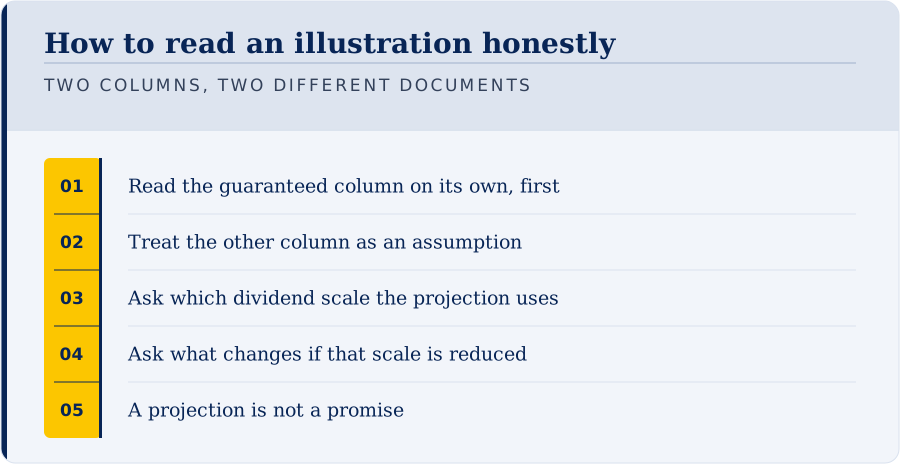
- Read the guaranteed column alone first. It is the part written into the contract. Everything else rests on assumptions about the insurer's future results.
- Count every dollar you pay. A break-even year that leaves out extra deposits, or a guaranteed column that leaves out the paid-up additions those deposits bought, gives you a different answer from the true one.
- Set the current-scale column beside the reduced-scale column. The Autorité des marchés financiers says you will usually receive a realistic scenario and an adverse scenario. The distance between them is what depends on the dividends the insurer's board has yet to declare.
- Treat the dividend scale interest rate as an input, not a return. It is one of the inputs the insurer uses to set its dividend scale. Your policy's growth also reflects the cost of the insurance, expenses and the design. Whenever the cash value is below what you have paid, your return on the cash value to date is below zero, whatever the published rate.
- Ask what happens if premiums stop in year two, year five and year ten. The answer at each point tells you where the cost sits. A recommendation that has not been run through those three dates has not been tested.
A presentation that shows only the illustrated column has removed the information you need. The single most useful question is this one: what proportion of my first-year deposit exists as guaranteed net cash surrender value at the end of year one? It needs no interpretation, and the answer is on a page you have already been shown. If a representative will not put that figure in writing, do not sign until they do.
What does the break-even year tell you, and what does it not?
The break-even year is the first year in which the guaranteed net cash surrender value equals everything you have paid. It is worth knowing. It tells you how long your money is committed before leaving would, on guaranteed figures, give back what you put in.
It is a liquidity test, not a price. Reaching break-even in year ten means ten years in which the guaranteed cash value earns nothing beyond what you paid in, which is a cost in itself. Two designs with the same break-even year can have very different values at year twenty and very different death benefits. And a design that reaches break-even sooner is not automatically cheaper: it may carry less insurance for the same premium, which is a different purchase, not a better price.
Illustrative example, with assumptions shown. Say you pay $20,000 at the end of each year for ten years, $200,000 in all, and your guaranteed column reaches $200,000 at the end of year ten. On guaranteed figures, you have your payments back and nothing more. Had the same payments gone somewhere earning an assumed 3% a year before tax, they would have grown to about $229,278: $20,000 multiplied by 11.4639, the ten-year accumulation factor at 3%. The 3% is an assumption for arithmetic, not a forecast, and the example ignores tax on both sides and the death benefit the policy provided for all ten years. What it shows is that break-even hides a cost: what the money could have earned in the meantime.
So compare designs on the same need, the same funding period, the same dividend option and the same borrowing scenario. Then read the later guaranteed values and the death benefit as well as the break-even year, because a single year cannot price a contract that may run for decades.
What does it cost to leave, and what if you cannot keep paying?
The figure that matters most is not the annual cost. It is what leaving costs at the moment you might want to.
In the first years, the guaranteed value can be well below what you have paid, and on some designs nil, so leaving then recovers little. As the years pass, on a contract funded as designed, the guaranteed value rises toward cumulative premiums, and the year it gets there is in your contract's table. After that, the question changes from what you lose by leaving to what you give up: the coverage, and the guaranteed values still to come.
Surrender is not the only door. If money becomes tight, ask the insurer what your contract allows before you miss a premium. The options depend on the contract.
| Option | Coverage | Value | Tax point to check |
|---|---|---|---|
| Keep paying as designed | Continues | Grows under the contract | None from paying the premium |
| Reduced paid-up insurance, where the contract provides it | A smaller amount of coverage for life, with no more premiums | Applied to buy the smaller coverage | Ask the insurer whether it changes the policy's tax position |
| Automatic premium loan, where the contract provides it | Continues while the value supports the loan | A policy loan grows against the value | Our reading of subsection 148(9): an amount the insurer applies directly to pay a premium is excluded from the proceeds of a policy loan; confirm with the insurer and your accountant |
| Surrender | Ends | You receive the net cash surrender value | Income only to the extent the proceeds exceed the adjusted cost basis |
| Termination with a loan outstanding | Ends | Settled against the loan | Can produce income, possibly in a year with no cash to pay the tax |
On a surrender, or a termination with a loan outstanding, the proceeds for tax are the cash surrender value less the loans owing. So the cheque after the loan is settled is not the figure that decides the tax, and income arises only to the extent those proceeds exceed the adjusted cost basis. Before you surrender, ask the insurer in writing for the disposition proceeds, the loan settlement, the adjusted cost basis and the tax slip it expects to issue, and have an accountant review them even if little cash will be paid. Quebec residents also file with Revenu Québec.
The Income Tax Act does not treat a lapse caused by unpaid premiums as a disposition if the policy is reinstated no later than 60 days after the end of the calendar year of the lapse. That exception is written for premium lapses. If a contract ends because the loan overtook the value securing it, ask the insurer and your accountant in writing whether the exception can apply, rather than assuming it does. Reinstatement itself is the insurer's decision under the contract. The full picture of what can go wrong is in risks and failure modes.
What does borrowing add to the cost?
conceded before anything is answered
What the critics get right
- Early cash value is low against the premium paid
- The commitment is long and costly to abandon
- Costs are not disclosed line by line
- A household without durable surplus has cheaper places to hold money
- The comparison usually offered is the wrong comparison
A policy loan gives you access to the value without surrendering the contract. It is not free, and it is not unconditional. The insurer advances the money under the contract, secured by the cash value, up to a limit the insurer sets. You owe the insurer. The interest is owed to and paid to the insurer; it does not come back to you. The insurer sets the rate and may change it. When a loan first becomes available, the forms, any consents required and how the request is processed all depend on the contract.
A loan from an outside lender secured by the policy is a separate transaction, and the lender decides whether to lend, on its own terms. The two are sold under the same phrase, borrowing against the policy, so set them side by side.
| Point | Policy loan | Loan from an outside lender, secured by the policy |
|---|---|---|
| Who lends | The insurer, under the contract | A bank or other lender |
| Who decides | The contract and the insurer's rules, up to the insurer's limit | The lender, after its own application and credit review |
| Rate | Set by the insurer, which may change it | Set by the lender, on its terms |
| Who receives the interest | The insurer | The lender |
| Who owes whom | You owe the insurer | You owe the lender, and the policy is assigned to it as security |
| Tax on the advance | A disposition; income only to the extent the proceeds exceed the adjusted cost basis immediately before the loan | Assigning the policy as security is not a disposition |
| At the death of the person insured | The balance is deducted from the death benefit | The lender is repaid from the proceeds under the assignment |
| If the balance outgrows the value | The policy can end under its terms | The lender's terms apply |
The tax, in a little more detail. A policy loan is a disposition under subsection 148(9) of the Income Tax Act, and only the part of its proceeds above the adjusted cost basis immediately before the loan is income. The loan also lowers the adjusted cost basis, so a later loan can create income where an earlier one did not. Repaying a loan that was partly included in income can give a deduction under paragraph 60(s) in the year of repayment, up to the amount previously included; it is a deduction in that year, not a refund of the earlier tax. Interest you leave unpaid can be added to the loan under the contract and bear interest in turn. The details are in when a policy loan becomes taxable.
Whether an outstanding loan changes your dividends depends on the contract. Some participating contracts adjust the dividend on the part of the value securing a loan; others do not. Neither arrangement makes the loan free, because interest is owed to the insurer either way. Ask for your insurer's dividend policy and loan provision in writing, and check the loan balance against the value more often than once a year when the margin is narrow.
Illustrative example, with assumptions shown. Say you take a $50,000 policy loan at an assumed 5% a year, compounded yearly, and pay no interest for five years. The balance would grow to about $63,814: $50,000 multiplied by 1.05 five times over. The 5% is an assumption, not any insurer's rate; your insurer sets its own, may change it, and applies interest as your contract provides. Whether that cost is reasonable depends on what you would otherwise have paid to borrow, or on what your savings would have earned if you would have paid cash. The comparison question takes that apart.
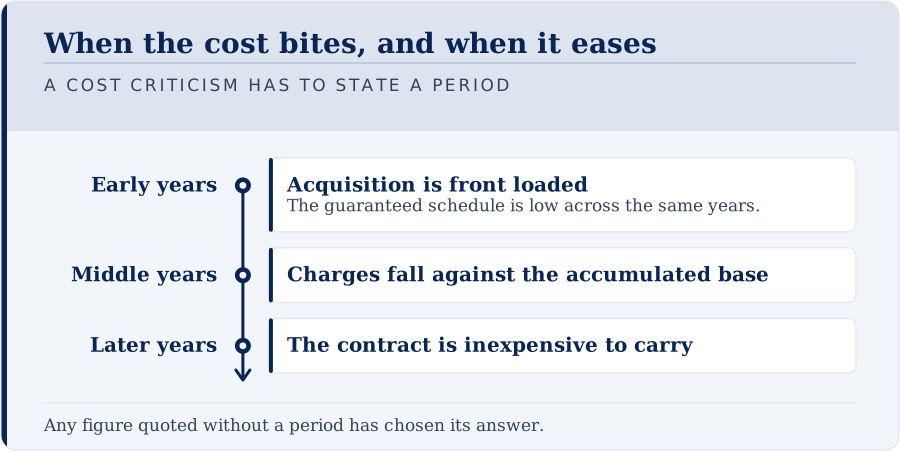
How does the cost change over the life of the contract?
The figure people quote is a snapshot, and the picture moves.
Early on, the cost is heavy relative to the value. Acquisition costs fall in these years and the guaranteed column starts low.
In the middle years, on a contract funded as designed, the guaranteed value moves toward what you have paid and then past it, at the pace your contract's table sets. Acquisition is behind you, and each year's charges are a smaller share of a larger value.
Later, the yearly charges can be small relative to the value the contract carries. That does not make the contract cheap in total. What the money could have earned elsewhere keeps counting for as long as it stays committed, and the insurance keeps being paid for.
So any cost criticism has to state a period. "Expensive" is accurate about the early years. After that the answer depends on your contract's figures and on what you compare them with, and a presentation that uses only one half of the picture, in either direction, has chosen its conclusion.
What should you compare the cost against?
the commonest reasons it fails
Who this method does not suit
- 01A household whose income cannot carry an ordinary decade
- 02Anyone who may need the capital in the first several years
- 03Anyone who will not repay what they draw
- 04Anyone who does not actually want permanent coverage
- 05Anyone who cannot say what the contract is for
A cost can only be judged against an alternative, and choosing the alternative is where comparisons get rigged.
Against term life insurance. Term costs far less for the same death benefit over its period, and it builds no cash value. If your need is temporary, term does that job for less. Read its renewal and conversion provisions, because they decide what happens when the term ends; conversion is an option some contracts offer, with its own deadlines, not a promise of the cheapest outcome. The comparison with permanent coverage is fair only where the need is permanent.
Against permanent coverage without a participating account. If the need is permanent and cash value is not what you want, term 100 or non-participating whole life can provide lifelong coverage. The Autorité des marchés financiers suggests comparing participating insurance with these on cost, amount of coverage and cash surrender value.
Against a low-cost fund. For growth alone, a fund publishes its expense ratio, and on growth alone the contract can lose. The honest response is that the two do different jobs, not that the comparison is unfair. Registered plans such as a TFSA or an RRSP also do different jobs from a life insurance policy; questions about them belong with a professional licensed for them.
Against what you would really have done. Ask yourself honestly what this money would otherwise do: be invested steadily, pay down debt, sit in reserve, or be spent. Only your own record answers that, and the answer changes the comparison. No illustration can show it, because it depends on you: your marginal tax rate, your habits, and what you would actually have done with the money rather than what you might have done. That is not a defect in the illustration. It is a limit on what any illustration can tell you.
The test for an honest comparison, whoever prepared it, this practice included:
- the same period on both sides;
- the same cost treatment, after costs against after costs;
- the same certainty, guaranteed against guaranteed and projected against projected;
- the same tax treatment;
- an alternative you would actually have chosen;
- the death benefit counted on one side, and its absence on the other.
A comparison missing any one of these is an argument, not an analysis.
What does the cost buy, and when is it defensible?
The criticism is about disclosure. The response is not that the costs are small. It is that they buy specific things a household can decide it wants, or does not.
- A death benefit payable whenever the person insured dies, while the policy is in force and less any loan owing, priced on the health the person insured had when the policy was issued.
- A guaranteed schedule of values, written into the contract, that does not fall in a poor year. Guarantees cost money to provide, because the insurer must reserve for them conservatively.
- Access to the value during life through a policy loan, within the insurer's limit and at a rate the insurer sets and may change, without a new credit application to an outside lender, and with the tax and lapse consequences set out above.
- Growth that is not taxed each year while the policy remains an exempt policy under the Income Tax Act.
- Underwriting once. After issue, the coverage continues whatever happens to the health of the person insured, as long as the policy stays in force.
The cost is defensible in two situations. Where permanent coverage is genuinely needed, the cost of the insurance is the purchase itself, and setting it against a portfolio that provides no death benefit compares two things that do different jobs. And where the contract is held long enough for the early costs to be absorbed, by an owner whose surplus survives an ordinary bad decade and not only a good year, the early shortfall becomes history rather than a live risk. That condition has to be checked for each household. It cannot be assumed.
If you may need the money within the first years, carry high-rate debt, or do not want permanent coverage for its own sake, you would be paying for things you will not use. A household that wants none of these things is paying for all of them. That is a suitability finding rather than a cost finding, and it is why "expensive" and "wrong for you" are different conclusions. The Autorité des marchés financiers puts it plainly: participating insurance is "generally intended for an affluent clientele".
A participating whole life contract is insurance first. It is not a savings account, a deposit or an investment, and judged only as a way to grow money it can compare poorly with options that do only that job. Whether the trade is worth making depends on facts about you.
What questions settle the cost before you sign?
Each question has someone whose job it is to answer it. Ask them in writing.
| Question | Who answers |
|---|---|
| What will I have paid, and what is the guaranteed net cash surrender value, at years 1, 3, 5, 10 and 20? | The representative, from the insurer's illustration |
| Does my policy have a surrender charge, and on what schedule? | The insurer, from the contract |
| What is deducted from each extra deposit, and what does it cover? | The insurer |
| Does the guaranteed column include the paid-up additions my deposits buy? | The insurer or the representative |
| What does the reduced dividend scale show beside the current one, and what is the scale's date? | The insurer |
| How is the representative paid on this policy, and how much? | The representative |
| What is the loan provision: limit, how the rate is set, when it can change, and the effect on dividends? | The insurer |
| What is the adjusted cost basis now, and at each year I might borrow or leave? | The insurer |
| How would a loan, a surrender or a termination be taxed in my situation? | Your accountant; Quebec residents also file with Revenu Québec |
| Who must consent to a loan or an assignment, and how does a beneficiary designation interact with it? | A lawyer, or in Quebec a lawyer or notary |
| What are the terms of a loan secured by the policy? | The outside lender |
Figures given aloud in a meeting are hard to check afterwards, and a written request costs nothing when the figures come from the contract. Year one, year five and year ten, read beside what you paid, and the cost structure is no longer a matter of opinion. It is a matter of reading.
A thirty-minute discovery meeting
A first conversation establishes whether this fits. No illustration is prepared and nothing is arranged.
Often the answer is no, and you will hear it during the call rather than in a proposal afterwards.
This form reaches Canadian Wealth Creation Centre Inc. Any meeting, any advice and any insurance product is provided by Canadian Wealth Creation Centre Inc., through its representatives who are licensed in the client's province. IBC Financial is the company's educational website: it distributes no product and no financial service, and it gives no individualised advice.
Common questions
What is the management expense ratio on a whole life policy?
How is the advisor paid, and when?
When does the contract break even?
Is the cost worth it?
What am I actually paying for?
Is there a provincial premium tax on life insurance?
How much of my first-year deposit becomes guaranteed cash value?
What does it cost to get out in year three?
Does the cost stay the same across the life of the contract?
Does interest on a policy loan count as a cost of the contract?
How do I compare this cost against a fund fairly?
Are all these charges the insurer's revenue?
What would make the cost criticism go away?
Does every whole life policy have a surrender charge?
Is the dividend scale interest rate my return?
What if I can no longer pay the premium?
Sources
- Income Tax Act s.148(9), Justice Laws Canada, verified 2026-08-21
- Income Tax Act, R.S.C. 1985, c. 1 (5th Supp.), subsection 148(1) and subsection 148(9) (definitions of disposition, paragraphs (b), (f) and (g). Policy loan. Proceeds of the disposition. Adjusted cost basis), Justice Laws Canada, current to 3 September 2026, as read for this site and recorded on its policy loan tax page and silo hub, verified 2026-09-29
- Income Tax Act paragraph 60(s), deduction for repayment of a policy loan up to amounts previously included, Justice Laws Canada, as recorded on this site, verified 2026-09-16
- Ontario Ministry of Finance, Corporations Tax: Insurance Premium Tax (insurers operating through a permanent establishment in Ontario generally pay the tax. Life insurance 2%. Section 74 of the Corporations Tax Act). Page updated 29 April 2026, verified 2026-09-29
- Revenu Québec, Tax on insurance premiums (rate 9%) and Exemptions (an individual policy for insurance of persons). Last updated 2 February 2026, verified 2026-09-29
- Autorité des marchés financiers, How to access the cash surrender value without cancelling your insurance (often no cash surrender value in the initial years. Method and table must be included in the policy. Policy loans. Borrowing from another financial institution using the policy as collateral. Reduced paid-up insurance), verified 2026-09-29
- Autorité des marchés financiers, Participating and non-participating whole life insurance (expenses of the participating account. Dividends not guaranteed. A realistic scenario and an adverse scenario. Generally intended for an affluent clientele. Comparison with whole life and term 100), verified 2026-09-29
About the author

Jose Salloum is a Financial Security Advisor (conseiller en sécurité financière) certified by the Autorité des marchés financiers in Quebec, a Life and Accident & Sickness Insurance Agent licensed by the Financial Services Regulatory Authority of Ontario, and a Life Insurance Agent licensed by the Insurance Council of British Columbia. Licensed since 2001.
He has practised Infinite Banking since 2015 and founded Canadian Wealth Creation Centre Inc. in 2016. From 2020 to 2024 he was an IBC (Infinite Banking Concepts™) Authorized Practitioner of the Nelson Nash Institute, a private certification rather than a regulatory licence.
IBC Financial is the educational website of Canadian Wealth Creation Centre Inc., open to all Canadians. Services come only from Canadian Wealth Creation Centre Inc. Its representatives hold a licence in each province served: Quebec, Ontario, Alberta, British Columbia, Manitoba and New Brunswick. Jose Salloum's own licences cover Quebec, Ontario and British Columbia. This page is general education and not advice on any individual file.
Last reviewed 2026-09-29. By Jose Salloum, Financial Security Advisor in Quebec. In Ontario, Life and Accident & Sickness Insurance Agent. In British Columbia, Life Insurance Agent.