

The Infinite Banking Concept® in Canada
The Infinite Banking Concept® is Nelson Nash's name for a way of thinking about financing. His premise was that a family's need for financing is greater than its need for life insurance protection. The family builds its own financing system over time, so that ordinary purchases are financed through it, less interest goes to outside lenders, and its reliance on them can eventually end. The usual tool is a specially designed, high-cash-value, participating whole life insurance policy from a Canadian mutual life insurance company. A policy loan is an advance from the insurer, which receives the interest. It takes years and steady funding.
Here is the short version. You pay premiums into a specially designed, high-cash-value, participating whole life insurance policy. The policy builds cash value. When you need money for a car, equipment or a renovation, you take a policy loan from the insurer against that cash value, pay the insurer interest, and repay the loan on a schedule you choose. In Canada, the part of a policy loan above the policy's adjusted cost basis is taxable income, so the arithmetic matters. It works for people who have durable surplus cash flow, think in decades, and want permanent life insurance for its own sake. For most other people it does not.
The aim this practice works toward, built on the method Nelson Nash named The Infinite Banking Concept®, is roughly this:
80%
Concept and thinking
20%
The participating contract
That split is this practice's own view, not a measured figure; it describes an order of importance.
The eighty percent is how you think about money. Who does the financing in your life, for every purchase and every obligation? What happens to a dollar after it leaves? Does the capital come back, or is it simply gone? Are you deciding, or are you applying for permission? None of that needs a contract, and you can improve most of it before you buy anything.
The twenty percent is the policy, and the word that matters is designed. Take the same insurer's product, arrange it for the largest possible death benefit, and it behaves very differently from one arranged for accessible cash value. Once it is issued, it largely cannot be redesigned. It is an ordinary regulated insurance product with nothing proprietary about it.
So why does the split matter? Because a household that buys the twenty percent without the eighty has bought an expensive policy. The contract supplies capacity. It does not supply the thinking, and nothing that is sold can. That is why we assess whether you can sustain and run the method before any contract is discussed.
Why a participating policy is an insurance product and not an investment, and why people describe it as one anyway, is explained on life insurance is not an investment.
What is the method Nelson Nash named The Infinite Banking Concept®?
It is a way of thinking about financing before it is a product. Nelson Nash's premise was that a family's need for financing is greater than its need for life insurance protection, so the family builds, over years, its own system for financing ordinary purchases, pays less interest to outside lenders and eventually stops relying on them. The usual tool is a specially designed, high-cash-value, participating whole life insurance policy: it accumulates cash value, and when money is needed you ask the insurer for a policy loan secured by that value, use the money, and repay it.
The idea was set out by Nelson Nash in a book published in 2000. Nash worked for about ten years as a forestry consultant in North Carolina and then spent more than thirty-five years as an agent for two mutual life insurers, according to the Nelson Nash Institute. That second career matters when you read his work: he was describing a feature that insurance contracts had offered for a century, and he knew it from the inside. What he contributed was the framing.
The full account, covering the definition, the mechanics, the costs, the risks, the tax treatment and who it suits, is on how a household finances its own life.
The term The Infinite Banking Concept® is a mark of Infinite Banking Concepts, LLC. The full trademark and non-affiliation statement appears in the disclosures at the foot of every page on this site.
How does a policy loan work in Canada?
A policy loan is money the insurer lends you from its own funds, with your policy's cash value as the security. Some documents call it an advance; the Income Tax Act calls it a policy loan, and so do we. There is no credit check, because the cash value already secures the loan. The detail is on how a policy loan actually works.
Four facts decide what a policy loan really costs you.
The insurer sets the interest rate, and it can change. The policy loan guide of a Canadian mutual life insurance company, for example, says the insurer reviews the rate from time to time and may change it at any time. Ask for the current rate, and how it has moved, before you rely on it.
There is usually no fixed repayment schedule. You can repay at any time, in amounts you choose. That flexibility is the appeal, and it is also the risk, because nothing outside you makes the payment happen.
Interest you do not pay is added to the loan. At each policy anniversary, unpaid interest is capitalised: it joins the balance, and interest is then charged on the larger amount.
If the debt outgrows the cash value, the policy ends. When the total owed, interest included, exceeds the cash value, the policy lapses. A lapse with a loan outstanding is a disposition for tax purposes, and the amount above the adjusted cost basis can be taxable in a year when no cash reaches you. That is why repayment is the heart of the method.
Illustrative example. Assume a policy loan of $30,000 at an assumed rate of 6% a year, and assume you pay nothing. At the first anniversary, $1,800 of interest is added and the balance becomes $31,800. Left alone for ten years at the same assumed rate, the balance grows to about $53,700. The rate is an assumption for the arithmetic, not any insurer's quote. The point is the shape: an unpaid loan compounds against you while the cash value grows on its own schedule, and if the loan catches up, the policy lapses.
A loan from a bank that takes your policy as collateral is a different thing: it is not a policy loan and not a disposition under section 148. The bank underwrites it, sets its own terms and can call it, and it has its own costs and risks at death.
Here is how the three usual ways of paying for a large purchase compare.
| Policy loan | Bank loan secured by the policy | Paying cash | |
|---|---|---|---|
| Who provides the money | The insurer, from its own funds | A bank or other lender | You, from savings |
| Credit approval | None; the cash value secures it | The lender underwrites it | None |
| Interest rate | Set by the insurer; can change | Set by the lender under its agreement | No interest; you give up what the cash would have earned |
| Repayment | Usually no fixed schedule | The lender's terms; the loan can be called | Nothing to repay; rebuilding savings is up to you |
| Tax when you borrow | The part above the adjusted cost basis is income (s.148) | Not a disposition; assigning a policy as security is excluded | None from the payment itself |
| If left unpaid | Interest is added yearly; the policy lapses if the debt exceeds the cash value | The lender can enforce its security against the policy | Not applicable |
| At death | The balance is deducted from the death benefit | The lender is repaid from the death benefit under the assignment | Not applicable |
What it is not
read one illustration as two documents
What is guaranteed, and what is not
- Cash valueGuaranteed: Set out in the schedule at issue. Not guaranteed: Projected totals, which assume the current scale holds.
- Death benefitGuaranteed: Guaranteed, subject to the contract terms. Not guaranteed: Anything the declared dividends add to it.
- The annual decisionGuaranteed: A level premium, fixed by the contract. Not guaranteed: Dividends, declared annually and never guaranteed.
It is not a product. The product is an insurance contract. This is a way of using one, and the distinction matters because the contract exists, is regulated and can be evaluated, while a strategy cannot be bought.
It is not an investment. A participating policy is life insurance. Judged purely as a way to grow money against a market portfolio it usually compares poorly, which is why that is the wrong test and why selling it that way produces the disappointment most of the criticism describes.
It is not independence from the financial system. You hold a contract with an insurer, administered by that insurer under its terms.
It is not a way of lending to yourself. The insurer lends its own funds, charges interest and keeps it. You pay that interest as you would to any lender; the question is whether the arrangement is worth that cost for you.
What does it cost?
Here are the costs, in the order you meet them.
The premium is higher than coverage alone would cost. A policy designed for accessible cash value is funded well above the minimum needed for the death benefit. That extra funding is what builds the cash value, and it is money you cannot use elsewhere while it is committed.
The early years cost the most. Part of every premium pays for the insurance, the insurer's expenses, the premium tax and the advisor's compensation, and those costs fall heaviest at the start. If you surrender the policy in the first years, you get back the cash surrender value, which sits well below what you paid. That loss is permanent.
Extra deposits carry their own charge. On one mutual insurer's participating policy, for example, an 8% premium load applies to each excess deposit, according to that insurer's product summary. Ask for the figure on the contract you are shown.
Every policy loan carries interest paid to the insurer, as the example above shows, and that interest does not come back to you.
The charges are not published as a single expense ratio. Insurers publish dividend scale notices, and your illustration shows guaranteed and non-guaranteed values year by year. Compare policies on the guaranteed column and on the cash value at the years you care about, not on a projection.
And the person explaining it to you is paid. The insurer pays a commission when a contract is issued, and smaller amounts may follow in later years. We tell you that plainly because a product that needs decades of stable funding and pays its advisor at the start is a combination you should know about before you decide.
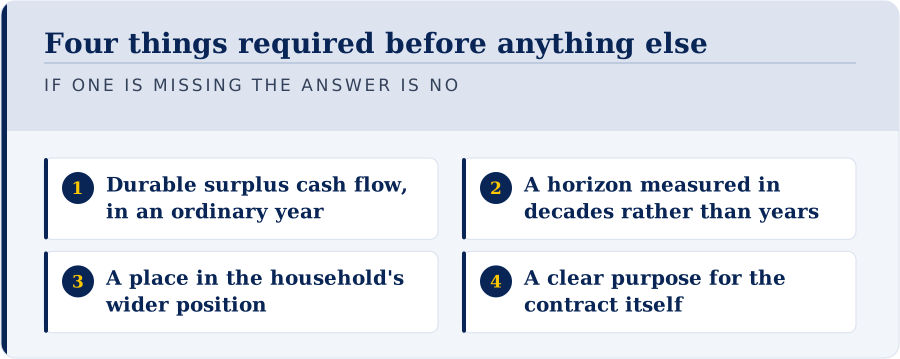
The four things it requires
If one of these is missing, the answer is no, and finding that out now costs nothing.
Durable surplus cash flow. Not a good year. A normal year, sustained, with room to spare. The structure punishes interruption, and interruption is what happens to people whose income is not stable.
A horizon measured in decades. Enter a contract and abandon it within a few years, and it returns far less than you paid into it.
A place in your wider plan. With a fixed surplus, every dollar goes somewhere, and a dollar in premium is a dollar that is not in your TFSA, your RRSP or your FHSA. Those accounts keep their purpose, and this approach does not ask you to abandon them. It does ask you to decide the order deliberately. A presentation that treats the policy as a replacement for them has misdescribed it.
A clear purpose. A contract designed for maximum death benefit behaves differently from one designed to make value accessible early. The decision is made at issue and cannot be revisited later without cost. If you cannot say what the contract is for, nobody can design it correctly for you.
Where is the case for this weakest?
Start with the comparison. The argument usually sets a policy loan against borrowing from an outside lender. A fair comparison starts with the alternative you would actually use: your savings, a bank loan, a line of credit, or waiting. Paying from savings avoids interest but uses liquidity; borrowing keeps other assets in place while adding debt and interest. Measured against the alternative truly available to you, the advantage can be much smaller than the usual pitch suggests, and sometimes it disappears.
That argument is a fair one, and it has its own page: the comparison question.
Then the incentives. People are sold this who should not be. Compensation is paid mostly at issue, while the product needs decades of stable cash flow, and that tension is real.
The full set of objections, with a verdict on each, is in objections and risks.
Which Canadian tax rules decide whether it works?
one payment doing three jobs
Where a permanent premium goes
- 01Part meets the cost of the insurance itself
- 02Part covers the insurer's expense and the premium tax
- 03Part builds the contractual value of the policy
- 04The split is not itemised on an illustration
- 05Base premiums follow the contract's own terms
Much of what you will read online was written for the United States, and the differences are not cosmetic. Read at face value, it warns you about rules that do not apply here and says nothing about the ones that do. These are the Canadian rules that matter.
The exempt test limits how much you can put in. A Canadian policy must stay exempt under Regulation 306, Income Tax Regulations (Regulations, section 306) for the growth inside it to avoid annual taxation. A design that pushes too much money in too fast can run into that limit, which is why insurers monitor the test. One mutual insurer, for example, states that it will not accept an excess deposit that would cause the policy to lose its exempt status. A policy that fails the test has its accruing income taxed every year.
A policy loan is a disposition. Under ITA s.148(9) and subsection 148(1) of the Income Tax Act (Act, section 148), the part of a policy loan above the policy's adjusted cost basis just before the loan is included in your income in the year you receive it. It is taxed as ordinary income, not as a capital gain. Every loan also reduces the adjusted cost basis, so the room for the next tax-free loan shrinks. American material saying policy loans are always tax free is describing a different statute.
Illustrative example. Assume your statement shows an adjusted cost basis of $60,000, and you take a policy loan of $40,000. The loan is below the adjusted cost basis, so nothing is included in your income, and the adjusted cost basis falls to $20,000. The following year you take another $30,000. That loan is $10,000 above the $20,000 that remains, so $10,000 is included in your income for that year. The figures are assumptions for the arithmetic, and they ignore anything else that moves the adjusted cost basis during the year. How to read the figure on a real statement is explained on is my policy loan over my ACB?.
The adjusted cost basis moves in both directions. It rises with the premiums you pay and falls by the accumulated net cost of pure insurance and by policy loans and withdrawals. On a well-funded policy it usually rises in the early years and falls later, once the cost of insurance overtakes new premium. That is why a loan that is tax free in year ten may not be in year thirty. Ask the insurer for the figure in writing before any large loan.
Repaying a taxed loan gives some of it back. If part of a loan was included in your income, repaying the loan later gives a deduction under paragraph 60(s) of the Income Tax Act, up to the amount that was taxed. The repayment also rebuilds the adjusted cost basis.
Loan interest is deductible only when the money earns income. Interest on a policy loan used for a car or a family renovation is not deductible. Interest on money borrowed to earn business or property income can be, under paragraph 20(1)(c) of the Income Tax Act, provided the interest is not added to the adjusted cost basis and the insurer confirms it on Form T2210. The steps are on how a policy loan actually works. Do it with your accountant.
Death is handled differently from the United States. Canada has no estate tax. At death there is a deemed disposition of capital property under subsection 70(5) of the Income Tax Act, and probate fees in some provinces. A death benefit paid to a named beneficiary is not taxable to that beneficiary and is paid outside the estate, less any policy loan still outstanding.
For a corporation, the capital dividend account is net of the adjusted cost basis. When a corporation receives a death benefit, its capital dividend account is credited with the death benefit minus the policy's adjusted cost basis, under subsection 89(1) of the Income Tax Act. On a heavily funded corporate policy the credit can be much smaller than the death benefit, which is why the corporate case is a separate analysis.
Assuris replaces the state guaranty associations an American reader will see named. If a member insurer fails, Assuris protects the higher of $1,000,000 or 90% of the death benefit, and the higher of $100,000 or 90% of the cash value, calculated after deducting any policy loans (Assuris). It is not a government guarantee and not deposit insurance. On a large policy, the 90% matters.
The detail, with more arithmetic, is on is life insurance taxable in Canada.
What it is for
This is the positive case, and it belongs before any list of who it fits.
Building a pool of capital you own. The contract is in your name. A policy loan against it does not depend on a lending committee that has never met you. The insurer administers the contract, sets the loan rate under the method the contract describes, and can change that rate over time; what it cannot do is decide whether you, personally, qualify for the loan. The decision to use the capital is yours.
Keeping your capital where you do not have to reapply for it. What disappears is the approval, not the cost: the insurer still sets the rate and the contract still has rules.
Financing what your life actually requires through that pool rather than around it. A vehicle, a renovation, equipment, an opportunity that appears on short notice. The money leaves and comes back, and the capacity rebuilds because you repaid it.
Coverage that does not expire, underneath all of it, paying whenever death occurs.
And capital that can pass to the next generation. The policy can name a successor owner, ownership can be transferred during your life, and the death benefit goes to the beneficiaries you name. Each route has its own tax result, which your accountant and notary confirm. What passes on most reliably, though, is the habit: children who have watched a family finance its purchases this way and repay what it drew.
This practice describes the outcome as Infinite Financial Sovereignty®, a registered trademark of Jose Salloum. Sovereignty here means the decisions are yours, not that any outcome is assured: the guarantees are contractual obligations of the issuing insurer, dependent on its solvency, and dividends are never guaranteed.
Who it is for
People who would rather own the decision. The households that take to this are usually the ones already uncomfortable with how much of their financial life is decided elsewhere.
People with a long view. Not because the arrangement is slow, though it is, but because they already think in decades: about children, about a business, about what outlives them.
People who want permanent coverage in its own right. They want the death benefit. They do not tolerate it as the cost of something else.
Business owners and incorporated professionals, whose income arrives unevenly and for whom a repayment pace they set themselves is worth something a salaried household may not need.
Families thinking across generations, where the point is a structure that continues and not a payout that ends.
Who it does not suit
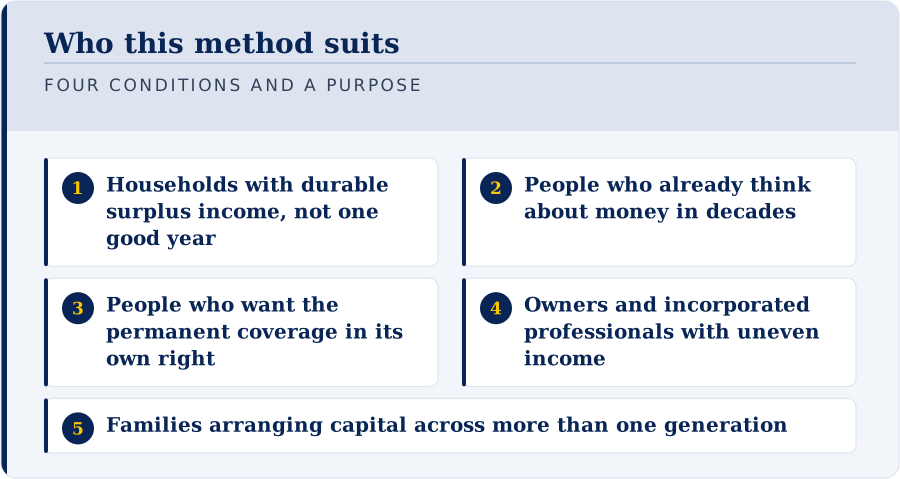
five situations it tends to suit
Who this method suits
- 01Households with durable surplus income, not one good year
- 02People who already think about money in decades
- 03People who want the permanent coverage in its own right
- 04Owners and professionals who can fund premiums through uneven years
- 05Families arranging capital across more than one generation
A household whose cash flow cannot carry the funding through an ordinary decade. An ordinary decade contains a bad year, and that year is the test. This is the commonest reason it fails.
Anyone who may need that capital within the first several years. Early years build slowly, and leaving early returns less than was paid in.
Anyone who will not repay what they draw. No lender calls and no credit consequence follows, but the loan keeps growing, and when it passes the cash value the policy lapses with a tax bill attached. If you know you will not repay, do not begin.
Anyone who does not actually want permanent coverage. If the death benefit is unwanted, this is a financing arrangement wearing an insurance policy, and there are cheaper ways to finance things: a line of credit or a secured loan costs less to set up and carries no insurance charges.
Anyone who cannot say what it is for. The design is largely fixed at issue and follows from the purpose.
Anyone whose household cannot talk directly about money. The arrangement needs agreement sustained over decades, and one that only one partner understands does not survive.
And anyone being told it suits everybody. That is the clearest sign that the person explaining has stopped explaining. In our view, most households should not do this.
The claims that should never be made about this approach, with the correct versions, are at claims that should never be made.
What actually happens over thirty years?
The ranges below describe many designs this practice sees; they are not guarantees, and your own illustration shows your actual years.
Years one to five. You pay premiums, well above what coverage alone would cost. The cash value sits well below what you have paid. Nothing about this period feels like progress, and it is where most people who abandon the approach abandon it, which is also when leaving costs the most.
Years five to ten. The gap narrows. On many designs the accessible value becomes large enough for a real purpose: a vehicle, equipment, a short-term business need. This is the first point at which the approach does anything, and the first real test of the discipline, because the question becomes whether the loan is repaid.
Years ten to twenty. On many designs the total cash value passes everything you have paid in at some point in this window. Ask for that year on the guaranteed column and on the illustrated column, because they are different years. Loans and repayments become routine. The contract is supporting activity, not merely existing.
Beyond twenty. Growth inside the contract is doing more than new premium. The death benefit has grown without further underwriting, as long as dividends buy paid-up additions. Households that reach this stage have told us the early years were harder than they had been led to expect. That is what has been said in this office. It is not the result of a survey.
Nothing in that sequence is fast, and none of it is automatic. It depends on behaviour sustained for decades, which is a harder requirement than any product feature.
Where the arrangement extends beyond one household, private family capital covers what changes when more than one generation takes part.
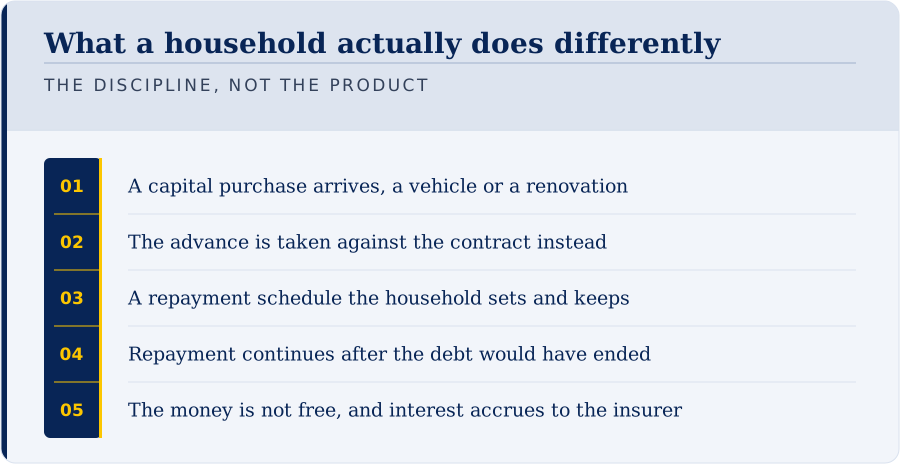
What does a household actually do differently?
When a vehicle, equipment or a renovation comes up, you take a policy loan instead of a commercial loan or cash, and the whole discipline sits in what happens next. If you repay the loan and then keep making the payment, you rebuild the capacity you used. If you stop when the balance clears, you have taken an ordinary loan at an ordinary cost, through a more expensive instrument. And if you never repay, you have drawn down the contract, and the consequence arrives later, usually when you most need the policy.
What it asks of you, rather than of the product, is short. Cash flow that survives a bad decade. A twenty-year view at least. The discipline to repay when nobody requires it. The willingness to read one statement a year and check four figures: the cash value, the loan balance, the adjusted cost basis and the death benefit. And a real wish for permanent coverage.
The question the concept actually asks
Not which product to buy, and not which account to fill first. Who is doing the financing in your life?
Every household finances everything it owns: a car, a roof, a business opportunity, an education. It pays cash, which gives up what that capital would otherwise have earned, or it borrows, which pays somebody else for the use of theirs. Most households never notice they are choosing between two costs.
Nelson Nash's argument was that somebody performs this financing function for every dollar that moves through a household over a lifetime, and that the question worth asking is who. The policy is the tool that lets you perform part of it yourself, at a cost. It is not the point, and it is not what is being bought.
That is why the usual advice to fill registered accounts first, then consider everything else, starts from a different objective: accumulating in the most tax-efficient container. That is a sound objective, and for many households it is the right one. It answers a different question from the one this concept asks. In practice you will weigh both, because your surplus is finite, and the question of order belongs in your own plan, decided with your own figures.
None of that is a recommendation to you. It may fit you or it may not, and that depends on facts this page does not have, which is what the assessment below is for.
The four roles, examined
the security is the contract itself
What an advance does to the death benefit
- 01The balance owing is deducted while it stands
- 02Unpaid interest capitalises and the balance grows
- 03The reduction follows the balance, not the original advance
- 04A death benefit is not fixed while the contract is drawn on
- 05Repayment restores the amount reaching a beneficiary
This is the framework underneath the approach. It describes what a household already does, not what a product provides. In plain terms: four ways money moves through your life, and who decides each one.
The Saver sets money aside and gives up its use meanwhile. The limit is that saved capital is usually either working or available, rarely both.
The Borrower gets the use of capital now and pays for it. The limit is that somebody else sets the cost and the terms, and both can change at renewal, in a rate cycle, or when your circumstances make you a weaker credit.
The Participant shares in the results of a pooled arrangement. The limit is that someone else holds the capital producing those results, so the participation can be adjusted, reduced or ended by a decision that is not yours.
The Administrator decides where capital goes, in what order and on what terms. Its main limit is behavioural: it asks for discipline most people find hard. It still works inside real limits: the contract's terms, the loan rate the insurer sets, the exempt test and the insurer's own solvency. It is also the only role a family can hold together and pass on.
Every household performs the first three constantly, usually without thinking about it. The fourth is open to all of them and exercised by very few. What the contract contributes is a place where the saver and the borrower can work against the same capital. That is a real feature. It does not remove the limits.
What to ask, and what to ask it about
Here is the question to put to your insurer, and a few to put to whoever is explaining this to you.
Who does the financing in my household today, for each thing I have financed? The answer is usually a lender, a leasing company, and the household itself paying cash. Naming them is where the understanding starts.
What does the guaranteed column show at years three, five and ten? A break-even year does not settle anything, but it is the contractual floor, and you are entitled to see it before you sign.
How is the policy loan rate set, how often can it change, and what has it been over the last several years?
What is the adjusted cost basis likely to be at year ten and year twenty on this design?
What happens if I cannot fund this for two years?
What does your assessment cover? Disability, critical illness, job loss, business interruption. If those are not examined, what you have is a sales qualification, not a suitability review.
Who should not do this? An honest answer arrives quickly and names categories.
What are you paid, and when? Our answer: the insurer pays us a commission when a contract is issued, and smaller amounts may follow in later years. If you ask, we tell you the amount on your own proposal before you sign.
Honest expectations
Six statements you can hold on to.
The first five years will not feel like progress, and the contract will be worth less than you have paid into it.
The guaranteed column is a real number you can see before signing, and the contractual floor is later and lower than most people expect.
Dividends will move, in both directions, and an illustration showing a constant scale is showing an assumption.
This is not built to compete with a diversified portfolio as a way to grow money, and we do not present it that way.
The coverage is real and pays whenever death occurs, as long as the policy is in force, and that is what is actually being bought.
In our view, most households should not do this. The ones that should generally want permanent coverage for its own sake and can sustain the funding through a poor decade.
Hold those six and far fewer things will surprise you. They will not remove every surprise: rates, dividends, laws and your own life can all change.
Thinking that costs nothing to start
Most of this method needs no contract, and you can begin the eighty percent this week. The eighty and twenty are this practice's own characterisation, not a measurement.
List what you have financed in the last five years: vehicles, renovations, education, equipment, a tax bill. For each one, name who did the financing: a lender, a leasing company, or you paying cash and giving up what that money would otherwise have done.
For each, name what it cost. Not the price. What left and did not come back: the interest paid to somebody else, or the earnings the cash would have produced. Both are real. Only one appears on a statement.
Notice what you will finance in the next five years. The list is rarely empty, and knowing it is what separates a plan from a reaction.
For each future item, ask whether you will be deciding or applying, and what happens if the answer that comes back is no.
Then ask what would change if that capital sat somewhere you set the terms of its use.
That exercise is the method. It costs an evening, it involves no product, and if you do it carefully you will know more about your own position than an illustration can show you. Many people who complete it conclude they do not need a contract, and that is a legitimate outcome of doing it properly.
A thirty-minute discovery meeting
A first conversation establishes whether this fits. No illustration is prepared and nothing is arranged.
Often the answer is no, and you will hear it during the call rather than in a proposal afterwards.
This form reaches Canadian Wealth Creation Centre Inc. Any meeting, any advice and any insurance product is provided by Canadian Wealth Creation Centre Inc., through its representatives who are licensed in the client's province. IBC Financial is the company's educational website: it distributes no product and no financial service, and it gives no individualised advice.
How Canadian Families Use Infinite Banking, Step by Step
From the idea to the daily discipline: what the method asks of a household, what it is not, and the claims nobody should ever make about it.
| Can a young family with a mortgage build its own financing system? UPDATEDA young family can build a financing system, but protection, emergency cash and costly debt come first. Learn when a whole life policy fits or should wait. | Read more |
| Capital Held Within a Family UPDATEDHow a family holds capital in participating policies and lends it among relatives in Canada: the two debts, the tax rules, the paperwork and who it suits. | Read more |
| Claims That Should Never Be Made About This Approach UPDATEDTen claims often made about this approach that are wrong in Canada, each with the correct version, the rule behind it and a question that tests it. | Read more |
| Economic Value Added: What It Means for a Family's Money NEWEconomic value added means charging yourself for every dollar of capital. How the business idea works, why Nash used it, and how a family can apply it. | Read more |
| How can parents teach children to think like a lender? UPDATEDHow Canadian parents can teach children that every purchase is financed, build saving and repayment habits, and explain what a parent-owned policy cannot do. | Read more |
| How do two partners run a family financing system together? UPDATEDAgree on policy ownership, loan rules and a shared record before using a family financing system. Learn how to handle changes, costs and disagreements. | Read more |
| How does a family review its own financing system each year? UPDATEDUse this annual review to check policy loans, repayments, premiums, cash value, tax details and upcoming purchases before making new financing decisions. | Read more |
| How long before a family financing system can finance a purchase? UPDATEDA first purchase may be small, and the timing depends on your policy. Learn what early cash values, dividends and loan terms mean for Canadian families. | Read more |
| How should a family decide what its financing system should finance? UPDATEDLearn how to screen family purchases for a policy loan, the household budget or an outside lender, while protecting your reserve and repayment capacity. | Read more |
| How to Finance a Car with the Infinite Banking Strategy NEWBuying cars with a policy loan in Canada: Nash's method, a 6.50% loan rate, two real illustrations, work vehicle tax rules and the limits, stated plainly. | Read more |
| Infinite Financial Sovereignty® Made Easy NEWFinancial sovereignty in plain words: build capital you control, use insurer advances with care, repay on a schedule. A goal over years, with its limits. | Read more |
| Life Insurance Is Not an Investment UPDATEDIs life insurance a good investment in Canada? As a growth vehicle, usually not. What a participating policy does do, what it costs, and who it suits. | Read more |
| Nash's Twin Sisters Story, Explained Simply NEWNash's twin sisters story in plain words: two sisters, the same dollars, two places for the money to wait, and what the result teaches a Canadian family today. | Read more |
| The Eight Rules of Infinite Banking NEWThe eight rules of Infinite Banking for Canadians: five from Nelson Nash, one added by David Stearns and two by Jose Salloum, each with its limits. | Read more |
| The IBC Policy, Which Policy Does Nash's Concept Actually Use? NEWNo insurer sells a product called an infinite banking policy. What the phrase means in Canada, how to spot the contract and what the name does not promise. | Read more |
| What Is Known as The Infinite Banking Concept®: How the Method Works in Canada UPDATEDWhat the concept is, how the method works in Canada, what it costs, what it risks, how long it takes and who it suits. Education from IBC Financial. | Read more |
| What does it mean to think like a lender with your family’s money? UPDATEDLearn how Canadian families can apply a lender’s habits to purchases and policy loans, including repayment, records, costs and the risks of falling behind. | Read more |
| What does recapturing interest mean in Canada? UPDATEDWhat recapturing interest means in the concept Nelson Nash described, what policy loan repayments restore, and the costs and Canadian tax rules. | Read more |
| What goes into a written one-page family financing plan? UPDATEDLearn how to write a one-page family financing plan with five years of purchases, funding choices, repayment rules, loan limits and review dates. | Read more |
| What happens to a family financing system in a hard year? UPDATEDA job loss, illness or business downturn can strain a family financing system. What to protect first, which contract options to check and what each costs. | Read more |
| What mistakes stall a family's financing system, and how are they avoided? UPDATEDLearn which funding, loan, tax and policy design mistakes can stall a family financing system, and the habits that help Canadian households avoid them. | Read more |
| Why Nash Said Your Premiums Should Match Your Income NEWNash said premiums and income should match. What he meant, why paying cash is not free, and the Canadian limits that make it a goal built over decades. | Read more |
| Why is a family financing system built before it is used? UPDATEDA family financing system takes years to build. Learn why early policy costs matter, how to fund for an ordinary year, and when to wait before using it. | Read more |
Common questions
What is the method known as infinite banking, in plain words?
Is this a product I can buy?
How much of this is the concept and how much is the contract?
Is the method known as infinite banking a scam?
Are policy loans taxable in Canada?
Does it require a special kind of policy?
How long before it does anything useful?
What is the strongest argument against it?
Does the American material about this apply in Canada?
Who is actually financing the things I buy?
What does the term The Infinite Banking Concept® actually refer to?
Do I need a large income to make this work?
What happens if I cannot pay the premium in a bad year?
What happens if the loan grows larger than the cash value?
Can I get my money back if I change my mind after two years?
Does this make me independent of the financial system?
Can a corporation or a business use the same approach?
At what age is it too late to start?
What do I actually do differently once the contract is in place?
What should I ask before signing anything?
What makes the method known as infinite banking fail?
What do you assess before anything is arranged?
Why avoid phrases that suggest you lend to yourself?
Where do households lose money without noticing?
Sources
- Income Tax Regulations, Regulation 306, Justice Laws Canada, verified 2026-08-21
- Income Tax Act s.148(9), Justice Laws Canada, verified 2026-08-21
- Assuris, Whole Life protection, net of policy loans, verified 2026-09-23
- A Canadian mutual life insurance company, policy loan key details, January 2020, verified 2026-09-23
- Nelson Nash Institute, Instructors, biography of R. Nelson Nash, verified 2026-09-23
- BMO Insurance, The Capital Dividend Account, advisor guide 948E (2025/10/31), s.89(1) paragraph (d), verified 2026-09-23
- Canada Revenue Agency, Line 8710 Interest and bank charges; Form T2210, verified 2026-09-23
About the author

Jose Salloum is a Financial Security Advisor (conseiller en sécurité financière) certified by the Autorité des marchés financiers in Quebec, a Life and Accident & Sickness Insurance Agent licensed by the Financial Services Regulatory Authority of Ontario, and a Life Insurance Agent licensed by the Insurance Council of British Columbia. Licensed since 2001.
He has practised Infinite Banking since 2015 and founded Canadian Wealth Creation Centre Inc. in 2016. From 2020 to 2024 he was an IBC (Infinite Banking Concepts™) Authorized Practitioner of the Nelson Nash Institute, a private certification rather than a regulatory licence.
IBC Financial is the educational website of Canadian Wealth Creation Centre Inc., open to all Canadians. Services come only from Canadian Wealth Creation Centre Inc. Its representatives hold a licence in each province served: Quebec, Ontario, Alberta, British Columbia, Manitoba and New Brunswick. Jose Salloum's own licences cover Quebec, Ontario and British Columbia. This page is general education and not advice on any individual file.
Last reviewed 2026-09-25. By Jose Salloum, Financial Security Advisor in Quebec. In Ontario, Life and Accident & Sickness Insurance Agent. In British Columbia, Life Insurance Agent.