

Family Finance
Family finance is the household layer: which decision comes before which, how education and a first home are funded in Canada, what protecting a household income actually requires, and which commonly sold products are lower priority than they are presented to be.
This section covers decisions made at the level of a household and not a product: what comes first, how the specifically Canadian accounts work, and which commonly sold things are lower priority than they are presented to be.
The order that actually matters
Most financial harm in a young household comes from doing the right things in the wrong sequence.
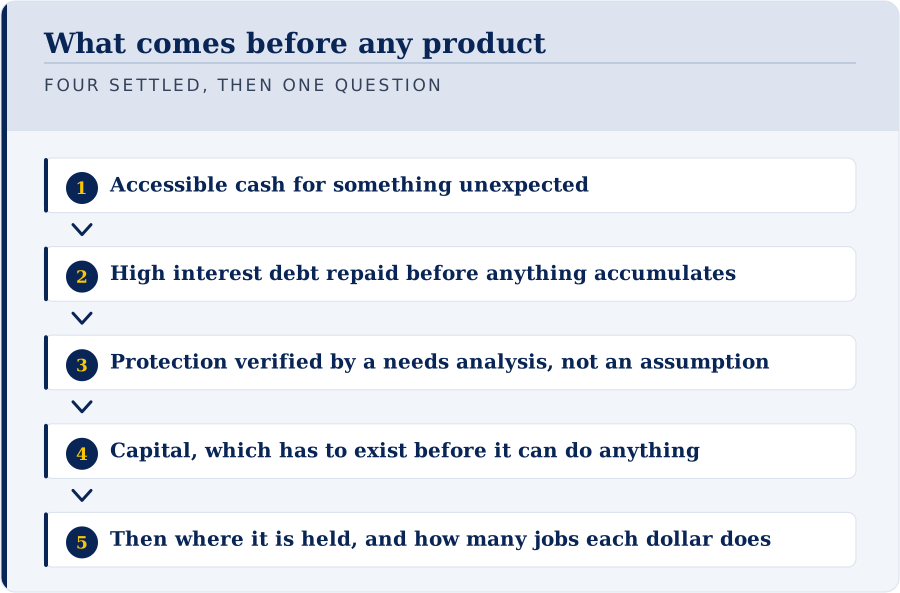
Emergency liquidity first. Money reachable within days, without penalty and without borrowing. This is not an investment decision and it should not be optimised as one. Its purpose is to prevent a temporary problem from becoming a permanent one, and a household without it solves every surprise with credit.
Then protect the income the household depends on. If the household needs two incomes, or one, then the loss of that income is the largest risk it faces. That means life coverage, and for most working people it also means disability coverage, which is more likely to be needed and is more often absent.
Then the registered accounts a family uses. An RESP where there are children, because of the grant. An FHSA where a first home is in view. A TFSA and an RRSP according to circumstances and marginal rate. This practice is not registered to rank them and does not.
Then, if surplus continues, longer-horizon structures. This is where permanent coverage for capital purposes enters, and not before. It requires durable surplus cash flow and a horizon measured in decades, which is exactly what a household still building an emergency fund does not have.
A presentation that arrives at step four while steps one to three are incomplete has reversed the order, and the reversal usually favours whoever is presenting.
Protecting a household income
The question is not how much insurance to buy. It is what would have to happen if an income stopped.
Term life insurance is usually the right answer for a temporary need, and the need here is frequently temporary: it lasts until a mortgage is discharged and children are independent. Term life insurance covers a defined period at the lowest cost per dollar of protection, and that is the correct tool for that job. This is covered in whole life insurance, which handles the product comparison.
Disability coverage is the more likely claim and the more common gap. Group coverage through an employer often ends with the employment and may define disability narrowly. Reading the actual definition is worth an hour.
Mortgage insurance from a lender is not the same thing as life insurance you own. The lender is the beneficiary, the coverage declines with the balance, and it ends if you change lenders. Owning the coverage yourself keeps the decision about where the money goes with your family.
Education funding
Now catch this part. An RESP is the starting point for most Canadian families, because contributions attract a federal grant. No other account offers a matching contribution of that kind, and that match is worth more than any investment decision made inside the account.
Three features are worth knowing before the account is opened. The grant is tied to contributions and to a child's age, so late starts lose room that cannot be recovered. Growth and grant are taxed in the student's hands on withdrawal, which is usually the point, because a student's rate is low. And there are rules about what happens where a child does not pursue eligible education, which are specific and worth reading and not assuming.
Anything beyond the RESP is a general savings decision and not an education one, and it should be evaluated as such.
A first home
The FHSA and the Home Buyers' Plan both exist, and they interact.
The FHSA is unusual in Canadian tax terms: a deduction on the way in and a tax-free withdrawal for a qualifying purchase, which no other account combines. Eligibility, opening deadlines and the period the account can remain open are all specific, and getting them wrong forfeits the benefit and not delaying it.
The Home Buyers' Plan draws from an RRSP and must be repaid over time. It is a loan from yourself in the literal sense that missed repayments become income.
Which to use, and in what combination, depends on facts about your situation. The rules change and the amounts change, so this page states the structure and not the figures, and the current figures should come from the Canada Revenue Agency or your accountant and not from any website.
Coverage on children
four settled, then one question
What comes before any product
- 01Accessible cash for something unexpected
- 02High interest debt repaid before anything accumulates
- 03Protection verified by a needs analysis, not an assumption
- 04Capital, which has to exist before it can do anything
- 05Then where it is held, and how many jobs each dollar does
Frequently sold, and usually not a priority. The honest position is worth stating plainly because it rarely is.
The financial loss a child's death causes a household is not primarily economic. Insurance answers economic loss. The amounts typically involved are small relative to what the household actually needs, and a family whose parents are underinsured while a child is covered has the position inverted.
There is one substantive argument and it deserves a fair hearing. Coverage acquired while a child is healthy establishes insurability. If a condition develops later, that coverage may be irreplaceable, and some contracts allow the amount to be increased at defined points without new medical evidence. That is a real feature and it is the only version of this case that stands up.
It comes after the parents are properly covered, not before, and anyone presenting it in the other order should be asked why.
Emergency liquidity, and why it is not an investment
Three properties matter and none of them is return.
Reachable quickly, meaning days and not weeks. Certain in amount, meaning not subject to a market on the day you need it. Free to use, meaning no penalty and no tax event triggered by using it.
An emergency fund optimised for return has usually sacrificed one of the three, and it fails at the moment it is needed. This is the clearest case in personal finance where the correct answer is the boring one.
Teaching children about money
Not a product question, and worth a section because it is the part with the longest effect.
The evidence points at practice and not instruction. A child who manages a small amount, makes a poor decision with it, and lives with the consequence learns something a lecture does not deliver. Errors made with small sums are inexpensive tuition.
Two things are worth being explicit about with older children: what the household actually earns and spends, at whatever level of detail is appropriate, and what things genuinely cost. Financial secrecy inside a family produces adults who find money frightening and not adults who are careful with it.
Life insurance for a household, sized honestly
The question most families arrive with, and it is arithmetic and not judgement.
What debt would remain, including the mortgage.
What income would need replacing, and for how long. Until the youngest child is independent, or until a surviving partner reaches retirement, are the two common answers and they produce very different numbers.
What specific obligations exist: education, a dependant needing lifelong support, a business or buy-sell commitment.
What already exists. Group coverage through work, which usually ends when the job does, and any individual policies already in force.
What would be available. Savings, a surviving partner's income, and any survivor benefits.
The remainder is the gap, and it should be rounded up and not down: at term prices the cost of a little extra coverage is small, and the cost of being short falls on somebody else.
For most households the answer is term life insurance, and often a large amount of it. It does the job of covering a temporary obligation for a fraction of the cost of permanent coverage, and the details are on term life insurance.
Insuring the parent who is not paid
five situations it tends to suit
Who this method suits
- 01Households with durable surplus income, not one good year
- 02People who already think about money in decades
- 03People who want the permanent coverage in its own right
- 04Owners and professionals who can fund premiums through uneven years
- 05Families arranging capital across more than one generation
The commonest gap in household coverage, and it is rarely raised.
A partner who does not earn a salary is doing work that would have to be replaced: childcare, household management, and the flexibility that lets the earning partner work as they do.
On their death, that work does not stop being necessary. It becomes paid work, or the surviving partner reduces their own hours to do it. Either way the household's finances change materially.
The amount is not the same as the earner's coverage and it is not nil, which is the figure most households implicitly choose.
A practical approach. Cost the replacement: childcare to school age, after school care, and the reduction in the surviving partner's earning capacity for as long as it would last. That number is usually larger than expected and is still modest at term prices.
Beneficiary designations, which cost nothing to get right
The highest-value hour available in household finance, and almost nobody spends it.
A named beneficiary receives the proceeds directly, in weeks, outside the estate, and without probate where the province charges it. Where the person named falls within a class the provincial legislation protects, the proceeds can also be out of the reach of the estate's creditors, but that depends on the province, on who is named, and on the designation not having been made once a creditor problem was already in view. It is a question for a lawyer in your own province and not a feature of the contract.
Where the estate is named, or nobody is, all three advantages are lost.
Name a contingent beneficiary. If the primary dies first and nobody else is named, the proceeds fall to the estate by default, which is the outcome the designation existed to prevent.
Review after any change: a marriage, a separation, a birth, a death. The insurer pays whoever is named, and not whoever was intended.
Quebec differs. A designation in favour of a married or civil union spouse is irrevocable unless stated otherwise, with consequences on separation that surprise people.
Tell somebody the policies exist, where they are, and who to contact. A contract nobody knows about is a contract nobody claims.
When a family's circumstances change
Five moments that should each trigger a review, and usually do not.
A birth. Coverage, beneficiary designations, guardianship in the will, and an RESP opened early enough for the grant to compound.
A separation. Designations, ownership of policies, and any obligation a separation agreement imposes to maintain coverage. A policy one spouse owns on the other continues unchanged unless somebody changes it.
A new relationship, with children from a previous one. Where the objective is protecting an inheritance and not defeating creditors, the structure matters and the default outcomes rarely match the intention.
A death in the family. Both the immediate administration and the effect on everybody else's designations.
A move between provinces. Insurance is provincially regulated and several of the rules above differ, particularly between Quebec and the common law provinces.
The household habits underneath all of it are on why personal finance matters, and none of them requires a product.
Arrangements spanning more than one household are covered on private family capital, including where they most often fail.
What this section deliberately does not recommend
Permanent insurance on a child as a savings vehicle. For education, an RESP attracts a federal grant on contributions, which is money that does not exist in an insurance contract. The grant is a real feature of that account and no contract offers one. The two are not alternatives, and a family that wants both funds both.
Complex structures for ordinary households. Trusts, holding companies and layered arrangements cost money to establish and to maintain, and for most families the statutory protections plus adequate liability insurance address the realistic risk.
Insuring the wrong risk. A household without adequate disability coverage, buying permanent life insurance, has inverted the priority. For most working adults the probability of a disabling illness during their working life exceeds the probability of death during it.
And anything before the emergency fund exists. Three to six months of expenses held in cash is unglamorous, generates no commission, and does more for a household's stability than any product on this site.
Disability coverage, which most households underweight
Named separately because it is the coverage most often missing and least often discussed.
For a working adult, earning capacity is the asset. It funds everything else, and for most people under fifty it is worth more than every other asset combined.
The probability of a disabling illness or injury during a working life exceeds the probability of death during it, and a disability leaves the household with the same expenses plus new ones, and without the income.
Group coverage through work is usually inadequate and it ends with the job. It is typically a percentage of salary, capped, taxable where the employer paid the premium, and defined against a broad definition of disability.
The definition matters more than the amount. Own-occupation coverage pays if you cannot do your own job. Any-occupation coverage pays only if you cannot do any job you are reasonably suited to, which is a much harder test and a much cheaper policy.
Individual coverage arranged while healthy is the version worth having, and health is the input that changes without warning.
This practice can advise on it, and it is worth stating that the compensation on disability coverage is a fraction of that on permanent life insurance. The ordering recommended here is not the one that pays most.
Critical illness and what it does differently
four rules that are frequently mixed up
Tax when a benefit is paid on death
- 01A life insurance benefit reaches a named beneficiary untaxed
- 02The public pension death benefit is taxable to the recipient
- 03Employer death benefits are exempt up to a stated limit
- 04Canada has no estate tax
- 05The deemed disposition at death can still be large
It pays a lump sum on diagnosis of a covered condition, after a survival period, regardless of whether the person can work.
It is not disability coverage and does not replace it. Disability pays income while you cannot work. Critical illness pays once, on diagnosis, and the money is unrestricted.
Where it fits is the gap the other two do not cover: the costs that arrive with a serious diagnosis and are not medical, in a country where treatment is publicly funded but the surrounding costs are not. Time off for a partner, travel, home adaptation, or simply the ability to stop worrying about money for a year.
The definitions are the product. Covered conditions are defined precisely and the definitions differ between insurers. Read them and not the brochure, and ask specifically about partial payments for early-stage conditions.
It is optional in a way the first two are not. A household without income replacement or life coverage has a gap. A household without critical illness coverage has a preference.
The order, restated as a checklist
An emergency fund, three to six months of expenses, in cash.
Adequate disability coverage, own-occupation where available, individually owned.
Life coverage sized to the gap, usually term life insurance, on both partners including one who is not paid.
High-rate debt cleared.
Registered room: a TFSA, an RRSP and, where there are children, an RESP, each a destination with its own rules and not a competitor to the others.
Beneficiary designations reviewed, primary and contingent, and somebody told the policies exist.
Then, and only then, permanent coverage or anything more elaborate, and only where the need is genuinely permanent.
Six of those seven cost nothing in commission, which is the most useful thing this page can tell you about how to read the rest of this site.
What a household should ask an advisor
Seven questions, none of which requires financial knowledge to ask.
What is the gap you calculated, and how? A number, with the working shown: debt, income replacement, obligations, minus what already exists.
Is my disability coverage adequate, and is it own-occupation? If this is not raised before life insurance, that ordering is worth asking about.
What is my non-earning partner insured for, and how did you arrive at it?
What would term life insurance cost for the coverage you are recommending? Ask even if permanent is being proposed, because the difference is the price of permanence and you are entitled to see it.
Who is named on each policy, primary and contingent, right now?
What are you paid on this, and what would you be paid if I bought term life insurance instead?
Who should not buy what you are recommending? An honest answer arrives quickly and names categories.
The last two are the useful ones, and the reaction to them tells you as much as the answers.
Why this section leads with what pays least
An unusual ordering for a page published by an insurance practice, and the reason should be stated and not left to be noticed.
Because it is the correct ordering. An emergency fund, disability coverage and adequate term life insurance address the risks a household is most likely to meet. Permanent coverage addresses a narrower need and suits a minority.
Because a household that gets the first steps right is better protected, and a practice describing itself as educational cannot recommend the profitable steps first and claim the description.
And because it is checkable. Anyone can verify that disability coverage costs less in commission than permanent life insurance, and that an emergency fund generates none at all. A recommendation that runs against the recommender's interest carries information that a recommendation aligned with it does not.
The compensation position is stated on the author page and at the foot of every page: paid by commission from an insurer when a contract is issued, nothing charged to a reader, and therefore has a commercial interest in the outcome.
Wills, guardianship and the documents nobody has
the shelter holds while the policy stays exempt
What exempt status does and does not do
- What the exemption givesNo annual tax on increases in cash value while the policy stays exempt (section 12.2 and Regulation 306); A death benefit that is not taxed as policy income.
- What it does not giveProtection from tax on a surrender, a lapse, or a policy loan above the adjusted cost basis; Protection if the policy stops being exempt.
Adjacent to insurance and frequently the larger gap in a household's arrangements.
A will. Without one, provincial intestacy rules decide who receives what, and the result rarely matches what a couple would have chosen. Common-law partners are treated differently across provinces and in several they inherit nothing by default.
Guardianship for minor children. Named in the will, and it is the reason most young parents finally make one. Without it a court decides, without knowing the family.
Powers of attorney, for property and for personal care. These matter while you are alive and are the documents most often missing. Without one, nobody can manage finances, pay a premium, or respond to a lapse notice if capacity is lost.
A list of what exists and where. Policies, accounts, the advisor, the accountant, the lawyer. An arrangement nobody knows about is an arrangement nobody uses, and this costs an afternoon.
Quebec differs throughout. The Civil Code governs, notarial wills operate differently, and the protection mandate replaces the power of attorney for personal care.
None of this is insurance work. It is legal work, and a practice that arranges coverage without asking whether these exist has addressed part of the problem.
A household with adequate coverage and no will has protected the money and left its destination to a statute. Both halves of that arrangement matter, and only one of them generates a commission, and the other is the one a family notices first when it is missing, usually in the weeks after a death when nobody can find anything and no one has authority to act.
What changes when a child is born
The event that prompts most first conversations, and the one where the ordering is easiest to get wrong.
Coverage on the parents, not the child. The financial risk is a parent's income stopping, not a child's. Coverage on a child addresses insurability and a very long horizon, which is a different question and rarely the urgent one.
A will and a named guardian, which is the reason most young parents finally make one.
Beneficiary designations reviewed, on every policy including any through work.
An RESP opened early, because the federal grant on contributions compounds with the time remaining.
And disability coverage checked, since a household with a new dependant has just increased what its income has to carry.
What changes at a separation
The event that undoes more household planning than any other, and the one nobody prepares for.
Beneficiary designations do not change themselves. A former spouse named on a policy remains named until somebody changes it, and the insurer pays who is named.
Ownership of policies is a separate question from the designation, and a separation agreement may address one and not the other.
In Quebec a designation in favour of a married or civil union spouse is irrevocable unless stated otherwise, which constrains what can be done afterwards and surprises people at the worst moment.
Support obligations may require coverage to be maintained, and the agreement should say who owns it, who pays it, and how the other party confirms it is still in force.
Group coverage through work may cover a spouse who is no longer one. Worth checking and not assuming.
Three pages about the contract across a family
A contract on the life of a child is one of the most emotionally sold arrangements in the country and one of the least well explained. A child has no income to replace, so the ordinary reason for life insurance does not apply, and the page starts there: insuring a child.
The provision that protects the ability to buy insurance later is the one most often allowed to expire, because the window passes and no reminder is sent: guaranteed insurability.
What a permanent contract taken young actually does, and the six reasons a person of that age usually should not take one: the first contract at twenty five.
What this section does not own
Transfer between generations. That is an estate question, governed by the deemed disposition, probate and beneficiary designations, and it belongs to estate planning.
The strategy applied across a family. Where a household runs a capital strategy across generations, that belongs to the strategy section, which covers the approach known as The Infinite Banking Concept®, a term originated by Nelson Nash.
Product mechanics. Cash value, dividends and advances belong to policy basics.
Comparisons against registered accounts. Those are arguments rather than descriptions and belong in objections and risks.
Interrupted earnings and what follows them. A designation left unchanged after a divorce, the contribution room a leave never generated and what a survivor actually receives belong to financial sovereignty for women.
What to do first, in practice
Three actions, none of which requires buying anything.
Work out how long the household could function with no income. The answer is usually shorter than expected and it establishes the size of the emergency fund.
Read the actual definition of disability in any group coverage you hold. It is frequently narrower than assumed.
Check what registered room is unused. The notice of assessment states it, and for most households that room is the better use of surplus money before anything else is considered. Understand that much and you will not be misled.
A thirty-minute discovery meeting
A first conversation establishes whether this fits. No illustration is prepared and nothing is arranged.
Often the answer is no, and you will hear it during the call rather than in a proposal afterwards.
This form reaches Canadian Wealth Creation Centre Inc. Any meeting, any advice and any insurance product is provided by Canadian Wealth Creation Centre Inc., through its representatives who are licensed in the client's province. IBC Financial is the company's educational website: it distributes no product and no financial service, and it gives no individualised advice.
How Canadian Families Plan the Big Costs Before They Arrive
University fees, a first contract at twenty-five, a policy for a child, two incomes in your forties: what to settle first, and what can wait.
| A Large Sum Arrives, and Nothing Has to Be Decided This MonthA single large sum, one chance to place it well, and a queue of people with opinions. What the arrival actually requires, which is less than it appears. | Read more |
| A New Baby and the First Year of Money NEWA new baby budget for Canada: leave benefits outside Quebec and under QPIP, the Canada child benefit, the RESP grant, a will, beneficiaries and coverage. | Read more |
| Blended Families and Who the Life Insurance Contract Protects NEWBlended family life insurance in Canada: who the designation pays, children under 18, a former spouse, Quebec rules, support orders and how to divide coverage. | Read more |
| Grandparents Helping Grandchildren with Money NEWGrandparents helping grandchildren in Canada: RESP limits and grants, tax on gifts, raising a grandchild, loans, fairness between families and Quebec rules. | Read more |
| Helping an Adult Child Buy a First Home NEWHelping your child buy a first home in Canada: down payment rules, gift letters, family loans, co-signing, FHSA and HBP limits, Quebec rules and fairness. | Read more |
| Insuring a Child, and What the Contract Is Actually ForA participating contract on a child's life in Canada: who owns it, what it is genuinely for, what it is not, and why the parents come first. | Read more |
| Life and Critical Illness Insurance for Children in Canada: What the Numbers Show NEWCanadian statistics on serious illness in children, what critical illness and life insurance on a child can and cannot do, and why age at application matters. | Read more |
| One Income and a Parent at Home NEWWhat a Canadian family gains and risks on one income: the real value of a second pay, child benefits, the spouse amount, CPP child rearing, Quebec rules, cover. | Read more |
| Pay Off the Mortgage or Save First? NEWPay down the mortgage or save? Prepayment privileges, penalties, renewal, after-tax arithmetic, access to cash, registered plans and Quebec rules, laid out. | Read more |
| Requalifying Mid-Career, and the Timeline That Got ShorterA qualification earned once and earned again costs years of income. What that does to a household balance sheet, and to the arithmetic of the years that remain. | Read more |
| The Family Emergency Reserve NEWHow much a Canadian family can keep for emergencies, where to hold it, what EI pays and when, deposit protection, credit lines, Quebec rules and insurance. | Read more |
| The First Contract at Twenty-FiveWhat a permanent life insurance contract taken young does, what age changes in its pricing, and the ordinary reasons a person that age should not proceed. | Read more |
| The Guaranteed Insurability OptionThe guaranteed insurability option on a Canadian life insurance contract: a right to buy more coverage at stated future dates without new evidence of health. | Read more |
| Think Like the Wealthy: How Affluent Families Pay for Their Children's Education, Activities and Future NEWWhat it costs to raise a child in Canada, what affluent families add, and how they plan school, sport and university with an RESP, savings and policy loans. | Read more |
| Two Incomes in the Forties, and Where the Money GoesA household at its highest ever income can feel poorer than it did at half of it. Where the money goes in the financed decade, described without a lecture. | Read more |
| University Fees: A Known Cost on a Known DateAlmost no household expense announces itself years ahead. Tuition does, which changes what can be prepared for it and what the containers each do. | Read more |
| When a Parent of Young Children Dies: The Money That Follows NEWAfter a parent of young children dies in Canada: claims to file, what CPP, QPP and the child benefit pay in 2026, who manages a child's money, and tax dates. | Read more |
| Who Owns a Child's PolicyWho owns a participating contract taken out on a child in Canada, what the owner controls that the child does not, and what changes when ownership transfers. | Read more |
Common questions
What should a young family do first?
Should I buy life insurance on my children?
What is the most efficient way to fund education in Canada?
How do the FHSA and the Home Buyers Plan work together?
When does permanent life insurance make sense for a family?
How much life insurance does my family actually need?
Should a stay at home parent have life insurance?
Is mortgage insurance from my lender the same as life insurance?
Is the disability coverage through my employer enough?
What is the difference between critical illness and disability coverage?
How big should an emergency fund be?
Do common law partners inherit automatically in Canada?
What happens to my life insurance when I separate?
What should we sort out when a baby is born?
What should I ask an insurance advisor?
About the author

Jose Salloum is a Financial Security Advisor (conseiller en sécurité financière) certified by the Autorité des marchés financiers in Quebec, a Life and Accident & Sickness Insurance Agent licensed by the Financial Services Regulatory Authority of Ontario, and a Life Insurance Agent licensed by the Insurance Council of British Columbia. Licensed since 2001.
He has practised Infinite Banking since 2015 and founded Canadian Wealth Creation Centre Inc. in 2016. From 2020 to 2024 he was an IBC (Infinite Banking Concepts™) Authorized Practitioner of the Nelson Nash Institute, a private certification rather than a regulatory licence.
IBC Financial is the educational website of Canadian Wealth Creation Centre Inc., open to all Canadians. Services come only from Canadian Wealth Creation Centre Inc. Its representatives hold a licence in each province served: Quebec, Ontario, Alberta, British Columbia, Manitoba and New Brunswick. Jose Salloum's own licences cover Quebec, Ontario and British Columbia. This page is general education and not advice on any individual file.
Last reviewed 2026-08-21. By Jose Salloum, Financial Security Advisor in Quebec. In Ontario, Life and Accident & Sickness Insurance Agent. In British Columbia, Life Insurance Agent.