

What Is The Infinite Banking Concept®? How the Method Works in Canada: The Process, Benefits, Steps, Costs and Insurance Requirements
What is The Infinite Banking Concept®? It is a way of thinking about who finances the purchases in your life, and how to build the capacity to do more of that through a financing system you control. Nelson Nash described the concept in Becoming Your Own Banker® (2000). In Canada, a participating whole life insurance contract is usually the tool. The contract matters, but the first step is learning to plan purchases, keep capital available and repay what you use.
Written by Jose Salloum, a Financial Security Advisor (conseiller en sécurité financière) certified by the Autorité des marchés financiers in Quebec and licensed in Ontario and British Columbia, licensed since 2001. He passed the Nelson Nash Institute examination in 2019, received its certificate, dated 2020, in February 2020, and was a member of the Institute and an IBC (Infinite Banking Concepts™) Authorized Practitioner from 2020 to 2024. These are private certifications, not regulatory licences, and they confer no government authority. He is paid commissions by insurers when a client buys a policy, so he has a commercial interest in what you decide, and you should know that before you read another word.
If you read one page before we talk, make it this one. It covers the whole method in plain language: what it is, how it works in Canada, what it costs, how long it takes and who it suits, so that you can judge the idea itself rather than the marketing around it. Everything here is education. IBC Financial is the educational website of Canadian Wealth Creation Centre Inc.; it holds no licence, distributes no product and no financial service, gives no individualised advice and concludes no transaction. Every client relationship, every piece of advice and every insurance product comes through Canadian Wealth Creation Centre Inc. and its representatives who are licensed in the province where the client lives.
What Is The Infinite Banking Concept®?
The Infinite Banking Concept® starts with a question: who supplies the financing for the things your household needs? The name is a registered trademark of Infinite Banking Concepts, LLC, and Nelson Nash set the concept out in Becoming Your Own Banker®, published in 2000. A lender may pay for a car or renovation now while you repay over time. Or you may pay cash you have saved. Either way, the purchase affects what your money can do next. The concept asks you to make those decisions deliberately rather than treat each purchase as a separate event.
Our practice teaches that way of thinking first. A contract cannot decide which purchases make sense, how much you can afford to commit, or whether you will follow through on repayment. Those are household decisions. Teaching the concept, and not only the contract, is the centre of our work.
A participating whole life insurance contract is the usual tool for putting the concept into practice in Canada. With steady premiums, it builds cash value under a schedule of guaranteed amounts. The insurer may also declare dividends, but dividends are never guaranteed. Once sufficient cash value is available, the owner can request a policy loan without a credit application. The loan is an advance from the insurer, secured by the policy's cash value. The insurer charges interest, and the owner can usually choose when and how much to repay, subject to the contract's terms.
The cash value remains in the contract and continues to be administered under its terms while the loan is outstanding. That does not cancel the loan cost. An unpaid balance, including interest, reduces what beneficiaries receive and can put the policy at risk if it grows too large. In Canada, the portion of a policy loan above the policy's adjusted cost basis is taxable. Growth inside the policy avoids annual taxation only while the policy meets the exempt policy rules.
The name is a metaphor. You do not become a financial institution of any kind. Neither Canadian Wealth Creation Centre Inc. nor IBC Financial is a bank: they are not deposit-taking institutions. Your premiums are not deposits, and nothing here is covered by the Canada Deposit Insurance Corporation.
Why Does the Concept Start With Financing, Not Insurance?
Nash's starting point was that a family's need for financing over its lifetime is far greater than its need for life insurance protection. He was not saying protection is unimportant. If people depend on your income or care, adequate coverage matters. His point was that financing comes up repeatedly throughout life, not only when someone dies.
Think of what a household may pay for over its working years: cars, a home, education, equipment, a business, repairs and emergencies. Someone supplies the money for each purchase. When you use an outside lender, you pay interest for the use of that lender's money. When you pay cash, you avoid that interest, but the cash is no longer available to earn whatever it might otherwise have earned or to meet another need.
That second cost is easy to overlook because no bill arrives for it. It is also not a fixed or guaranteed amount: what the cash could have earned depends on where it would have been held and what happened afterward. The point is not that paying cash is wrong, or that taking a loan is always preferable. It is that both choices deserve a full comparison.
Across a working life, interest paid to outside lenders and the possible growth given up when cash is spent can add up. Nash wanted families to notice that recurring financing need and prepare for it before the next purchase arrived. Instead of asking only, "How will we pay for this?", the family can also ask, "What source of financing are we building for future purchases, and how will we restore it after we use it?"
Life insurance has a distinct job: providing protection. In this concept, participating whole life insurance also supplies a contractual way to build cash value and access financing against it. Insurance is the tool; financing is the purpose of using that tool in this particular way. Neither purpose excuses buying coverage you do not need or committing premiums your household cannot sustain.
How Does the Method Work?
Three things happen, always in the same order, and that order is the whole design. You put capital in, you take capital out, and you put it back. A family that does the first two and skips the third has bought an expensive contract; a family that does all three has adopted a method that can serve it for decades.
Funding. You pay premiums into a participating whole life contract built for cash value rather than for the biggest possible death benefit. Part of each premium buys the base coverage, and part goes into a paid-up additions rider, which is the piece that makes value reachable early. The guaranteed cash values are written into the policy schedule year by year, so you can see your floor before you sign. Anything above that floor depends on dividends, which are declared each year and are not guaranteed.
Drawing. Once the accessible value is large enough to be useful, you ask the insurer for a policy loan secured by the contract. Your contract stays in force while the loan is outstanding.
Repaying. The insurer charges interest on the balance at a rate it sets and can change over time. You decide the repayment schedule, and until the money is back, the amount paid on death is reduced by the balance and the interest that has built up. Keeping your own repayment promise is the habit everything else rests on.
- 1Fund. Premiums and, where the contract allows, paid-up additions build cash value inside a participating whole life contract. In the early years that value is lower than what has been paid in.
- 2Draw. When a purchase arrives, the owner may request a policy loan from the insurer against the cash value. The insurer charges interest, and the contract keeps running.
- 3Repay. The owner repays on a schedule the owner sets. Until the loan and its interest are repaid, the amount paid at death is reduced by the balance.
Does the Method Work in Canada?
if one is missing, look again
Four things required before anything else
- Durable surplus cash flow, in an ordinary year
- A horizon measured in decades rather than years
- A place in the household's wider position
- A clear purpose for the contract itself
Yes, and the Canadian version has its own rules. Most of what you will find online was written for the United States, where the tax law is different, and a Canadian who follows it will get both the arithmetic and the tax treatment wrong. In Canada the frame is set by the Income Tax Act and the Income Tax Regulations, and it is precise enough to plan around with confidence.
The tax frame is Canadian. Growth escapes annual tax only while the contract stays exempt under Regulation 306 of the Income Tax Regulations, and a policy loan is a disposition under section 148 of the Income Tax Act, taxable above the adjusted cost basis; ask your insurer for that figure in writing before any loan. The tax section below sets out each rule and its condition.
The contracts come from Canadian insurers regulated federally or provincially, and Assuris protects Canadian policyholders up to the higher of $1,000,000 or 90% of the death benefit and the higher of $100,000 or 90% of the cash value, calculated after any policy loans (Assuris). The guarantees are contractual obligations of the insurer that issued them, dependent on its continued solvency, and they are not backed by any government. Knowing exactly what stands behind your contract is part of owning it well.
- A policy loan can create taxable income in Canada, depending on the contract's adjusted cost basis, which the insurer confirms before the loan.
- Canadian contracts must stay within the exempt test in the income tax rules, not the American rules most published material assumes.
- Policyholder protection is provided within limits by Assuris. Participations, commonly called policy dividends, are not guaranteed.
- The advice comes from someone licensed in the province where you live.
Who Created The Infinite Banking Concept®?
Nelson Nash worked the idea out of his own hard experience. He spent about ten years as a forestry consultant and then more than thirty-five years as an agent for two mutual life insurers, according to the Nelson Nash Institute, so he knew the contract from the inside. In the early 1980s, when American interest rates climbed past twenty percent, he was carrying heavy debt. Looking for a way out, he took a fresh look at the participating whole life contracts he already owned and saw them differently: not as insurance he had bought and forgotten, but as a place to hold capital and move it on his own terms.
He published what he learned in 2000 as Becoming Your Own Banker®. The book is short, direct and deliberately repetitive, and it is much more about behaviour than about insurance, which is why this page starts with financing rather than with the contract.
The fair criticisms are worth knowing, because knowing them is what lets you use the idea well. The first is cost: a participating contract is an expensive place to hold money in its early years, and the book says little about that period. The second is temperament: the method assumes you will repay what you borrow, and some households find that harder than they expect. Both are manageable when you plan for them from the start.
Nash died in 2019, and the Nelson Nash Institute continues to certify practitioners. Neither Canadian Wealth Creation Centre Inc. nor Jose Salloum is affiliated with, sponsored by, or endorsed by Infinite Banking Concepts, LLC or the Nelson Nash Institute.
What Are the Benefits of The Infinite Banking Concept®?
You set the terms. A policy loan is not underwritten. There is no credit decision, no covenant and no restriction on how you use the money. If you have ever been refused credit in a hard year, you know what that is worth.
Interest still leaves, but the terms change. Interest on a policy loan is paid to the insurer and flows into its participating account, whose results are shared among all its participating policyholders; it is not credited back to you as the borrower. What changes is who sets the repayment pace, not whether the interest is paid.
Coverage that never expires. Underneath everything sits permanent life insurance, in force for life as long as the contract is maintained, payable to a named beneficiary free of income tax and outside the estate. Whatever else the contract does, it protects the people who depend on you.
Protection from creditors, in the right circumstances. When you name a beneficiary in the protected class under provincial insurance law, or make an irrevocable designation, policy values may be beyond the reach of creditors. It depends on your province, the designation and the timing, so it is a question to confirm with a lawyer.
A home for surplus that resists impulse spending. Money held in a contract with a funding commitment attached is harder to spend on a whim and easier to leave growing, and that alone can make a saving habit easier to keep.
It offers
- Capital you can reach without applying to a lender.
- A loan the insurer does not require you to repay on a fixed schedule.
- Values that keep operating under the contract while a loan is outstanding.
It costs
- Interest charged by the insurer on every loan.
- A lower death benefit while a loan is outstanding.
- Early cash values below the premiums paid, which punishes an early surrender.
Test Yourself: Five Questions on the Canadian Mechanics
Try to answer each one before you open it. If you get four right, our first thirty minutes together will be very productive. If not, start with the book, which we send you free of charge.
1. Which kind of contract does the method require in Canada?
A participating whole life contract issued by a Canadian insurer, designed for cash value. Term life insurance builds no value at all. Universal life is a different contract with different guarantees and a different risk profile, and it is not what the method describes.
2. Who lends the money when a policy loan is taken?
The insurer does, secured by the contract. The money does not come out of the policyholder's own account and it is not borrowed from the policyholder. That misdescription is a very common error in material on this subject.
3. Are dividends guaranteed?
No. A dividend is declared annually at the discretion of the insurer's board of directors, based on the performance of the participating account. Past declarations do not predict future ones. What is contractual is the guaranteed cash value in the policy schedule.
4. What happens to the death benefit while a loan is outstanding?
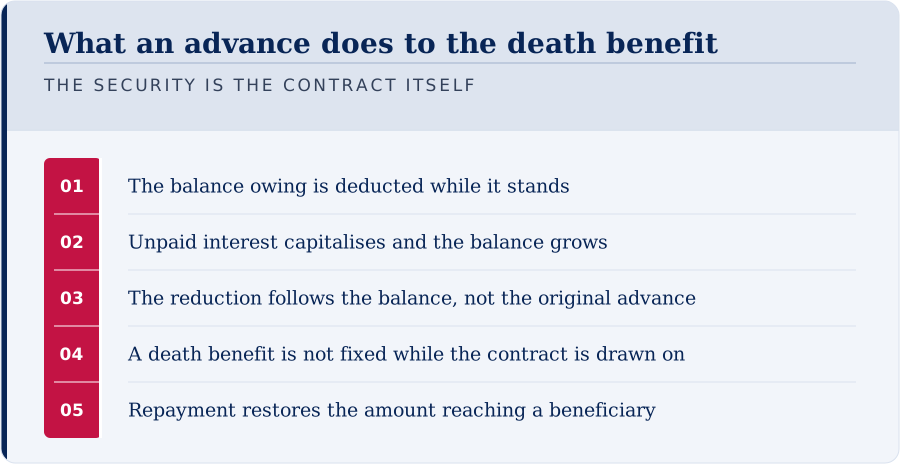
It is reduced by the outstanding balance and the accrued interest, and it returns to its full level as the balance is repaid. This is the trade the contract makes and it is why repayment is the habit the method is built on.
5. What keeps the growth from being taxed each year?
The exemption test under Regulation 306 of the Income Tax Regulations, which the insurer administers. It is a condition of the contract rather than an election a policyholder makes, and it is the reason a contract cannot be overfunded without limit.
What Are the Tax Advantages of the Method?
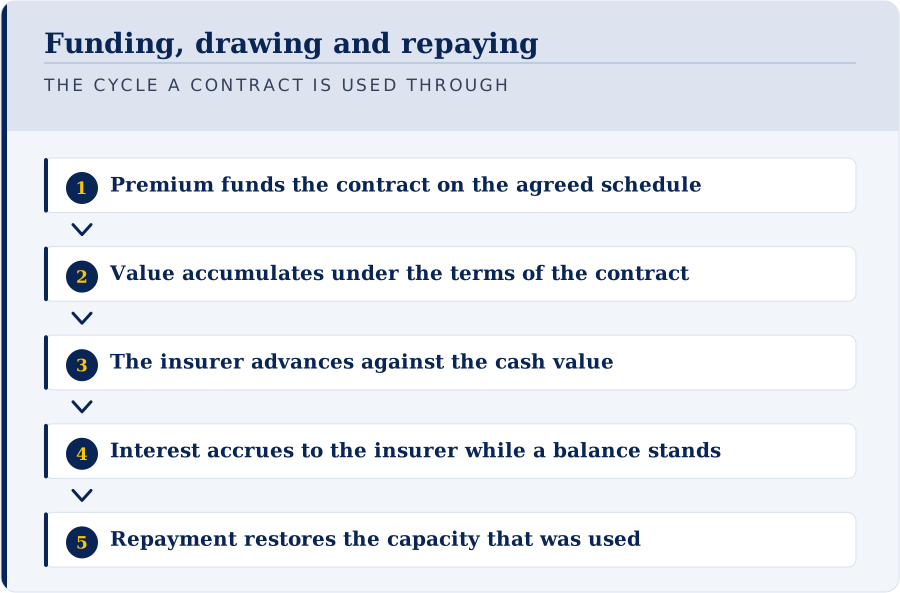
the cycle a contract is used through
Funding, drawing and repaying
- 01Premium funds the contract on the agreed schedule
- 02Value accumulates under the terms of the contract
- 03The insurer advances against the cash value
- 04Interest accrues to the insurer while a balance stands
- 05Repayment restores the capacity that was used
There are three, and each comes with a condition you should understand. None of what follows is tax advice, and this practice does not provide it; take your own facts to a qualified tax professional before you act.
Growth is not taxed each year while the contract stays exempt. Under Regulation 306 of the Income Tax Regulations, a contract that meets the exemption test grows without an annual tax charge. The condition is that it keeps meeting the test, which your insurer monitors and which limits how much you can pay in and how quickly.
A policy loan is taxed only on the part above the adjusted cost basis. Section 148 of the Income Tax Act treats a policy loan as a disposition: up to the adjusted cost basis nothing is included in income, and any part above it is income in the year you receive it. Each loan also lowers the adjusted cost basis, so a loan that is tax free early in the contract's life can be partly taxable later. The condition is that the contract stays in force. A contract that lapses with a large loan outstanding can create a tax bill in a year with no cash to pay it, and that is exactly why repayment is built into the method.
A death benefit is generally received free of income tax by a named beneficiary, outside the estate and therefore outside probate in the provinces where probate applies. Compare that with an RRSP or a RRIF, where the value is generally brought into income at death unless a qualifying rollover applies, and you can see how much more can reach the next generation intact.
The tax treatment is not the reason to do this; it is what makes a patient, disciplined structure worth the wait. Choose the method for the control and the protection it gives your family, and let the tax treatment be the reward for doing it properly.
How Do You Become Your Own Source of Financing?
Start by thinking like a lender. A lender considers what money is available, what a purchase will cost, how it will be repaid and whether there will still be enough capacity for the next need. You can apply that discipline to your household without pretending to be a financial institution.
List the purchases you expect in the coming years. For each one, consider the choices open to you: pay cash, use an outside lender, delay the purchase or, if you have a suitable contract with enough available cash value, request a policy loan. Compare the costs and limits of each choice. A policy loan is not automatically cheaper than another loan, and it is not free.
Look at how your money flows, not at the contract. Income arrives and goes to four places: it is saved, it buys assets, it is given away or it is spent. The method only asks that the saved part wait somewhere it keeps working and stays within reach, and that the borrowing you were going to do anyway be done against that pool instead of at a counter elsewhere. For example, financing a $40,000 vehicle over five years at 8% means monthly payments of about $811 and roughly $8,660 of interest paid to the lender. That figure is illustrative arithmetic, not a quote, and a policy loan also carries interest, but it shows how much is at stake each time you finance something.
Build the financing system before you need it. Cash value takes years to develop, while premiums require steady funding from the start. A participating whole life contract generally costs the most in its early years relative to the cash value available. If you cancel it early, the cash surrender value may be much less than the premiums you paid. This approach needs a long horizon, dependable surplus cash flow and a real reason to want permanent life insurance protection.
When you do use a policy loan, set terms for yourself before the money arrives. Choose a repayment amount and schedule that fit your budget, record the balance, and review it alongside the policy's cash value each year. The insurer may not require regular repayments, but interest continues to accrue. If you let the balance grow, it can reduce the death benefit and may eventually cause the policy to lapse, potentially with tax consequences.
Repayment is how the household restores financing capacity for a later purchase. It does not mean the insurer pays your loan interest back to you. You pay interest to the insurer. The question is whether, after all the premiums, loan interest and other costs, this arrangement helps your household keep more control over its next financing decision.
Over time, the goal is to finance more ordinary purchases through the system you have built, reduce interest paid to outside lenders and, where your circumstances allow, eventually stop relying on them for those purchases. We call that long term goal Infinite Financial Sovereignty®, a registered trademark of Jose Salloum. It is a direction to work toward, not a promised result. Large purchases, limited cash value or a change in income may still call for an outside lender.
This approach does not suit a household that needs its committed money back soon, cannot fund premiums consistently, does not want permanent coverage or is unlikely to repay its loans. Learning the concept can still help that household make clearer financing decisions without buying a contract.
What Are the Costs and Fees Associated with the Method?
The costs are real, they come early, and you can see every one of them before you sign. They appear in the illustration and in the policy schedule, and you are entitled to read both, line by line.
| Cost component | Where it is found | When it bites |
|---|---|---|
| Premium commitment | The contract, fixed at issue | Every year, in good years and bad |
| Cost of insurance | Built into the level premium, priced by age and health at issue | Spread over the life of the contract; the level premium pays more than the mortality cost early and less later |
| Acquisition and administration, including first-year commission and underwriting | Recovered by the insurer through early-year values | Heaviest in the early contract years |
| Policy loan interest | Charged by the insurer, at a rate it sets and can change | While a balance is outstanding |
| Surrender consequences | The policy schedule's guaranteed values | Worst in the early years |
| Advisor commission | Paid by the insurer, disclosed on this site | At issue and on renewal |
The premium matters most, because it is a commitment rather than a fee. The practice does not arrange contracts below roughly three hundred dollars a month. That is not a sales floor: a smaller commitment builds a structure too small to be useful while still carrying the full weight of the early years.
Surrendering early is where money is truly lost. In the first several years the guaranteed cash value can be lower than the premiums paid. If you may need that capital back inside that window, keep it somewhere you can reach directly, and use the contract for the money you can leave alone.
What Are the Disadvantages and Risks of the Method?
It takes years, not months. The section on building cash value below explains the timing. If you may need that capital within the first several years, this is not the right tool for that money, and we will tell you so.
The commitment continues through hard years. The premium does not pause because income did. Options such as reduced paid-up coverage exist, and they are options with a price, not free exits. Choosing a level you can carry in an ordinary year is your main protection.
Dividends are not guaranteed. They are declared each year at the discretion of the insurer's board of directors, and past performance does not indicate future results. An illustration showing the same scale for forty years is showing an assumption, not a forecast, so ask to see it at a lower scale.
A loan that is never repaid slowly shrinks what you leave behind. The balance and its interest reduce the amount payable at death for as long as they stand. Left long enough, a loan can grow toward the contract's value and put the contract itself at risk, which is the one outcome that can also produce a tax bill.
It is not an investment, and comparing it to one misleads. A participating whole life contract is an insurance product. Setting its values beside stock market returns compares two things built for different jobs. The contract gives you contractual guarantees, a favourable tax treatment and access on your own terms; it does not give you market returns and never claims to.
It depends on one insurer's strength. The guarantees are contractual obligations of the insurer, dependent on its continued solvency and not backed by any government, and Assuris protection applies only within the limits set out above, calculated after any policy loans. That is why the choice of insurer deserves real attention.
It suits fewer families than the enthusiasm around it suggests. The section on who should consider it is written to help you rule yourself out as readily as to rule yourself in.
What Type of Life Insurance Policy Do You Need for the Method?
A participating whole life contract from a Canadian insurer, designed for cash value. Nothing else does the job, and most of the disappointment in this field comes from substitutes that were sold as if they did.
| Contract type | Cash value | Participates in insurer earnings | Suitable for the method |
|---|---|---|---|
| Participating whole life | Guaranteed schedule, plus dividends when declared | Yes | Yes, this is the contract described |
| Non-participating whole life | Guaranteed schedule only | No | Partly, with no dividend participation |
| Universal life | Depends on the investment options chosen | No | No, different guarantees and different risk |
| Term life | None | No | No, it builds nothing |
| Term to 100 | Generally none or minimal | No | No |
Participating means your contract shares in the results of the insurer's participating account, through dividends declared each year at the board's discretion. That participation is what lifts your values above the guaranteed schedule over time, and it is also the part that is not promised.
The insurer matters, and the criteria matter more than the brand. Look at the length and consistency of its dividend history, the strength of its participating account, whether it applies direct or non-direct recognition to loans, how its paid-up additions rider is built, and its financial strength ratings. This site does not rank insurers or recommend one; that choice is made with Canadian Wealth Creation Centre Inc. against your own facts, and the reasoning is given to you in writing.
One design warning. A contract sold as participating whole life can still be built the ordinary way, weighted toward the death benefit, and then it behaves nothing like the method describes. The right contract type is necessary, and the right design is what makes it work.
How Do You Set Up a Whole Life Insurance Policy for the Method?
regulated as insurance under provincial law
Why this is not an investment
- 01It is a contract that pays a benefit on death
- 02It is regulated as insurance under provincial law
- 03Contractual value and dividends are insurance features
- 04Judge it as insurance: coverage, cost, access
Setting up the contract is a series of decisions, and the first ones are the ones you cannot undo. The structure is largely fixed at issue, which is why the design conversation is worth more than any conversation that follows it.
Start with the purpose. A contract built to fund equipment purchases in a business behaves differently from one built to pass an estate efficiently to two children. The purpose sets the split between base coverage and the paid-up additions rider, and that split sets everything else.
Then choose the life insured and the owner. They are not always the same person, and in a corporate arrangement they often are not. The choice has tax and creditor consequences that are hard to reverse later, and it is one of the places where your lawyer and accountant earn their fee.
Then apply, and let the insurer decide. Underwriting looks at your health and your finances, it takes weeks rather than days, and the insurer sets the rating. No advisor controls that outcome, and a trustworthy one will never suggest otherwise.
What Are the Steps to Getting Started with the Method?
Five steps, always in this order:
- The discovery meeting. Thirty minutes, free, with nothing arranged and no illustration prepared. We send you the book free of charge, and we ask you to read it and this page beforehand so that our time together starts from a shared understanding.
- Your Financial DNA. Your suitability record. It covers what happens to the funding if your income stops through disability, critical illness, job loss or a business downturn, because that is the question the early years turn on.
- The design meeting. Your purpose shapes the structure, and the structure is largely fixed at issue. We read the illustration together, including at a reduced dividend scale.
- Application and underwriting. The insurer decides, not the advisor. Medical and financial evidence is gathered and the rating is set.
- Service after the contract is in force. The funding, the dividend scale and any loan are reviewed with you every year, and the same family is there for you between reviews.
How Do You Borrow Against Your Policy's Cash Value with the Method?
You ask the insurer in writing, and the money arrives. There is no credit application and no approval committee, because the insurer's security is the contract it already issued. The request is administrative rather than discretionary, and it is usually settled within days.
The money is the insurer's, not your own. This is the point most material on the subject gets wrong. Your contract's value stays with the insurer as security while the loan is outstanding, which is exactly why that value keeps being administered under the contract's terms.
Interest is charged at a rate the insurer sets and can change. Whether the credited growth on the portion securing the loan is affected depends on whether your insurer applies direct or non-direct recognition. That differs between insurers, so it is confirmed for your contract, not assumed.
You choose the repayment schedule. No instalment is demanded and no penalty applies for repaying early. The amount paid at death is reduced by the balance and its interest until the money is back, and unpaid interest added to the balance compounds. Writing your schedule down on the day you borrow is what turns a loan into a method.
How Long Does It Take to Build Sufficient Cash Value with the Method?
Years, and the real answer depends on three things: the design, the funding pattern and the insurer. Anyone quoting a single number without all three is guessing.
The first years are the slow ones by design. The cost of putting a permanent contract in force is heaviest at the start, so the value you can reach in the first year or two sits well below what you have paid in. It is not hidden: it is printed in the policy schedule, year by year, before you sign.
On many designs, in this practice's experience, a useful point arrives between the fifth and tenth year, meaning enough accessible value to fund something real, such as a vehicle or an equipment purchase. Weighting the design toward the paid-up additions rider brings that point closer; weighting it toward base coverage pushes it further out.
Ask for the year, not the range. An illustration shows the value you can reach in every contract year, at the guaranteed scale and at a reduced dividend scale. You should leave the design meeting knowing the year your own number crosses the level that matters to you.
What Is Policy Design with the Method?
the shelter holds while the policy stays exempt
What exempt status does and does not do
- 01What the exemption givesNo annual tax on increases in cash value while the policy stays exempt (section 12.2 and Regulation 306); A death benefit that is not taxed as policy income.
- 02What it does not giveProtection from tax on a surrender, a lapse, or a policy loan above the adjusted cost basis; Protection if the policy stops being exempt.
Design is how your premium is split between base coverage and the paid-up additions rider, and it is where a contract that truly serves the method is separated from one that only looks like it.
Each part does a different job. Base coverage carries the permanent guarantee and most of the cost. The paid-up additions rider buys additional paid-up insurance that increases the contract's value immediately and shares in dividends from then on. A design weighted toward the rider makes value reachable sooner; a design weighted toward base coverage produces a larger death benefit in the long run.
There is no single right answer. It depends on whether you want access during your working life or the largest possible transfer at the end, and most families want some of each. That is a conversation about your purpose, not a technical preference.
The limits come from the insurer and from the exemption test. Rider capacity is written into the contract, and Regulation 306 limits how much can be paid in relative to the coverage. Good design works well inside those limits; an advisor who talks as if there were none is describing something that cannot be issued.
How Does the Method Help with Retirement Planning?
It gives you a source of capital whose value does not depend on the market on the day you need it. A retiree drawing from a RRIF in a bad year sells assets at low prices and brings the proceeds into income. Drawing on a policy loan in the same year does neither.
It can soften sequence-of-returns risk. Two retirees with the same average returns can end up in very different places depending on when the bad years fall relative to when withdrawals begin. Having a second source to draw on in the bad years can give your investments time to recover.
It works alongside your other plans, not instead of them. RRSPs, a TFSA and a portfolio each do things a contract cannot. The contract adds something different: access to capital without selling an investment, and with no tax on a policy loan that stays within the adjusted cost basis. That basis often shrinks later in life, so a retirement loan can become largely taxable; a loan from a third-party lender secured by the policy, known as a collateral loan, is not a disposition, and it carries risks of its own.
Can the Method Build Generational Wealth?
It can move wealth between generations efficiently, which is the more accurate way to say it. The comparison shows why. An RRSP or RRIF is generally brought into income at death unless a qualifying rollover applies. Non-registered assets are generally treated as sold at fair market value, with the accrued gain taxed. A death benefit paid to a named beneficiary is treated differently, and the gap between those outcomes is where the planning value lies.
Ownership structure multiplies the effect, and the care required. A contract owned personally, by a corporation or by a trust produces different tax, creditor and control outcomes. Corporate ownership in particular works with the capital dividend account, which on death is credited with the death benefit minus the policy's adjusted cost basis (subsection 89(1) of the Income Tax Act), and it should be arranged with your accountant and lawyer looking at the same facts.
No amount is promised here. What reaches your family depends on the funding, the design, the dividend scale declared and the age at death. Any page quoting a range is quoting an assumption, and we would rather show you your own illustration.
Who Should Consider Using This Strategy?
Families with durable surplus income and a horizon measured in decades. That is the whole test, and it is narrower than most material on the subject admits.
It fits well for a salaried professional with real room in a normal month; a business owner with retained earnings and no disciplined place to keep capital that stays available; a household five or ten years from retirement with assets already built and a wish to pass them on deliberately; and a retired household with pension or investment income and an estate to organise.
It is not the right fit for someone living outside Canada, since these contracts are issued to residents; someone with no income and no income-producing assets, for whom the better first step is building a surplus; someone whose horizon is shorter than several years, since early values are lower than the premiums paid; someone carrying high-interest consumer debt, which should be cleared first; and someone looking for market returns, since this is not an investment and does not behave like one.
Temperament matters as much as arithmetic. A family that funds it well for three years and then stops has not had a bad contract; it has had an interrupted plan. The families who stay the course are the ones who see more from it.
Ready to Build Your Own Family Capital System in Canada?
The next step is a thirty-minute conversation, and nothing is arranged in it. No illustration is prepared, no product is chosen and no application is started. We will ask you a few questions: whether you are working, whether you live in Canada and in which province, whether the concept rather than the product makes sense to you, and whether you are ready to be coached and to hold to it.
We send you the book free of charge before the call, and reading it is what makes that half hour so valuable. Sometimes the honest answer is that this does not suit you, and it is far better to hear that during the call than in a proposal afterwards. A decision this important can wait a week.
Who you will be dealing with. Canadian Wealth Creation Centre Inc. is the firm: incorporated in 2016, based in Laval, Quebec, and reachable at cwcc.ca. Every client relationship, every piece of advice and every insurance product comes through it and its representatives who are licensed in the province where the client lives. IBC Financial is the educational website; it holds no licence, distributes no product and no financial service, gives no individualised advice, and concludes no transaction.
A thirty-minute discovery meeting
A first conversation establishes whether this fits. No illustration is prepared and nothing is arranged.
Often the answer is no, and you will hear it during the call rather than in a proposal afterwards.
This form reaches Canadian Wealth Creation Centre Inc. Any meeting, any advice and any insurance product is provided by Canadian Wealth Creation Centre Inc., through its representatives who are licensed in the client's province. IBC Financial is the company's educational website: it distributes no product and no financial service, and it gives no individualised advice.
Common questions
Is The Infinite Banking Concept® just life insurance?
What does it mean to think like a lender?
Can the concept eliminate my need for outside lenders?
What does the method actually do for a household?
How long before the capital is usable?
Is any of this a deposit?
Are the dividends guaranteed?
Do I have to be wealthy for this to work?
What happens to the coverage while an advance is outstanding?
How is this treated under Canadian tax rules?
Who arranges the contract, and who advises?
What happens in the first conversation?
What comes after the first meeting?
Sources
- Income Tax Regulations, Regulation 306, Justice Laws Canada, verified 2026-08-26
- Income Tax Act s.148(9), Justice Laws Canada, verified 2026-08-26
About the author

Jose Salloum is a Financial Security Advisor (conseiller en sécurité financière) certified by the Autorité des marchés financiers in Quebec, a Life and Accident & Sickness Insurance Agent licensed by the Financial Services Regulatory Authority of Ontario, and a Life Insurance Agent licensed by the Insurance Council of British Columbia. Licensed since 2001.
He has practised Infinite Banking since 2015 and founded Canadian Wealth Creation Centre Inc. in 2016. From 2020 to 2024 he was an IBC (Infinite Banking Concepts™) Authorized Practitioner of the Nelson Nash Institute, a private certification rather than a regulatory licence.
IBC Financial is the educational website of Canadian Wealth Creation Centre Inc., open to all Canadians. Services come only from Canadian Wealth Creation Centre Inc. Its representatives hold a licence in each province served: Quebec, Ontario, Alberta, British Columbia, Manitoba and New Brunswick. Jose Salloum's own licences cover Quebec, Ontario and British Columbia. This page is general education and not advice on any individual file.
Last reviewed 2026-09-25. By Jose Salloum, Financial Security Advisor in Quebec. In Ontario, Life and Accident & Sickness Insurance Agent. In British Columbia, Life Insurance Agent.