

Paid-Up Additions
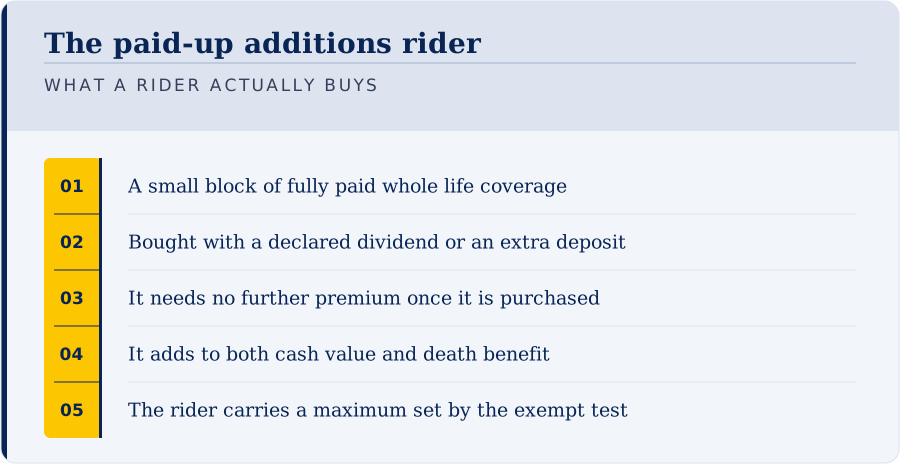
A paid-up addition is a small block of fully paid participating whole life insurance, bought with a policy dividend or with an extra deposit your contract allows. It needs no further premium, adds to both the cash value and the death benefit, and earns dividends of its own, which are not guaranteed. Two limits cap deposits: the contract's own deposit terms and the tax rule that keeps the policy exempt. In the early years a deposit adds less cash value than you pay in.
A paid-up addition is a small block of participating whole life insurance that is fully paid for the day it is bought. You buy it with a policy dividend or with an extra deposit your contract allows. No further premium is ever owed on it. It adds to both the cash value and the death benefit, and it earns dividends of its own, which are not guaranteed.
That last point is the whole appeal: dividends buy additions, and additions earn dividends that can buy more. Whether the feature helps you depends on three things you can check before you pay a dollar: how much of each deposit becomes cash value in the early years, which limits cap your deposits, and how long you can leave the money alone.
What is a paid-up addition?
It is extra whole life coverage bought inside a contract you already own, in whatever amount the money applied will buy at the attained age of the person insured. The price is a single payment, so the addition is settled the moment it is bought, while the base policy is paid for year after year.
The mechanism is simple once you see it in order. A dividend or a deposit buys a small amount of fully paid-up insurance. That insurance has its own cash value. It is itself participating insurance, so it earns dividends of its own, and those dividends can buy the next addition.
Both figures move, though not by the same amount. The death benefit rises by the coverage bought. The cash value rises by the value of that coverage, which starts below the amount applied and then grows. Over a long contract the cash value closes on the death benefit. In a contract designed to mature at age 100, the two are built to meet at that age; your own contract states what happens then.
Where does the money for additions come from?
Two sources, and they behave differently. A dividend is declared by the insurer's board and is applied as your dividend option directs. A deposit is money you choose to add, under a provision of the contract that allows it. Some owners use both: the dividend option buys additions every year, and deposits go in on top.
| Dividends applied to buy additions | Optional deposits under a rider | |
|---|---|---|
| Who decides the amount | The insurer's board, each year; not guaranteed | You, within the contract's deposit terms and the exempt test |
| What the contract must contain | A dividend option set to buy paid-up additions | A deposit provision (a rider or an option) |
| Tax in the year it is applied | Nothing to report while the dividend buys additions | Nothing to report; it is a premium paid under the policy |
| Effect on your adjusted cost basis | None: it is not a premium you paid and not proceeds you received | Raises it, as a premium paid |
| Can it stop? | Yes, if no dividend is declared or you change the option | Yes, if you stop depositing; ask what that does to future room |
Both sources buy the same thing: fully paid coverage that joins the participating pool. The difference is who controls the flow and what it does to your adjusted cost basis, and that difference shows up later, when money comes out.
What is a paid-up additions rider, and can you add one later?
A paid-up additions rider is the provision that lets you pay more than the scheduled premium, with the extra buying paid-up coverage. Insurers use different names for it, such as a deposit option or an additions option, and two contracts can use similar names for different things. The contract wording, not the brochure, tells you what yours does. The scheduled premium itself is explained on insurance premium.
Without such a provision, your dividends may still buy additions, but the contract may not accept money of your own beyond the scheduled premium. Whether a deposit option can be added or increased after issue depends on the insurer, the policy generation, the dividend option in force, the limits remaining under the contract and, in some cases, new underwriting of the person insured. Before you assume you need a new policy, ask the insurer for the provision that applies to your contract and for a written decision on your request. A new policy is priced at the age and health of the person insured on the day it is applied for, so the insurer's answer comes first.
The rider carries a cost. Part of each deposit pays for the insurance being bought and for the insurer's expense of providing it, so a deposit does not become cash value dollar for dollar. How much becomes cash value in the first year depends on the product. The question that settles it for you is short: "What is the first-year cash value for each $1,000 deposited under this rider?"
How does a dividend or a deposit become an addition?
Five steps, and each one leaves a trace you can check.
- Money arrives, from a declared dividend under the paid-up additions option or from a deposit under the rider.
- It buys coverage at the attained age of the person insured, as a single payment, so an older person insured gets less coverage per dollar than a younger one.
- The coverage joins the contract and raises the total death benefit. It does not lapse on its own while the contract stays in force; it ends if you surrender it or if the contract ends.
- It creates cash value at once, less than the amount applied in the early years.
- It shares in future dividends from the participating account, if any are declared.
Your next annual statement should show the addition, its coverage and the new totals. Check it. A deposit that was received but not applied, or applied under the wrong option, is easier to correct in the same year than five years later.
What limits how much you can deposit?
each one taxed differently
Three ways to reach the value, often confused
- An advance, A withdrawal, A surrender
- The contractStays intact, under its terms; Value is removed permanently; Ends.
- The death benefitReduced while a balance is outstanding; Usually reduced, and not restored later; Ends with the contract.
- Can it be undoneYes, by repaying the balance; No, not by paying money back; No, and insurability may not be there again.
- TaxGenerally a disposition; a taxable gain can arise if the advance exceeds the adjusted cost basis; Amounts above the adjusted cost basis can be taxable; Amounts above the adjusted cost basis are taxable.
Two separate limits apply, and they come from different places.
The first limit is the contract's own deposit terms. The insurer sets them in the contract: a minimum deposit, a maximum, and sometimes a window each year in which deposits are accepted.
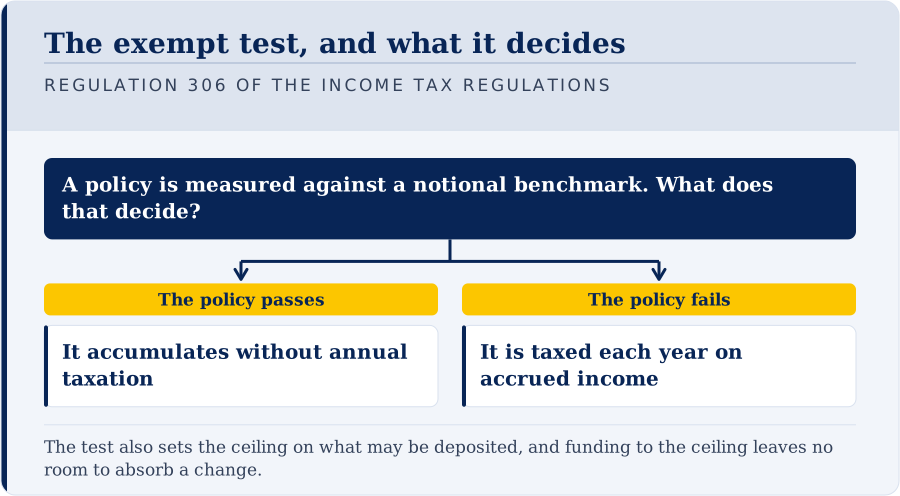
The second limit is the exempt test in Regulation 306, Income Tax Regulations. Canadian tax law sets it. It compares your contract with a benchmark policy and caps how much value the contract can build relative to its coverage, so that the policy keeps its exempt status and its growth is not taxed each year.
| The contract's deposit terms | The exempt test | |
|---|---|---|
| Who sets it | The insurer, in the contract | The Income Tax Regulations, section 306 |
| What it caps | The amount and timing of the deposits the insurer accepts | How much value the contract may carry relative to its coverage |
| Where you find it | The rider or deposit provision in your contract | The insurer's exempt-test calculation for your contract |
| What happens when you reach it | The insurer declines or returns the deposit under the contract | The insurer can decline or redirect the deposit to keep the contract exempt |
| The question to ask | "What are the minimum, the maximum and the window under my contract?" | "How much room remains this year before the exempt test is affected?" |
If an insurer declines a deposit, ask which of the two limits applied. The answer tells you whether anything can change. Contract terms stay as written, while exempt-test room can grow as the contract ages. Some contracts hold an amount that does not fit in a side account, taxed differently, until room appears; ask whether yours does and how that account is taxed.
The exempt test also shapes design. Coverage creates room: the amount of coverage decides how much value the contract may hold, and so how much can go in through the rider. A design weighted toward deposits has to carry enough coverage for the deposits it plans, which is why the base premium and the rider are sized together at issue, and why the insurer's illustration of each design is what shows the trade-off for your case. What happens when a contract fails the test is set out in the exempt test and what happens when a contract fails it, and the term itself in the glossary entry on the exempt test.
What do additions do for you?
The cash value grows faster than the base contract alone would produce, because each addition brings value of its own and then earns dividends on it, if dividends are declared.
The death benefit rises without new underwriting, within the terms set at issue. The rider's terms decide how much coverage you can add this way, and inside those terms no new medical evidence is asked for. That matters to anyone whose health has changed since the policy was issued.
You have some flexibility. Within the rider's terms and the exempt test, you can deposit more in a good year and less in a tight one. Ask the insurer what a smaller or missed deposit does to future room under your contract.
Growth inside an exempt contract is not taxed each year. The conditions are set out in tax-deferred growth.
And the value can be reached while the coverage stays in force, through a policy loan. That loan comes from the insurer, which charges interest at a rate it sets and may change, and which receives that interest. Interest you do not pay is added to the balance. The balance comes off the death benefit, and if it grows past the value securing it, the policy can end. A policy loan is also a disposition for tax under ITA s.148(9). A loan from another lender, with the policy assigned as security, is that lender's own decision, and the assignment is not a disposition. The four ways to reach the money are compared in the section on getting money out, below.
What do additions cost, and what can go wrong?
Not all of the money becomes value. Part of every deposit pays for the insurance and the insurer's expense. In the early years the cash value sits below what you have paid in, and a contract ended then returns less than it cost.
Dividends are not guaranteed. Where additions are bought with dividends, the funding itself depends on the scale the insurer's board declares each year. The scale has moved in the past and can move again.
More coverage is not automatically what you need. A larger permanent death benefit helps where the need is permanent. Where it is not, the money is buying something no one will use.
Deposits have ceilings you do not control: the contract's terms and the exempt test, both described above. A plan that assumes unlimited deposits will meet one of them.
The contract also becomes harder to compare. A base policy plus a rider plus a dividend option is not one number, which is part of why the cost criticism set out in objections and risks has real force.
How does the money move, year by year?
Year one. The base premium is paid and a deposit goes in under the rider. Part of the deposit buys paid-up coverage; part pays the cost of that insurance and the insurer's expense. The cash value exists, and it is well below the total paid. The guaranteed column on the illustration shows that gap before you sign.
Year two. The same thing happens again, and last year's addition now shares in any dividend declared. Two things are growing: the base contract and the additions bought so far.
The years that follow. The gap between what you have paid and what the contract holds narrows. Each new addition is smaller relative to the total, so more of the growth comes from what is already there and less from new money.
Later. The guaranteed cash surrender value passes what you have paid in, if it does so within the years shown. From then on, the question is no longer what you would lose by leaving but what you would give up. None of this is fast, and a presentation that makes it sound fast is describing something else.
How do you check the break-even year?
This is a liquidity check, not a rate of return. Find the first policy year in which the guaranteed cash surrender value equals the total you have paid in, counting the base premiums and every optional deposit. Use the guaranteed column and assume no loans. On some designs that year falls within the years the illustration shows. On others the answer is "not reached within the years shown". Either answer is useful if you know it before you commit.
Illustrative example. Assume a base premium of $5,000 a year and a rider deposit of $3,000 a year, both paid for 10 years, with no loans. The total paid by the end of year 10 is $80,000 ($8,000 a year for 10 years). The check is whether the guaranteed cash surrender value shown for year 10 on your illustration is at least $80,000. If it is not, move down the guaranteed column to the first year that reaches the running total of your payments, or note that it is not reached within the years shown. These figures are assumptions for the arithmetic only and come from no contract.
The year tells you how long the money must stay put before an exit returns at least what went in, on guaranteed values alone. It does not tell you whether the insurance was worth having: a contract that paid a death benefit in year six did its job whatever its cash value was. If no one has shown you the year, ask for it in writing: "In which policy year does the guaranteed cash surrender value first equal cumulative payments, including optional deposits, assuming no loans?"
What is guaranteed, and what is not?
read one illustration as two documents
What is guaranteed, and what is not
- 01Cash valueGuaranteed: Set out in the schedule at issue. Not guaranteed: Projected totals, which assume the current scale holds.
- 02Death benefitGuaranteed: Guaranteed, subject to the contract terms. Not guaranteed: Anything the declared dividends add to it.
- 03The annual decisionGuaranteed: A level premium, fixed by the contract. Not guaranteed: Dividends, declared annually and never guaranteed.
| Item | Guaranteed? | Who decides it |
|---|---|---|
| Cash values of the base policy | Yes, as printed in the contract's table | The contract |
| Coverage and cash value of an addition already bought | Set by the contract once the addition is bought; ask the insurer to confirm for yours | The contract |
| Future dividends and the dividend scale | No | The insurer's board, each year |
| Your right to deposit | Only within the rider's terms and the room under the exempt test | The contract and the tax rules |
| Policy loan interest rate | No | The insurer, which may change it |
| Coverage in an enhanced design | Depends on the contract; ask which part is guaranteed and what ends a guarantee | The contract |
The guaranteed values are the insurer's contractual obligation, and they depend on the insurer staying solvent. No government backs them. Solvency is supervised according to the insurer's charter: the Office of the Superintendent of Financial Institutions for a federally incorporated insurer, and the home province for a provincially incorporated one (the Autorité des marchés financiers in Quebec).
Assuris is the second line. Every life insurer authorized in Canada must be a member. If a member insurer fails, a whole life policyholder keeps up to $1,000,000 or 90% of the promised death benefit, whichever is higher, and up to $100,000 or 90% of the promised cash value, whichever is higher, calculated on the net values after policy loans. Those limits were read on Assuris on 26 September 2026; Assuris sets them and can change them. It is not deposit insurance and not a government guarantee.
How do you read an illustration that includes additions?
Find the guaranteed column. It shows what the contract does if no dividend is ever paid, and it is the floor under everything else.
Find the dividend scale used, stated as a rate or as the current scale. The whole projected column rests on it. Ask for the same illustration at a scale one percentage point lower. If it cannot be produced, you have been shown one scenario.
Compare the two columns at year 10 and at year 20. The gap is the size of the assumption you are being asked to accept.
Check the deposit shown. Is it paid every year for decades, and could you pay it in an ordinary year, not only a good one?
Check where the illustration stops. A stopping point at a flattering year tells you less than one that runs to an advanced age.
An illustration is a projection under stated assumptions, not a forecast. The assumptions are the document, not a footnote to it.
Which dividend option buys additions, and what do the others do?
Options vary by insurer and by contract. The ones you are likely to meet are these, and your contract lists the ones it offers.
- Buy paid-up additions. Coverage and value both rise, and the addition earns future dividends. Nothing is reported in the year, and your adjusted cost basis is unchanged.
- Take it in cash. The dividend is proceeds of a disposition of part of your interest in the policy under paragraph 148(2)(a) of the Income Tax Act. Subsection 148(1) includes in income only the part above your adjusted cost basis, and the dividend lowers that basis.
- Leave it on deposit with the insurer. The dividend is treated like a cash dividend: it lowers your adjusted cost basis and is income only above it. The interest credited on the deposit is taxable each year.
- Reduce the premium. The dividend pays part of what is owed. It helps when cash is tight, and it gives up the accumulation.
- Buy one-year term insurance, or an enhanced mix of term and additions. More coverage now, with less added cash value or none.
None of these is right in general. The choice depends on whether the contract exists for coverage, for building value or for access to cash, and it can be changed only as your contract allows; some changes need evidence of insurability. Each option is set out in the dividend options and what each one does.
How are paid-up additions taxed?
Going in, a dividend that buys additions creates nothing to report, and a deposit is a premium that raises your adjusted cost basis. Growth inside the contract is not taxed each year while the contract stays exempt.
Coming out is where the rules bite, and each route has its own. A cash dividend falls under paragraph 148(2)(a), as above. A policy loan is a disposition under the definition in ITA s.148(9). Only the part of the loan above your adjusted cost basis immediately before the loan is income, the loan lowers the basis, and repaying it restores the basis and can give a deduction under paragraph 60(s) up to the amounts previously included. A lapse or a surrender with a loan outstanding can produce income only to the extent the proceeds exceed the basis.
A withdrawal, which in these contracts means surrendering some additions, is a partial surrender. Subsection 148(4) sets against it only a proportionate share of your adjusted cost basis, so part of a withdrawal can be income even when you have taken out less than you paid in.
Illustrative example. Assume your adjusted cost basis is $40,000, the policy's accumulating fund (the value the tax rules use, which the insurer calculates) is $100,000, and you surrender additions for $10,000. The basis set against the withdrawal is $40,000 multiplied by $10,000 over $100,000, which is $4,000. The amount included in income is $10,000 less $4,000, which is $6,000, and your remaining basis is $36,000. The figures are assumptions for the arithmetic; the insurer reports the real ones. This is a reading of the Act, not a ruling, so confirm your own figures with an accountant.
The federal rules apply everywhere in Canada, and Quebec residents also file with Revenu Québec. Buying additions does not make a premium deductible; the narrow cases in which part of a premium can be deducted are covered in which part of the premium is deductible.
How do you get money out, and what does each route cost?
one payment doing three jobs
Where a permanent premium goes
- 01Part meets the cost of the insurance itself
- 02Part covers the insurer's expense and the premium tax
- 03Part builds the contractual value of the policy
- 04The split is not itemised on an illustration
- 05Base premiums follow the contract's own terms
Four routes, and they differ in who pays you, who is owed, and what the tax rules do.
| Route | Who pays you | Who receives interest | Tax provision | Adjusted cost basis | Death benefit |
|---|---|---|---|---|---|
| Policy loan | The insurer, as an advance under the contract | The insurer, at a rate it sets and may change | A disposition under s. 148(9); income only above the basis | Lowered by the loan; restored by repayment | Reduced by the balance and unpaid interest |
| Withdrawal (partial surrender of additions) | The insurer, from the value | No one; nothing is owed | A partial disposition, with a proportionate basis under s. 148(4) | Reduced by the share set against the withdrawal | Reduced for good by the coverage surrendered |
| Collateral loan | Another lender, on its own approval and terms | That lender | The assignment is not a disposition (s. 148(9), paragraph (f) of the definition) | Unchanged by the assignment | The lender is repaid from it under the assignment, if still owed |
| Full surrender | The insurer, the net cash surrender value | No one | A disposition; income above the basis | Ends with the contract | Coverage ends |
A policy loan and additions belong in the same plan. Value built by additions counts toward what the insurer will lend, so a heavily funded contract reaches a usable amount sooner. An outstanding loan reduces the death benefit, including the part built from additions. Interest you do not pay is added to the balance, and a CRA technical interpretation (2016-0658641E5, 31 May 2017) describes that capitalised interest as a further policy loan; it may not reflect the CRA's current position. If the balance grows past the value, the policy can lapse, and a lapse with a loan outstanding can produce income to the extent the proceeds exceed the basis, at a moment when there may be no cash to pay the tax. A lapse reinstated within the period the Act allows is not a disposition.
If you lend money from a policy loan to a relative, there are two debts: you owe the insurer, and your relative owes you. The loan itself is explained in policy loans, the tax side in when a policy loan becomes taxable, and a full surrender in cash surrender value.
Paid-up additions and reduced paid-up: what is the difference?
The words overlap, and the two move in opposite directions. A paid-up addition adds coverage: money goes in, and the death benefit and the cash value rise.
Reduced paid-up is a non-forfeiture option, taken on the way out. Premiums stop, and the contract shrinks to whatever amount of fully paid coverage its value will support. Nothing more is paid and nothing more is added.
One grows a contract while it is being funded; the other keeps some coverage when premiums can no longer be paid. Asking for the wrong one at the wrong moment is expensive, so use the full name of each when you write to the insurer.
How do additions compare with an enhanced coverage design?
Some contracts offer an enhanced or blended design that combines base whole life with a layer of term insurance, with dividends used over time to replace the term layer with paid-up additions. It buys more initial death benefit for the same premium, and part of that coverage relies on dividends.
Terms differ by insurer. In some designs part of the enhanced coverage is guaranteed for a period; in others, what happens when dividends fall short depends on the contract. Ask two questions in writing: which part of the coverage is guaranteed, and for how long; and what ends a guarantee, such as a change of dividend option, a policy loan or a missed premium.
A plain paid-up additions design buys less initial coverage per dollar, and each addition, once bought, is fully paid. Which suits you depends on whether the priority is coverage now or value later. Matched illustrations of both designs from the same insurer are the fair way to compare them.
Where do paid-up additions fit in the wider strategy?
Practitioners describe an approach they call The Infinite Banking Concept®, a term originated by Nelson Nash and a registered trademark of Infinite Banking Concepts, LLC. Neither this practice nor its author is affiliated with, sponsored by or endorsed by that company or the Nelson Nash Institute.
Additions matter there because the approach relies on value the owner can reach. A contract funded heavily through a rider builds reachable value sooner than one funded at the base premium alone.
Three qualifications come with it. Sooner is not soon: even a heavily funded contract takes years, and the break-even check above tells you how many on guaranteed values. The funding has to hold through ordinary years, not only good ones. And the approach is disputed on grounds that are partly correct; the arguments are set out in objections and risks, which is a good place to start as well as to finish.
Do additions make sense when the person insured is older?
The arithmetic changes. An addition is priced at the attained age of the person insured, as a single payment. At 40, a given amount buys a substantial block of coverage. At 70, the same amount buys much less, because the insurer is pricing a nearer claim.
The share that shows up as cash value rises with age. That can look like an advantage; it is the same pricing seen from the other side. The time for additions to earn dividends and buy more additions also shortens.
So the purpose has to come first. At 70, funding additions to build value works against the mechanism. Funding them to leave a larger, fully paid death benefit, especially when health has changed since issue and new coverage would be hard to obtain, can make good sense.
What changes when a corporation owns the contract?
the number that decides what is taxable
The adjusted cost basis
- 01The tax cost of the contract to its owner
- 02It rises with the premiums that are paid
- 03It falls as the net cost of pure insurance is deducted
- 04It decides how much of an amount taken out is taxable
- 05On a long held contract it declines toward nothing
The cash value sits on the corporation's balance sheet. It forms part of what a buyer values, and it counts among the assets not used in an active business, which can affect whether the shares qualify for the capital gains exemption on a sale. Additions raise that value on purpose, so the timing of a sale and the size of the deposits belong in one conversation.
On the death of the person insured, the corporation's capital dividend account is credited with the death benefit less the policy's adjusted cost basis, under the definition in ITA s.89(1). Additions raise the death benefit and deposits raise the basis, so the credit does not move in simple proportion. Paying the credit out to shareholders requires an election under subsection 83(2) of the Income Tax Act, filed on CRA Form T2054; the steps are in paying a capital dividend after a death.
Additions do not make the premium deductible. None of this argues against corporate additions. It argues for the corporation's accountant being in the conversation before the rider is funded, as set out in what business owners need from insurance and capital.
What if you already own a contract?
Start with the contract, not the illustration. Ask the insurer for a policy summary. It shows whether a deposit provision exists and which dividend option is set.
Ask what room remains this year under both limits: the contract's deposit terms and the exempt test.
Check the dividend option. Some owners have never chosen it on purpose; it was set at issue and left there.
Ask for the current guaranteed cash value and the current total cash value, side by side. The gap is the part built from dividends declared in past years.
Ask what a smaller or missed deposit does under your contract: whether the rider stays open, whether future room shrinks, and whether a window closes.
If your contract has no deposit provision, put the question from the rider section to the insurer and get its written decision before anyone proposes a new policy.
What should you ask before you add money?
- Is the need for coverage permanent? If it is temporary, more permanent coverage is the wrong purchase.
- Could you make the deposit in an ordinary year, not only a good one?
- Does the money exist after an emergency fund and any expensive debt? Registered plans such as a TFSA, an RRSP or an FHSA do a different job; put questions about them to a professional licensed for them.
- What is the first-year cash value for each $1,000 deposited?
- Which limit caps your deposits this year, and how much room remains under each?
- What is the break-even year on the guaranteed column, counting optional deposits, or is it not reached within the years shown?
- What does the illustration look like at a lower dividend scale?
- What happens if you stop depositing?
- Who will service the contract in 10 years? A contract like this can outlive the working relationship with the person who arranged it.
When are paid-up additions the wrong choice?
When the extra coverage would exceed any need. Permanent death benefit nobody requires is a cost without a purpose.
When the money is not there yet. A deposit that takes the place of an emergency fund or of paying down an expensive debt has been sized wrongly.
When you will need the money soon. As a rule of thumb, test the horizon against your own illustration: if you may need the money before the break-even year on the guaranteed column, the design has not had time to outrun its early costs.
When the deposit depends on an exceptional year. A level of funding an ordinary year cannot carry will stop, and stopping partway leaves you with the early costs and little of the later growth.
When you have no cash elsewhere. Value in a contract is reached through a loan or a withdrawal, each with a cost and a tax result, so it does not replace an emergency fund.
What do people get wrong about paid-up additions?
That a deposit becomes cash value dollar for dollar. It does not, least of all early. Part buys coverage, and part meets the cost of that coverage and the insurer's expense.
That a rider can always be added later if things go well. It depends on the insurer, the policy and, in some cases, the health of the person insured. Ask for the provision and a written decision.
That dividends are a return on the deposit. A dividend is a distribution from the participating account, declared at the board's discretion and reflecting investment results, claims and expenses. It is not interest and it is not guaranteed.
That more coverage is always better. Coverage is a cost. Where the need is temporary or absent, extra permanent coverage buys something the household will not use.
That the insurer caps deposits only to protect its margin. Two limits apply: the contract's deposit terms, which the insurer sets, and the exempt test, which tax law sets. Ask which one stopped a deposit.
That additions make the contract liquid. They raise the value, and reaching it still takes a loan, a withdrawal or a surrender, each with its own cost, timing and tax result.
Is adding money to your contract the right move for you?
It depends on facts that only you, and the people you choose to advise you, can see: why the coverage exists, how durable your cash flow is, what else the money is for, and how long it can stay put. The questions above turn those facts into answers you can check against the contract.
Everything here is written by someone paid by commission when a contract is issued, which is stated on the author page and in the disclosure at the foot of every page. You decide.
The contracts these additions sit inside are explained in policy basics and whole life insurance.
A thirty-minute discovery meeting
A first conversation establishes whether this fits. No illustration is prepared and nothing is arranged.
Often the answer is no, and you will hear it during the call rather than in a proposal afterwards.
This form reaches Canadian Wealth Creation Centre Inc. Any meeting, any advice and any insurance product is provided by Canadian Wealth Creation Centre Inc., through its representatives who are licensed in the client's province. IBC Financial is the company's educational website: it distributes no product and no financial service, and it gives no individualised advice.
Common questions
What is a paid-up addition?
Do PUAs only work with whole life insurance?
What is a paid-up additions rider?
Is there a limit on how much I can put in?
What is the difference between paid-up additions and reduced paid-up?
How does money actually turn into a paid-up addition?
Does all of my deposit become cash value?
Can I add a paid-up additions rider to a policy I already own?
What happens if I stop making deposits into the rider?
What are the dividend options, and which one buys paid-up additions?
Do paid-up additions increase my death benefit without a medical?
Are paid-up additions worth it if the insured is older?
Are paid-up additions taxable?
How do paid-up additions affect how much I can borrow against the policy?
What should I check on an illustration that includes paid-up additions?
When are paid-up additions the wrong choice?
Can I take money out of my paid-up additions without cancelling the policy?
Are my paid-up additions protected if the insurer fails?
Sources
- Income Tax Regulations, Regulation 306, Justice Laws Canada, verified 2026-09-26
- Income Tax Act s.148, Justice Laws Canada, verified 2026-09-26
- Income Tax Act, R.S.C. 1985, c. 1 (5th Supp.), subsections 148(1), 148(4), 148(7) and 148(9), paragraph 60(s) and section 12.2, Justice Laws Canada, current to 21 July 2026, verified 2026-09-16
- Income Tax Act, R.S.C. 1985, c. 1 (5th Supp.), subsections 148(1), 148(2) and 148(9), definition of adjusted cost basis, and paragraph 148(2)(a), Justice Laws Canada, Act current to 21 July 2026, verified 2026-09-16
- Income Tax Act s.89(1), capital dividend account, Justice Laws Canada, verified 2026-09-14
- Canada Revenue Agency, Form T2054, Election for a Capital Dividend Under Subsection 83(2), modified 24 March 2025, verified 2026-09-27
- Canada Revenue Agency, technical interpretation 2016-0658641E5, Policy loan interest, 31 May 2017, verified 2026-09-23
- Assuris, Whole Life protection, net of policy loans, verified 2026-09-26
- Assuris, home page: every life and health insurance company authorized to sell insurance in Canada must be a member, verified 2026-09-26
- Income Tax Regulations, Regulation 306, Justice Laws Canada, verified 2026-08-21
- Income Tax Act s.148(9), Justice Laws Canada, verified 2026-08-21
About the author

Jose Salloum is a Financial Security Advisor (conseiller en sécurité financière) certified by the Autorité des marchés financiers in Quebec, a Life and Accident & Sickness Insurance Agent licensed by the Financial Services Regulatory Authority of Ontario, and a Life Insurance Agent licensed by the Insurance Council of British Columbia. Licensed since 2001.
He has practised Infinite Banking since 2015 and founded Canadian Wealth Creation Centre Inc. in 2016. From 2020 to 2024 he was an IBC (Infinite Banking Concepts™) Authorized Practitioner of the Nelson Nash Institute, a private certification rather than a regulatory licence.
IBC Financial is the educational website of Canadian Wealth Creation Centre Inc., open to all Canadians. Services come only from Canadian Wealth Creation Centre Inc. Its representatives hold a licence in each province served: Quebec, Ontario, Alberta, British Columbia, Manitoba and New Brunswick. Jose Salloum's own licences cover Quebec, Ontario and British Columbia. This page is general education and not advice on any individual file.
Last reviewed 2026-09-28. By Jose Salloum, Financial Security Advisor in Quebec. In Ontario, Life and Accident & Sickness Insurance Agent. In British Columbia, Life Insurance Agent.