
Estate Planning in Canada: What It Is, How It Works, Importance, Costs
Estate planning is the process of arranging how assets are preserved, managed and distributed on death or incapacity. In Canada it turns on the deemed disposition at death, provincial probate rules that differ sharply between Quebec and the common law provinces, and beneficiary designations that pass outside the estate entirely.
Estate planning is a critical process that extends far beyond creating a simple will. This guide covers the essential aspects of estate planning in Canada, from understanding what it is and how it works to knowing when to start and what it costs. It examines why estate planning matters for ensuring your wishes are honoured, reducing tax burdens, and providing smooth succession for your heirs.
You will find the documents a complete estate plan requires, including wills, powers of attorney and healthcare directives, alongside practical considerations such as when to update a plan, how to find a qualified lawyer, and what blended families need to handle differently. The question of whether you are beginning to build assets or managing substantial wealth, this page provides the foundation for an estate plan that does what you intend.
What protects assets from creditors in Canada, what does not, and the timing rule that governs all of it, is on asset protection.
How the deemed disposition falls on a property portfolio, and what funds it, is on real estate investor retirement planning.
What is Estate Planning?
Estate planning is the process of arranging how your financial assets and real estate will be preserved, managed and distributed after your death or in the event of incapacity. It involves creating legal documents that set out your wishes for your property, your health care decisions and the care of minor children, while addressing the tax consequences of transferring assets.
According to a 2023 Angus Reid survey, only 51% of Canadians have a will, leaving 49% of adults without any formal estate plan despite owning an average of $329,000 in assets per household, as at 2023. As Elena Hoffstein, partner at Miller Thomson LLP, has put it, estate planning is not just for wealthy people. It is essential protection for anyone who wants to control what happens to their assets and their loved ones when they are no longer able to make those decisions.
One distinction governs everything that follows, and most guides bury it. Some assets pass through your estate and are governed by your will. Others pass outside it, by designation or by survivorship, and your will does not touch them. A life insurance death benefit with a named beneficiary is in the second category. So is a registered plan with a designated beneficiary, outside Quebec. So is property held in joint tenancy, again outside Quebec.
That means a person can have a carefully drafted will and still have most of their wealth distributed by documents signed years earlier and never reviewed.
How does Estate Planning Work?
Now catch this part. Estate planning works through the creation and maintenance of documents that direct how your assets will be managed and distributed according to your wishes. The process typically begins with an inventory of assets, averaging $682,900 per Canadian household as at 2024, followed by determining beneficiaries, selecting a person to hold legal control, and drafting the necessary documents with an estate lawyer whose fees average between $1,800 and $3,500 for a basic plan.
As Margaret O'Sullivan, Managing Partner at O'Sullivan Estate Lawyers and a certified specialist in estates and trusts law, has observed, effective estate planning is an ongoing process requiring regular review as family circumstances, financial situation and legal requirements change.
The person holding legal control is called different things in different places. In the common law provinces they are an executor, or in some provinces an estate trustee. In Quebec they are a liquidator, appointed under the Civil Code, and their powers and obligations are set out in the Code and not derived from the will alone. The distinction is not cosmetic: the liquidator's duties, the timelines and the accounting requirements differ.
The order in which things happen also matters. The deemed disposition, the probate application where one is required, the payment of debts and taxes, and only then distribution to beneficiaries. An estate that lacks cash at the second or third of those stages will sell assets to raise it, frequently at the wrong moment and frequently the asset the family most wanted to keep.
Why is Estate Planning Important?
protection arranged late is not protection
Asset protection turns on timing
- 01Statutory exemptions under provincial law
- 02Ownership structures arranged in advance
- 03Insurance with a properly named beneficiary
- 04A transfer made to defeat a known creditor can be reversed
- 05Protection put in place early is the protection that holds
Estate planning matters because it ensures your assets are distributed according to your wishes while minimising tax and legal complications for those you leave behind. It prevents the probate process, which takes 12 to 18 months in Canada and costs between 5% and 7% of total estate value, potentially saving families substantial sums on estates valued at $500,000 or more through proper beneficiary selections.
As Jordan Atin, estate planning lawyer and author of The Family War: Winning the Inheritance Battle, has said, without proper estate planning you are essentially letting provincial laws and probate courts decide what happens to everything you have worked for, which rarely aligns with what most people would have wanted.
Ensuring Wishes Are Honored
Estate planning ensures your funeral wishes and healthcare decisions are honoured by creating legally binding documents that clearly express your intentions regarding transfer of property, personal care, and guardianship of minor children. A properly executed estate plan prevents your assets from being distributed according to provincial intestacy laws, which differ across all provinces and territories and may allocate only 30% to 50% of assets to a surviving spouse, with the remainder going to children or other relatives without regard to your family's actual structure.
Intestacy is not a neutral default. It is a formula written for the average case, applied to yours. It makes no provision for a common law partner in several provinces, no provision for a stepchild you raised, and no provision for the person you would have chosen to manage things.
Reducing Tax Burdens
Estate planning reduces tax burdens by implementing strategies that minimise probate fees, capital gains and income tax that might otherwise diminish the value of assets transferred to beneficiaries. Strategic planning can help beneficiaries avoid the effects of deemed disposition at death, which triggers capital gains tax on the appreciation of assets, with combined rates varying by province of residence.
The deemed disposition is the mechanic worth understanding properly. Canadian tax law treats most capital property as having been sold at fair market value immediately before death. A cottage bought decades ago, a portfolio of securities, shares in a private company: all are treated as sold, and the gain is taxable on the final return.
Nothing was actually sold. No money arrived. The tax is due regardless.
That is why liquidity, and not growth, is the estate question insurance actually answers. A death benefit arrives at the moment the liability does, and it is the reason a family can keep an asset instead of selling it to pay a tax bill triggered by a death.
A spousal rollover defers, it does not forgive. Property passing to a spouse or a qualifying spousal trust generally transfers at cost, so no gain arises at the first death. It arises at the second. Plans built around the first death frequently ignore what waits at the second.
Providing Smooth Succession
Estate planning provides smooth succession by establishing clear instructions for asset management, business affairs and advance care decisions before they are needed. A comprehensive succession plan can reduce the probate process substantially, preventing family disputes that affect 46% of estates and lead to litigation in 18% of cases, according to a 2023 Canadian Legal Wills survey.
Most disputes are not about money. They are about a decision nobody explained. A child left less than a sibling for a reason that made sense and was never written down. An asset promised verbally and left elsewhere in a will. The cheapest estate planning available is a letter, kept with the will, explaining why the plan is what it is.
What Documents Do I Need For Estate Planning?
Estate planning requires several essential documents including a will, powers of attorney, an advance care plan, and potentially a trust depending on your situation. The fundamental documents include a last will and testament, used by 72% of Canadians with estate plans, advance healthcare directives, implemented by only 38% of adults, an enduring power of attorney, used by 35% of Canadians, and testamentary trusts, established by 26% of individuals with assets exceeding $300,000.
As Barry Fish, co-founder of Fish & Associates, has noted, the four cornerstone documents every Canadian adult needs are a will, a power of attorney for personal care, a power of attorney for property, and a living will. These provide the minimum protection every person requires regardless of asset level.
A fifth document belongs on that list and rarely appears: your beneficiary designations. They are not part of your will, they override it for the assets they cover, and they are frequently decades old. Insurance contracts, registered plans, pensions. A designation naming a former spouse remains effective until it is changed, and the contract does not know your circumstances have changed.
Quebec differs on the will itself. A notarial will, prepared and kept by a notary, requires no probate. That single difference removes a delay and a cost that dominate estate administration elsewhere in the country, and it is a reason Quebec residents should not assume advice written for Ontario applies to them.
When Should I Start Estate Planning?
Adults should start estate planning as soon as they acquire assets, marry, have minor children, or reach the age of majority, regardless of wealth. The optimal time is the late twenties to early thirties, yet 82% of millennials in Canada lack basic estate documents despite 59% of them owning homes valued at an average of $472,000, as at March 2024.
As Suzana Popovic-Montag, Managing Partner at Hull & Hull LLP and a certified specialist in estates and trusts law, has observed, there is no advantage in waiting. Waiting until you are older, wealthier or facing health issues significantly increases the risk of lacking legal protection when circumstances change unexpectedly.
Insurance has an additional timing consideration the general advice misses. Coverage is priced at issue on health at issue. A person who defers the decision until an estate plan feels urgent may find that the coverage the plan depends on is more expensive, restricted, or unavailable. That is not an argument for hurrying. It is an argument for making the decision while it is still a decision.
How Much Does Estate Planning Cost?
Estate planning costs vary widely with complexity, location and the documents required, ranging from around $400 for basic wills to $12,000 or more for comprehensive plans. As at 2024, the national average cost in Canada for a basic estate plan covering a will, powers of attorney and healthcare directives is $2,250, while more complex plans involving spousal trusts and asset protection average $5,500 to $7,800, with ongoing trust administration costing $2,500 to $3,800 annually for larger estates.
As Ed Olkovich, a certified specialist in estates and trusts law, has said, while do-it-yourself options exist at lower cost, professionally prepared estate plans typically deliver many times their cost in tax savings, asset protection and probate avoidance.
The cost that dwarfs all of these is the one nobody quotes: the tax. Probate fees are measured in fractions of a percent to just under two percent depending on province. The deemed disposition can be measured in tens of percent of an asset's appreciation. A plan that optimises probate and ignores the income tax consequence has optimised the smaller number.
These figures are as at 2024 and several are unattributed on the page they came from. Treat them as indicative and not as quotations, and confirm current costs with the professional you engage.
How Often Should I Update My Estate Plan?
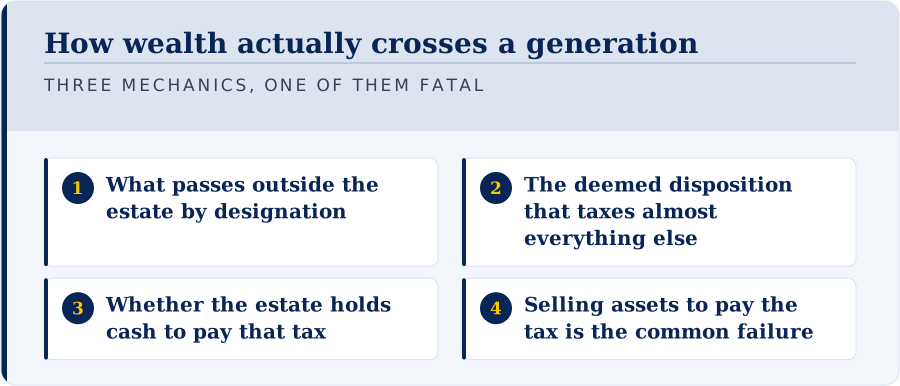
three mechanics, one of them fatal
How wealth actually crosses a generation
- What passes outside the estate by designation
- The deemed disposition that taxes almost everything else
- Whether the estate holds cash to pay that tax
- Selling assets to pay the tax is the common failure
Estate plans should be updated after major life events and reviewed at least every three to five years to ensure they remain aligned with current wishes and applicable law. Significant events triggering updates include marriage or divorce, affecting 43% of estate plan revisions, births and deaths, prompting 38% of updates, acquisition of assets, causing 31% of modifications, and major tax law changes.
As Corina Weigl has noted, estate plans should never be static documents. They require regular maintenance, with more frequent reviews during periods of significant personal, financial or business change.
Separation is the event that does the most damage and receives the least attention. A separation is not a divorce, the legal effect differs by province, and in the interval a designation naming a former partner remains effective. This is the single most common avoidable error in the whole field, and checking it costs nothing.
The other frequently missed trigger is a corporate reorganisation. Where a company owns a policy and the company is restructured, the ownership and beneficiary arrangements can stop matching the structure they were built for. That is discovered at a death or a sale, which are the two worst moments to discover anything.
What Are Trusts in Estate Planning?
Trusts are legal arrangements allowing a trustee to hold and manage assets until beneficiaries reach specific milestones. They take various forms including alter ego trusts, used by 21% of Canadians with estate plans, family trusts, implemented by 14% of high-net-worth individuals, and Henson trusts, established for Canadians with disabilities.
As Tim Cestnick has said, trusts are not just tax-saving vehicles but tools for protecting assets from creditors, providing for loved ones with special needs, and ensuring a legacy is managed as intended across generations.
Most people do not need one, and saying so is part of honest advice. A trust adds cost, administration, and a tax return every year. It earns its place where there is a specific problem to solve: a beneficiary who should not receive capital outright, a blended family requiring a defined split, a business succession, a disability where preserving benefit entitlement matters.
The twenty-one year rule catches people. Most trusts face a deemed disposition of their property every twenty-one years, which can trigger tax inside the trust long after the person who created it has died. A trust established without a plan for that date has deferred a problem and not solved one.
How Do I Find a Good Estate Planning Lawyer or Notary?
Individuals should find a good estate planning professional by seeking referrals from licensed advisors, professional bodies and provincial law societies, and by interviewing several candidates with specific expertise in estates.
Experienced estate lawyers in Canada charge between $400 and $650 per hour, or flat fees ranging from $1,800 to $6,000 for comprehensive plans, with 68% of clients reporting they interviewed at least three before selecting one, according to a 2023 Canadian Bar Association survey.
As Rachel Blumenfeld, partner at Aird & Berlis LLP, has noted, the right lawyer will have not only technical expertise but the ability to explain complex terms simply, relevant experience with similar situations, and a willingness to collaborate with your accountant and your other advisors.
A note on the word itself. Canada has lawyers, and in Quebec notaries. It does not have estate planning attorneys, and a Canadian searching that term is being sent to a profession that does not exist here. In Quebec a notary handles wills, and a notarial will avoids probate entirely, which makes the choice of professional a substantive decision and not a preference.
How Should Blended Families Handle Estate Planning?
the number that decides what is taxable
The adjusted cost basis
- 01The tax cost of the contract to its owner
- 02It rises with the premiums that are paid
- 03It falls as the net cost of pure insurance is deducted
- 04It decides how much of an amount taken out is taxable
- 05On a long held contract it declines toward nothing
Blended families should create clear documentation balancing the needs of current spouses and children from previous relationships, preventing unintended disinheritance through careful asset mapping and beneficiary designation.
With approximately 42% of Canadian marriages involving at least one previously married spouse and 68% of remarriages involving children from prior relationships, tools such as spousal trusts, life insurance and clearly defined contingent beneficiary designations are essential.
As Lynne Butler, estate lawyer and author of Estate Planning Through Family Meetings, has said, the cardinal rule for blended families is specificity. Vague provisions almost invariably lead to conflict, so each person's rights must be explicitly defined.
Insurance is used in blended families for a structural reason. It allows one group to be provided for without dividing an asset another group needs whole. A business, a family property, a farm. The death benefit goes to one side and the asset passes intact to the other, which is a cleaner answer than instructing a liquidator to divide something indivisible.
The contingent designation matters more here than anywhere. If the primary beneficiary dies first and no contingent is named, the proceeds fall into the estate, become subject to the will, and end up distributed by exactly the mechanism the designation was meant to bypass.
What Estate Planning Laws Do I Need to Know?
Several bodies of law apply, and they vary by jurisdiction. The key frameworks include the deemed disposition rules at death, provincial probate fees, which range from none in Quebec to just under two percent in Nova Scotia as at 2024, succession legislation with variations across provinces, and provincial trust legislation.
As Kim Moody, director of Canadian tax advisory at Moodys Tax Law, has said, understanding the interplay between federal and provincial law is crucial. Many clients focus exclusively on probate fees while overlooking income tax implications, which often have a far greater impact.
Three further rules belong in any Canadian estate discussion and are absent from most.
The exempt test. Growth inside a life insurance contract is not taxed annually provided the contract remains exempt under Regulation 306, Income Tax Regulations. That treatment is conditional and not automatic, and it underpins every claim made about insurance in an estate context.
The Capital Dividend Account. Where a private corporation receives a death benefit, the amount in excess of the policy's adjusted cost basis is credited to a notional account under ITA s.89(1), from which the corporation may pay a capital dividend to shareholders free of tax. This has no United States equivalent, which is why American material on corporate life insurance does not transfer, and it is the strongest uniquely Canadian argument in this entire subject.
Assuris. The guarantees in an insurance contract are the insurer's contractual obligations and depend on its solvency. They are not government backed. Assuris provides protection to Canadian policyholders within published limits, which is meaningful and is not the same thing as deposit protection.
How can estate planning incorporate The Infinite Banking Concept®
Estate planning can incorporate the approach through the deliberate use of participating whole life insurance as a wealth transfer vehicle. The strategy uses a contract with accumulated cash value to create transfers to beneficiaries while retaining access to capital during the owner's lifetime.
A properly structured death benefit is generally received free of income tax by a named beneficiary, subject to the contract remaining exempt under the Canadian rules. Approximately 58% of wealthy individuals use some form of life insurance in their estate planning, according to a March 2023 survey by Lincoln Financial Group, which is a United States survey and should be read as indicative and not as a Canadian figure.
According to Nelson Nash, founder of The Infinite Banking Concept® and author of Becoming Your Own Banker®, the deliberate placement of dividend-paying whole life insurance within a comprehensive estate plan can serve a family across generations.
Three qualifications belong with that, and they are the difference between an argument and a pitch.
Participating whole life insurance is an insurance product and it is not an investment. Judged against a market portfolio as a way to grow money it usually compares poorly. Judged as liquidity that arrives exactly when a tax liability does, it is answering a different question, and that is the question worth evaluating in an estate context.
Dividends are not guaranteed. They are declared annually at the discretion of the insurer's board, and a plan built on an assumed scale is a plan built on an assumption.
It does not suit everyone. It requires durable surplus cash flow, a horizon measured in decades, and registered contribution room already considered. The arguments against it, including the ones that are correct, are set out at length in objections and risks, which is the honest place for a reader to start.
Where the corporate analysis differs
Where a corporation owns the contract, the estate question changes and not scales.
The premium is paid with corporate dollars taxed at corporate rates. The cash value sits on the corporate balance sheet and can affect a valuation. The death benefit is received by the corporation, credited to the Capital Dividend Account in excess of the adjusted cost basis, and paid out to shareholders as a capital dividend. Each of those steps has its own consequences and its own ways of going wrong.
Structuring errors here are among the most expensive available and they surface at a death or a sale. That is treated separately with business owners.
What an estate actually costs a family in time
the security is the contract itself
What an advance does to the death benefit
- 01The balance owing is deducted while it stands
- 02Unpaid interest capitalises and the balance grows
- 03The reduction follows the balance, not the original advance
- 04A death benefit is not fixed while the contract is drawn on
- 05Repayment restores the amount reaching a beneficiary
The financial cost is quoted everywhere. The other cost is not.
Probate takes months. During that period the executor or liquidator may have limited authority to deal with assets, banks may freeze accounts pending appointment, and property cannot generally be sold. A family with obligations continuing through that window has to meet them from somewhere.
The final return has a deadline. Tax arising on the deemed disposition is payable whether or not the estate has been settled and whether or not any asset has been sold. Interest runs on what is unpaid.
Assets that pass outside the estate move quickly. A death benefit with a named beneficiary is paid on proof of death and not on completion of an estate administration. That difference in timing, and not any difference in amount, is why liquidity planning and estate planning are the same conversation.
The emotional cost of an unclear plan is borne by whoever administers it. Usually a spouse or an adult child, at the worst moment of their life, reading documents they have never seen and making decisions they were never briefed on. A plan that is complete and explained is a kindness to a specific person, and it is worth naming that person while writing it.
Six questions to bring to a first estate meeting
Answering these before the meeting makes the meeting shorter and better.
Who passes outside my estate today? Every insurance contract, registered plan and pension, and who is named on each.
What would the deemed disposition be if I died today? Your accountant can estimate it. It is frequently larger than expected.
Would my estate need to sell something to pay it? If yes, which asset, and would the family want to keep it.
Who would administer this, and do they know? Naming someone who has never been told is common and unkind.
What have I promised verbally that is not written down? Most disputes trace back to exactly this.
What changed since the last time I looked? A separation, a birth, a death, a corporate reorganisation, a move to another province. Where the question is narrower, which beneficiaries a statute actually shelters from a creditor and until when, that is answered on the designation and what a creditor can reach.
Two pages on what an estate actually meets
An estate can own a great deal and hold no money. A cottage, a farm, a private company and a tax liability arriving on a deemed disposition, with nothing liquid to pay it. What the liquidator or executor faces, what they are personally exposed to, and the five routes that exist: an estate with assets and no cash.
Naming a minor child directly as beneficiary is one of the most consequential mistakes in Canadian estate arrangements, because a minor cannot give a valid discharge to an insurer. What a trust does instead, and what it costs: a death benefit and a testamentary trust.
What to do next
Three things, in order, and none of them is buying anything.
Find out what passes outside your estate. List every insurance contract, registered plan and pension, and check who is named. That single exercise resolves more estate problems than any other action available to you.
Size the deemed disposition. Ask your accountant what would be owed if you died today. What is and is not taxable at death, including the treatment of CPP and employer death benefits alongside insurance proceeds, is set out in taxes on death benefits. The number is frequently larger than expected, and knowing it is useful whether or not you ever do anything about it.
Then decide whether liquidity is the problem. If the answer is that your estate has ample cash, insurance is answering a question you do not have. If the answer is that it would need to sell something, that is when the conversation is worth having.
How wealth actually moves between generations, what passes outside the estate, and why liquidity rather than size determines whether it survives the transfer, is set out in generation wealth building.
For more information about estate planning, the learning centre indexes everything on this site by subject.
Figures on this page are as at 2024 unless a source states otherwise. Several statistics quoted here appeared without attribution in the original and should be confirmed with the professional you engage before being relied upon. Understand that much and you will not be misled.
A thirty-minute discovery meeting
A first conversation establishes whether this fits. No illustration is prepared and nothing is arranged.
Often the answer is no, and you will hear it during the call rather than in a proposal afterwards.
This form reaches Canadian Wealth Creation Centre Inc. Any meeting, any advice and any insurance product is provided by Canadian Wealth Creation Centre Inc., through its representatives who are licensed in the client's province. IBC Financial is the company's educational website: it distributes no product and no financial service, and it gives no individualised advice.
How Canadian Families Pass Capital On Without Selling It
The tax at death, the beneficiary designation, what a creditor can reach and where the cash comes from, so the people you leave behind are not forced to sell.
| A Death Benefit and a Testamentary TrustHow a life insurance death benefit can be directed to a trustee rather than to a person in Canada, what the will must set out, and what a trust costs to run. | Read more |
| A Minor Beneficiary, a Beneficiary Who Cannot Be Found, and the Estate by DefaultWhat an insurer does with a death benefit when the beneficiary is a child, cannot be located or has died first, in Quebec and in a common law province. | Read more |
| An Estate With Assets and No CashAn estate can hold a cottage, a farm or a private company and no money for the tax arising at death. What that obligation is, and the routes that exist. | Read more |
| Asset ProtectionWhat asset protection means in Canada, which protections exist by statute, what structures do and do not achieve, and the timing rule that governs all of it. | Read more |
| Family Patrimony and the Beneficiary DesignationWhat Quebec's family patrimony does to a life insurance contract, and how a beneficiary designation behaves at marriage and divorce. | Read more |
| Generation Wealth BuildingHow wealth is built and transferred across generations in Canada: what passes outside the estate, the deemed disposition, liquidity, and where insurance fits. | Read more |
| Taxes on Death BenefitsHow death benefits are taxed in Canada: life insurance proceeds, the CPP death benefit, employer death benefits, survivor benefits, and who reports what. | Read more |
| The Deemed Disposition at Death and Where the Death Benefit SitsSubsection 70(5) of the Income Tax Act, the spousal rollover, the RRSP and RRIF inclusions, the clearance certificate, and where a death benefit sits. | Read more |
| The Designation and What a Creditor Can ReachArticle 2457 of the Civil Code, the protected class under a provincial Insurance Act, and how insolvency law undoes a late change of designation. | Read more |
| Will Verification in Quebec and the Death BenefitIn Quebec, will verification replaces probate. What it establishes, its cost in delay rather than fees, and how the death benefit sits outside it. | Read more |
Common questions
Does a life insurance death benefit go through probate?
What is the deemed disposition at death?
Why are Quebec estate rules different from the rest of Canada?
Do I need a trust in my estate plan?
How does life insurance fit into an estate plan?
What happens if I die without a will in Canada?
How much does estate planning cost in Canada?
When should I start estate planning?
How often should I review my estate plan?
What is the difference between an executor and a liquidator?
Should I name my estate as the beneficiary of my life insurance?
What is a contingent beneficiary and why does it matter?
How long does probate take and what happens to the money in the meantime?
How do I choose an estate lawyer or notary in Canada?
Are do it yourself will kits good enough?
What should I bring to a first estate planning meeting?
Does a notarial will avoid probate in Quebec?
Sources
- Income Tax Regulations, Regulation 306, Justice Laws Canada, verified 2026-08-21
- Income Tax Act s.89(1), Capital Dividend Account, Justice Laws Canada, verified 2026-08-21
- Assuris, published protection limits, verified 2026-08-21
About the author

Jose Salloum is a Financial Security Advisor (conseiller en sécurité financière) certified by the Autorité des marchés financiers in Quebec, a Life and Accident & Sickness Insurance Agent licensed by the Financial Services Regulatory Authority of Ontario, and a Life Insurance Agent licensed by the Insurance Council of British Columbia. Licensed since 2001.
He has practised Infinite Banking since 2015 and founded Canadian Wealth Creation Centre Inc. in 2016. From 2020 to 2024 he was an IBC (Infinite Banking Concepts™) Authorized Practitioner of the Nelson Nash Institute, a private certification rather than a regulatory licence.
IBC Financial is the educational website of Canadian Wealth Creation Centre Inc., open to all Canadians. Services come only from Canadian Wealth Creation Centre Inc. Its representatives hold a licence in each province served: Quebec, Ontario, Alberta, British Columbia, Manitoba and New Brunswick. Jose Salloum's own licences cover Quebec, Ontario and British Columbia. This page is general education and not advice on any individual file.
Last reviewed 2026-08-21. By Jose Salloum, Financial Security Advisor in Quebec. In Ontario, Life and Accident & Sickness Insurance Agent. In British Columbia, Life Insurance Agent.