

Money Principles
Money principles are the ideas under every financial choice: what a choice costs in the alternative it rules out, how growth compounds and where projections overstate it, whether money you commit comes back, how quickly you can reach it, what waiting and being wrong cost, and how to compare two options fairly. They apply to a mortgage, an account, a loan or a policy alike. Reading them is free; the firm behind this site sells life insurance and is paid by insurer commission if a policy is bought.
Money principles are the few ideas that sit under every financial choice, whatever you end up buying or deciding not to buy. What does a choice cost in the alternative it rules out? How does growth compound, and where is that arithmetic oversold? Does money you commit come back to you, and how fast can you reach it when you need it? What does waiting cost, and what happens if your assumption turns out wrong? Each question works on a mortgage, a car, a savings account or a business decision, and each one lets you test an offer before you say yes to it.
You should also know who is talking. Reading here is free and needs no contract. The firm behind this site sells life insurance, and it is paid by the insurer, by commission, if a policy is bought through it, as the author page states. Use these principles as tools you can turn on anything you are shown, including anything this practice shows you.
What are the principles, in one table?
Twelve ideas do most of the work. Each asks one question, and each has a longer treatment in this section or elsewhere on the site.
| Principle | The question it asks | Read more |
|---|---|---|
| Opportunity cost | What did you give up to do this? | Opportunity cost |
| Fair comparison | Are both options measured the same way? | The comparison question |
| Compound growth | What does the projection assume? | Compound interest |
| Capital recovery | Does the money come back, and by what route? | Capital recovery |
| Liquidity | How fast, how sure and at what cost can you reach it? | Liquidity section below |
| Cost of waiting | What does delay cost for this particular choice? | Waiting section below |
| Tax deferral | Is the tax avoided or only postponed? | Tax section below |
| Risk | What goal could the money fail to meet? | Risk section below |
| Sequence | Does the order of returns change your result? | Sequence section below |
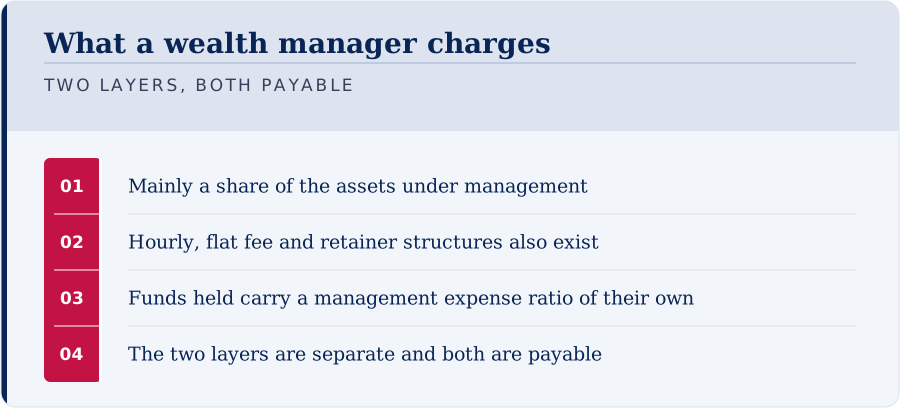
| Fees | What share of the return does the cost take? | What a wealth manager charges |
| Inflation | What will the number buy when you reach it? | Inflation section below |
| Debt | What are the rate, term, purpose and effect on flexibility? | Debt section below |
How do you use them on a real decision?
Before comparing products, answer four questions about the money itself. They take an evening, and they need no one's help:
- What is the money for, and by when? A goal with a date changes which risks matter.
- What would you actually do with it otherwise? Name the real alternative, not a model one.
- How much must stay reachable, and how fast? Write the amount down.
- What happens if your income stops or your assumption fails? Describe the bad year, not the average one.
Then compare each route you are considering on the same lines: what it costs at the start and over time, when you can reach the money, what is guaranteed and what is only projected, who you would owe money to, and what the downside looks like if you have to stop. A route that looks good only when one of those lines is left blank has not yet been compared.
Where should you start if you read nothing else?
Find out what you actually spend, not what you intend to spend. Three months of statements will tell you, and the figure can surprise you in either direction.
Then find the surplus, if there is one. A durable surplus, the money left over in an ordinary year and not only in a good one, is what creates choices. It does not decide which insurance, debt or savings choice is right; it only makes choosing possible.
Then list the large costs you expect in the next five years (a car, a roof, a tax bill, a down payment, a child's schooling) and write next to each one how you would pay for it today: savings, a loan, or something else. That list shows where the next decisions will fall.
Keep some money you can reach quickly for an emergency. A reserve set aside before it is needed is what keeps an ordinary shock from being paid for with expensive credit.
Spending less than you earn, over a long period, is the habit every other idea here assumes. No contract or strategy on this site replaces it. That is also why this practice looks at cash flow first, and why a first conversation can end with the plain answer that nothing should be arranged yet. The personal finance basics page takes these first steps further.
What is opportunity cost?
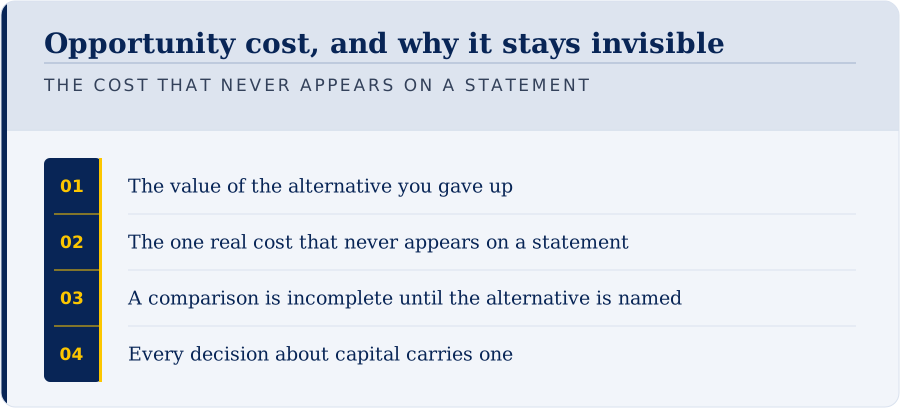
Opportunity cost is the value of what you gave up in order to do the thing you did. Money spent or committed in one place is not available for another, and the other use had a value too. A decision that looks free because nobody charged a fee may still have cost you something real.
Two consequences matter more than the definition.
First, every comparison is incomplete until the alternative is named. A strategy described as better is better than something. When that something is left unstated, ask what it is, because the honest comparison may be less flattering. This site applies that test to its own subject in the comparison question.
Second, the alternative is personal. The right comparison is not what a model portfolio would have done. It is what you would actually have done with the money, which may be quite different, and may be very little at all. The full treatment is on opportunity cost.
How do you compare two options fairly?
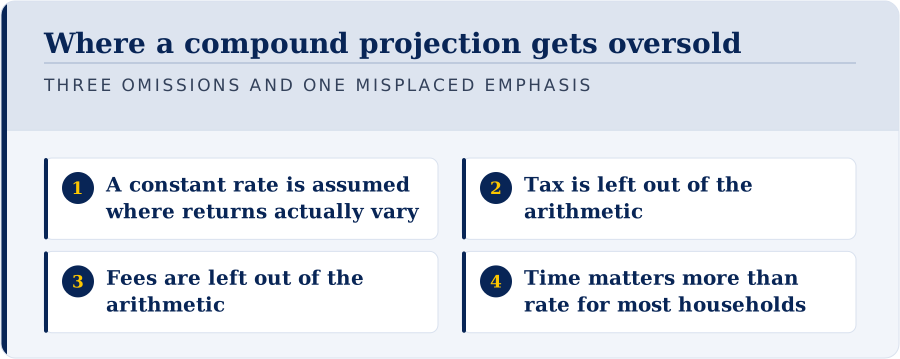
three omissions and one misplaced emphasis
Where a compound projection gets oversold
- 01A constant rate is assumed where returns actually vary
- 02Tax is left out of the arithmetic
- 03Fees are left out of the arithmetic
- 04Time matters more than rate for most households
Check four conditions. A comparison missing any one of them is advocacy, whoever presents it.
- The same time period. Any two things can be made to win by choosing when to start and when to stop.
- The same fee treatment. After fees against after fees, or before against before. Mixing them creates a gap in whichever direction was chosen.
- The same certainty. A guaranteed contractual value and a projected average are different kinds of number, even when the digits look alike.
- Everything each option provides. If one includes a death benefit and the other does not, that belongs in the comparison, not in a footnote.
An honest comparison can end in a mixed result, with each option better at something. When a comparison hands a clean win to whatever the presenter sells, go back over the four conditions before you accept it.
How does compound growth work, and where is it oversold?
Compound growth is growth earned on an amount that already includes earlier growth. The arithmetic is real, and it is why time can matter more than the rate you earn. Starting earlier gives every dollar more years to work.
Presentations of it can overstate it in four ways worth recognising.
A constant rate is assumed. A projection that shows the same return every year describes a smooth path that no real market or dividend scale follows.
A nominal rate is not a real rate. Inflation erodes purchasing power every year. A projection in nominal dollars across decades describes a number, not what that number will buy.
Tax and fees are left out. A return quoted before tax, fees and trading costs is not a return anybody received, and the gap compounds too, in the wrong direction.
Uninterrupted is an assumption, not a fact. Compound projections assume contributions continue and nothing is withdrawn. Real lives include job changes, illness and years when nothing goes in. A projection that never allows for interruption describes a life nobody lives.
None of this makes compounding untrue. It makes a compound projection worth reading slowly, assumptions first, and it makes the guaranteed figures in any arrangement more telling than the projected ones. More on the arithmetic is on compound interest.
What is capital recovery?
Capital recovery asks whether money you commit comes back to you, so it can be used again, or is spent for good. That is a separate question from the rate of return, and a household can get one right and the other wrong.
Money comes back by two routes: the income an asset produces while you hold it, and what you receive when you sell it. A purchase that consumes capital, such as a holiday or the interest on a loan, does not come back by either route, even when its price is identical to that of something that does.
A tax deduction is a different thing, and it is worth keeping apart. A deduction can lower the tax you owe if the expense qualifies for you under the Income Tax Act, but it does not hand back the money you spent. Count it as a tax saving at your own rate, never as a second return of the same dollars.
The clearest case is interest paid. Money paid as interest to a lender is gone from your household, whatever happens next. Over a working life the total can be large, and it is worth adding up. Two people can pay the same amount for the same car and end in different places, depending on whether their capital was consumed or came back to be used again. The full treatment is on capital recovery.
What is liquidity worth?
Liquidity is the ability to turn something into usable money, quickly, without loss. Its value shows most clearly when it is missing. An asset you cannot reach when you need it forces you to solve the problem another way, by selling something else at a poor moment or by borrowing on terms you did not choose.
It has three dimensions, and they are not the same:
- Speed: how long it takes to get the money.
- Certainty: whether you know the amount in advance.
- Cost: what the conversion takes out, in fees, penalties, taxes or a forced sale price.
An asset can be strong on one and weak on another. A stock can be sold in a day at an uncertain price; a term deposit may have a known value but a penalty for early withdrawal; a house has neither speed nor certainty.
Reachable money does not have to sit idle. It can still earn interest, although the rate, the withdrawal conditions and the risk differ from one account to another. And a reserve planned in advance can spare you the borrowing entirely. Compare the cost of keeping money reachable with the cost and availability of borrowing before you tie funds up for years.
Liquidity is also why a plan built only for the highest return can fail. A portfolio that must be sold at a bad moment has been sold at a bad moment, whatever its long-run average.
What does it cost to wait?
Deferring a decision is a decision, and its price depends on what you are deferring.
Where something compounds, delay costs the growth that would have happened. Where something is priced on age or health, as life insurance is, delay costs the price that was available; coverage that is affordable while you are healthy may become more expensive, restricted or unavailable after your health changes.
Registered accounts each follow their own rules on delay, set out by the Canada Revenue Agency. Here is what the CRA pages say, as read on 29 September 2026:
| Account | When room starts to build | What happens to unused room |
|---|---|---|
| TFSA | For a Canadian resident, room starts to accumulate at 18 (CRA) | Unused room carries forward; withdrawals are added back to your room on January 1 of the next year |
| FHSA | Room exists from the year you open your first FHSA (CRA) | Carryforward is limited to the lesser of $8,000 and a calculated amount; lifetime contributions are limited to $40,000 |
| RRSP | Room is based on 18% of the previous year's earned income, up to the annual limit, less your pension adjustment (CRA) | Unused deduction room carries forward |
| RESP grant (CESG) | The grant is 20% of contributions, up to $500 a year for an eligible child (Canada.ca) | Unused grant room carries forward, but the grant in any year is capped at $1,000; at 16 and 17 a child qualifies only if contribution conditions were met before 15; the lifetime grant is $7,200 |
So waiting to open an FHSA can mean room that never builds, while unused TFSA room waits for you. These accounts do different jobs, and nothing here ranks them against each other or against a policy. Take the registered-plan side of a decision to a professional licensed for it, and confirm your own room with the CRA.
None of this is an argument for hurry. A decision measured in decades does not improve by being made this week, and anyone using the cost of waiting to create pressure has turned the point upside down. It is a fact to weigh, not a reason to rush.
Is tax deferred the same as tax free?
the cost that never appears on a statement
Opportunity cost, and why it stays invisible
- The value of the alternative you gave up
- The one real cost that never appears on a statement
- A comparison is incomplete until the alternative is named
- Every decision about capital carries one
No, although the two are sometimes spoken of as one.
Deferred means the tax is paid later, possibly at a different rate, possibly by someone else, such as an estate, and possibly all at once. Deferral has real value, because money that has not yet been taxed keeps working. But the tax is still owed. It sits inside the account as a future bill, not as a cost that vanished.
Free means no tax arises when the rules are met. In Canada that treatment is narrow, and each case has conditions:
- RRSP: contributions are deductible within your limit, and the CRA says you generally pay tax when you make withdrawals (CRA). That is deferral.
- TFSA: contributions are not deductible, and income earned in the account is generally tax-free, even when you withdraw (CRA).
- FHSA: contributions are generally deductible, and a qualifying withdrawal to buy a first home is tax-free (CRA); other withdrawals can be taxed.
- Life insurance: the payment of a death benefit is not a disposition of the policy under the Income Tax Act (s. 148(9), definition of disposition, para. (j)). Growth inside an exempt policy is not taxed each year, but a policy loan or surrender can produce income to the extent the proceeds exceed the adjusted cost basis (s. 148(1)).
The practical point: a comparison between a deferred arrangement and a taxed one is incomplete until the eventual tax is counted. A comparison that skips it flatters the deferred side. What rate will apply to you later is a question for an accountant with your figures in hand. Federal rules apply everywhere in Canada; Quebec residents also file a return with Revenu Québec.
Is risk the same as volatility?
No. Volatility is how much a value moves. Risk is the chance that the money will not do the job it was meant to do.
They are related, and they behave differently. An account whose value never moves can be very risky if it falls behind the cost of what it has to pay for. An asset that moves a great deal may carry little risk against a goal thirty years away, and a great deal against a goal next spring.
The risk that matters is set by the goal, which means you cannot describe it without knowing the goal. A conversation about risk that never asks what the money is for is measuring the wrong thing, however precisely.
How does behaviour shape the result?
Financial outcomes depend on what people actually do, not only on what an arrangement would produce in theory.
A plan that needs monthly discipline for thirty years is a plan with a behavioural assumption built in. A structure where the right action happens automatically can beat one where it must be chosen again every month, even when the second looks better on paper.
This cuts both ways, and both should be said. It is an argument for arrangements that build in a discipline. It is also a warning about arrangements that punish an interruption, because an interruption is a normal part of a life, not a failure of character. Before you commit, ask what happens to the plan in the year you cannot keep it up.
What is the velocity of money, and what does it not promise?
Some writers on the financing approach this site discusses use "velocity" for the number of uses a dollar serves before it leaves a household. A dollar in an account does one job. The same dollar spent, recovered and used again has done several. As a prompt, it is useful: it makes you notice interest paid out and cash that leaves for good.
It is not a return. Moving the same dollar more often does not by itself make a household better off, and a dollar used badly several times is worse than a dollar left alone. Redeploying recovered money can change an outcome, but only a comparison of the actual cash flows, borrowing costs, risks and alternative uses shows whether it helps in your case.
One more point of vocabulary. Economists use "velocity of money" for something else: how often money changes hands across a whole economy. When you meet the phrase, ask which meaning is intended.
Where does money leave a household without a line on a statement?
two different questions about one dollar
Recovery is not the same as return
- 01Return asks what the money earned
- 02Recovery asks whether the money came back
- 03Capital returns through the income an asset produces
- 04Capital returns through the eventual sale
- 05Capital returns through the deductions its cost permits
Some costs show on a statement, like interest. Others have to be estimated, because no one sends you a bill for them. Four are worth naming:
- Interest paid to lenders. It is visible on statements but accepted as the cost of living, and it is easy never to add it up over a lifetime.
- Earnings given up on cash spent. Paying cash avoids interest, and it also removes money that was earning something. The saving is visible; the cost is not.
- The return given up on money held for access. Money kept reachable may earn less than money tied up for longer, although the gap depends on the account and the terms.
- A loan refused or granted too late. An opportunity that needed financing and did not get it in time leaves no record, only a missed chance.
No general ranking of the four holds for every household; your own figures decide which one matters most to you. The point of naming them is that a household that sees all four is deciding, while one that sees only the first is watching one line and leaving three unexamined.
How do fees work against a return?
A fee charged as a percentage of your assets is not a percentage of your return. A fee of one percent a year on a portfolio returning six percent before fees has taken about a sixth of the return, not one percent of it.
It compounds against you. The fee comes off a balance that would otherwise have kept growing, so over time the loss is the fee plus everything it would have earned. And it is charged in bad years too, whether performance was good, flat or negative.
None of that makes fees illegitimate. Advice, administration and management have real costs, and a fee stated openly is better than a cost buried somewhere else. What matters is knowing the number, which is examined on what a wealth manager charges.
The same test applies to insurance. A specially designed, high-cash-value, participating whole life insurance policy publishes no management expense ratio. Its costs are built into the premiums, the guaranteed values and the dividend scale, which makes them hard to set beside a fund's MER. That is a real disadvantage, and it is stated as one across this site.
What does inflation do to a plan, and to a mortgage?
Inflation is the variable left out of many projections, and it quietly decides whether a plan worked.
A level amount buys less every year. Illustrative example, assuming a constant three percent a year: prices double in about twenty-four years (1.03 to the power of 24 is about 2.03), so purchasing power roughly halves. A projection in nominal dollars showing a large number in year forty has not told you what that number will buy.
It affects insurance and income products unevenly. A level annuity payment buys less across a long retirement. A level death benefit buys less by the time it is paid. A contract whose values grow may or may not keep pace, and the guaranteed values in a policy do not adjust for inflation. Ask for a projection in today's dollars, or at least ask what inflation assumption sits behind the one you were shown.
Inflation also erodes debts fixed in dollars, but a Canadian mortgage needs care here. The Financial Consumer Agency of Canada separates the amortization, the time it takes to pay the mortgage off, from the term, which it says may range from a few months to five years or more; at the end of each term you renew (FCAC). So inflation shrinks the real value of the principal you still owe, while the rate is set again at each renewal, and inflation that pushes rates up reaches you then. A Canadian mortgage is not the long fixed-rate loan found in some American examples.
Where an argument rests on how money is created, the mechanism is set out on the money multiplier, including why the textbook version does not describe Canadian lending.
Why is the cost of being wrong not symmetric?
It is tempting to compare decisions by their expected outcome. The more useful comparison is what happens when the assumption fails.
Some errors are recoverable. Holding too much cash for a few years costs some growth and little else. A portfolio that underperforms can be left alone or changed.
Some are much harder to undo. Coverage that is affordable while you are healthy may become more expensive, restricted or unavailable after your health changes. A policy surrendered in its early years is gone, and a new one is priced on your age and health at that later date. A conversion option ends on the date the contract sets.
Weight the decision to match. Where the downside is recoverable, the expected outcome is a fair guide. Where it is not, ask what happens if you are wrong, because cheap protection against an error you cannot undo can be worth more than its expected value suggests.
That is why features such as convertibility, disability coverage and the right to buy more coverage later can matter more than their price implies. They are inexpensive protections against errors that are hard to reverse. Whether you need them is a question about your household, not a rule.
When does the order of returns matter?
An average return over thirty years says nothing about the order in which the years arrived, and the order can change your result.
For one lump sum left alone, it does not. The same yearly returns in a different order give the same ending value, because multiplication does not care about order.
Once money goes in or comes out along the way, the order matters. Illustrative example, simple arithmetic and not a forecast: you invest $100 today and another $100 after one year, over two years.
| Order of returns | After year 1 | Add $100 | After year 2 |
|---|---|---|---|
| Gain of 10%, then loss of 10% | $110 | $210 | $189 |
| Loss of 10%, then gain of 10% | $90 | $190 | $209 |
Same two returns, same money in, a $20 difference, because the second $100 met a different year. With withdrawals the effect is stronger. Poor returns in the first years of drawing income, while withdrawals continue, remove capital that is then not there to recover. That is why a projection built on an average return flatters a retirement plan: it assumes a smooth path no market provides.
This is also the fair argument for a contractual floor, and it should be stated only as far as it is true. The guaranteed cash values in a specially designed, high-cash-value, participating whole life insurance policy are set by the contract and do not fall with the markets. Dividends are not guaranteed, and they are separate from those values. And drawing money from a policy is not free:
- Money taken while the policy stays in force comes as a loan or a partial surrender. In a policy loan, the insurer advances the money and the interest is owed to and paid to the insurer; the insurer sets the rate and can change it. With a collateral loan, a lender such as a bank lends on its own terms against the assigned policy and receives the interest.
- Interest accrues in good years and bad. Loans and interest left unpaid reduce the death benefit the beneficiary receives.
- For tax, a policy loan is a disposition, and the part of it above the adjusted cost basis immediately before the loan is income (Income Tax Act s. 148(1) and s. 148(9)). Assigning the policy as security for a loan from another lender is not a disposition (s. 148(9), para. (f)).
- If the loan balance grows past the value securing it, the contract can end, and income can arise to the extent the proceeds exceed the adjusted cost basis. The contract governs when that happens; ask for the provision in writing.
None of this is a claim that the arrangement outperforms, and any version that slides into one has overstated it. The mechanics are set out in full on policy loans.
Which debt is worth carrying?
name the alternative, or there is none
The comparison that is actually honest
- 01The usual case compares an advance to an outside loan
- 02That holds only if you would have borrowed anyway
- 03If you would not have, compare it against paying cash
- 04Interest on an advance is paid to the insurer
- 05A comparison is incomplete until the alternative is named
Not all debt is equal, and treating it as one category leads to poor decisions in both directions. Four features separate one obligation from another.
The rate. Interest on high-rate consumer credit is a certain cost, while what an asset will earn is not. Paying it down is a return equal to the rate you stop paying, with no market risk.
The term. How long the rate holds matters as much as the amortization. A Canadian mortgage amortized over many years still renews at each term, and its rate can change then. Long repayment is not the same as a long fixed rate.
The purpose. Borrowing for something that produces income is a different proposition from borrowing for something that does not, whatever the rate. Only the first can, in some cases, make the interest deductible, and whether it does depends on the Income Tax Act's use test and on your facts, which an accountant should check.
What it does to flexibility. A household carrying large fixed payments has fewer choices in a hard year, and fewer choices is how an ordinary setback becomes a serious one.
What this site will not tell you is that borrowing is always wrong, or that a particular structure makes it right. You will hear both claims from people selling something, and neither survives contact with a specific household's numbers.
What does each place for a surplus dollar actually do?
The same dollar can go to very different jobs. This table describes each tool by its function, as the CRA and the Income Tax Act describe it. It is not an order of priority, and nothing here ranks one against another; that depends on your goals, your room and your circumstances.
| Job the money does | Tool | How you reach the money | Tax, in outline | What it does not do |
|---|---|---|---|---|
| Stop paying high interest | Paying down consumer debt | The saving is the interest you stop paying | Interest you avoid is not income | It builds no reserve you can draw on |
| Emergency reserve | A savings account or short-term deposit | Quickly, depending on the terms | Interest is taxed each year | It may earn less than money tied up longer |
| Flexible long-term saving | TFSA | Withdrawals at any time, subject to what the account holds | Income and withdrawals generally tax-free; no deduction going in | It gives no deduction |
| Retirement saving with a deduction | RRSP | Withdrawals are generally taxed as income | Deduction going in; tax deferred, not avoided | It does not escape tax on the way out |
| A first home | FHSA | A qualifying withdrawal for a first home | Contributions generally deductible; qualifying withdrawal tax-free | It serves only a qualifying first home |
| A child's education | RESP with the CESG | Payments for post-secondary education | Educational assistance payments are taxed to the student; a refund of contributions is not taxed | It serves only education |
| A death benefit for a set period | Term life insurance | No cash value to reach | Payment of the death benefit is not a disposition of the policy | Nothing is paid if the term ends first |
| A permanent death benefit with a cash value | Participating whole life insurance | Policy loan or surrender; values are low in the early years | Growth in an exempt policy is not taxed yearly; a loan or surrender above the adjusted cost basis is income | Costs are not shown as an MER; dividends are not guaranteed |
A specially designed, high-cash-value, participating whole life insurance policy is life insurance first. It is not a savings account, a deposit or an investment, and it belongs in the table only for a household that wants permanent coverage for its own sake. The registered-plan rows are described, not recommended; take those questions to a professional licensed for them.
Where does insurance fit among these principles?
The principles come first because they let you judge what you are shown afterwards, including by this practice. Each one applies to a life insurance contract exactly as it applies to anything else: its opportunity cost, the certainty of its values, its fees, its liquidity in the early years, and the cost of being wrong about it. A contract that fails these tests for your household should not be bought.
A few facts keep that judgement honest. The policy is an insurance contract under which the insurer pays a death benefit when the person insured dies, in exchange for premiums. The owner can ask the insurer for an advance against the cash value; that advance is a loan from the insurer, with interest owed to the insurer. Guaranteed values are set by the contract, dividends are not guaranteed, and an illustration is a projection, not a promise.
How a policy works is set out in policy basics. The financing approach built on it is covered in the strategy section. The case against it, including the arguments that are correct, is in objections and risks. Technical words are defined in the glossary.
How do the principles apply to an ordinary purchase?
The principles above are general. These four pages apply the same principles to purchases a household actually makes, treating each route the same way and naming each route's costs.
A vehicle, paid for with cash, with a lender's loan or lease, with a policy advance from the insurer, or with a collateral loan from another lender: paying for a vehicle.
A renovation, which can be financed on the family home itself, and is therefore also a decision about which asset carries the risk: paying for a renovation.
A tax bill that arrives on a known date, and how a household funds it, which is a different question from how much is owed: a tax bill in April.
A down payment, which is two questions rather than one: where the money waits, and how it is used when the day comes: the down payment.
Which page answers which question?
Every page in this section can be read usefully by someone who will never buy anything. Here is where each question is answered:
- Why personal finance matters, and the habits under everything else: why personal finance is important.
- What a choice costs in the alternative it excludes: opportunity cost.
- How compounding works and where projections overreach: compound interest.
- Whether money you commit comes back: capital recovery.
- What advice and management cost in Canada: what a wealth manager charges.
- How lending creates money, and why the textbook version misleads: the money multiplier.
- Four purchases, each run through every route: the vehicle, renovation, tax bill and down payment pages above.
Anything specific to how an insurance contract works belongs in policy basics. Anything that holds only for someone following a particular strategy belongs in the strategy section. Any comparison against a non-insurance alternative, and any question asked adversarially, belongs in objections and risks.
Who answers which question?
No single professional answers every part of a financial decision. Ask each one the questions that belong to them:
- A licensed insurance advisor or the insurer: what coverage need a policy would solve, which values are guaranteed and which are illustrated, how the loan rate is set, and what happens if premiums stop.
- A lender: its own approval, security, rate and repayment terms for any loan, including a collateral loan against a policy.
- An accountant: your registered-account room, the adjusted cost basis of a policy, the tax on a loan or surrender, and whether any interest is deductible.
- A lawyer (in Quebec, a lawyer or a notary): ownership, beneficiary designations and estate questions under your province's law.
Ask anyone who advises you how they are paid. A good answer is plain and comes without hesitation, and it tells you how to weigh what you hear next.
A thirty-minute discovery meeting
A first conversation establishes whether this fits. No illustration is prepared and nothing is arranged.
Often the answer is no, and you will hear it during the call rather than in a proposal afterwards.
This form reaches Canadian Wealth Creation Centre Inc. Any meeting, any advice and any insurance product is provided by Canadian Wealth Creation Centre Inc., through its representatives who are licensed in the client's province. IBC Financial is the company's educational website: it distributes no product and no financial service, and it gives no individualised advice.
How Money Really Works, Before Any Product Is Involved
Opportunity cost, compound interest, capital recovery, the true cost of a vehicle or a renovation: the ideas that make every financial decision clearer.
| A Tax Bill in April UPDATEDA personal tax balance arrives on a known date. How the instalment system, a line of credit, a payment arrangement and a policy advance each fund it. | Read more |
| Capital Recovery UPDATEDWhat capital recovery means, the capital recovery factor, and how depreciation and the Canadian capital cost allowance relate to it, with worked examples. | Read more |
| Compound Interest UPDATEDHow compound interest works, the formula and what each term means, why frequency matters, the rule of 72, and the three ways the arithmetic is overstated. | Read more |
| How Affluent Families Pay for the Wedding Their Daughter Dreams Of NEWHow to pay for a wedding in Canada: what cash really costs, the ways families pay, and how a policy loan works, with a worked $200,000 example and its risks. | Read more |
| Opportunity Cost UPDATEDWhat opportunity cost means, how it is calculated, explicit and implicit costs, how it differs from sunk cost, and why the alternative must be named. | Read more |
| Paying for Travel, Vacations and Children's Sports: Cash, Card Points and Your Policy NEWYou pay cash for travel and collect card points. Where should that cash wait? A worked example at 6.5% compares savings, a card balance and a policy loan. | Read more |
| Paying for a Renovation UPDATEDHow a Canadian household pays for a renovation: cash, a secured line against the home, unsecured credit, a policy advance, or a collateral loan on a policy. | Read more |
| Paying for a Vehicle UPDATEDThe four ways a Canadian household pays for a vehicle, compared on where the money comes from, what security is taken, who sets the rate and what each costs. | Read more |
| The Down Payment UPDATEDA down payment holds two questions: where capital waits while it is accumulated, and where it comes from on the day. Both, without a product attached. | Read more |
| The Money Multiplier UPDATEDWhat the money multiplier is, how it is calculated, what the reserve ratio does, and why the textbook version does not describe Canadian banking. | Read more |
| What Are the Fees for a Wealth Manager? UPDATEDHow wealth management is charged in Canada: percentage of assets, hourly, flat and retainer structures, management expense ratios, and embedded costs. | Read more |
| Why Is Personal Finance Important? UPDATEDWhat personal finance covers, where the field came from, the five areas it spans, how to set your own priorities, and what changes once you understand it. | Read more |
Common questions
What are money principles?
What is opportunity cost, in one sentence?
Is compound growth really as powerful as people say?
What does capital recovery mean?
Is a tax deduction the same as getting my money back?
Why does liquidity matter if the money is growing?
What is the velocity of money in personal finance?
Is tax deferred the same as tax free in Canada?
Is risk the same thing as volatility?
Does the order of returns matter while I am still saving?
Why is a one percent fee worse than it sounds?
Do I lose anything by waiting to open a registered account?
Does inflation help Canadian mortgage borrowers?
Is all debt bad?
How do I compare two options fairly?
Where does money leave a household without showing up on a statement?
Does having a surplus mean whole life insurance suits me?
Who lends the money in a policy loan, and who receives the interest?
Sources
- Canada Revenue Agency, Participating in your FHSAs (room in the year the first FHSA is opened, carryforward the lesser of $8,000 and a calculated amount, $40,000 lifetime limit). Page modified 2026-09-17, verified 2026-09-29
- Canada Revenue Agency, First home savings account (FHSA) overview (contributions generally deductible, qualifying withdrawals tax-free). Page modified 2026-02-02, verified 2026-09-29
- Canada Revenue Agency, Before you contribute to a TFSA (room starts to accumulate at 18 for a resident, withdrawals added back the next January 1). Page modified 2026-02-20, verified 2026-09-29
- Canada Revenue Agency, What is a TFSA (contributions not deductible, income and withdrawals generally tax-free). Page modified 2026-09-17, verified 2026-09-29
- Canada Revenue Agency, How contributions affect your RRSP deduction limit (18% of previous-year earned income up to the annual limit, less pension adjustment, unused room carried forward). Page modified 2026-01-29, verified 2026-09-29
- Canada Revenue Agency, Making withdrawals from an RRSP (withdrawals generally taxable, withholding applies). Page modified 2026-01-29, verified 2026-09-29
- Canada Revenue Agency, Canada Education Savings Grant (20% of contributions, $500 a year or $1,000 with unused room, conditions at 16 and 17, $7,200 lifetime). Page modified 2026-02-27, verified 2026-09-29
- Canada Revenue Agency, Payments from an RESP (educational assistance payments taxed to the student, refund of contributions not taxable). Page modified 2026-09-16, verified 2026-09-29
- Financial Consumer Agency of Canada, Mortgage terms and amortization (terms from a few months to 5 years or more, renewal at the end of each term). Page modified 2025-10-15, verified 2026-09-29
- Income Tax Act, R.S.C. 1985, c. 1 (5th Supp.), subsections 148(1) and 148(9) (policy loan. Disposition, paragraphs (b), (f) and (j)), Justice Laws Canada, as recorded on this site's objections and risks hub, verified 2026-09-29
About the author

Jose Salloum is a Financial Security Advisor (conseiller en sécurité financière) certified by the Autorité des marchés financiers in Quebec, a Life and Accident & Sickness Insurance Agent licensed by the Financial Services Regulatory Authority of Ontario, and a Life Insurance Agent licensed by the Insurance Council of British Columbia. Licensed since 2001.
He has practised Infinite Banking since 2015 and founded Canadian Wealth Creation Centre Inc. in 2016. From 2020 to 2024 he was an IBC (Infinite Banking Concepts™) Authorized Practitioner of the Nelson Nash Institute, a private certification rather than a regulatory licence.
IBC Financial is the educational website of Canadian Wealth Creation Centre Inc., open to all Canadians. Services come only from Canadian Wealth Creation Centre Inc. Its representatives hold a licence in each province served: Quebec, Ontario, Alberta, British Columbia, Manitoba and New Brunswick. Jose Salloum's own licences cover Quebec, Ontario and British Columbia. This page is general education and not advice on any individual file.
Last reviewed 2026-09-29. By Jose Salloum, Financial Security Advisor in Quebec. In Ontario, Life and Accident & Sickness Insurance Agent. In British Columbia, Life Insurance Agent.