

How a Participating Policy Works, Year by Year
Your premium pays for the insurance, the insurer's costs and premium tax, and a reserve that becomes the guaranteed cash value printed in your policy. The insurer may also declare a dividend, which is not guaranteed; used to buy paid-up additions, it adds coverage and cash value of its own. You reach the value through a policy loan from the insurer, a withdrawal where the contract allows one, or a surrender, and a loan or surrender above your adjusted cost basis is income in that year.
A specially designed, high-cash-value, participating whole life insurance policy works in four steps, and the rest of this section explains each one in detail.
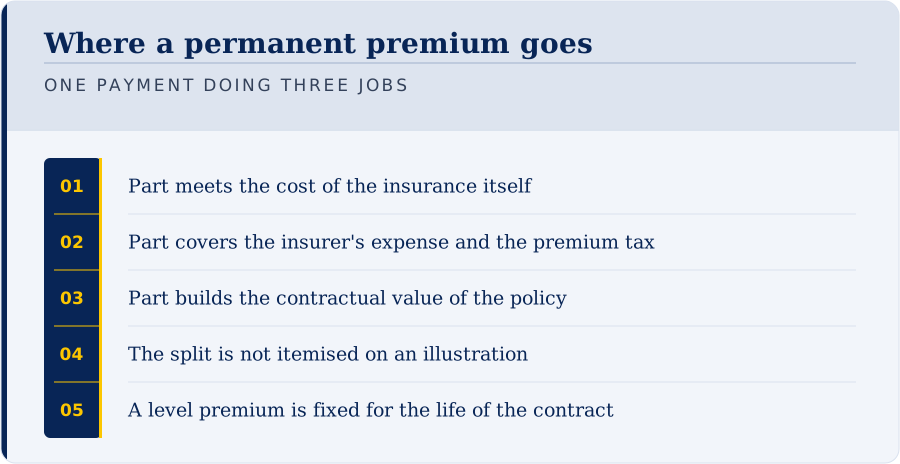
- Your premium pays for three things at once: the insurance, the insurer's costs and premium tax, and a reserve that becomes the guaranteed cash value printed in your policy's schedule.
- The insurer may declare a dividend each year from its participating account. It is not guaranteed.
- A dividend can buy paid-up additions: small blocks of fully paid coverage with their own death benefit and their own cash value, which can earn dividends of their own.
- You reach the value in one of three ways: a policy loan from the insurer, a withdrawal where the contract allows one, or a surrender. Each has its own tax result, and a loan or surrender above your adjusted cost basis is income in that year.
Two questions deserve an answer before any of the mechanics: who should not buy this, and what happens if you stop paying. Both are answered below, because a household should know the exits before it studies the engine.
The section at a glance: where each question is answered
This page gives the short version of every mechanism in a participating contract. Each row below points to the guide that covers it in full.
| Your question | The short answer | The full guide |
|---|---|---|
| Where does my premium go? | Insurance, the insurer's costs, premium tax, and the reserve behind the cash value | Insurance premium |
| How do dividends buy more coverage? | They purchase fully paid additions with their own values | Paid-up additions |
| What is my policy worth if I leave? | The cash surrender value, minus any loan | Cash surrender value |
| How is a dividend set, and what are the options? | The insurer declares it; it is not guaranteed | Dividend-paying life insurance |
| How does a policy loan work? | The insurer advances money against the cash value and charges interest | How a policy loan actually works |
| When is a loan taxable? | When it exceeds your adjusted cost basis, in the year you receive it | When a policy loan becomes taxable |
| What keeps growth untaxed? | The exempt test in Regulation 306 | The exempt test |
| Is any of it taxable in Canada? | Some transactions are; the death benefit usually is not | Is life insurance taxable in Canada? |
| What if I stop paying? | Seven options, each with a cost | Use it or lose it |
| How is my application decided? | Underwriting: four possible outcomes | Life insurance underwriting |
| How are Quebec contracts different? | The Civil Code governs them | The Civil Code and the life insurance contract |
| How is a death claim paid? | By the insurer, to the beneficiary, on proof of death | How a death claim is paid in Canada |
Who should not buy this, and the fair case against it
A surplus of cash each month is not, by itself, a reason to own permanent life insurance. Money left over tells you that you can pay a premium. It does not tell you that you need what the premium buys. In this practice's view, a participating contract makes sense only when most of these answers are yes:
- Is there a lasting need for insurance? Someone depends on you, an estate will need cash, or a business needs a plan for your death.
- Are you insurable? The insurer decides that, not you, and it decides on your health today.
- Do you have enough cash on hand for the next few years without touching the policy?
- Is any costly debt already under control? Interest on a high-rate card balance keeps running while the early cash value is still below what you have paid.
- Is your horizon long enough to pass the early years, when the cash surrender value sits below what you have paid?
- Would the premium survive a bad year: a job loss, an illness, a slow season in a business?
Registered plans such as a TFSA or an RRSP are savings plans, not insurance. This practice is licensed for insurance only, so it does not rank those plans against a policy; how they fit your situation is a question for a professional licensed to advise on them.
The fair case against, stated plainly. The early cash surrender value is below the premiums paid, so leaving early costs money. The commitment runs for decades. Growth above the guaranteed values depends on dividends, which are not guaranteed. Interest on a policy loan is paid to the insurer. A loan above your adjusted cost basis creates taxable income. The person who sells you the contract is paid by commission from the insurer. And a buyer with no lasting need for insurance pays for coverage they do not need. The costs are examined in full on the real costs.
The two jobs a contract does at once
It pays a death benefit. This is the primary purpose and the reason the product is insurance rather than anything else. It is why the cost of insurance exists and why the contract must be underwritten.
It builds a value. A guaranteed cash value, set out in a schedule inside the policy document at issue, which grows over the life of the contract.
Many misunderstandings in this field start when one of those jobs is treated as the real purpose and the other as a bonus. Both are contractual, both cost something, and a contract designed to emphasise one will do the other less well. Participating whole life is life insurance first; the cash value is part of how the insurer funds a promise that lasts for life.
Where the premium goes
what a rider actually buys
The paid-up additions rider
- 01A small block of fully paid whole life coverage
- 02Bought with a declared dividend or an extra deposit
- 03It needs no further premium once it is purchased
- 04It adds to both cash value and death benefit
- 05The rider carries a maximum set by the exempt test
A premium is not a deposit. It is the price of a contract, and it pays for several things at once. A whole life premium is quoted as one amount and the insurer does not itemise it, but economically it covers:
- The cost of the insurance. On a permanent contract the premium is levelled over the years rather than rising each year as renewable term does, so the early premiums carry more than the early risk requires and fund the reserve.
- Acquisition and distribution costs, including the advisor's commission. These fall largely in the first years.
- Policy and administration charges, at the contract level.
- Provincial premium tax, a real cost that varies by province and is rarely mentioned.
- The reserve that becomes your cash value.
Early cash value is low largely because those acquisition costs are paid at the start. Early cash surrender value can be below cumulative premiums, so check the guaranteed values at years 1, 3, 5 and 10 in the proposed illustration. That is not a defect and it is not hidden; it is the cost structure, examined in full on the real costs.
On holding more than one contract, and what limits total coverage, see how many policies you can have.
The guaranteed cash value
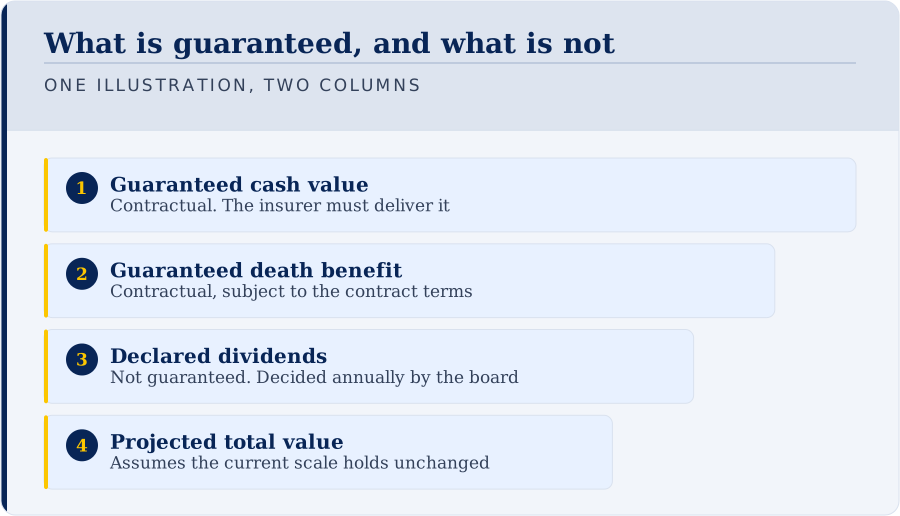
For a policy with guaranteed cash values, the schedule inside the issued policy states a cash value for each year of the contract. Those figures are contractual. They do not depend on the insurer's investment results, on a dividend being declared, or on any assumption made at the point of sale.
That schedule is the floor under the contract's own terms, and it is the number worth anchoring to. Two conditions sit under it: premiums are paid as contracted, and nothing is withdrawn and no loan is outstanding. The guaranteed figure is also not necessarily what you would receive on surrender, or the amount the insurer would advance, because charges and any outstanding loan come off first. When an illustration is shown, ask for the guaranteed column and read that one first. A presentation that shows only the illustrated column has left out the information you need most.
Guarantee or assumption? This table sorts the figures you will see.
| Item | What is contractually guaranteed | What can change | Where to check it |
|---|---|---|---|
| Base death benefit | The amount in the schedule, under the policy's conditions and while premiums are paid | Outstanding loans and unpaid interest reduce what is paid | The issued policy and your annual statement |
| Guaranteed cash values | The year-by-year schedule, under the issued terms and the required payments | Withdrawals, loans and missed premiums change the result | The schedule page of the issued policy |
| Future dividends | Nothing: they are declared, not promised | The insurer's decision each year, based on the participating account | The insurer's dividend notice and scale history |
| Illustrated values | Nothing beyond the guaranteed part inside them | Every change in the dividend scale | The dated illustration, at the current and a lower scale |
| Policy loan rate | Only what the policy provisions say about how it is set | The insurer sets the rate and may change it | The loan provisions and the insurer's notice |
| Paid-up additions already bought | Their own death benefit and cash value, on the terms your contract gives them | Future additions depend on future dividends | The contract and the annual statement |
Dividends: who declares them, and what the scale rate is not
Where a contract is participating, it may receive a dividend each year.
Who decides. The insurer, under its own process for its participating account. Not an advisor, not a formula in the contract, and not the owner. Federally regulated insurers manage their participating accounts under a guideline from the Office of the Superintendent of Financial Institutions on participating account management and disclosure to policyholders.
What it is based on. The results of the participating account: investment returns, claims experience, and the expenses of that block of business.
What it is not. It is not interest. It is not a share dividend. It is not guaranteed, and past declarations do not set future ones. A dividend scale can be lowered as well as raised. Ask the insurer for the dividend scale history of the product you are shown.
The dividend scale interest rate is not your return. Participating insurers commonly publish a dividend scale interest rate, and it is easy to read it as the policy's yield. It is one input the insurer uses to set dividends, alongside mortality and expenses, and your premium buys insurance as well as value. To see what the contract itself does, ask for the illustrated internal rate of return on the cash surrender value at years 10, 20 and 30.
What can be done with it, and the tax question for each. The options your contract allows, and any limits on additional deposits and their charges, vary by contract; ask which options yours permits and compare guaranteed and illustrated values for each.
| Dividend option | Effect on cash value and death benefit | The tax question |
|---|---|---|
| Buy paid-up additions | Adds coverage and cash value of its own, which can earn future dividends | Ask the insurer and your accountant how this option is reported for your contract |
| Take it in cash | Nothing added to the contract | Treated as proceeds of a disposition: it lowers your adjusted cost basis, and any part above the basis is income |
| Reduce the premium | The dividend pays part of the premium; values grow more slowly | The part applied at once to pay a premium is left out of the proceeds |
| Repay a policy loan | The loan balance falls, so the net death benefit rises | The part applied at once to repay a policy loan is left out of the proceeds |
| Leave it on deposit | Held by the insurer and credited with interest the insurer sets | Ask how the deposit and its interest are reported each year |
Which is appropriate depends on what the contract is for. The detail is on the dividend options and what each one does.
Paid-up additions
An addition purchased with a dividend is paid up: no further premium is due on it, and it carries its own death benefit and its own cash value. Ask whether your contract guarantees the values of additions once they are bought; that is where a paid dividend becomes lasting value.
This is the mechanism behind most of the growth people find surprising in a mature contract. Each year's additions can share in the following year's dividend, so the base on which the next declaration is calculated is larger than the last.
It is also the part most often adjusted at design time. In this practice's view, a contract weighted toward additional deposits usually builds accessible value faster and starts with a smaller death benefit for the same outlay, and a contract weighted toward base coverage does the reverse; the insurer's illustration of each design is what shows it for your case. Both are legitimate. Neither performs well at the other's job, and the decision is made at issue.
Reading an illustration year by year
each one taxed differently
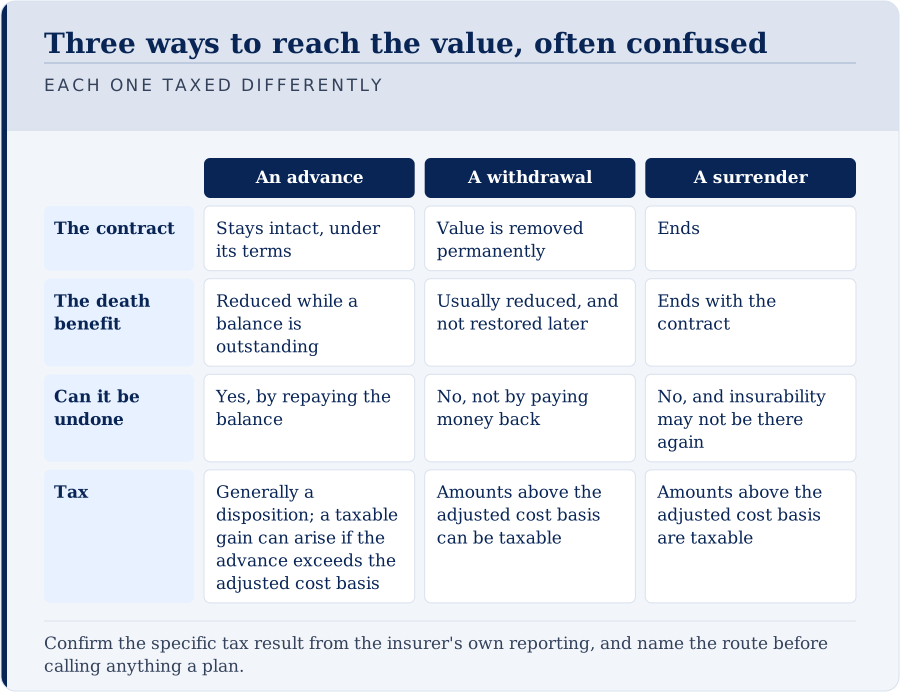
Three ways to reach the value, often confused
- 01An advance, A withdrawal, A surrender
- 02The contractStays intact, under its terms; Value is removed permanently; Ends.
- 03The death benefitReduced while a balance is outstanding; Usually reduced, and not restored later; Ends with the contract.
- 04Can it be undoneYes, by repaying the balance; No, not by paying money back; No, and insurability may not be there again.
- 05TaxGenerally a disposition; a taxable gain can arise if the advance exceeds the adjusted cost basis; Amounts above the adjusted cost basis can be taxable; Amounts above the adjusted cost basis are taxable.
An illustration is a table of years, and each stage of the contract asks you to read different columns. The common questions at the end of this page walk through the early, middle and later years. This is the practice's reading guide, not a forecast; every figure comes from the insurer's dated illustration for your case.
What to ask the insurer for, year by year
Ask for these values in writing, from one dated illustration. Every blank cell is filled from the insurer's dated illustration, never from this page. Note at the top: the product and its version, your province, the age and underwriting class of the person insured, the base premium and any additional deposits, and the dividend option with the date of the scale used. Ask as well for a stop-premium scenario and an unpaid-loan scenario.
| Policy year | Cumulative premium | Guaranteed cash surrender value | Illustrated value, current scale | Illustrated value, lower scale | Death benefit, guaranteed and illustrated | Adjusted cost basis | Loan available |
|---|---|---|---|---|---|---|---|
| 1 | |||||||
| 3 | |||||||
| 5 | |||||||
| 10 | |||||||
| 15 | |||||||
| 20 | |||||||
| 25 | |||||||
| 30 |
Why the mechanics matter more than the projection
Every section on this page describes how something works and not what it will be worth.
That ordering is deliberate. A household that understands the mechanics can evaluate any projection it is shown. One that has only seen a projection has nothing to check it against.
And the mechanics are knowable now. How a dividend is determined, what a policy loan costs, what the exempt test constrains, when a designation matters. None depends on an assumption about the next thirty years.
The projection depends on all of them and on a dividend scale nobody can promise. Read in that order, a projection is informative. Read first, it is persuasion.
Accessing value: the routes, and who owes whom
The routes are not interchangeable. Each one decides who pays, who owes whom, who receives the interest and what tax question follows.
| Route | Who pays or advances the money | Who owes whom, and who receives the interest | Effect on death benefit and cash value | The tax question | Can it be reversed? |
|---|---|---|---|---|---|
| Policy loan | The insurer, from its own funds, secured by the cash value | The owner owes the insurer; interest is paid to the insurer, at a rate the insurer sets and may change | Cash value stays in the contract; the balance and unpaid interest are deducted from the death benefit and the surrender value | A disposition: the part above your adjusted cost basis is income in the year received; the rest lowers the basis | The balance can be repaid; where a loan was taxed, part of a repayment may be deductible under paragraph 60(s); ask your accountant |
| Automatic premium loan | The insurer pays a missed premium as a loan, if the contract has the provision and it was elected | The owner owes the insurer; interest is paid to the insurer | Coverage continues; the loan grows against the values | Treated like a policy loan; ask the insurer how it is reported | The balance can be repaid |
| Withdrawal (partial surrender), where the contract allows | The insurer pays out part of the value | Nothing is owed; the value leaves the contract for good | Cash value falls; the death benefit is usually reduced | Only a proportional share of the basis is set against the amount taken, so part can be taxable | No |
| Full surrender | The insurer pays the cash surrender value minus any loan | Any loan is settled from the value; nothing is owed afterwards | Coverage ends | The amount above the basis is income that year; the gain can exceed the cash received when a loan is netted | No |
| Loan from a bank or another lender, secured by an assignment of the policy | The outside lender | The owner owes that lender; interest goes to the lender, on its terms, and it may be able to call the loan | The policy stays in force; the lender has a claim on it up to what is owed | The assignment that secures the loan is not a disposition; other consequences depend on your facts | On the lender's terms |
An advance under a policy is a disposition under ITA s.148(9). That is why the tax column above matters for every route that pays you out of the contract, and why a loan from another lender is treated differently.
A policy loan from the insurer, secured against the contract. The value stays in the contract, interest accrues, and the outstanding balance reduces the death benefit until repaid. It has its own page: how a policy loan actually works. How it compares with other credit is set out on a policy advance and other credit.
If you then lend the money to a relative, that is a second, separate debt. The relative owes you, and you still owe the insurer. Each debt needs its own terms, and the two are set out side by side on private family capital.
The adjusted cost basis
one payment doing three jobs
Where a permanent premium goes
- Part meets the cost of the insurance itself
- Part covers the insurer's expense and the premium tax
- Part builds the contractual value of the policy
- The split is not itemised on an illustration
- Base premiums follow the contract's own terms
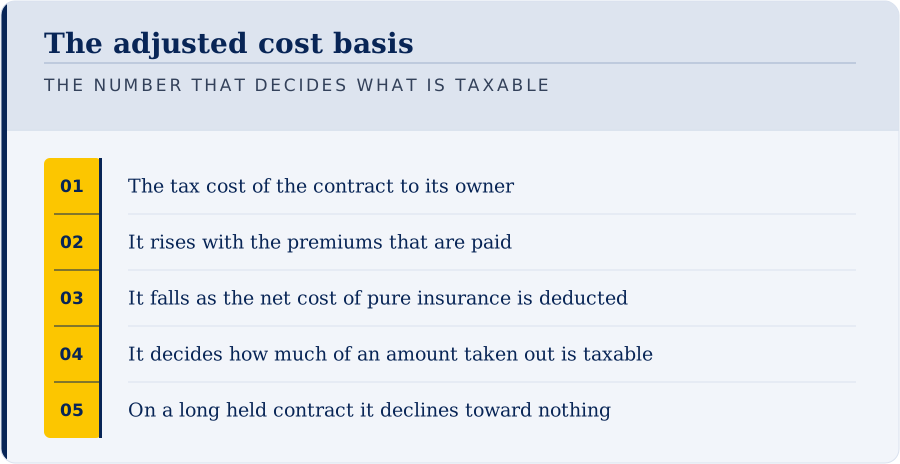
Every contract has an adjusted cost basis, often shortened to ACB: in plain words, the owner's tax cost in the contract. It matters because amounts you receive above it can be taxable. Two contracts with identical cash values can produce different tax results on the same transaction, and the difference is here.
How it is built, broadly. The premiums you have paid, minus the net cost of pure insurance the insurer calculates each year, minus amounts you have already received such as policy loans and cash dividends, plus loan repayments. The full definition is in section 148 of the Income Tax Act, and the plain version is on adjusted cost basis in the glossary.
Why it rises and then falls. Early on, premiums usually exceed the net cost of pure insurance, so the basis rises. Later that cost can exceed the premiums, and the basis falls, often toward zero on a long-held contract. A strategy that produced no taxable amount in the early years may not behave the same way decades later, so review the contract periodically rather than setting it and forgetting it.
The insurer can state the current figure. Ask for it.
The exempt test
Canadian tax rules limit how much value may build inside a policy relative to its death benefit. A contract staying within that limit is exempt, and growth inside it is not taxed each year the way interest in a non-registered savings account is.
The test is set out in Regulation 306, Income Tax Regulations, which you can read on Justice Laws. A contract may carry a provision that lets the insurer act to keep the policy exempt, but what the insurer does, and when, depends on the contract. Ask for the exempt-status provision in yours. If a policy stops being exempt, its tax treatment changes, and growth inside it can become taxable; what happens then is on the exempt test and what happens when a contract fails it.
Tax on accessing value
A policy loan is a disposition under section 148 of the Income Tax Act. In the year you take the loan, the part above your adjusted cost basis is included in your income. The part up to the basis is not income, but it lowers the basis, so later loans or a surrender are more likely to produce a taxable amount. The insurer advances the money and receives the interest. If you later repay a loan that was taxed, part of the repayment may be deductible under paragraph 60(s), up to the amounts previously included in income.
Where a lapse does the damage. If a policy lapses or is surrendered while a loan is outstanding, any policy gain is included in income in that year. The gain can be larger than the cash you receive, because the insurer nets the loan against the cash surrender value before paying you. It tends to arrive when there is no cash to pay it, because running short of cash is usually what caused the lapse. A lapse that is reinstated within the period the Income Tax Act allows is not treated as a disposition, so ask the insurer for that deadline the moment a lapse notice arrives.
Before you act, get two figures. No general page can give you a tax result for your own contract. Before a loan, a withdrawal or a surrender, ask the insurer for your current adjusted cost basis and an estimate for the transaction, and ask your accountant whether any amount enters your income under section 148. Someone who does not know a loan is a disposition will not know to ask. The fuller treatment is on when a policy loan becomes taxable.
If you stop paying premiums
Stopping is not the same as losing everything, but every exit has a price, and the price is highest in the early years. The contract sets out what happens.
| Option | Coverage | Cash value | The tax question |
|---|---|---|---|
| Grace period | Continues while you pay late, within the period the contract and provincial law set | Unchanged | None, if the premium is paid in time |
| Automatic premium loan, if elected | Continues | A loan grows against it, with interest paid to the insurer | It is a policy loan: the part above your basis can be income |
| Dividends applied to the premium | Continues while dividends are large enough; a lower scale can end that | Grows more slowly, since dividends no longer buy additions | The part applied at once to a premium is left out of the proceeds |
| Reduced paid-up insurance | A smaller permanent contract, with no more premiums | Stays, on the smaller contract | Ask the insurer whether the change creates a taxable amount |
| Extended term insurance | The full amount of coverage for a limited period, then it ends | Used to buy the term coverage | Ask the insurer whether the change creates a taxable amount |
| Surrender | Ends | Paid out, minus any loan | The amount above your basis is income that year |
| Reinstatement after a lapse | Restored, if the insurer agrees on the conditions the contract sets | Restored with the contract | A lapse reinstated within the period the Act allows is not a disposition |
Reinstatement is not automatic: the contract sets its conditions, which can include evidence of insurability and payment of the missed premiums with interest. The one outcome with no option attached is doing nothing: if a premium goes unpaid past the grace period and no provision applies, the contract lapses. Ask the insurer for written stop-payment values before you miss a payment. Each option is explained on use it or lose it.
Before the contract exists
the number that decides what is taxable
The adjusted cost basis
- 01The tax cost of the contract to its owner
- 02It rises with the premiums that are paid
- 03It falls as the net cost of pure insurance is deducted
- 04It decides how much of an amount taken out is taxable
- 05On a long held contract it declines toward nothing
Everything above assumes a contract has been issued. Getting one issued is its own process. It takes weeks rather than days, and it is where many of the surprises in this field happen.
What happens between the application and the policy is set out step by step on life insurance underwriting: the paramedical, the attending physician's statement, financial underwriting, and the four possible outcomes.
Income and net worth decide how large a contract can be. The insurer will not issue an amount that no economic loss supports, and it sets its own limits on top of the legal test of insurable interest. See financial underwriting and insurable interest.
A file can come back rated, postponed or declined, and each of those three means something different. What each one is, and what can be done about it, is on rated, postponed or declined.
Smoker status is a contract definition and not an ordinary word, it is verified in the laboratory, and it changes the cost of the contract for as long as it is held. See smoker status and the premium.
An answer given on the application can be tested years later. What a mistake costs, what the passage of time cures and what it does not, is on misrepresentation on an application.
Beneficiary designation
Who receives the death benefit, and on what terms.
Revocable designations can be changed by the owner. Irrevocable designations give the person named rights that can limit what the owner may do with the contract. That can include a policy loan or a change of beneficiary, so ask the insurer what consent it requires before you act.
Quebec only. In Quebec, a married or civil union spouse named as beneficiary in a document other than a will is irrevocable unless the designation states that it is revocable. If you want to keep control, tick "revocable" at application. This rule applies to married and civil union spouses under the Civil Code; it does not extend to de facto spouses or to the other provinces. The Quebec rules are set out on the Civil Code and the life insurance contract, and how a contingent beneficiary works is on contingent beneficiary.
A designation made years earlier, for sound reasons, in different family circumstances, is a frequent, avoidable error. It costs nothing to check, and it belongs on the checklist at every annual review.
Owning the contract: the annual statement and servicing
A contract of this kind runs for decades and outlives most advisory relationships. Owning it well takes one checklist, read once a year. It also takes three checks every few years. Both are set out in the common questions at the end of this page. So is what to do when the advisor who arranged the contract has moved on.
The provision that can keep a contract in force if the person it covers becomes disabled is set out on waiver of premium. The insurer waives the premiums the rider names only after two things: a disability that meets the contract's definition, and a claim it accepts under the rider. It does not waive them because income stops for another reason.
How a dividend is determined and what the options do is on dividend-paying life insurance.
Terms used across this site are defined in the glossary, which covers the adjusted cost basis, the exempt test, the dividend scale and the Capital Dividend Account.
What none of these mechanics decide
The question of whether any of it suits you.
The mechanics are the same for every household in Canada. What differs is the purpose, the cash flow and the horizon, and those decide the answer. The screening questions near the top of this page are a start; the decision itself belongs in a conversation about your own figures, with the insurer's illustration for your case on the table.
How this section is organised
The guides listed below are the reference layer for the whole site. Where another page mentions a mechanism in passing, it links here for the explanation, and one guide owns each concept rather than several explaining it slightly differently.
A note on order. Read the mechanics before any illustration you are shown. That order is the single most useful habit this section can give you.
What you will find here. Anything true of the contract whether or not a strategy is being run with it. If a sentence survives removing every reference to the strategy, it belongs here.
What sits in the strategy section. Anything that only holds for someone running the strategy built on top of a contract: funding design for that purpose, repayment discipline, sequencing.
What sits in objections. Anything asked as a challenge. "How does a policy loan affect the death benefit" is answered here. "Do policy loans really reduce my death benefit" is answered where challenges are answered, because a concession is a different page from an explanation.
Personal tax treatment here; corporate tax treatment with business owners. The taxpayer decides which section owns the question.
A thirty-minute discovery meeting
A first conversation establishes whether this fits. No illustration is prepared and nothing is arranged.
Often the answer is no, and you will hear it during the call rather than in a proposal afterwards.
This form reaches Canadian Wealth Creation Centre Inc. Any meeting, any advice and any insurance product is provided by Canadian Wealth Creation Centre Inc., through its representatives who are licensed in the client's province. IBC Financial is the company's educational website: it distributes no product and no financial service, and it gives no individualised advice.
How Your Policy Really Works, From Application to Claim
Everything a contract does, explained one question at a time: what underwriting asks, what the premium buys, how the cash value grows, how an advance is taxed, and who is paid at the end.
Applying and underwriting 9 guides
| Family History on an Application UPDATEDHow a Canadian application treats a parent's or sibling's illness, which relatives and which ages matter, and what family history does not decide alone. | Read more |
| Financial Underwriting and Insurable Interest UPDATEDWhy a Canadian insurer asks about income, net worth and purpose before issuing a contract, how those answers set the ceiling, and what the exempt test adds. | Read more |
| Life Insurance Underwriting UPDATEDWhat happens between a signed Canadian life insurance application and an issued policy: disclosure, medical evidence, financial review and the four outcomes. | Read more |
| Misrepresentation on an Application UPDATEDWhat an incorrect or incomplete answer on a Canadian life insurance application means later: the duty of disclosure, the two year limit, and fraud. | Read more |
| Smoker Status and the Premium UPDATEDHow Canadian insurers define smoker status, what the twelve month question covers, how a cotinine test verifies it, and what a wrong answer costs at claim. | Read more |
| The Genetic Non-Discrimination Act and What an Insurer May Ask UPDATEDWhat the Genetic Non-Discrimination Act forbids a life insurer to require, what it leaves untouched, and what a Canadian application still asks about health. | Read more |
| The Medical and What It Measures UPDATEDWhat the paramedical exam for Canadian life insurance actually measures, who performs it, when an ECG is added, and what an abnormal result leads to. | Read more |
| Travel, Residency and Occupation UPDATEDHow a Canadian life insurance application prices foreign travel and occupation, and how residence and status can affect whether an insurer issues it. | Read more |
| When an Application Is Rated, Postponed or Declined UPDATEDWhat a rating, a postponement and a decline each mean on a Canadian life insurance application, how a rating is priced, and what options remain afterwards. | Read more |
Premiums, values and dividends 6 guides
| Cash Surrender Value UPDATEDWhat cash surrender value is, how it differs from cash value, what surrender charges do, how a surrender is taxed, and what to weigh before ending a contract. | Read more |
| Dividend-Paying Life Insurance UPDATEDWhat a life insurance dividend actually is, how the insurer determines it, the five ways it can be used, why it is not a return, and why it is never guaranteed. | Read more |
| Insurance Premium UPDATEDWhat a premium actually buys, the components inside it, what drives the price, payment modes and what they cost, and what happens when a payment is missed. | Read more |
| Paid-Up Additions UPDATEDWhat paid-up additions are, how a PUA rider works, what they do to cash value and death benefit, what they cost, and where they stop being useful. | Read more |
| Tax-Deferred Growth UPDATEDWhat tax deferral actually is, where it exists in Canada, the difference between deferred, exempt and tax-free, and why deferral is not forgiveness. | Read more |
| The Exempt Test and What Happens When a Contract Fails It UPDATEDHow section 306 of the Income Tax Regulations tests a life insurance contract each year, what failing costs under the Income Tax Act, and why it is permanent. | Read more |
Policy loans and tax 4 guides
| Is Life Insurance Taxable in Canada? UPDATEDHow life insurance is taxed in Canada: the death benefit, premiums, policy loans, dividends, ownership transfers, corporate ownership and how Quebec differs. | Read more |
| Is My Policy Loan Over My ACB? UPDATEDA loan balance above the ACB on your statement usually means no tax: the ACB already reflects your loans. How to read it, and what to do about the interest. | Read more |
| Policy Loans in Canada UPDATEDA policy loan is an advance from the insurer secured against the cash value. How the amount is set, how interest accrues, and how it is taxed in Canada. | Read more |
| When a Policy Loan Becomes Taxable UPDATEDA policy loan is a disposition under subsection 148(9) of the Income Tax Act, and the part above the adjusted cost basis is income in the year it is taken. | Read more |
The people and the contract 8 guides
| An Advance of the Death Benefit While Living UPDATEDHow a terminal illness advance (living benefit) works on a Canadian life policy: the medical condition, the cost to the beneficiary, tax questions and consent. | Read more |
| Contingent Beneficiary UPDATEDWhat a contingent beneficiary is, when the designation takes effect, how it differs from a primary designation, and the errors that send proceeds to an estate. | Read more |
| How Many Life Insurance Policies Can You Have? UPDATEDThere is no legal limit on how many life insurance policies you can own in Canada. What limits you is financial underwriting, and how insurers assess coverage. | Read more |
| How a Death Claim Is Paid in Canada UPDATEDWhat a claimant sends, the thirty days the statutes give the insurer, the two-year window, the suicide clause, and where the money goes when nobody is named. | Read more |
| The Civil Code and the Life Insurance Contract UPDATEDQuebec is the only province where a life insurance contract is governed by the Civil Code. Declaration of risk, contestability, beneficiary, succession. | Read more |
| Use It or Lose It: Five Things a Participating Contract Can Take Away NEWWhat use it or lose it really means in a Canadian participating whole life contract: deposit room, option dates, insurability, loans and the early years. | Read more |
| Waiver of Premium Rider UPDATEDWhat a waiver of premium rider does, how the definition of disability decides whether it ever pays, the waiting period, exclusions, cost and who it suits. | Read more |
| What Is a Policyholder? UPDATEDWho owns a life insurance contract, how the owner differs from the insured and the beneficiary, and why the distinction matters at the time of a claim. | Read more |
Common questions
What is the difference between the guaranteed and the illustrated column?
Does the cash value belong to me?
Why is the cash value so low in the early years?
What makes a policy exempt, and why does it matter?
Who decides the dividend?
What is the adjusted cost basis and why does it fall over time?
What is the difference between a withdrawal and a surrender?
What should I look for on my annual policy statement?
What is the contestability period on a Canadian life insurance policy?
Can I cancel a life insurance policy right after I sign it?
What happens to my policy if the insurance company fails?
What can the insurer do with my application besides approving it?
What is the difference between a revocable and an irrevocable beneficiary?
What do I do if the insurer denies a claim?
Which document wins if the illustration and the policy disagree?
How often should a permanent policy be reviewed once it is in force?
Which parts of my own contract should I actually locate and read?
Is the dividend scale interest rate my policy's return?
Is a policy loan taxed?
Are dividends taxable?
Why is my cash value lower than what I have paid?
What happens if I cannot pay?
Is my cash value protected if the insurer fails?
Is the death benefit taxable?
Who lends in a policy loan, and who receives the interest?
Is cash value a savings account?
Do beneficiaries receive the cash value plus the death benefit?
Is a bank loan secured on my policy the same as a policy loan?
Does a beneficiary designation avoid all estate costs and creditors?
What should I look for in the early years of a whole life illustration?
What changes in the middle and later years of a whole life illustration?
How much does an unpaid policy loan grow?
How long does it take for a life insurance claim to be paid?
What can I do if my application is declined or rated?
What should I ask before buying a specially designed, high-cash-value, participating whole life insurance policy?
How is a partial withdrawal from a life insurance policy taxed?
Sources
- Income Tax Regulations, Regulation 306, Justice Laws Canada, verified 2026-08-21
- Income Tax Act s.148(9), Justice Laws Canada, verified 2026-08-21
- Assuris, published protection limits, verified 2026-08-21
- Assuris, home page: membership required of every life and health insurer authorized to sell insurance in Canada, verified 2026-09-26
- Assuris, Whole Life protection, calculated on net values after policy loans, verified 2026-09-26
- Income Tax Act s.89(1), capital dividend account, Justice Laws Canada, verified 2026-09-23
About the author

Jose Salloum is a Financial Security Advisor (conseiller en sécurité financière) certified by the Autorité des marchés financiers in Quebec, a Life and Accident & Sickness Insurance Agent licensed by the Financial Services Regulatory Authority of Ontario, and a Life Insurance Agent licensed by the Insurance Council of British Columbia. Licensed since 2001.
He has practised Infinite Banking since 2015 and founded Canadian Wealth Creation Centre Inc. in 2016. From 2020 to 2024 he was an IBC (Infinite Banking Concepts™) Authorized Practitioner of the Nelson Nash Institute, a private certification rather than a regulatory licence.
IBC Financial is the educational website of Canadian Wealth Creation Centre Inc., open to all Canadians. Services come only from Canadian Wealth Creation Centre Inc. Its representatives hold a licence in each province served: Quebec, Ontario, Alberta, British Columbia, Manitoba and New Brunswick. Jose Salloum's own licences cover Quebec, Ontario and British Columbia. This page is general education and not advice on any individual file.
Last reviewed 2026-09-26. By Jose Salloum, Financial Security Advisor in Quebec. In Ontario, Life and Accident & Sickness Insurance Agent. In British Columbia, Life Insurance Agent.