

Insurance and Capital for Canadian Business Owners
For an incorporated owner, the insurance questions turn on structure. The entity that owns the policy, pays each premium and receives the proceeds decides the tax at every step: premiums funded with corporate dollars, the passive income rule on surplus kept in the company, the capital dividend account after a death, and a second taxed step before money reaches a shareholder. Settle that structure in writing with your accountant and lawyer before any application.
Corporate life insurance is a life insurance policy that a Canadian corporation owns and pays for, on the life of a shareholder or a key person. When the corporation is also the beneficiary, the death benefit is paid to the company, not to a family. That one change of owner moves the whole analysis: which tax rate the premium dollars have already paid, how the company's other savings are taxed, what the company can pay out after a death, and who controls the contract while everyone is alive.
The policy is insurance first. A participating whole life contract is not a savings account or an investment, even when a corporation owns it. Its guaranteed values are written in the contract. Its dividends are not guaranteed; the insurer decides them each year, and they can go down. In the early years the cash surrender value is generally below the premiums paid, and the contract's own table shows by how much. The mechanics of the contract are in policy basics, treatment at death in estate planning, and the strongest arguments against the whole idea in objections and risks.
What changes when a corporation owns the policy?
Four things change, and each one changes the numbers.
- The premium dollars. A personal premium is paid with money already taxed in your hands. A corporate premium is paid with money taxed at corporate rates, which are lower on active business income that qualifies for the small business deduction.
- How the company's other savings are taxed. Investment income inside a private corporation is taxed at higher rates, and above a threshold it shrinks the federal small business limit. Growth inside an exempt policy is treated differently while it stays in the policy.
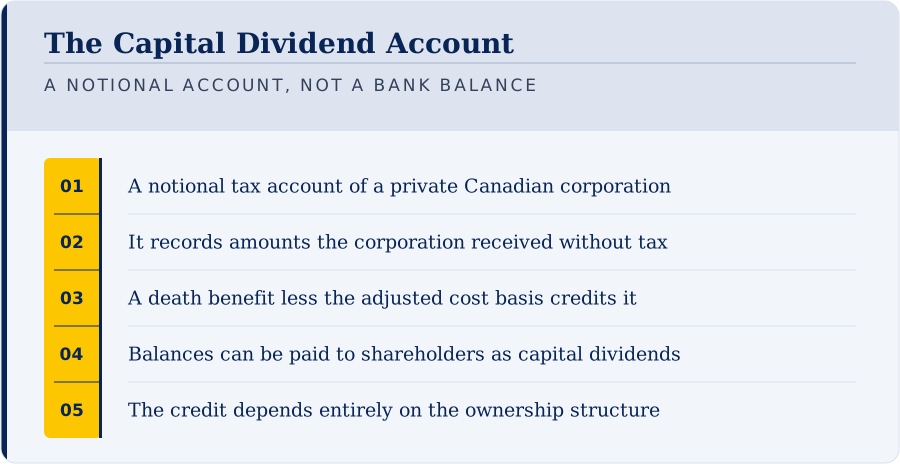
- What happens at death. A private corporation that receives a death benefit can add the proceeds, less the policy's adjusted cost basis, to its capital dividend account and pay that amount to shareholders by election.
- Who owns, pays and receives. Personally, the answer is simple. Inside a group of companies it is not, and the tax result depends on it.
The first point is a funding comparison, not a proven saving. Money that stays in the corporation still has to come out one day, as salary, as a dividend or, after a death, as a capital dividend, and each route carries its own tax. A fair comparison runs the whole path, including the cost of the insurance and what the same dollars would have done elsewhere. Your accountant runs it with your province and your company's figures.
Which entity should hold the contract (you, your operating company or a holding company) has no general answer. The factors are set out one by one, with no structure recommended, on personal or corporate ownership of the contract, and the corporate tax rules in depth on corporate-owned life insurance. One caution: the capital dividend account is a Canadian rule, so do not plan a Canadian policy from material written for American readers.
Who owns the policy, who pays, and who receives the money?
Four roles sit on every corporate file. Write them down before anything is signed.
| Role | Who it can be | What it decides |
|---|---|---|
| Owner (the policyholder) | You, your operating company or a holding company | Who can take a policy loan, change the beneficiary or surrender the contract |
| Person insured | You, a partner or a key employee | Whose death pays the benefit; that person consents when someone else owns the policy |
| Premium payer | The owner, or another person or company | Whether a shareholder benefit question arises |
| Beneficiary | The owner, another company, a family member or an estate | Who receives the death benefit, and whether a capital dividend account credit can arise |
Suppose a corporation pays a premium on a policy the shareholder owns, or one payable to the shareholder's family. The Canada Revenue Agency can then include a benefit in the shareholder's income under subsection 15(1) of the Income Tax Act. Its page on shareholder benefits lists a shareholder's life insurance premiums paid by the corporation, and a corporation's guarantee of a shareholder's personal loans, among its examples. A gap between owner, payer and beneficiary is a reason to look closely, not proof: the CRA asks who received what, in what capacity, and what it was worth.
Other combinations, such as a holding company paying for a policy that names the operating company, raise different questions and call for your accountant's written opinion. A transfer of ownership after issue can itself be a disposition for tax, so owner, payer and beneficiary are settled together, in writing, with your accountant and lawyer before the application is signed. Review them again whenever the company is reorganised or amalgamated, or a shareholder joins or leaves, because the contract does not update itself. See when the corporation pays and the shareholder owns and the holding company and where the contract sits.
A company also needs an insurable interest in the life insured, or that person's written consent. In Quebec, article 2418 of the Civil Code sets that rule; the other provinces set theirs in their insurance acts.
What is corporate coverage used for?
frequently the same person, not always
Three roles inside one contract
- 01One contractAll three can differ. Only the policyholder changes it, subject to any irrevocable beneficiary.
- 02The policyholderOwns the contract and holds its rights, subject to any assignment.
- 03The insuredThe person whose life is covered.
- 04The beneficiaryReceives the death benefit.
Name the job first. It decides the owner, the amount, how long the coverage must last and whether permanent insurance is needed at all.
- Key person coverage. The company insures someone whose death would damage revenue, credit or continuity, and it owns the policy, pays for it and receives the death benefit. The amount comes from what the disruption would cost. Term insurance can meet this need; what permanent coverage leaves on the balance sheet is on key person coverage and the capital that stays.
- Buy-sell funding. Surviving shareholders need money to buy a deceased owner's shares, and the funding has to match the shareholders' agreement.
- Estate liquidity. At death your shares are deemed to be disposed of, and unless they pass in a way that defers the tax, such as to a spouse, tax can be owing whether or not there is cash to pay it. Coverage can arrive when that bill does.
- Loan protection. A lender may take a collateral assignment of the policy (a hypothec in Quebec). The corporation still owns it; the lender is paid from it first, and its right is released when the loan is repaid.
- Lifetime coverage kept in the company. A permanent policy the corporation owns also builds cash value that is not taxed each year while the contract stays exempt under Regulation 306, Income Tax Regulations. It remains insurance, with the costs set out below.
Overhead expense coverage, which pays fixed business costs while an owner is disabled, is a separate disability contract, not a feature of a life policy. Ask about its covered expenses, waiting period, benefit period and exclusions.
One rule holds across all of these: do not buy a permanent policy to fund a business need that is only a few years away. The early cash values are generally below the premiums paid, and the premium becomes one more fixed cost in the year you can least afford it.
How does the capital dividend account work after a death?
A death benefit that a corporation receives as beneficiary is not taxed as its income. For a private corporation, the proceeds received because of the death are added to its capital dividend account, less the policy's adjusted cost basis immediately before the death. The rule is paragraph (d) of that definition in subsection 89(1) of the Income Tax Act. The account holds no money. It is a running tax record of what the corporation may pay out as capital dividends.
- The credit is net of the adjusted cost basis. The basis changes over the life of the contract, so the credit is not a fixed share of the death benefit. An insurer policy loan outstanding at death also reduces the amount received.
- Paying it out takes an election. The corporation files CRA Form T2054 under subsection 83(2) by the earlier of the day the dividend becomes payable and the day it is first paid; a Quebec corporation also files Revenu Québec form CO-502. A late election can still be made, with a penalty. Electing more than the balance is the expensive error: the excess is taxed at three fifths under subsection 184(2), unless the corporation, with its shareholders' concurrence, elects in time to treat it as a separate taxable dividend.
- Who receives it matters. A shareholder resident in Canada receives a properly elected capital dividend without income tax. A shareholder living outside Canada generally pays Canadian withholding tax on it.
Capital gains, capital losses and earlier capital dividends move the same balance, so the corporation's accountant calculates it before any dividend is declared.
Illustrative example. Assume a private corporation owns a policy on your life and is its beneficiary. At your death it receives $1,000,000. The insurer reports an adjusted cost basis of $120,000 immediately before the death, and no policy loan is outstanding. The credit is $1,000,000 less $120,000, or $880,000. The other $120,000 stays in the corporation as ordinary surplus. The figures are assumptions for the arithmetic only.
The full reference is on the capital dividend account, and the filing after a death, step by step, on paying a capital dividend after a death.
How is money that stays in the corporation taxed?
Active business income is taxed at a low rate up to the business limit, which the CRA's T2 corporation income tax guide gives as $500,000 for a corporation not associated with any other. Once retained profit is invested, the income it earns is taxed at higher rates, part of which can be refunded when the corporation later pays taxable dividends.
The federal passive income rule. The rule sits in paragraph 125(5.1)(b) of the Income Tax Act. The federal business limit shrinks when the adjusted aggregate investment income of the corporation and its associated corporations is more than $50,000. The income counted is that of their tax years that ended in the previous calendar year. For a corporation with the full $500,000 limit, each dollar above $50,000 takes $5 off the limit, which reaches nil at $150,000.
Illustrative example. A corporation with the full limit and no associated companies earned $90,000 of adjusted aggregate investment income in its tax year that ended last calendar year. The reduction is 5 times ($90,000 less $50,000), or $200,000, so this year's federal business limit is $300,000.
The provinces decide for themselves. The CRA states that the Ontario small business limit is not subject to the federal passive income reduction. Quebec runs its own small business deduction through Revenu Québec, whose note of 4 May 2026 confirms that its reduction based on the hours paid to employees stays in place. Other provinces set their own rules.
Where a policy fits. On our reading, growth inside an exempt policy that is not included in the corporation's income in a year does not add to its adjusted aggregate investment income for that year. That changes when money comes out. A surrender, or a policy loan larger than the adjusted cost basis, creates income for the corporation under subsection 148(1); a partial withdrawal is measured against a proportional part of the basis under subsection 148(4). Policy amounts included in income count in that measure. A policy is a narrow answer to a narrow problem.
Three ordinary responses, each with a cost your accountant should price:
- Pay more out personally and invest outside the company, accepting the personal tax now.
- Move surplus to a holding company, which does not by itself solve this rule, because associated corporations are counted together.
- Hold assets whose growth is not investment income each year, the technical basis on which corporate-owned exempt insurance is proposed.
The mechanism in full, with no product named as the answer, is on retained earnings and the passive income rule, and the places a reserve can sit are compared, with no winner, on the corporate reserve.
How does a corporation get money from its policy, and who lends it?
a notional account, not a bank balance
The Capital Dividend Account
- 01A notional tax account of a private Canadian corporation
- 02It records amounts the corporation received without tax
- 03A death benefit it receives, less the adjusted cost basis, may credit it
- 04Available balances may be paid out as capital dividends
- 05The credit depends entirely on the ownership structure
Borrowing against a corporate policy can mean two different loans.
A policy loan. The corporation, as owner, asks the insurer for an advance. The insurer lends its own money, up to a loan value the contract sets, secured by the policy's cash value. The corporation owes the insurer, and the interest is charged by and paid to the insurer, at a rate the insurer sets and may change. Unpaid interest can be added to the loan, depending on the contract.
A loan from another lender. The corporation borrows from an outside lender and pledges the policy by a collateral assignment (a hypothec in Quebec), which the insurer records. The lender decides whether to lend and receives the interest. The corporation owes the lender, still owns the policy, and gets the lender's release on repayment.
| Point | Policy loan | Loan from another lender, secured by the policy |
|---|---|---|
| Who lends | The insurer | A lender outside the policy |
| Who owes | The corporation, to the insurer | The corporation, to the lender |
| Who receives the interest | The insurer | The lender |
| Who decides | The contract sets the loan value; the insurer sets the rate | The lender's credit decision and loan agreement |
| Tax when it is taken | A disposition under subsection 148(9); income only above the adjusted cost basis | The assignment itself is not a disposition |
| At death | The balance is deducted from the death benefit | The lender is paid first under the assignment |
| If it goes unpaid | The contract can end, with possible tax | The lender enforces its security |
Only the part of a policy loan above the adjusted cost basis immediately before the loan is income to the corporation, and the loan lowers that basis. Repaying it restores the basis and can give a deduction under paragraph 60(s), limited to amounts previously included in income. If the contract ends with a loan outstanding, the proceeds for tax are the cash surrender value less the loans owing, so the small cheque at the end does not decide the tax. Before any surrender, ask the insurer in writing for the proceeds, the loan settlement, the adjusted cost basis and the tax slip it expects to issue.
Interest can be deductible under paragraph 20(1)(c) only when the corporation uses the money to earn income from a business or property, and that paragraph excludes money borrowed to acquire a life insurance policy. For a policy loan, the interest counts only as the insurer verifies it on CRA Form T2210. Premiums are generally not deductible; a limited deduction can exist under paragraph 20(1)(e.2) where a policy is assigned as collateral for a business loan, under conditions your accountant checks.
The advance goes to the corporation, not to you. Moving money from the company into your hands is a second transaction, by salary, by dividend or by repaying a shareholder loan, each with its own tax. See the shareholder loan and the policy loan, how a policy loan works and the immediate financing arrangement. The financing approach known as The Infinite Banking Concept®, which R. Nelson Nash described, has its own pillar, including where its case is weakest.
What does a corporate policy cost, and what is guaranteed?
A participating whole life premium is a long commitment. Part of each premium pays for the insurance and the insurer's costs, and part builds the guaranteed cash value. The guaranteed values in the contract are the only numbers the insurer promises. Paid-up additions bought with dividends add coverage and cash value, but only once a dividend is actually paid. Ask for these in writing before the corporation applies:
- An illustration with separate columns for guaranteed values and for the current dividend scale, plus one at a lower scale.
- The insurer's year-by-year projection of the adjusted cost basis.
- The cash surrender value at years 1, 5 and 10, against the premiums paid by then.
- The loan provision: how the loan value and the interest rate are set and changed, and what happens as the loan approaches the cash value.
- The options if the corporation misses a premium, and what each does to the coverage.
- How the representative is paid: commission from the insurer, and whether it differs between the base premium and any additional deposit.
How much premium the corporation can carry is a test, not a figure, set out on funding premiums from corporate cash flow. Run it against the company's worst year, not an average one. The guarantees are the insurer's promise, so they rest on its solvency. An insurer incorporated federally is supervised by the Office of the Superintendent of Financial Institutions; one incorporated in a province is supervised by that province, through the AMF in Quebec. Every life insurer authorized in Canada must belong to Assuris. Assuris protects a whole life policyholder for up to $1,000,000 or 90% of the promised death benefit, whichever is higher, and up to $100,000 or 90% of the promised cash value, whichever is higher, calculated on net values after policy loans.
Who does this suit, and who does it not suit?
Corporate permanent coverage deserves a closer look when four things are true. There is a lasting need for a death benefit. There is surplus beyond what the business needs for operations and reserves. The horizon is long enough for the early years to pass. And your accountant and lawyer have reviewed the structure before signing.
It does not suit an owner whose exit is a few years away, whose cash flow swings with no reserve behind it, who carries expensive debt, or who has no lasting need for coverage. For that owner, no is the useful answer.
The fairest case against it is short. A participating policy commits the corporation to years of premiums. It returns less than was paid if surrendered early, and it depends on dividends the insurer does not guarantee. It can weigh on the share tests for the capital gains exemption, and it can create taxable income when money comes out during life. Its clearest tax advantage arrives at death.
| Need | Options to compare | What the comparison must show |
|---|---|---|
| Coverage for a fixed period | Term insurance and permanent insurance | Term has no cash value and ends; compare matched quotes |
| Money the business may need soon | A liquid corporate reserve | Access now; its income is taxed yearly and counts in the passive income measure |
| Expensive debt | Paying it down | A saving equal to the interest avoided; no death benefit |
| Your own retirement savings | Registered plans such as an RRSP or a TFSA | They do different jobs; questions about them go to a professional licensed for them |
| A lasting death benefit with cash value | Participating whole life | Guaranteed and non-guaranteed values apart, early values, the tax on the way out |
An accountant asked to review such a proposal will find a briefing on accountants and the strategy they are asked to approve.
Salary or dividends: what does each one build?
where the structure usually goes wrong
Corporate-owned life insurance
- The company owns the contract and pays the premium
- Premiums are generally not deductible
- Corporate funding is not, by itself, a tax saving
- A death benefit it receives may credit the Capital Dividend Account
- Ownership and beneficiary structure is where it fails
- RRSP room. The CRA calculates your RRSP deduction limit as your unused room carried forward, plus 18% of the previous year's earned income up to the annual limit, less any pension adjustment. Its limits page sets that limit at $33,810 for 2026. Salary is earned income; dividends are not, so a year paid only in dividends adds no new room. Room already earned carries forward.
- Public pension. Salary builds Canada Pension Plan entitlement, or Quebec Pension Plan entitlement for work in Quebec. An owner-manager effectively funds both the employer and the employee contributions. Dividends build neither.
- The company's tax. Salary is deductible to the corporation. Dividends come from income the corporation has already been taxed on.
- Integration. Canadian tax is designed so that income earned through a company and paid out approximates what it would have borne personally. The mix changes timing more than destination.
- Disability coverage. Insurers differ in how they count dividend income for the disability benefit you can buy. Ask for the insurer's income rules before you settle the pay mix.
The comparison, with neither ranked, is on salary, dividend and the contract, and how an owner's retirement comes together on the business owner's retirement plan.
What must be true for your shares to qualify for the capital gains exemption?
The lifetime capital gains exemption applies to qualified small business corporation shares. The CRA's Guide T4037, Capital Gains, sets three tests. At the sale, the share is a share of a small business corporation, which turns on what its assets are used for. Throughout the 24 months before, more than 50% of the fair market value of the assets was used principally in an active business in Canada, or consisted of certain shares and debts of connected corporations. And throughout those 24 months, no one other than you, your partnership or a related person owned the share.
A corporate-owned policy is part of what the company holds, and like surplus investments it can weigh against these tests. How a policy on a shareholder's life is valued for them has its own rule in the Act, so ask your accountant to run the test with the policy in it. Purification, moving non-active assets out, has its own tax, and the 24-month look-back means it starts well before a buyer appears. See selling the company and the contract and, for dentists, selling the practice.
What should a shareholders' agreement settle?
An agreement decides what happens. Insurance decides whether there is money to do it with, and the two have to match.
- The events. Death, departure, disability and dispute, each with its own trigger.
- Valuation. A formula agreed when the company was young can produce a number nobody accepts a decade later.
- Who buys, in what order and when. Including what happens if the buyer cannot pay.
- Disability. An owner who is alive, unable to work and still holding shares raises questions a death does not.
- The funding. A buyout with no funding produces a forced sale or a dispute; funding with no agreement produces money and no mechanism.
Review it when the business changes: a new owner, a change in value or in what the company does. In Quebec, have a lawyer or notary check that its terms fit Quebec law. The two classic funding structures, at equal length, are on funding a buy-sell agreement.
What does incorporation not protect you from?
the definition is the whole rider
The waiver of premium rider
- 01It keeps the contract in force without premiums
- 02It applies if the insured becomes disabled
- 03The contract's definition of disability is the whole rider
- 04An own occupation definition pays where a broader one does not
Incorporation limits liability for the company's obligations. It does not cover a personal guarantee you signed, so keep a schedule of every guarantee: what, to whom and against what.
Directors can be held personally liable for unremitted payroll deductions and for GST or HST, and in some cases for unpaid wages, subject to conditions that include a due-diligence defence; provincial laws, Quebec's among them, add rules of their own. An incorporated professional remains personally liable for their own professional acts.
Keep separate accounts and a current minute book, and do not mix personal and company money. On our reading, Canadian courts set a corporation aside only in narrow circumstances, but poor records make it hard to show which transactions belonged to the company. A liability policy can pay for a defence and a judgment, within its limits and exclusions. See asset protection and, when the company itself is in difficulty, a corporate contract when the company is in trouble.
Why do succession and an exit take years?
An exit is a transaction: a sale, a wind-down or a transfer on a given date. Succession is a transition, measured in years, in which someone else learns to run the business while you are still there to be asked. A business that cannot run without its founder is worth less, and may not sell at all.
What makes a business transferable also makes it saleable: documented processes, a management team, customer relationships that belong to the company, and financials that survive a buyer's review. Each takes years. See the succession planning process and, for an owner who means to sell in ten years, an exit in ten years. A sale happens on a date and at a price a buyer helps decide, so build a second source of retirement capital that does not depend on it.
How do professions and trades change the picture?
An incorporated professional meets all of this with features of its own: income that varies across a career, a practice that may or may not be saleable, and in some professions, rules on who may hold shares. Trades meet the same rules through equipment cycles, seasonal cash flow and contracts that end.
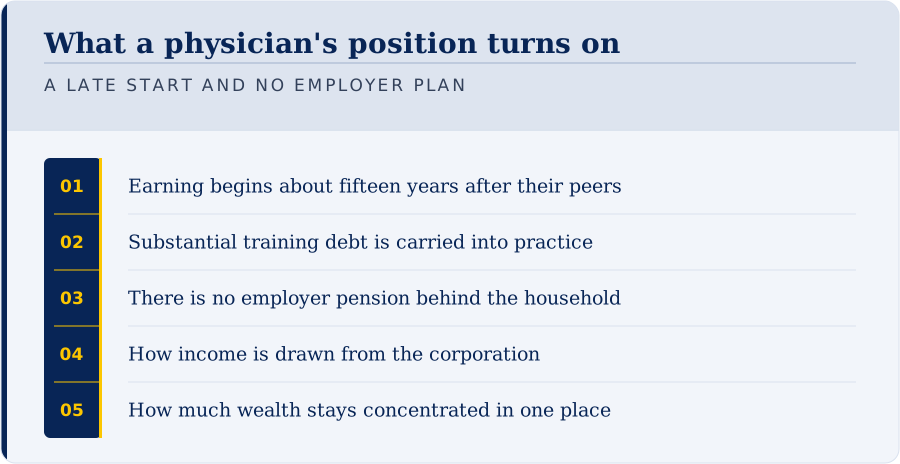
- Physicians and dentists. Incorporated physicians and retained earnings; for dentists, from student debt and buying a practice to the professional corporation and disability and the capital plan.
- Other practices. Veterinarians, pharmacy owners, small law firms, design practices and partnership buy-ins.
- Uneven income. IT consultants, real estate agents and landscaping and snow removal.
- Equipment and land. Contractors, trucking fleets, manufacturers, restaurants and farm families.
What should you settle before any product conversation?
Structure first, then documents, then coverage. The structure decides what is possible, the documents decide what happens, and the coverage funds what the documents require. Coverage bought first is sized against nothing.
- What does the corporate structure look like today?
- What is the surplus earning, and where does the passive income measure stand against the $50,000 threshold?
- Is a sale in view, and would the shares qualify today?
- Is there a shareholders' agreement, when was it last read, and is it funded?
- What personal guarantees exist, to whom, and against what?
- Who runs the business, signs and decides if you cannot work tomorrow, and is that written down?
- Is the minute book current?
- What do you need personally, apart from the business?
| Question | Who answers it |
|---|---|
| Guaranteed values, dividends, the loan provision, premium options | The insurer, through a licensed representative |
| Capital dividend account, passive income, share qualification, extraction tax | Your accountant |
| Ownership, beneficiary, assignment, the shareholders' agreement | Your lawyer (in Quebec, a lawyer or notary) |
| A loan secured by the policy | The lender, in writing |
Services come only from Canadian Wealth Creation Centre Inc.; IBC Financial is its educational website. If a policy is bought, the representative is paid by commission from the insurer, and you are entitled to ask how. The provinces in which each representative is licensed are on the pages of Jose Salloum and Michael Salloum, and what a first conversation involves is on becoming a client.
A thirty-minute discovery meeting
A first conversation establishes whether this fits. No illustration is prepared and nothing is arranged.
Often the answer is no, and you will hear it during the call rather than in a proposal afterwards.
This form reaches Canadian Wealth Creation Centre Inc. Any meeting, any advice and any insurance product is provided by Canadian Wealth Creation Centre Inc., through its representatives who are licensed in the client's province. IBC Financial is the company's educational website: it distributes no product and no financial service, and it gives no individualised advice.
How Canadian Business Owners Use Infinite Banking
Your corporation, your profession, your exit. Guides written for owners who want retained earnings to do more, and who want to know the tax consequence before they sign anything.
For dentists 10 guides
For physicians 10 guides
For pharmacists 9 guides
Corporate ownership and tax 15 guides
| A Corporate Contract When the Company Is in Trouble UPDATEDA corporately owned participating contract is a company asset. What a secured creditor or a receiver can reach, and the tax a forced surrender creates. | Read more |
| Canadian Business Owners, Real Estate Investors and Dentists in the US: Whole Life Insurance and Tax on Both Sides of the Border NEWCanadian business owners, real estate investors and dentists with US work, shares or property: residence tests, US policy rules, FBAR and estate tax. | Read more |
| Corporate-Owned Life Insurance (COLI) UPDATEDHow corporate-owned life insurance works in Canada: who owns it, who is named, how the Capital Dividend Account operates, and where structuring goes wrong. | Read more |
| Funding Premiums from Corporate Cash Flow UPDATEDA durable cash flow test for owners deciding what premium an incorporated business can commit to, measured against its worst year and no figure supplied. | Read more |
| How a Capital Dividend Is Elected and Paid After a Shareholder Dies UPDATEDThe order of events after a death: what credits the capital dividend account, the directors' resolution, Form T2054, late filing, and an excessive election. | Read more |
| Retained Earnings and the Passive Income RuleHow section 125(5.1) grinds a corporation's business limit as adjusted aggregate investment income rises, why it lands a year later, and who measures it. | Read more |
| Salary, Dividend, and What Each One BuildsSalary or dividend while a contract is funded: deductible payroll, gross up and credit, earned income, registered room, pension entitlement, your CPA's call. | Read more |
| The Accountant Asked to Approve This, and What to Check UPDATEDA briefing for the professional asked to approve or reject a corporate-owned participating contract: the mechanism, the concessions, and the questions. | Read more |
| The Capital Dividend Account, Explained for Canadian Business Owners NEWHow the capital dividend account lets a private Canadian corporation pay tax-free dividends: what builds it, how life insurance feeds it, the rules to respect. | Read more |
| The Corporate ReserveFour places an incorporated business can keep reserve money, compared one feature at a time: operating credit, deposits, certificates, participating contracts. | Read more |
| The Policyholder Decision for an Incorporated Owner UPDATEDCorporate or personal policyholder: premium dollars, balance sheet visibility, capital dividend account credit, benefit to a shareholder, exemption testing. | Read more |
| The Shareholder Loan and the Policy LoanA shareholder loan and a policy advance compared for an incorporated owner: counterparty, documentation, interest, balance sheet, death and sale. | Read more |
| What a Corporate Contract Leaves on the Balance Sheet UPDATEDWhat a key person contract leaves behind while everyone is alive: living value, the cost against term life insurance, shareholder benefit risk, and sizing. | Read more |
| When the Corporation Pays the Premium and the Shareholder Owns the ContractSubsection 15(1) of the Income Tax Act, the four ways a corporation can pay a life insurance premium, and the tax result the Act produces for each one. | Read more |
| Which Company Should Hold the Contract, and What That ChangesOpco or holdco as policyholder: which entity pays, who is named, where the capital dividend credit lands, and what a transfer does not promise. | Read more |
Succession, sale and partners 5 guides
| Buying Into a Partnership at the Point of Highest Debt UPDATEDA partnership buy-in is one purchase, financed, settled in a few months, at the point of highest debt in a working life. What the buyer is actually signing. | Read more |
| Funding a Buy-Sell Agreement UPDATEDWhat a shareholders' buy-sell agreement must settle, the two structures that fund it, and why an obligation with no money behind it is only a promise. | Read more |
| Selling the Company, and the Contract Inside ItTwo sale structures, a contract moved out of the corporation, deemed disposition under s.148(7), shareholder benefit, and qualifying small business status. | Read more |
| Ten Years to the Exit, and a Contract That Wants Thirty UPDATEDWhy an owner leaving in ten years should usually say no: costly first decade, corporate dollars tied up, a buyer who wants none of it, shares at risk. | Read more |
| What Is the Succession Planning Process?Succession planning covers two questions: who leads the business next, and who owns it next. Most plans answer the first and leave the second undecided. | Read more |
Your profession 11 guides
| Cost Per Mile, and the Cost of Capital Nobody CostedA fleet owner costs fuel, tires and maintenance to the cent. The one line never costed is capital, and the lender's security is the truck itself. | Read more |
| Farm Families and the Land That Cannot Be Divided UPDATEDNearly all of a farm's value sits in one asset that is also the workplace and the home. What that does to a succession, and where the cash comes from. | Read more |
| Manufacturers and the Machine That Outlives Its Financing UPDATEDA plant buys a machine that will run for two decades and finances it over a fraction of that. The mismatch between those two numbers is the conversation. | Read more |
| Six Months of Income Against Twelve Months of Cost UPDATEDA seasonal operator earns in part of the year and pays for all of it. Why the numbers are stable rather than unstable, and what that changes. | Read more |
| Somebody Else's Calendar: The Refit, the Lease and the GuaranteeA restaurant refits when a franchisor or a landlord says so, not when it is ready. What that timing costs, and where the household sits behind the lease. | Read more |
| The Contractor With One Client and a Contract That Ends UPDATEDOne client at a time, a contract with an end date, and a day rate that has to cover everything an employer used to. The arithmetic, without rhetoric. | Read more |
| The Design Practice and the Obligation That Outlives the Work UPDATEDA design practice delivers a project and keeps an obligation for years afterwards. How claims-made cover, run-off and a staged fee cycle actually interact. | Read more |
| The Holdback, the Crew and the Money Already Earned UPDATEDA contractor can be profitable on paper and short at the till, because a holdback keeps money already earned. What that gap costs, and who is paid for it. | Read more |
| The Real Estate Agent's Year: Lumpy Income, Monthly Bills UPDATEDCommission arrives in lumps and stops in the quiet months. What a self-employed salesperson can hold that smooths the gap, and what nobody should hold. | Read more |
| The Small Firm, the Draw, and Money That Is Not the Firm'sA partner draws rather than earns a salary, and holds an account of money that is not the firm's. What both facts do to liquidity in a small practice. | Read more |
| Veterinarians and What the Practice Is Worth to Anybody ElseA veterinary practice is worth what somebody else will pay for it, and the owner is usually the last person to find out what that number is. | Read more |
Common questions
Should my corporation own the policy, or should I own it personally?
What is the capital dividend account?
Does a corporate owned policy affect the sale of my business?
Why is the corporate case treated separately from the personal one?
Is a corporate owned policy an investment for my company?
What is the passive income rule and does it affect my corporation?
Should I pay myself salary or dividends?
What is key person insurance?
What is buy-sell funding and why does the agreement have to match it?
What is the shareholder benefit problem in a corporate insurance file?
Will my shares qualify for the lifetime capital gains exemption?
What should a shareholders agreement say about death and disability?
Can I use the money in a corporate owned policy personally?
Can I treat my business as my retirement plan?
What is the difference between succession and an exit?
Are corporate life insurance premiums tax deductible?
When my corporation takes a policy loan, who lends and who is paid the interest?
What is different for a corporation in Quebec?
Sources
- Income Tax Act, subsection 89(1), capital dividend account, paragraph (d): proceeds received on a death, less the adjusted cost basis. Justice Laws Canada, as recorded on this site., verified 2026-09-29
- Income Tax Act, subsections 83(2) to 83(5) and 184(2) to 184(4): the capital dividend election, the late election, and the tax on an excessive election. Justice Laws Canada, as recorded on this site., verified 2026-09-29
- Income Tax Act, paragraph 125(5.1)(b) and the definition of adjusted aggregate investment income in subsection 125(7). Justice Laws Canada., verified 2026-09-30
- Canada Revenue Agency, T2 Corporation Income Tax Guide, chapter 4, lines 410 and 426, modified 28 May 2026. The business limit and the passive income reduction., verified 2026-09-30
- Canada Revenue Agency, Ontario small business deduction, modified 23 April 2026. The Ontario limit is not subject to the federal passive income reduction., verified 2026-09-30
- Revenu Québec, tax news of 4 May 2026 on the small business deduction, and form CO-502 for the capital dividend election. As recorded on this site., verified 2026-09-29
- Canada Revenue Agency, How contributions affect your RRSP deduction limit, modified 29 January 2026., verified 2026-09-30
- Canada Revenue Agency, MP, DB, RRSP, DPSP, ALDA, TFSA limits, YMPE and the YAMPE, modified 1 December 2025. The RRSP dollar limit for 2026 is $33,810., verified 2026-09-30
- Employment and Social Development Canada, Canada Pension Plan overview, modified 3 August 2026. Quebec operates its own plan., verified 2026-09-30
- Canada Revenue Agency, Shareholder benefits, modified 10 June 2025. Life insurance premiums and loan guarantees are listed as examples., verified 2026-09-30
- Income Tax Act, subsection 15(1), benefit conferred on a shareholder. Justice Laws Canada, as recorded on this site., verified 2026-09-16
- Income Tax Act, subsections 148(1) and 148(9) and paragraph 60(s): policy loans, dispositions and the adjusted cost basis. Justice Laws Canada, as recorded on this site., verified 2026-09-16
- Income Tax Act, paragraphs 20(1)(c) and 20(1)(e.2), and CRA Form T2210 for policy loan interest. As recorded on this site., verified 2026-09-28
- Income Tax Regulations, Regulation 306, the exempt policy test. Justice Laws Canada., verified 2026-08-21
- Canada Revenue Agency, Guide T4037, Capital Gains: the tests for qualified small business corporation shares., verified 2026-09-30
- Assuris, whole life protection: up to $1,000,000 or 90% of the promised death benefit and up to $100,000 or 90% of the promised cash value, whichever is higher, on net values after policy loans. Every life insurer authorized in Canada must be a member. As read on assuris.ca and recorded on this site., verified 2026-09-26
- Civil Code of Québec, article 2418: insurable interest or written consent. LégisQuébec, as recorded on this site., verified 2026-09-29
About the author

Jose Salloum is a Financial Security Advisor (conseiller en sécurité financière) certified by the Autorité des marchés financiers in Quebec, a Life and Accident & Sickness Insurance Agent licensed by the Financial Services Regulatory Authority of Ontario, and a Life Insurance Agent licensed by the Insurance Council of British Columbia. Licensed since 2001.
He has practised Infinite Banking since 2015 and founded Canadian Wealth Creation Centre Inc. in 2016. From 2020 to 2024 he was an IBC (Infinite Banking Concepts™) Authorized Practitioner of the Nelson Nash Institute, a private certification rather than a regulatory licence.
IBC Financial is the educational website of Canadian Wealth Creation Centre Inc., open to all Canadians. Services come only from Canadian Wealth Creation Centre Inc. Its representatives hold a licence in each province served: Quebec, Ontario, Alberta, British Columbia, Manitoba and New Brunswick. Jose Salloum's own licences cover Quebec, Ontario and British Columbia. This page is general education and not advice on any individual file.
Last reviewed 2026-09-30. By Jose Salloum, Financial Security Advisor in Quebec. In Ontario, Life and Accident & Sickness Insurance Agent. In British Columbia, Life Insurance Agent.