

Participating Life Insurance
Participating whole life insurance is permanent life insurance with two layers. The contract guarantees the premium, the death benefit and a schedule of cash values, as long as the required premiums are paid. The insurer may also pay a yearly policy dividend from its participating account, declared by the board and not guaranteed. It can suit a permanent need and a horizon of decades, not a temporary need or money you may want back soon. The author is paid by commission from the insurer when a policy is issued.
Before deciding anything, look at two things that are in writing before you sign. The first is the guaranteed cash surrender value, year by year: what the insurer would pay if you ended the policy, set beside what you will have paid by then. The second is what borrowing means here: a policy loan is an advance from the insurer against that value, with interest paid to the insurer, and it is a debt until it is repaid.
Is it worth having? For the right person, it can be a very good contract. The test is three facts about you: a need for life insurance that is permanent, a premium that survives an ordinary bad year, and money that can stay committed for decades. It is life insurance, not an investment, and if any one of those facts is missing, it is the wrong tool; no dividend scale fixes that.
What is guaranteed, and what is not?
Every other decision depends on keeping these two layers apart. Here is each element, its condition and where to find it.
| Element | Guaranteed? | Condition | Where to find it |
|---|---|---|---|
| Premium | Yes, for the base coverage | Fixed at issue for the pay period chosen | The contract's premium schedule |
| Base death benefit | Yes | The required premiums are paid; any policy loan and unpaid interest are deducted at death | The contract's face page |
| Guaranteed cash value schedule | Yes, for the base coverage | The required premiums are paid | The table of guaranteed values in the contract |
| Policy dividends | No | Declared each year by the board, at its discretion | The illustration's non-guaranteed columns, which assume today's scale never changes |
| Paid-up additions bought with dividends | Depends on the contract | Additions already bought usually have guaranteed values; some contracts guarantee the base cash value but not the cash value of additions; future additions are never guaranteed | The paid-up additions provision of your contract |
| Dividend-dependent parts of enhanced or blended designs | No | They rely on dividends continuing at a sufficient level | The illustration and the design notes |
| Projected totals in an illustration | No | They assume today's scale holds for decades | The illustration's projected columns |
The guarantees are the insurer's obligations, not government-backed deposits, and they depend on its solvency. The Canada Deposit Insurance Corporation does not cover insurance policies. Assuris, the industry-funded protection organisation, protects Canadian policyholders if a member insurer fails. For whole life, you keep your death benefit up to $1,000,000 or 90% of it, whichever is higher, and your cash value up to $100,000 or 90% of it, whichever is higher, both calculated after any policy loans (Assuris, whole life, read 24 September 2026). So a $250,000 death benefit is protected in full, while on a $2,000,000 death benefit you keep $1,800,000.
How does the participating account work?
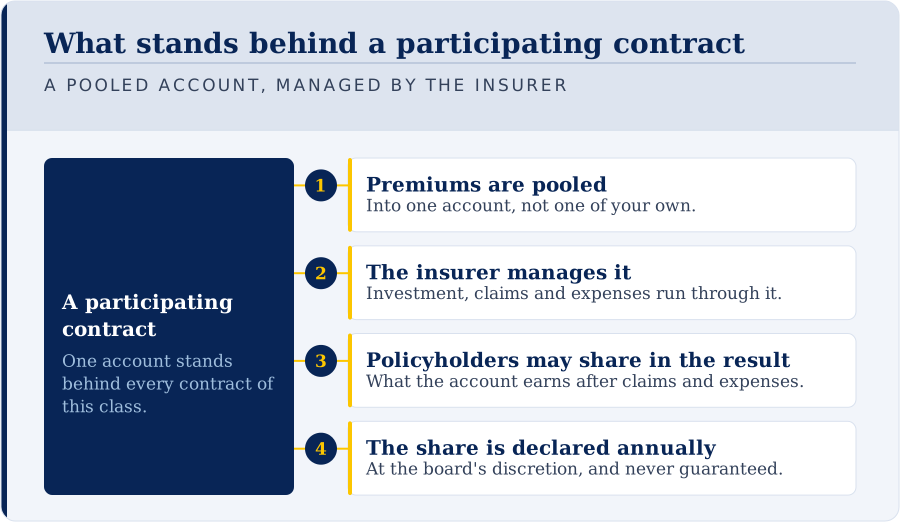
"Participating" means the policy shares in the results of an account, not in the ownership of the company. Premiums from participating policies go into the insurer's participating account. The insurer invests that money, pays claims and expenses from it, and may distribute part of the results to participating policyholders as dividends.
A federally incorporated insurer must keep separate accounts for its participating policies (section 456 of the Insurance Companies Act), and its directors must set a dividend policy and a policy for managing the participating account (section 165), which must be available to policyholders, as OSFI's Guideline E-16 sets out. That is separate accounting inside the insurer. It is not a segregated fund that you own, and it does not protect the account from every risk the insurer faces. Insurers chartered in Quebec follow Quebec law instead. When you look at a proposal, ask which participating account your policy would belong to.
A participating policyholder is not a shareholder, but does have a voice. Under subsection 153(1) of the Insurance Companies Act, participating policyholders of a federally incorporated insurer are entitled to vote, subject to the Act; for insurers chartered in Quebec, Quebec law applies. A vote gives you no control over how the account is invested. Your insurer's annual meeting materials set out your rights.
The account holds bonds, mortgages, real estate, equities and other assets, in proportions the insurer sets. The mix differs from one insurer to the next. Where much of the account sits in fixed income, a change in interest rates reaches the dividend scale slowly, because the account still holds older assets bought at earlier rates. That works in both directions.
Ask your insurer for its dividend policy, its participating account management policy and its latest participating account disclosures, including the asset mix and the scale history where it publishes them.
How is a dividend decided?
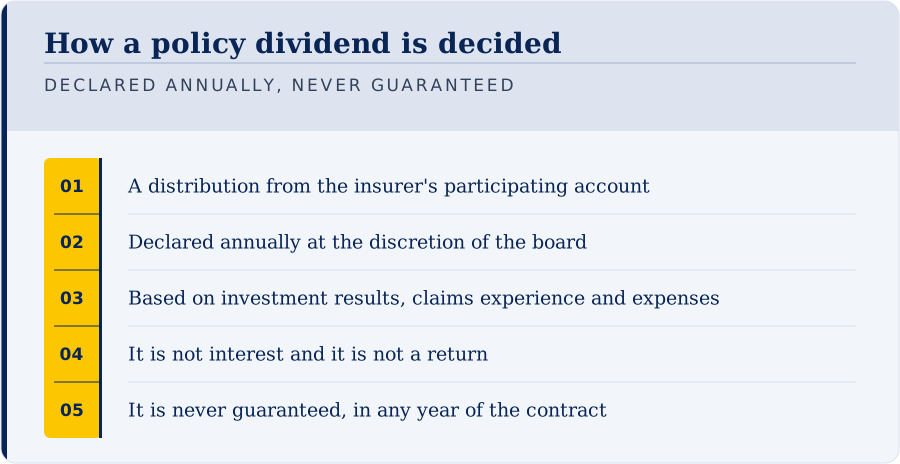
The word "dividend" is borrowed from corporate finance, and it misleads. A share dividend is a distribution of profit to the owners of a company. A policy dividend is a distribution from a pooled insurance account to participating policyholders. It is not interest, and it is not an investment return.
Three results feed it, and all three can move:
- investment income on the participating account, after the insurer's investment costs;
- claims experience, meaning whether insured people died earlier or later than the pricing assumed; better-than-expected mortality adds margin to the account, and worse-than-expected uses it up;
- expenses, meaning what the insurer actually spent to issue and administer the policies, against what was priced.
The board then decides, once a year, under the insurer's dividend policy. Insurers generally smooth the scale rather than pass each year's results straight through, which is why declared scales move gradually while markets jump around.
Here is where the popular phrase "not exposed to market volatility" needs care. The guaranteed cash value schedule does not move with markets; that part is accurate. Everything above the schedule depends on an account that holds real assets, whose returns respond to interest rates, credit conditions and property values. Smoothing slows the movement. It does not prevent it, and the scale can fall.
The dividend scale interest rate is not your return
Insurers publish a dividend scale interest rate, and people often read it as the yield on their policy. It is not. It is an input to the dividend calculation, tied to the participating account's investments, and not the return on your premiums. Your premiums also pay for the cost of insurance, expenses, premium tax and the early cost of putting the policy in force, so the two figures measure different things. To compare cash-value outcomes at stated dates, ask for the internal rate of return on the cash surrender value at years ten, twenty and thirty, once on the guaranteed column and once on the current scale, with the death benefit shown separately.
How does a policy work, from application to claim?
from application to claim
The life of a participating policy
- 01Underwriting sets the price and acceptanceApplication. Your health history decides both.
- 02Premium, death benefit and guaranteed values are fixedIssue. Provided the required premiums are paid.
- 03The board may declare a dividendEach year. Applied under your option; never guaranteed.
- 04A policy loan, a collateral loan or a surrenderDuring your life. Each has its own cost and tax result.
- 05The death benefit is paidAt death. Less any policy loan and unpaid interest.
You apply and are underwritten. The insurer reviews your medical history and sometimes asks for an examination. The price and whether you are accepted follow from that.
You pay a level premium. Part covers the cost of insurance, part builds the guaranteed value, and part meets the insurer's expenses and premium tax.
The board declares a dividend scale, usually once a year, and your share is applied according to the dividend option you chose.
The guaranteed values build on the contract's schedule whether or not a dividend is ever declared, provided the required premiums are paid.
You can reach the value during your life through a policy loan from the insurer, a loan from a third-party lender secured by the policy, or a partial or full surrender, each with its own cost and tax result. The year-by-year mechanics are on how a participating policy works.
What can a dividend be used for?
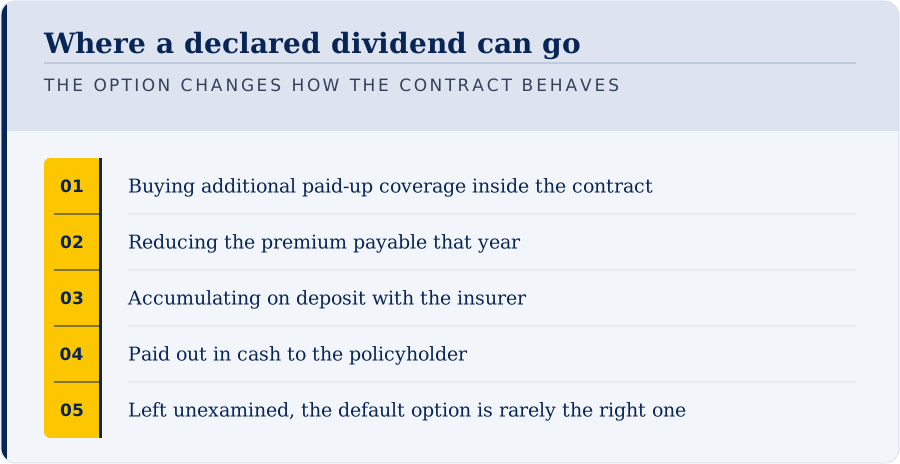
These are the usual options for a declared dividend; not every insurer offers all of them, so confirm the list in your own contract.
Buy paid-up additions. The dividend is applied to buy small amounts of fully paid coverage inside the policy, each with its own cash value and death benefit, and each eligible for future dividends. How they build is covered on paid-up additions.
Reduce the premium. The dividend pays part of what you owe that year.
Take it in cash. The money comes to you. For tax, a dividend counts as proceeds from disposing of part of your interest in the policy, so it reduces the adjusted cost basis, and any part above that basis is income under section 148 of the Income Tax Act.
Leave it on deposit with the insurer, earning interest at a rate the insurer declares. That interest is taxable every year.
Buy one-year term insurance, which adds temporary rather than permanent coverage.
How the option changes the tax. Under paragraph 148(2)(a), the part of a dividend applied immediately under the policy's terms to pay a premium or repay a policy loan is left out of those proceeds, as the CRA explains in Interpretation Bulletin IT-87R2 (paragraph 19, archived). Ask the insurer how it reports the option you choose before you choose it.
What does it cost, and why?
A participating policy costs more than non-participating whole life for the same coverage, and considerably more than term insurance. You pay for the guarantees and for the chance of a dividend, and the price reflects that whether or not a dividend ever arrives.
Your premium depends on your age, sex and health, the amount of coverage, the pay period, the design (how much goes to paid-up additions, for example) and the insurer. Do not infer a price from a general description: ask for current illustrations from more than one insurer on the same assumptions and compare them line by line.
The premium is made of several parts, and knowing them explains most of the criticism:
- the cost of insurance, the mortality charge any life policy carries;
- acquisition cost, meaning underwriting, issue and distribution, including commission; these expenses help explain why early surrender values can sit well below the premiums paid;
- ongoing administration, servicing the policy for decades;
- premium tax, a provincial charge on insurance premiums;
- the margin behind the guarantees, because a contract promising a value schedule for life must be priced to keep that promise in poor conditions.
None of these is itemised on a statement. There is no published expense ratio to set beside a fund's, and that is a fair criticism. What you can still compare are the annual premium, the total premiums over time, the guaranteed and illustrated cash surrender values year by year, and the loan terms.
Illustrative example. Assume you pay $10,000 at the start of each year. By the end of year three you have paid $30,000. Suppose the guaranteed cash surrender value at that point were $18,000. A surrender then would return $12,000 less than you paid. The values are assumptions for the arithmetic, not any insurer's figures; your own illustration shows the real ones.
Types of participating policy
Insurers differ mainly in how quickly the policy is paid for and what the design is weighted toward.
Life pay. Required base premiums continue for life: the longest commitment. Ask for the total premiums and the guaranteed cash surrender values at the years that matter to you.
Limited pay, such as twenty years or to age sixty-five. Premiums for a set period, after which the base policy is paid up and continues without further premiums. A higher annual premium and a finite commitment. Do not assume faster early values: compare the same insurer's actual designs on same-assumption illustrations, and note any optional payments that continue after the pay period. Dividends after the pay period are still not guaranteed.
Single premium. One payment, or a large additional deposit. It must fit the insurer's product limits and the exempt test in Regulation 306, set out below. Ask whether the insurer offers the design.
Estate designs and accumulation designs. The same insurer often offers two versions: one weighted toward the largest death benefit per premium dollar, the other toward faster cash value, usually through a larger paid-up additions rider. They are different products despite similar names, and the choice may be hard or impossible to change later, so ask what your contract allows before you sign.
Blended or enhanced designs. These mix base whole life with term insurance that dividends are expected to replace with paid-up coverage over time. They give more coverage per dollar at the start, and the part that depends on dividends is not guaranteed. If the scale falls, the conversion may not complete, so ask the insurer what happens to the coverage in that case.
The exempt test, and why it limits what you can pay in
Canadian tax law separates an insurance policy from an investment wrapper. A policy that meets the exempt test in section 306 of the Income Tax Regulations grows without annual tax. A policy that is not exempt can be subject to annual accrual taxation under section 12.2 of the Income Tax Act, and a policy that stops being exempt may be treated as disposed of. The current version of the test applies to policies issued from 1 January 2017.
The test compares your policy with a benchmark policy, so paying far more than the coverage supports pushes the policy toward the limit.
Whether a particular policy is exempt is a question for the insurer and your accountant. Ask the insurer how much can be deposited while the policy stays exempt, how it tests and reports exempt status, and what funding schedule the contract allows.
Getting money out: who lends, and who is paid?
four parties, two kinds of debt
Who lends, who owes, who is paid
- 01Policy loan: the insurer advances the money and is paid the interest
- 02Collateral loan: a third-party lender advances it, holding an assignment
- 03You, as owner, owe the debt, whichever of the two lends
- 04A relative you lend to owes you, a second and separate debt
- 05Unpaid policy loan interest is added to the loan and can end the policy
The cash value is a value inside the contract, not a separate account, and there are four main ways to use it.
| Route | Who provides the money | Who is paid the interest | Tax point | Effect on the death benefit |
|---|---|---|---|---|
| Policy loan | The insurer, secured by the cash value | The insurer | A disposition under s. 148; the part above the adjusted cost basis is income | Reduced by the loan and unpaid interest |
| Collateral loan | A third-party lender, which decides whether to lend and on what terms | The third-party lender | Assigning the policy as security is not a disposition | The lender is repaid first from the benefit if the loan is still outstanding |
| Partial surrender, where the contract permits | The insurer pays part of the value | No interest | The adjusted cost basis is prorated (s. 148(4)); the gain on that part is income | Reduced under the contract's terms |
| Surrender | The insurer pays the cash surrender value | No interest; the policy ends | Gain above the adjusted cost basis is income | Coverage ends |
A policy loan is an advance from the insurer. You ask for it with a loan request or agreement. The contract states whether the interest rate is fixed or variable. On many contracts, interest you leave unpaid is added to the loan at each anniversary. If the total debt grows larger than the cash value, the policy can lapse. How loans work in practice is on policy loans.
A collateral loan comes from a third-party lender. The lender looks at your credit and the policy, decides whether to lend and on what terms, and takes an assignment of the policy as security. Its rate and conditions are its own, and it can call the loan on the terms it sets. The borrower, the policy owner, the beneficiary and the lender may be different parties: the borrower owes the debt, and the owner assigns the policy as security.
Illustrative example. Assume you take a $50,000 policy loan at an assumed rate of 6% a year, and you pay no interest. At the first anniversary, $3,000 of interest is added, so you owe $53,000. At the second, interest of $3,180 brings the balance to $56,180. The rate is an assumption for the arithmetic, not any insurer's rate; your contract states how your own rate is set. Paying the interest each year keeps the balance from compounding against the policy.
Interest on a policy loan is not automatically deductible. The CRA allows a claim only for a policy loan used to earn income, and asks you to have the insurer complete Form T2210, which verifies the interest. Whether your use qualifies is a question for your accountant.
Lending to a family member creates two debts. A relative cannot borrow from your policy. You, as owner, request the policy loan and owe it to the insurer. If you then lend the money to a relative, that is a second, separate debt from the relative to you. Write down the parties, the amount, the interest, the repayment dates, what happens if a payment is missed and what happens if either party dies; in Quebec, ask a lawyer or notary which written instrument fits. The relative repaying you does not by itself repay your loan from the insurer, and the tax treatment of the family loan is for an accountant. How this fits a family plan is on private family capital, our term for how a family documents loans funded from a policy.
Taxation, in outline
This is general information, not tax advice; the result on your own facts belongs with a tax professional.
Growth inside the policy is not taxed each year while the policy stays exempt.
Policy dividends are taxed according to the option you choose, under section 148 of the Income Tax Act, as set out under what a dividend can be used for.
A policy loan is a disposition (paragraph (b) of the definition in subsection 148(9)). Under subsection 148(1), the part of a policy loan above the adjusted cost basis is included in your income in the year you receive it, and each loan lowers the basis for the next. If you later repay a loan that was included in income, paragraph 60(s) can allow a deduction up to the amount included, subject to its conditions. A loan from a third-party lender secured by an assignment of the policy is not a disposition (paragraph (f) of the same definition).
Illustrative example. Assume the insurer confirms $45,000 as the adjusted cost basis immediately before this loan, with no earlier transaction to adjust for, and you take a policy loan of $55,000. The first $45,000 is covered by the basis; the remaining $10,000 is included in your income for that year, and the basis falls to zero. The figures are assumptions for the arithmetic; ask the insurer for your own basis in writing before any large loan.
A surrender is a disposition too. The taxable policy gain is calculated under section 148 from the insurer's proceeds and adjusted cost basis figures. It is not simply the cheque you receive minus your total premiums, because the adjusted cost basis is not the same as the premiums paid, and a loan repaid from the surrender value still counts in the calculation. The insurer reports the gain; your accountant can check it.
The death benefit is generally received free of income tax by a named beneficiary.
When a private corporation is the beneficiary and receives the death benefit, the proceeds minus the policy's adjusted cost basis are generally added to its capital dividend account, under paragraph (d) of the definition in subsection 89(1) of the Income Tax Act, as the CRA's IT-430R3 (archived) explains, subject to the statutory adjustments and the corporation's actual account balance. Paying a capital dividend to its shareholders then needs a separate election under subsection 83(2), made on CRA Form T2054. Owning a policy credits nothing by itself, and a gain on a surrender or a policy loan is income, not a capital dividend account credit. The corporate side is set out on corporate-owned life insurance.
Where this product meets the wider strategy
Participating whole life is the contract underneath the approach practitioners call The Infinite Banking Concept®, a term originated by Nelson Nash and a registered trademark of Infinite Banking Concepts, LLC. Neither this practice nor its author is affiliated with, sponsored by or endorsed by that company or the Nelson Nash Institute. No policy is a bank, and a premium is not a deposit.
In plain terms, the approach works like this: you borrow from the insurer against your policy's cash value to pay for things you would otherwise finance elsewhere, you decide the repayment schedule, and the interest is paid to the insurer. The case for it is about discipline and control over the terms, not about the policy earning a better return.
The product is used there because it combines a guaranteed value schedule with value you can borrow against. The approach is disputed on grounds that are partly correct, and those are set out in objections and risks. The approach itself is explained on the overview of the approach.
Reading a participating illustration
The illustration is your main evidence before you commit. It is not a guarantee, and it says so.
Ask for clearly labelled guaranteed and non-guaranteed values, including a reduced-scale scenario. For a new policy, the guaranteed columns show the policy with no dividend ever paid; on an existing policy, confirm whether additions already bought are included. The projected columns add the current dividend scale. The gap between them is the size of the assumption you are being asked to accept. A current-scale illustration is not a forecast, so read the insurer's reduced-scale illustration next, with the changed assumption stated.
Check the funding assumption. Many illustrations assume every premium is paid for decades. Ask what the policy looks like if three years are missed.
Do not assume a break-even year. Ask whether, and in which illustrated year, the guaranteed cash surrender value first equals your cumulative premiums. It may not do so in the years shown, and the comparison is not a break-even date or proof that leaving costs nothing. Set it beside the years you might realistically need to leave.
Here is the table to fill in from your own illustration. Every cell comes from the insurer's document; none is filled in here. Write the insurer, product and illustration date above the table, mark any value not supplied as such, and ask for the net amount payable on surrender after any policy loan.
| Policy year | Premiums paid to date | Guaranteed cash surrender value | Current-scale cash surrender value | Reduced-scale cash surrender value | Total death benefit | Loan balance, if any | Adjusted cost basis |
|---|---|---|---|---|---|---|---|
| 1 | [insurer] | [insurer] | [insurer] | [insurer] | [insurer] | [insurer] | [insurer] |
| 3 | [insurer] | [insurer] | [insurer] | [insurer] | [insurer] | [insurer] | [insurer] |
| 5 | [insurer] | [insurer] | [insurer] | [insurer] | [insurer] | [insurer] | [insurer] |
| 10 | [insurer] | [insurer] | [insurer] | [insurer] | [insurer] | [insurer] | [insurer] |
| 15 | [insurer] | [insurer] | [insurer] | [insurer] | [insurer] | [insurer] | [insurer] |
| 20 | [insurer] | [insurer] | [insurer] | [insurer] | [insurer] | [insurer] | [insurer] |
| Your likely exit year | [insurer] | [insurer] | [insurer] | [insurer] | [insurer] | [insurer] | [insurer] |
Once it is filled in, read across each row. Where the guaranteed column sits well below the premiums paid, leaving costs money. Where the reduced-scale column still does the job you need, the plan does not rest on today's scale.
What happens if you stop paying
your contract decides which road is open
When the premium stops
- A premium is still unpaid when the grace period ends. What can happen?
- A loan pays the premium; the policy continues and the balance growsPremium loan.
- Reduced paid-up or extended term coverage, on the contract's termsOption elected.
- The policy lapses, or you surrender it for its cash surrender valueNo value left.
What follows is how contracts commonly work; your own contract sets the terms. Ask the insurer for the options, the future guaranteed values under each and the deadlines while you are still paying comfortably.
A grace period applies after a missed premium, and the policy stays in force during it. Your contract states how long it lasts.
An automatic premium loan can pay a missed premium from the policy's value if there is enough. The policy continues, and a loan balance starts growing with interest.
Reduced paid-up coverage, where the contract offers it, stops the premiums and keeps a smaller amount of permanent coverage that the value can fully pay for.
Extended term coverage, where the contract offers it, uses the value to keep coverage for a limited period, after which the coverage ends.
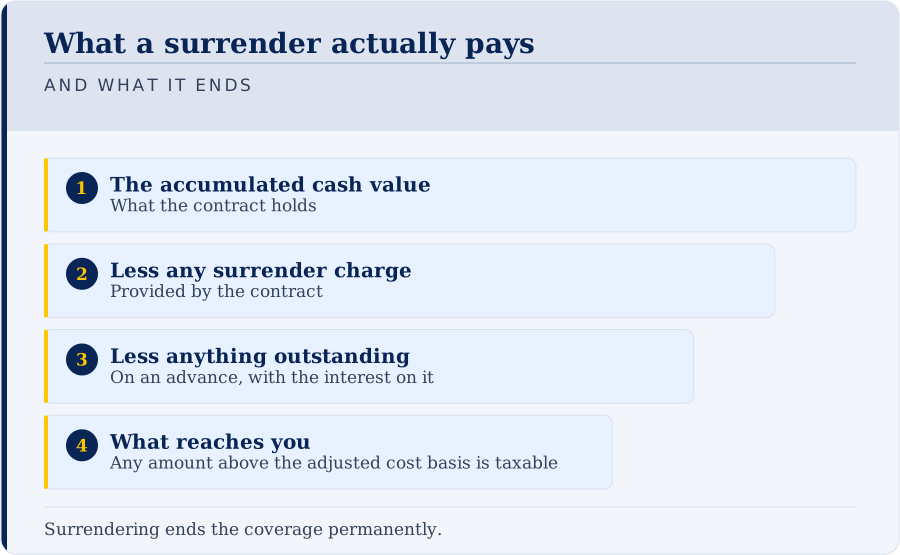
Surrender ends the policy. The insurer pays the cash surrender value, less any policy loan and unpaid interest. The tax on any gain is calculated under section 148 as described above, and it can create a tax bill in a year when the cash has already gone to repay the loan.
Lapse with a loan outstanding is the worst of these outcomes. Coverage ends, and a taxable amount can arise even though you received nothing that year. It is set out on the case against this product.
Ask the insurer to fill in this table beside your illustration:
| Policy year | Grace period ends | Automatic premium loan balance | Reduced paid-up coverage | Extended term: coverage and end date | Loan and interest | Possible taxable gain, as reported by the insurer |
|---|---|---|---|---|---|---|
| 3 | [insurer] | [insurer] | [insurer] | [insurer] | [insurer] | [insurer] |
| 10 | [insurer] | [insurer] | [insurer] | [insurer] | [insurer] | [insurer] |
| Your likely exit year | [insurer] | [insurer] | [insurer] | [insurer] | [insurer] | [insurer] |
What happens at claim, and what the benefit is protected from
A named beneficiary claims directly. The insurer usually asks for a claim form, proof of death such as a death certificate, and proof of the claimant's identity, and sometimes a physician's statement. How long payment takes depends on the insurer and the paperwork.
Any policy loan and unpaid interest are deducted from the benefit before payment.
With a named beneficiary other than the estate, the proceeds are generally paid directly and stay outside the estate, so fees charged on estate assets do not normally apply to them. Creditor protection, the effect of an assignment and your right to change the designation depend on your province and the facts.
In Quebec, a spouse's designation needs a second look. Under article 2449 of the Civil Code of Québec, designating a married or civil union spouse as beneficiary, in a writing other than a will, is irrevocable unless otherwise stipulated. Later changes, and some uses of the policy as security, may then need the spouse's consent. Where the beneficiary is your married or civil union spouse, a descendant or an ascendant, the rights under the contract are exempt from seizure until the beneficiary receives the sum insured (article 2457), and an irrevocable designation keeps them exempt while it lasts (article 2458). How this meets family patrimony is on family patrimony and the beneficiary designation.
Where the estate is the beneficiary, the proceeds enter the estate, are exposed to the estate's creditors and may attract probate fees where the province charges them. Naming a beneficiary costs nothing.
Participating, non-participating and universal life
These are the three permanent options people most often compare. None is better in general; each does a different job. If the need ends, price term first; if it is permanent, compare guaranteed coverage, funding and exit values before any dividend projection.
| Participating whole life | Non-participating whole life | Universal life | |
|---|---|---|---|
| Guaranteed cash value | Yes, on the schedule | Contract-dependent: check whether a guaranteed schedule exists and its values | Depends on the design and the options chosen |
| Guaranteed death benefit | Yes | Yes | Depends on funding and costs |
| Dividends | Possible, never guaranteed | None | None; growth depends on the options you choose |
| Premium | Higher | Lower | Flexible within limits |
| Who makes the investment decisions | The insurer, inside the participating account | The insurer, in its general account; your contractual values do not depend on the results | You, among the insurer's options |
| Value can exceed the schedule | Yes, through dividends | No policy dividends; some designs may add a bonus under their own terms | Yes or no, depending on results |
| Complexity | Higher | Lower | Higher |
A non-participating policy pays no participating policy dividends. Some designs provide only contractual values; others may add a bonus under their own terms. Compare guaranteed and non-guaranteed columns, premiums and riders on matched current quotes. The comparison is set out in full on participating and non-participating.
Universal life separates the two parts: a cost of insurance and an account you direct among the insurer's options. More control means more risk, because poor results can require higher premiums later or put the coverage at risk. With a participating policy, the guaranteed schedule does not depend on any investment decision you make. The details are on participating whole life and universal life.
Strengths and drawbacks
Both lists are real, and a fair decision holds them side by side.
What the product does well. Permanent coverage at a premium fixed at issue. A guaranteed floor of cash values that does not move with markets, provided the premiums are paid. Possible dividends, smoothed but never guaranteed. Value you can reach during your life, at a cost. And the tax treatment described above.
What it does less well, in its strongest form. It costs substantially more than term insurance for the same coverage. Charges are front-loaded, so early cash values sit below the premiums paid and the early years are illiquid. You cannot see the costs line by line. Dividends are discretionary, scales have moved before and can fall, and a plan that only works on today's scale is fragile. Borrowing has a real interest cost paid to the insurer or a lender. And the product is sometimes sold to people it does not suit, partly because it is hard to evaluate; that is a criticism of distribution rather than of the contract.
Who it suits, who it does not, and what a surplus does not prove
It can suit you if all of these hold:
- the need is permanent: tax on a deemed disposition at death, a dependant who will always need support, or a business obligation that does not expire;
- the premium is sustainable in an ordinary year, not only a good one, and through a poor decade;
- you have an emergency reserve in place and no high-interest debt outstanding;
- the money can stay in place for decades.
It does not suit you if:
- the need is temporary, because term insurance does that job for far less;
- you may need the money within several years;
- your income varies enough that a missed year is plausible;
- you want growth alone and do not want the death benefit.
What a surplus does not establish. Say you have $20,000 a year left over. That does not show a permanent insurance need, whether an insurer will accept you at standard rates, whether you have a reserve, whether debt should come first, or whether $20,000 survives a bad year. Answer those before any illustration is run.
Illustrative example. Assume a premium of $20,000 a year. By the end of year five you will have paid $100,000, and by the end of year ten, $200,000. Set those totals beside the guaranteed cash surrender value in the same years of your own illustration. The gap in the early years is the price of leaving. The premium is an assumption for the arithmetic.
Other tools do different jobs. Paying down debt, holding emergency savings, term insurance, non-participating whole life and universal life each answer a different need. Before you buy participating insurance, the Autorité des marchés financiers (AMF) suggests checking whether cheaper insurance combined with TFSA, RRSP, RESP or pension plan contributions would serve you better. This practice is licensed for insurance only, so ask a professional authorised for registered plans about that side.
Buying it for a child or grandchild
insurability and time, not an education fund
A policy for a child: what it does, and what it does not
- 01What it can doSecure coverage before any health condition appears; Start while the mortality charge is at its lowest; Give the contract decades to build value.
- 02What it does not doMove the premiums to the child: you own it and you pay; Serve as an education savings plan; that is a different job; Settle the tax on a later transfer; your accountant checks that.
A common question, and the arguments on both sides are real.
What is true. Premiums are lowest at young ages, because the mortality charge is lowest. The coverage issued stays in force if a health condition appears later; any future increase without evidence depends on a rider, if any. And the policy has more years to build value than it will ever have again.
What is often overstated. That it is a savings vehicle for the child's education. A registered education savings plan attracts a federal grant on contributions, money that does not exist inside an insurance contract. The two do different jobs, and a family that wants both funds both.
Who carries the premium. You, as owner, pay the premiums. If ownership is later transferred to the child, the premiums become the child's decision. Under subsection 148(8) of the Income Tax Act, a transfer to your child can, where its conditions are met, be made at the policy's adjusted cost basis, so no gain arises at that point (CRA IT-87R2, paragraph 18, archived). Your accountant confirms whether the conditions apply.
The whole question is worked through on insuring a child, including ownership and guaranteed insurability.
Common misunderstandings
That dividends are guaranteed because they have always been paid. A payment record is history, not a commitment. Ask your insurer for its dividend payment record and scale history.
That a higher illustrated value means a better contract. It may mean a more optimistic assumption. Compare the guaranteed columns first.
That a policy loan is your own money coming back to you. It is an advance from the insurer, secured by the cash value, with interest paid to the insurer. The value stays in the policy as security, and the loan is a debt.
Questions to ask, and who answers them
Take this list to any meeting about a participating policy.
- What is the guaranteed cash surrender value at years one, three, five and ten, beside the premiums I will have paid?
- Does the guaranteed cash surrender value ever equal my cumulative premiums in the years shown, and if so, in which year? What would I actually receive on surrender after any loan?
- Which dividend scale does this use, what has the scale history been, and what does the insurer's reduced-scale illustration show?
- How is the policy loan rate set, how much of the cash value can I borrow, and what happens to unpaid interest?
- What happens if I miss three years of premiums, and which non-forfeiture options does this contract offer?
- What is the insurer's financial strength rating, and which participating account would this policy belong to?
- Who should not buy this product, and who will service the policy in ten years?
Different people hold different answers:
| Who | What to ask them |
|---|---|
| The insurance advisor | Whether a permanent need exists; the illustration on current and reduced scales; the commission paid on the policy |
| The insurer | How the loan rate is set, the maximum loan, limits on paid-up additions, non-forfeiture terms, how it tests exempt status and the funding schedule allowed, the adjusted cost basis |
| A third-party lender | Whether it will lend against the policy, its loan-to-value limit, whether interest is added to the loan, and what would make it call the loan |
| Your accountant | The adjusted cost basis over time, the tax on a loan or surrender above it, interest deductibility, the capital dividend account |
| A lawyer or notary | Beneficiary designations, Quebec irrevocability, the effect of an assignment, and any written agreement for a family loan |
A good answer to "who should not buy this?" arrives quickly and is specific. If an advisor cannot name who should not buy this, treat that as a warning sign.
What to review each year
A policy like this runs for decades and is usually left alone, which is where most disappointment begins.
Read the annual statement. Four figures: the guaranteed value, the total value, any loan balance with its interest, and the dividend applied.
Check the dividend option still fits. Your reasons change; the option set at issue often never does.
Check the beneficiary designation after any marriage, separation, birth or death.
Compare the statement with the illustration you were shown. Tracking below the projected column is normal when the scale has moved. Tracking below the guaranteed column is not, and means something needs explaining.
Check any loan against the cash value. If the balance is growing faster than the value, decide now whether to pay the interest, repay part of the loan or change the plan.
Confirm who services the policy, because an advisor who has left is a common reason a sound policy drifts from its design.
Before you decide
This page does not recommend the product to you. Whether it suits you rests on the facts about you set out above, and on what else the money is needed for.
If the checklist above points toward a permanent need, a premium you can keep paying and money you can leave committed, the next step is a proposal: it takes underwriting and your own illustration, read with the questions above.
Everything here is written by someone paid by commission from the insurer when a policy is issued, as stated on the author page and at the foot of every page. Ask for the commission on any proposal before you sign.
The wider product picture is on whole life insurance, and the cash value itself is explained on cash surrender value.
A thirty-minute discovery meeting
A first conversation establishes whether this fits. No illustration is prepared and nothing is arranged.
Often the answer is no, and you will hear it during the call rather than in a proposal afterwards.
This form reaches Canadian Wealth Creation Centre Inc. Any meeting, any advice and any insurance product is provided by Canadian Wealth Creation Centre Inc., through its representatives who are licensed in the client's province. IBC Financial is the company's educational website: it distributes no product and no financial service, and it gives no individualised advice.
Common questions
Is participating life insurance the same as whole life insurance?
Do participating policies pay a dividend every year?
Is the dividend scale interest rate my return?
Who lends when I borrow against my policy, and who is paid the interest?
Are policy loans tax-free in Canada?
Is my policy protected if the insurer fails?
Does a $20,000 annual surplus mean I should buy one?
Is a policy dividend a return on my premium?
What does participating life insurance cost in Canada?
What is the participating account and how is it regulated?
Who should consider participating life insurance?
Who should not buy participating life insurance?
How is the dividend scale actually decided?
What can a dividend be used for?
What should I ask about an illustration before I sign?
What is the exempt test and why does it limit what I can pay in?
What are reduced paid-up and extended term insurance?
Does the insurer keep the cash value when I die?
Should I buy a participating policy for a child or grandchild?
What are the different types of participating policy?
What are the strongest criticisms of participating life insurance?
Can I borrow my full cash value?
Is my death benefit protected from every creditor and probate cost?
What happens if I stop paying the premiums?
Can I deduct the interest on a policy loan?
Sources
- Income Tax Regulations, Regulation 306, Justice Laws Canada, verified 2026-08-21
- Income Tax Act s.148, paragraph 60(s) and subsection 89(1), Justice Laws Canada, verified 2026-09-24
- Insurance Companies Act, Justice Laws Canada, verified 2026-09-24
- OSFI Guideline E-16, participating account management and disclosure (Insurance Companies Act ss. 456 and 165), verified 2026-09-24
- CRA Interpretation Bulletin IT-87R2 (archived), paragraphs 18 and 19: policy dividends under paragraph 148(2)(a) and transfers to a child under subsection 148(8), verified 2026-09-24
- CRA Interpretation Bulletin IT-430R3 (archived), paragraphs 1 and 5: life insurance proceeds and the capital dividend account, verified 2026-09-24
- CRA, Line 22100 and Form T2210, Verification of Policy Loan Interest by the Insurer, verified 2026-09-24
- CRA Form T2054, Election for a Capital Dividend Under Subsection 83(2), verified 2026-09-24
- Civil Code of Québec, arts. 2449, 2457 and 2458, LégisQuébec, verified 2026-09-24
- Assuris, Whole Life protection, net of policy loans (page last modified 5 July 2025), verified 2026-09-24
About the author

Jose Salloum is a Financial Security Advisor (conseiller en sécurité financière) certified by the Autorité des marchés financiers in Quebec, a Life and Accident & Sickness Insurance Agent licensed by the Financial Services Regulatory Authority of Ontario, and a Life Insurance Agent licensed by the Insurance Council of British Columbia. Licensed since 2001.
He has practised Infinite Banking since 2015 and founded Canadian Wealth Creation Centre Inc. in 2016. From 2020 to 2024 he was an IBC (Infinite Banking Concepts™) Authorized Practitioner of the Nelson Nash Institute, a private certification rather than a regulatory licence.
IBC Financial is the educational website of Canadian Wealth Creation Centre Inc., open to all Canadians. Services come only from Canadian Wealth Creation Centre Inc. Its representatives hold a licence in each province served: Quebec, Ontario, Alberta, British Columbia, Manitoba and New Brunswick. Jose Salloum's own licences cover Quebec, Ontario and British Columbia. This page is general education and not advice on any individual file.
Last reviewed 2026-09-25. By Jose Salloum, Financial Security Advisor in Quebec. In Ontario, Life and Accident & Sickness Insurance Agent. In British Columbia, Life Insurance Agent.