

Retirement Planning in Canada
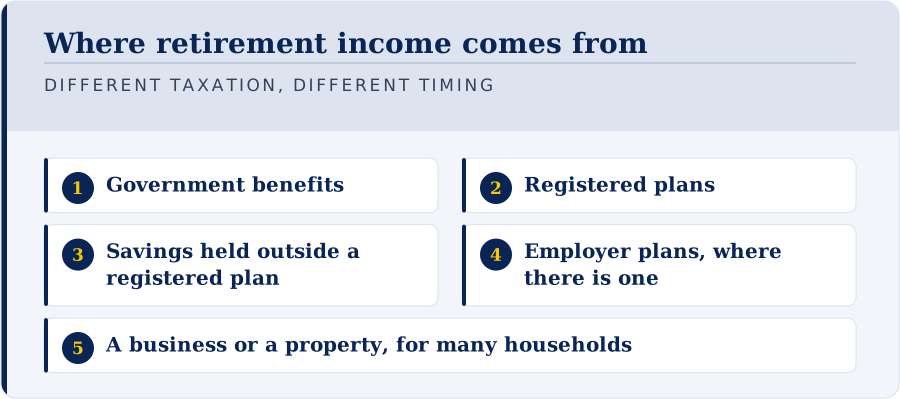
Canadian retirement income is assembled from several sources with different tax treatments and different timing: government benefits, registered plans, non-registered savings, employer plans, and for many people the value of a business or a property. Planning is largely about the order they are drawn in and the risks that determine whether the money lasts.
Retirement planning in Canada is less about a single decision than about how several sources fit together, and in what order they are drawn.
This section covers the general framework and the risks that determine outcomes. Specific situations, an incorporated professional, a business owner approaching a sale, a real estate investor, have their own pages, because each faces a different problem and not the same problem at a different scale.
What tax deferral actually is, where it exists in Canada, and why deferred is not the same as tax-free, is set out on tax-deferred growth.
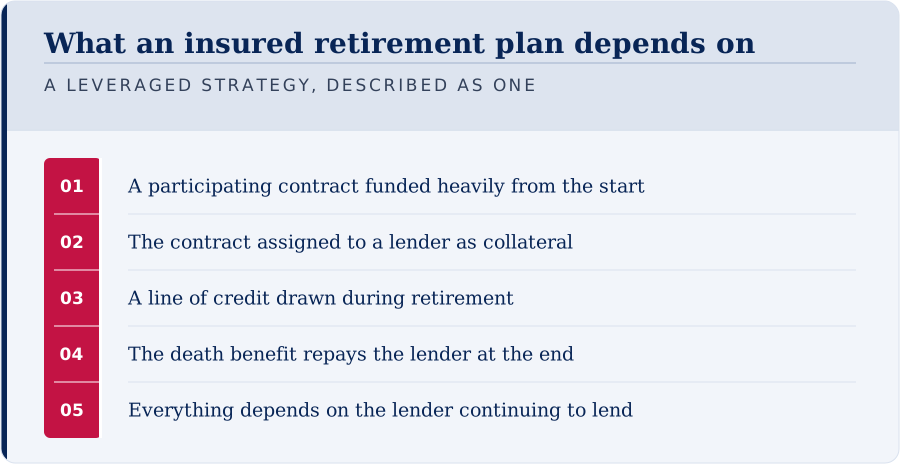
The leveraged arrangement that borrows against an assigned policy for retirement income, what it depends on and how it fails, is on insured retirement plan.
Why the picture differs for a Canadian physician, with the late start and the professional corporation, is on doctor retirement plan.
Retirement where the wealth sits in property, with its illiquidity and its tax at death, is on real estate investor retirement planning.
What Canadian retirement income is actually made of
Most people assemble income from more than one of the following, and the tax treatment of each differs.
Government benefits. The Canada Pension Plan or the Quebec Pension Plan, which reflect what was contributed over a working life, and Old Age Security, which does not. Both can be started earlier or later than the standard age, and the choice of timing changes the amount permanently. Old Age Security is also subject to a recovery at higher income levels, which makes the timing of other withdrawals a live question and not an administrative one.
Registered plans. An RRSP, converted to a RRIF or an annuity by the end of the year you turn seventy-one, with a minimum withdrawal required each year thereafter whether or not you need the money. A TFSA, from which withdrawals are not income and do not affect income-tested benefits.
Employer plans. A defined benefit pension, which pays a stated amount, or a defined contribution plan, which pays what the account supports. The difference between the two is not the size of the number; it is who carries the risk.
Non-registered savings. Taxed as earned, with capital gains, dividends and interest treated differently from one another.
A business or a property. For many Canadians the largest single asset, and the one least like income until it is sold, which introduces timing and tax questions the others do not have.
Permanent life insurance, where it exists, which is discussed below with the qualifications it deserves.
The ordering question
The technical work in retirement planning is less about which sources you have than about the sequence in which you draw them.
With that settled, the next question follows. Drawing from a RRIF first reduces the taxable balance that must eventually be withdrawn anyway. Drawing from a TFSA first preserves flexibility but wastes the sheltered growth. Drawing from a non-registered account first can be efficient where the gains are modest. Delaying government benefits raises them permanently. Each choice affects the others, and the interaction is where an accountant earns their fee.
One rule sits above the rest and this site states it repeatedly. This practice is licensed to place insurance of persons and is not registered to advise on registered accounts, so it will not rank a TFSA or an RRSP against a contract in either direction. They are not alternatives, no ordering between them is required, and the order that suits a household is arithmetic on its own figures. This practice is paid by commission on insurance, which is exactly why it says so here and not in a footnote.
The risks that decide outcomes
Accumulation is about growth. Decumulation is about survival, and the risks are different.
Sequence of returns. Once withdrawals begin, the order returns arrive in matters enormously. Two portfolios with identical average returns produce very different outcomes if one suffers poor years early, because each withdrawal during a decline locks the loss in permanently. This is the single most underappreciated risk in retirement, and it is why the years immediately before and after retiring receive disproportionate attention.
Longevity. Planning to an average life expectancy means planning to run out half the time. The risk is not dying early; it is living longer than the money.
Inflation. A fixed income loses purchasing power every year. Over a retirement measured in decades the erosion is substantial, and a plan built on nominal figures overstates what it delivers.
Health and care costs. Frequently the largest unplanned expense, arriving at the point when earning capacity is gone.
Tax and benefit interaction. Withdrawals can trigger the recovery of income-tested benefits, which behaves like an additional marginal rate. A plan optimised for investment return and ignoring this can be worse than a simpler one that accounts for it.
Where permanent insurance fits, honestly
different taxation, different timing
Where retirement income comes from
- 01Government benefits
- 02Registered plans
- 03Savings held outside a registered plan
- 04Employer plans, where there is one
- 05A business or a property, for many households
Three functions, each specific, and none of them is a substitute for a retirement plan.
Capital not subject to contribution limits. Registered plans are capped. Where room is used and surplus continues, a permanent contract is one place that capital can sit and grow without annual taxation, provided it remains exempt under Regulation 306, Income Tax Regulations. That treatment is conditional, and not automatic.
Access without the tax consequence of a registered withdrawal. Requesting an advance against a contract is a different transaction from withdrawing from a RRIF, and it does not add to income for the year in the same way. It has its own cost and its own tax treatment, set out on how a policy loan actually works.
A death benefit, which is the primary purpose. In a retirement context this matters more than it first appears, because it allows other assets to be spent and not preserved. A household holding capital back so that something remains for the next generation is funding an inheritance out of its own retirement. Coverage can do that job instead.
The qualifications belong with the functions. Participating whole life insurance is an insurance product and it is not an investment. Judged against a market portfolio as a way to grow money it usually compares poorly. It requires durable surplus cash flow and a long horizon, and it suits fewer people than are shown it.
The government layer, and what it actually replaces
Two programmes carry part of every Canadian retirement, and both are smaller than people assume.
CPP or QPP is based on contributions made across a working life. It replaces a proportion of earnings up to a ceiling, which means higher earners see a smaller share of their income replaced. An owner paying only dividends contributes nothing and accrues nothing.
Old Age Security is based on residency and not contributions, and it is subject to a recovery tax above an income threshold. A single large income year, such as a business sale or a property disposition, can trigger that recovery, which is a timing consideration and not a reason to avoid the transaction.
The Guaranteed Income Supplement is income-tested and is not available to households with meaningful other income.
Deferring either payment raises it. Both CPP and OAS pay more if started later, and the decision turns on health, other income and whether the money is needed now. It is one of the few genuinely free optimisations available and it is frequently made by default and not by decision.
Neither programme is designed to carry a household, and for anyone accustomed to a professional or business income they replace very little.
Drawing down, which is harder than accumulating
The phase that decides outcomes and receives a fraction of the attention.
The order of withdrawals matters. Registered money is fully taxable on withdrawal. Non-registered money is taxed on realised gains. A TFSA is not taxed at all. Drawing in the wrong order across twenty years costs more than most product decisions save.
Minimums are compulsory. A RRIF requires a withdrawal each year from the year after conversion, whether or not the money is needed, and it is income for purposes of the OAS recovery tax.
Income smoothing is where the value sits. Realising income in a low year and not a high one, staying under a threshold that matters, and using different sources in different years.
The lump that ruins a year is the risk. A property sale, a business disposition, a large registered withdrawal. Each can be staged.
And none of this requires a product. It requires an accountant, a plan written down, and a household that reviews it annually.
What actually goes wrong in retirement
Five, in rough order of how often they arrive.
Outliving the money. The risk no portfolio removes and the reason annuities exist at all.
A poor sequence of returns early in drawing, which removes capital that never recovers.
Health costs that are not medical. Treatment is publicly funded; the surrounding costs are not. Home adaptation, travel, and a partner reducing their own hours to provide care.
Long-term care, which is the largest single unfunded item in most Canadian retirements and is rarely modelled at all.
Cognitive decline, which puts any arrangement requiring active management at risk in exactly the years it needs it. A plan that depends on being managed at eighty-five should say so before it is adopted.
A sixth belongs beside them. Supporting adult children, which is now common enough to be a planning assumption and not a contingency, and which almost no projection includes.
Long-term care, the item nobody funds
name the alternative, or there is none
The comparison that is actually honest
- 01The usual case compares an advance to an outside loan
- 02That holds only if you would have borrowed anyway
- 03If you would not have, compare it against paying cash
- 04Interest on an advance is paid to the insurer
- 05A comparison is incomplete until the alternative is named
Named separately because it is the largest unfunded exposure in most Canadian retirements and it is almost never in a projection.
Public coverage varies by province and covers less than people assume. Facility care carries a resident charge, home care is limited, and the difference between what is publicly available and what a family actually wants is paid privately.
The duration is the problem and not the monthly cost. A short period is absorbable. Several years is not, and it arrives at the point in a retirement when the capital was supposed to be running down and not being consumed faster.
It usually falls on one spouse first, and the cost is met from assets meant to support both.
Four ways households meet it, and each has a real cost. Self-funding, which requires capital held back and therefore not spent on retirement. Long-term care insurance, which is a distinct product with its own underwriting and its own definitions. A critical illness policy, which pays a lump sum on diagnosis and is not the same thing. Family care, which is unpriced and is paid in somebody's working hours.
Model it before assuming it will not happen. A plan that works only if nobody needs care is not a plan; it is an assumption with figures attached.
Where permanent insurance genuinely fits in retirement
Stated narrowly, because this is the section a practice like this one is most tempted to overstate.
Estate liquidity. A deemed disposition at death produces a tax bill payable before assets can conveniently be sold. Coverage sized to that liability provides cash at the moment it is owed, so heirs are not forced to sell property or shares in a poor market. This is the clearest use and it is a funding job, and not a growth one.
Permission to spend. A household intending to leave something behind often underspends its own retirement to protect the inheritance. Where coverage secures the legacy, the retirement capital can be used for the retirement. The benefit is behavioural and it is real.
A dependant who will always need support. The need does not expire, so the coverage should not either.
A business obligation that survives the owner.
And where it does not fit. As a way to grow money, where it usually compares poorly. As a substitute for registered plans. As an income source arranged through borrowing, which is a leveraged strategy examined separately on insured retirement plan including how it fails.
Four uses, narrowly stated. A description that finds more than four is probably selling.
How much is enough, and why the usual answers are unhelpful
A percentage of final salary is the common rule and it assumes spending follows income, which it does not. Two households on the same salary can need very different amounts.
A multiple of savings is the other, and it says nothing about what those savings must do.
The useful method runs the other way: start from spending.
What does the household actually spend now? Three months of statements answers it, and most people are wrong about the figure by a material margin.
Which of that stops at retirement? Commuting, professional fees, mortgage payments if the mortgage ends, and saving itself, which is often the largest single line and disappears entirely.
Which of it starts? Travel early on, health costs later, and support for adult children at unpredictable intervals.
What is already guaranteed? CPP or QPP, OAS, any defined benefit pension. Subtract it.
The remainder is what capital must produce, and it is the only number in this subject worth building a plan around.
Then ask what happens if it lasts ten years longer than expected, because that is the risk the arithmetic above does not carry.
An owner's position differs enough to need its own treatment, which is on the business owner's retirement plan.
Retirement is not one date
The framing that causes most of the disappointment.
It is rarely a single stop. Reduced hours, consulting, a partial sale, a period of caregiving that ends employment earlier than intended.
The early years cost more than the middle ones. Travel and activity front-load spending, then it settles, then health costs raise it again late. A projection assuming level spending across thirty years has described nobody.
And the timing is frequently not chosen. Health, redundancy or a family obligation decides it for a substantial share of people, which is the argument for having the plan work at several possible dates and not one.
Plan for a range. A plan that only works if you retire exactly at sixty-five, in good health, having sold the business at the expected price, is a plan with a single point of failure at each of those four points.
The order that holds for most households
frequently the same person, not always
Three roles inside one contract
- One contractAll three can differ. Only the policyholder changes it, subject to any irrevocable beneficiary.
- The policyholderOwns the contract and holds its rights, subject to any assignment.
- The insuredThe person whose life is covered.
- The beneficiaryReceives the death benefit.
Not advice, and an ordering defensible in most circumstances.
Know what you spend. Everything downstream depends on it.
Fill the TFSA. Tax-free on withdrawal, fully liquid, and it does not count as income against the OAS recovery tax in retirement, which makes it unusually useful late.
Use RRSP room where the marginal rate makes the deduction worthwhile.
Decide the CPP and OAS start dates deliberately, and not by default.
Write down the drawdown order before it is needed, with an accountant.
Model long-term care rather than assuming it will not arrive.
Then consider insurance, sized to a liability the earlier steps have identified, for one of the four uses named above.
Six of those seven generate no commission. That is the most useful thing this page can tell a reader about how to weigh the rest of this site.
The conversation worth having with a spouse
Retirement is usually planned as one household and lived as two people with different information.
Both should know what exists. Accounts, pensions, policies, where the documents are, and who to contact. The commonest crisis after a death is administrative and not financial: the money exists and nobody can find it.
Both should know the drawdown plan, because the survivor will be executing it alone.
Both should understand what changes at the first death. Pension survivor benefits are frequently reduced. CPP survivor benefits are capped. Two OAS payments become one. Household costs do not halve.
And both should have agreed what happens if one needs care, before anybody does. That decision made in advance is a plan. Made afterwards it is a crisis with a bill attached, taken by whichever spouse is still able to take it, usually alone and usually quickly.
The plan that survives being wrong
A retirement plan is a set of assumptions about forty years, and several will be wrong.
Assume you live longer than expected. The error is asymmetric: money left over is a small problem and running out is not.
Assume the timing is not yours. Health, redundancy or a family obligation decides it for a substantial share of people.
Assume returns arrive in an unhelpful order at some point during drawing.
Assume care will be needed by somebody.
A plan that works under all four is conservative and dull. A plan that works only if none occurs is a forecast wearing a plan's clothing.
The three numbers worth knowing before anything else
What you spend. Three months of statements answers it, and most households are wrong by a material margin.
What is already guaranteed. CPP or QPP, OAS, any defined benefit pension.
The gap between them. That figure is what capital has to produce, and it is the only number in this subject worth building a plan around.
Everything else on this site is downstream of those three, and none of them requires a product to establish.
To see the first number stretched across a whole retirement, the retirement calculator carries today's spending forward to 65, then across three stages to 95.
The failure these pages are written against
each one taxed differently
Three ways to reach the value, often confused
- 01An advance, A withdrawal, A surrender
- 02The contractStays intact, under its terms; Value is removed permanently; Ends.
- 03The death benefitReduced while a balance is outstanding; Usually reduced, and not restored later; Ends with the contract.
- 04Can it be undoneYes, by repaying the balance; No, not by paying money back; No, and insurability may not be there again.
- 05TaxGenerally a disposition; a taxable gain can arise if the advance exceeds the adjusted cost basis; Amounts above the adjusted cost basis can be taxable; Amounts above the adjusted cost basis are taxable.
A household arriving at retirement having planned the accumulation and not the drawing.
Thirty years of contributions, and no decision made about withdrawal order, timing of government benefits, care, or what happens at the first death. Accumulating is the easier half and receives most of the attention, and the harder half arrives whether or not it was planned for.
What this section is for
Establishing what a Canadian retirement is actually made of, so that any specific plan can be checked against it. Nothing here requires a product, and most of the work that decides outcomes generates no commission for anyone.
What this section does not own
The comparison against registered accounts. The question of whether a permanent contract is preferable to a TFSA or an RRSP for a particular person is a comparison against a non-insurance alternative, which is an argument and not a description. Those live in objections and risks, where the heavier disclosure applies and where the case against is stated at the same length as the case for.
The mechanics of the contract. Cash value, dividends, the adjusted cost basis and the exempt test belong to policy basics, which is the reference layer for this whole site.
The corporate analysis. How corporate surplus is taxed while held, and how a death benefit, less the policy's adjusted cost basis, is credited to the Capital Dividend Account, belongs with business owners.
The specific situations
Each of these faces a different problem, which is why each has its own page and not a section here.
The incorporated professional, whose retirement savings and business are the same pool of money, and whose contribution room is affected by how they pay themselves.
The business owner approaching a sale, for whom the retirement plan and the succession plan are one exercise, and for whom the timing of a sale can matter more than any investment decision.
The real estate investor, holding assets that produce income but are not liquid, and facing a deemed disposition on property that has appreciated for decades.
The insured retirement plan, which is a specific arrangement with specific requirements and specific ways of going wrong, and which is frequently described with more confidence than it deserves.
What to establish first
Before any product conversation, four things.
What the government benefits will actually pay, and when. Service Canada and Retraite Québec both provide estimates. Most people are surprised in one direction or the other.
What registered room remains. The notice of assessment states it. If there is meaningful unused room, that is the conversation to have first.
What the minimum withdrawals will be. A RRIF requires a withdrawal each year regardless of need, and for some households the forced withdrawal, not the spending, is what drives the tax bill.
The question of whether an inheritance is an objective. If it is, say so, because it changes the whole plan. If it is not, that changes it too, and a great many people have never been asked. A decision this size can wait a week.
Only after those four does a question about any product become answerable.
A thirty-minute discovery meeting
A first conversation establishes whether this fits. No illustration is prepared and nothing is arranged.
Often the answer is no, and you will hear it during the call rather than in a proposal afterwards.
This form reaches Canadian Wealth Creation Centre Inc. Any meeting, any advice and any insurance product is provided by Canadian Wealth Creation Centre Inc., through its representatives who are licensed in the client's province. IBC Financial is the company's educational website: it distributes no product and no financial service, and it gives no individualised advice.
How Canadians Use Permanent Insurance in Retirement
Where a contract sits beside your RRSP and TFSA, what an insured retirement plan depends on, and what the words tax free really mean in retirement.
| Business Owners Retirement PlanHow retirement planning differs when the wealth is in the business: the vehicles available, why the exit is the funding event, and what happens if it fails. | Read more |
| Doctor Retirement PlanWhy retirement planning differs for a Canadian physician: the late start, no employer pension, incorporation, and what each vehicle actually does. | Read more |
| How can a Canadian dentist plan retirement income without an employer pension? NEWA retirement guide for Canadian dentists without a pension: registered plans, the practice sale, corporate savings, policy loans, tax rules and their risks. | Read more |
| Insured Retirement PlanWhat an insured retirement plan is, why the loan comes from a lender rather than the insurer, what the structure depends on, and how it fails in practice. | Read more |
| Insured Retirement Plan or Infinite Financial Sovereignty®: One Policy, Two Uses NEWAn insured retirement plan and this practice's family-capital approach use one policy in opposite ways: who advances the money, when, the tax and the risks. | Read more |
| Is It Too Late After 65? Whole Life Insurance as a Warehouse of Wealth for Affluent Retirees NEWWhole life insurance after 65 or 72 in Canada: underwriting, cash value, policy and collateral loans, tax, rental income and legacy, with the limits stated. | Read more |
| Real Estate Investor Retirement PlanningRetirement when the wealth is in property: the illiquidity problem, the tax bill at death, concentration, and the exit that has to be planned years ahead. | Read more |
| Retirement Income From a Contract and the Word Tax-FreeWithdrawal, policy loan or collateral loan: how section 148 of the Income Tax Act treats each way value leaves a participating contract in retirement. | Read more |
Common questions
Should I fill my RRSP and TFSA before a contract?
What is sequence of returns risk?
Does permanent insurance replace a retirement plan?
When does the insurance conversation actually make sense?
What about my corporation?
How much do I actually need to retire in Canada?
In what order should I draw my retirement income?
Should I start CPP early or defer it?
What is the OAS recovery tax?
When do I have to convert my RRSP, and what happens then?
What is the difference between a defined benefit and a defined contribution pension?
How should I plan for long-term care?
What changes financially when the first spouse dies?
What actually goes wrong in retirement?
What should I establish before any product conversation?
Can life insurance let me spend more of my own retirement money?
Are the Quebec Pension Plan and the Canada Pension Plan the same thing?
In Quebec, what is a VRSP, and does it count as a pension?
Sources
- Income Tax Regulations, Regulation 306, Justice Laws Canada, verified 2026-08-21
- Assuris, published protection limits, verified 2026-08-21
About the author

Jose Salloum is a Financial Security Advisor (conseiller en sécurité financière) certified by the Autorité des marchés financiers in Quebec, a Life and Accident & Sickness Insurance Agent licensed by the Financial Services Regulatory Authority of Ontario, and a Life Insurance Agent licensed by the Insurance Council of British Columbia. Licensed since 2001.
He has practised Infinite Banking since 2015 and founded Canadian Wealth Creation Centre Inc. in 2016. From 2020 to 2024 he was an IBC (Infinite Banking Concepts™) Authorized Practitioner of the Nelson Nash Institute, a private certification rather than a regulatory licence.
IBC Financial is the educational website of Canadian Wealth Creation Centre Inc., open to all Canadians. Services come only from Canadian Wealth Creation Centre Inc. Its representatives hold a licence in each province served: Quebec, Ontario, Alberta, British Columbia, Manitoba and New Brunswick. Jose Salloum's own licences cover Quebec, Ontario and British Columbia. This page is general education and not advice on any individual file.
Last reviewed 2026-08-21. By Jose Salloum, Financial Security Advisor in Quebec. In Ontario, Life and Accident & Sickness Insurance Agent. In British Columbia, Life Insurance Agent.