

The Honest Case Against, and What It Gets Right
The strongest arguments are mostly correct: early cash value is low against premiums paid, the commitment is long and costly to leave, a household without durable surplus has cheaper places for its money, and comparing a policy loan with an outside loan is the wrong test for anyone who would have paid cash. The policy is insurance, not a savings or investment account, and a policy loan is an advance from the insurer. Your household and the contract's guaranteed values decide the rest.
The strongest arguments against using participating whole life insurance for the financing approach known as The Infinite Banking Concept® are mostly correct. Early cash value is low against the premiums you pay. The commitment is long and expensive to leave. A household without durable surplus has cheaper places for its money. And the comparison supporters offer, a policy loan set against a loan from an outside lender, is the wrong one for anyone who would have paid cash. None of that makes the product unlawful or useless. It makes it narrow, and it means the decision belongs to your household's figures rather than to a slogan.
Start with what the thing is, because every objection turns on it. A specially designed, high-cash-value, participating whole life insurance policy is insurance: a contract under which an insurer pays a death benefit when the person insured dies, whenever that happens, in exchange for premiums. It is not a savings account or an investment account, and no deposit insurance applies to it. It does build a cash value, and the owner can ask the insurer for an advance against that value. That advance is a loan from the insurer, with interest owed to the insurer.
What exactly is being criticised?
The criticism is aimed at a method more than at a product. The method funds a specially designed, high-cash-value, participating whole life insurance policy, sometimes above its minimum premium where the contract allows extra deposits, lets the cash value build over years, and then uses policy loans to pay for large purchases, repaying them on a schedule the owner sets. The product underneath is ordinary participating whole life insurance, issued by a licensed insurer and governed by provincial insurance law.
The vocabulary is part of what is criticised. The concept was set out by Nelson Nash, and the name The Infinite Banking Concept® and the title of his book are marks of Infinite Banking Concepts, LLC. Those words name a body of literature, not anything a Canadian licensed advisor provides, and they suggest a degree of control and independence that a contract with an insurer does not give. What the owner holds is a contract, administered by the insurer under its terms. Nobody becomes an institution. Technical terms used in these arguments are defined in the glossary.
The objections sort into three questions, and sorting them first saves a lot of confusion:
- Is the product what it is described as? A question of accuracy. It is an insurance contract, and where it has been sold as an investment, the criticism that follows is deserved.
- Does it cost more than the alternative? A question of arithmetic. Judged only as a way to grow money, it can lose to a low-cost portfolio, because part of every premium pays for insurance the portfolio does not provide.
- Does it suit this household? A question about you rather than the product, and the only one of the three that decides anything.
What do the critics get right?
Seven objections carry real weight. Each is set out as a critic would put it, with a verdict. The full list of nine, including the ones that are only partly conceded, is at what critics get right.
"It is a poor investment"
Compared with a low-cost equity portfolio over decades, the internal return on a participating policy is lower. Correct, when the test is growth. The policy pays a death benefit the portfolio does not, and the cost of that benefit sits inside the figure being criticised. Anyone told that it wins as a growth vehicle has been told something false, and anyone who does not want permanent coverage should not buy it to grow money.
"The fees are hidden"
A fund publishes a management expense ratio. A participating policy has no standardised equivalent that puts the whole cost in one percentage. The objection stands in part. Costs are absorbed inside the participating account and the contract's own charges. What you can ask for is the stated charges where the contract lists them, and the guaranteed schedule, which prices the whole structure in numbers you can read. That is a better tool for knowing what you own and a worse one for comparing products.
"You lose money in the early years"
Surrender in year three and you receive materially less than you paid. Correct. Acquisition costs fall heaviest at the start, and the contract is unforgiving of a change of mind. The figure was in the illustration's guaranteed column all along. The honest conclusion is about suitability: the product suits a household that can leave the money in place for a long time, and nobody else.
"It is sold to people it does not suit"
Compensation is paid when the policy is issued, the product is hard to evaluate, and a buyer may not be able to assess what is being shown. Correct, and the most serious of the seven. It is an objection to distribution rather than to the contract, which makes it no less serious for a household that was mis-sold. Ask who should not buy it, ask for the guaranteed column, and ask how the advisor is paid. The answers, and the reaction to the questions, tell you a lot.
"The dividends are not guaranteed"
Projections rest on a dividend scale the insurer can change. Correct. The guaranteed values are contractual; everything above them depends on dividends declared at the insurer's discretion. The scale is not arbitrary: it reflects the participating account's investment results, claims and expenses, as the insurer's dividend policy describes. A long record of paying dividends is evidence, not a commitment.
"The comparison is rigged"
Supporters set a policy loan against a loan from an outside lender and count the difference as a gain. Correct for anyone who would have paid cash, and dealt with in full in the next section.
"The language oversells it"
Correct. The slogans in this field promise independence from lenders and a kind of private institution. A policy delivers neither. It gives the owner a contractual right to request an advance from the insurer against the cash value, on the contract's terms. That access is real and can be useful. It is not independence.
Two other objections come up: that the insurer keeps your cash value at death, and that the whole thing is a scam. The first is partly correct and the second is not. Each has its own section below.
What should a policy be compared against?
The usual case for the strategy compares a policy loan with a loan from an outside lender and concludes that the owner keeps interest that would otherwise have left the household. It does not. Interest on a policy loan is owed to the insurer and paid to the insurer. And if you would never have borrowed for the purchase, the honest alternative is paying from savings, which costs no interest at all, although it uses your cash and gives up what that money would otherwise have earned. Measured against that, the advantage is much smaller than the usual presentation suggests, and sometimes it disappears. The argument is worked through at the comparison question.
The other standard alternative is to buy term life insurance and invest the difference. When the need for coverage is temporary, that route can do the insurance job for much less. Stated as a universal rule, it assumes the difference is actually invested, that it stays invested through a bad market, that the term coverage is renewed or replaced when it ends, and that you remain insurable. A fair comparison uses what you would really do, not a disciplined ideal.
Registered plans raise the same kind of question. A TFSA, an RRSP or an FHSA does a different job from life insurance, but contributions and premiums can draw on the same surplus dollars. Whether a policy would displace registered room belongs in the conversation before any contract is discussed. This practice is licensed to place insurance of persons and is not registered to advise on registered plans, so it gives no ordering between them and a policy, in either direction. Put registered-plan questions to a professional licensed for them. A general rule on that ordering, whichever way it points, is a sales argument rather than advice.
A comparison worth trusting has six features, and one that lacks any of them leans in some direction:
- The guaranteed column, not only the projection.
- Fees treated the same way on both sides: after fees against after fees.
- The death benefit priced, since only one of the two products provides one.
- A realistic alternative: what your household would actually have done.
- The early years shown, because year three matters more than year thirty to anyone who may not stay thirty years.
- The failure cases named: lapse, surrender, and a loan outstanding at death.
Done properly, such a comparison shows two things at once. Permanent insurance is an expensive way to grow money, and it provides something a portfolio does not. A presentation that offers only one of those halves is advocacy, not analysis.
How does borrowing against a policy actually work?
conceded before anything is answered
What the critics get right
- 01Early cash value is low against the premium paid
- 02The commitment is long and costly to abandon
- 03Costs are not disclosed line by line
- 04A household without durable surplus has cheaper places to hold money
- 05The comparison usually offered is the wrong comparison
A policy loan is an advance from the insurer, made under the contract and secured by the policy's cash value. You owe the insurer. The insurer sets the interest rate and may change it as the contract allows, and the interest is owed to and paid to the insurer; it does not come back to you. Depending on the contract, unpaid interest can be added to the loan balance. While the loan is outstanding, the insurer deducts the balance and the accrued interest from the amount paid when the person insured dies. Some contracts also change the dividend credited on the borrowed portion, so ask where your contract says so.
A collateral loan is a different transaction. An outside lender, such as a bank, lends to you and takes an assignment of the policy as security. You owe that lender, which sets the rate and the conditions, including when it can call the loan, and the interest goes to it. If the loan is still owing at death, the lender, as assignee, can be paid from the death benefit.
The third route is simply paying from savings. There is no lender and no interest. The cost is what that money would have earned and the cushion you no longer hold.
| Route | Who advances the money | Who receives the interest | Who sets the rate | Effect at death | Main tax point |
|---|---|---|---|---|---|
| Policy loan | The insurer, under the contract | The insurer | The insurer, which may change it | Balance and interest are deducted from the death benefit | A disposition; income only to the extent the proceeds exceed the adjusted cost basis |
| Collateral loan | An outside lender | That lender | That lender, under its own terms | The lender, as assignee, can be paid from the death benefit | Assigning the policy as security is not a disposition |
| Paying from savings | Nobody | Nobody | Not applicable | None on the policy | Whatever applies to the savings you draw on |
Tax follows the route. Under section 148 of the Income Tax Act, a policy loan is a disposition of an interest in the policy (the definition of "disposition", paragraph (b)), but only the part of the proceeds above the policy's adjusted cost basis immediately before the loan is income (subsection 148(1)). The loan lowers that basis. Repaying it restores the basis and can give a deduction in the year of repayment, up to amounts previously included in income (paragraph 60(s)). Assigning a policy as security for a loan from another lender is not a disposition (paragraph (f) of the same definition). Loan interest can be deductible only when the borrowed money is used to earn income from a business or property, and then only as the insurer verifies it on CRA Form T2210; interest on money used for personal spending is not deductible. That is our reading of the provisions, not a ruling. The mechanics and the tax are set out at how policy loans work.
What does the policy really cost, and why is early value low?
The costs are real and front-loaded: the cost of the insurance itself, the advisor's commission, the contract's own charges, and loan interest whenever capital is drawn. A large share of the early premiums goes to them, so the cash value in the first years sits well below what you have paid and closes the gap slowly. That is a structural feature rather than a penalty, and it is disclosed in the guaranteed column of the illustration. What each cost is, and how to measure it when no single fee figure exists, is at the real costs.
Illustrative example. Assume you pay $10,000 a year for three years, $30,000 in total, and the guaranteed cash surrender value at the end of year three is $18,000. The figures are chosen to show the arithmetic, not taken from any contract. If you surrender then, you receive $18,000, less any loan outstanding, and the $12,000 difference is gone for good. Your own illustration's guaranteed column shows the real figure for each year; read years one to ten before anything else.
The simplest cost test needs no formula. Put cumulative premiums beside the guaranteed cash value, year by year, and find the year where the second passes the first. That year depends on the contract and its design, and it tells you how long you must be sure of staying before leaving stops costing you part of what you paid. Ask for it in writing.
Opportunity cost is the one no illustration shows. Money placed in a policy is not somewhere else, and whether that trade is worth making depends on what the money would otherwise have done in your household.
What happens if premiums stop or the policy lapses?
Stopping premiums does not have one outcome; the contract decides. Depending on the contract and the values in it, dividends may be applied to pay or reduce premiums, an automatic premium loan may pay them from the cash value (a loan that bears interest and reduces what is paid at death), or the policy may be converted to reduced paid-up insurance: lower coverage with no further premiums. If none of those applies and nothing is paid, the policy can lapse and the coverage ends. Ask the insurer, in writing, for stop-paying scenarios at the years that matter to you, with the loan balance shown.
A lapse with a loan outstanding is one of the two endings that do the most damage. Loan interest keeps adding to the balance, and when the balance overtakes the value securing it, the contract can end under its terms. For tax, the proceeds of that disposition are the cash surrender value less the policy loans owing, so the small cheque, or no cheque at all, is not the figure that decides the gain. Income arises only to the extent the proceeds exceed the adjusted cost basis, but a tax bill can still arrive in a year with no cash and no coverage. Before you surrender, or let a policy with a loan end, ask the insurer in writing for the disposition proceeds, the loan settlement, the adjusted cost basis and the tax slip it expects to issue, and have an accountant review them even if little money changes hands.
A narrow exception exists. The definition of "disposition" excludes a lapse caused by unpaid premiums if the policy is reinstated no later than 60 days after the end of the calendar year in which it lapsed (paragraph (g)). It is written for premium lapses. If a contract ends because the loan overtook its value, ask the insurer and your accountant in writing whether the exception can apply; do not assume it does. Reinstatement itself is the insurer's decision under the contract, and in Quebec a reinstatement starts the two-year period and any suicide exclusion again (Civil Code, art. 2434).
Attention reduces this risk; it does not remove it. Reviews and a repayment plan help, but they cannot protect against a fall in income or a balance that grows faster than expected. When the margin between the loan and the value securing it is narrow, check it more often than the annual statement allows.
Which failure modes should you know about before signing?
the commonest reasons it fails
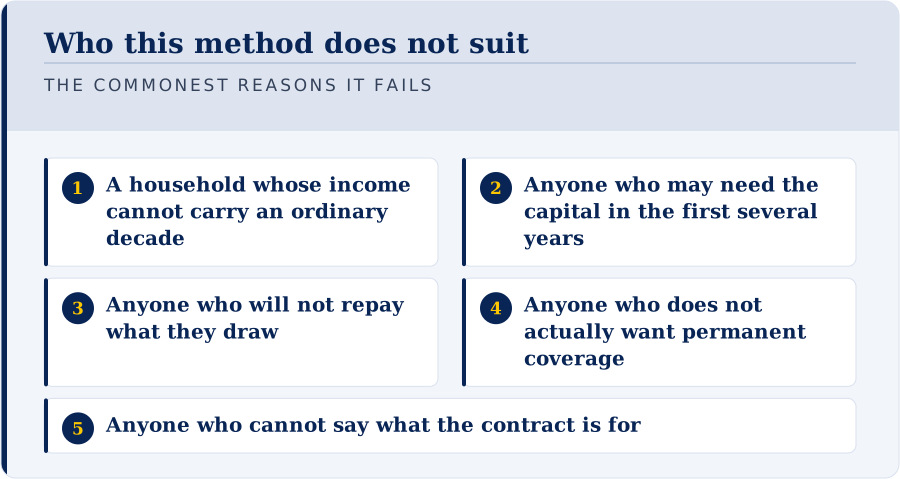
Who this method does not suit
- A household whose income cannot carry an ordinary decade
- Anyone who may need the capital in the first several years
- Anyone who will not repay what they draw
- Anyone who does not actually want permanent coverage
- Anyone who cannot say what the contract is for
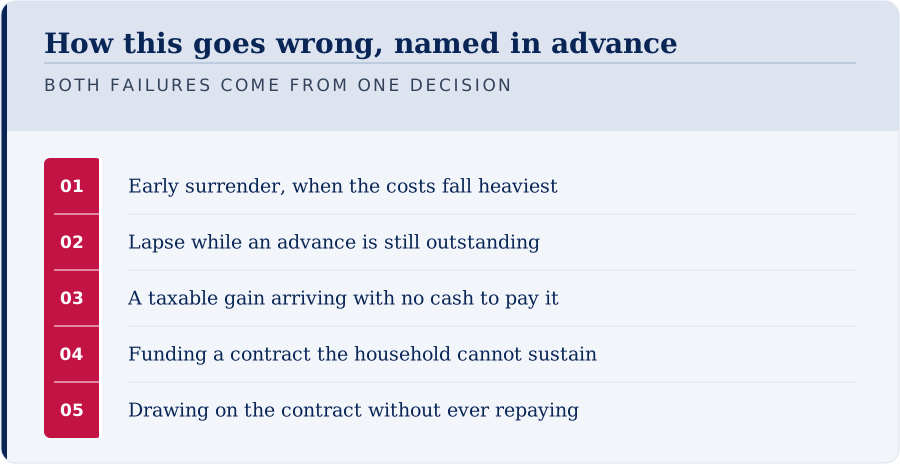
An objection says the product is a poor choice. A failure mode is what happens when a reasonable choice goes wrong. Which one threatens you depends on your cash flow, the design and how the policy is serviced, so they are listed here without a ranking. Each is examined in risks and failure modes.
- Early surrender. The contract ends when it returns least, and income can arise on the part of the proceeds above the adjusted cost basis.
- Lapse with a loan outstanding. Coverage ends and income can arise, possibly with no cash to pay the tax.
- Funding sized to a good year. A premium set on an exceptional year fails in an ordinary one, and stopping partway can cost more than never starting.
- Drawing without repaying. Loans that are never repaid shrink the death benefit and can move the policy toward lapse.
- Funding beyond the exempt limit. A policy that ceases to be exempt is deemed to have been disposed of (paragraph 148(2)(d)), which can create income, and it loses the tax treatment that exempt status gave it.
- A design that does not match the purpose. Some choices, such as riders and funding room, are set at issue, and changing them may take a new contract at an older age.
- An orphaned contract. The advisor has left, nobody reviews the dividend option or the loan balance, and the beneficiary designation is years out of date.

Does the insurer keep the cash value when the person insured dies?
Partly, in the sense critics mean. When the person insured dies, the beneficiary receives the death benefit, not the death benefit plus the cash value. The AMF says so plainly: the cash surrender value is not payable on death; the amount of insurance is (AMF, in French). On that point the objection describes the payout correctly.
What it misreads is the structure. The cash surrender value is not a separate account sitting beside the contract; it is a value inside the same contract, and for as long as the death benefit is the larger figure, the beneficiary receives the larger figure. As the cash value grows, the insurer's amount at risk, the death benefit minus the cash value, shrinks. The cash value is part of what funds the death benefit, so nothing extra is taken from you at death, but the pure insurance protection does shrink over time. Dividends used to buy paid-up additions can raise both figures, depending on the dividend option chosen. Any policy loan and interest owing are deducted from what is paid.
Contracts differ at advanced ages. Some are designed so that the guaranteed cash value reaches the face amount at a stated age; others keep the coverage in force past 100 on terms the contract sets. A policy written to age 100 does not necessarily endow. The difference matters for tax as well, because the maturity of a policy is a disposition (subsection 148(9), definition of "disposition", paragraph (c)). Ask for the guaranteed cash value and death benefit rows at ages 85 and 100, and for the clause that says what happens at 100. An illustration that stops before those ages cannot answer the question.
The fair version is simple: at death the beneficiary receives one amount, not two, and the contract tells you what that amount is at every age.
Do American criticisms apply to a Canadian policy?
If the criticism you have met came from an American source, it describes American law. Arguments built on the US modified endowment contract rules, or on section 7702 of the US Internal Revenue Code, do not govern a Canadian contract. Canada has its own limit, which does a similar job: the exempt test in Regulation 306 of the Income Tax Regulations caps how much a policy can accumulate relative to its insurance while keeping its tax treatment. There is no Canadian modified-endowment category; instead, a policy that ceases to be exempt is deemed to have been disposed of (paragraph 148(2)(d)). How the test works is set out at the exempt test.
Other differences travel with the tax code. The words a Canadian business may use to describe itself are restricted, the protection behind a Canadian policy is Assuris rather than an American state guaranty fund, and the person advising you must hold a provincial licence. Each is explained at American videos and Canadian law.
A Canadian reader who takes an American critique at face value is warned about rules that do not govern the contract and told nothing about the ones that do.
Is the corporate case different?
Criticism written for a personal buyer does not transfer directly to a corporation. For an incorporated business owner the arithmetic changes, because the corporation's surplus is taxed while it is held inside the company and because of what happens at death. When a private corporation receives life insurance proceeds as beneficiary because of a death, its capital dividend account is credited with the proceeds less the policy's adjusted cost basis immediately before the death (subsection 89(1), definition of "capital dividend account", paragraph (d)). A capital dividend is paid out of that account only if the corporation makes the election under subsection 83(2). Who owns the policy, who is the beneficiary and whether a loan or a collateral assignment is in place can all affect the result, so the corporation's accountant should calculate it before anyone relies on it. The payment itself is described at paying a capital dividend after a death.
Leverage has its own history. Two arrangements built on borrowing against a contract, the 10/8 arrangement and the leveraged insured annuity, are now defined in the Income Tax Act and lose the tax benefits they relied on; the capital dividend account paragraph just cited leaves out the proceeds of an LIA policy. The arrangements and the rules that ended them are at the 10/8 arrangement and the leveraged insured annuity.
None of that makes a policy suitable for a corporation. It makes the question different, to be answered on the corporation's own facts.
How safe is the policy if the insurer fails?
each one is wrong, and correctable
Claims that should never be made
- 01That you are borrowing your own money
- 02That you pay the interest to yourself
- 03That an advance leaves the contract untouched
- 04That it replaces a registered plan
- 05That the dividends are guaranteed
The guarantees in the contract are obligations of the insurer that issued it, not of any government, and CDIC deposit insurance does not cover life insurance policies. Each insurer's solvency is supervised according to its charter: by OSFI for a federally incorporated insurer, and by its home province for a provincially incorporated one, which in Quebec means the AMF.
Behind the insurers stands Assuris, an independent, not-for-profit, industry-funded compensation organisation. Every life and health insurer authorised to sell insurance in Canada is required to be a member. If a member fails, Assuris states that a whole life policyholder keeps up to $1,000,000 or 90% of the promised death benefit, whichever is higher, and up to $100,000 or 90% of the promised cash value, whichever is higher. Both are calculated on the net values after policy loans are deducted (Assuris, whole life protection).
Illustrative example. Assume a death benefit of $500,000, a cash value of $150,000 and a policy loan of $100,000. The net death benefit is $400,000, which is under $1,000,000, so under the published limits it would be protected in full. The net cash value is $50,000, under $100,000, so it would also be protected in full. The figures are chosen for the arithmetic; Assuris's own pages are the authority on how a claim is calculated.
Two checks take a few minutes: which regulator supervises your insurer, and whether it appears on Assuris's list of members.
Is it legitimate, or is it a scheme?
It is legitimate in the sense that matters legally. A specially designed, high-cash-value, participating whole life insurance policy is an insurance contract regulated under provincial insurance law, issued by insurers supervised for solvency as described above, and sold by agents whose licences appear in public registers kept by the licensing bodies, such as the AMF in Quebec, FSRA in Ontario and the Insurance Council of British Columbia. There is no recruitment structure and no return paid out of later buyers' money, and the terms are in a document you can read before signing. The longer answer, including how to check an advisor's licence, is at is it legitimate?
Legitimacy is still not the useful question, because a product can be entirely lawful and entirely wrong for your household. The claims made in favour of the approach that are simply wrong, with the correct version of each, are listed at claims that should never be made.
What has a Canadian regulator actually acted on?
One Ontario case is directly relevant. On 22 December 2022, the Financial Services Regulatory Authority of Ontario (FSRA) announced a compliance order against Greatway Financial Inc., a managing general agency, which consented to it. FSRA had earlier issued a notice of proposal alleging acts that could amount to an unfair or deceptive practice under Ontario's Insurance Act. Its concern was the training Greatway gave its contracted agents. FSRA alleged that those agents might give consumers inappropriate, inaccurate or misleading information and advice about the terms, benefits or advantages of certain policies. These included universal life policies sold under an insured retirement plan strategy (FSRA announcement).
Under the order, Greatway would deliver revised training to its agents, send existing universal life policyholders information to help them assess whether the policy was appropriate for their circumstances, and support policyholders who raised concerns with their insurer. The allegations were not a ruling about participating whole life insurance or about the concept criticised here, and the product named was universal life. The lesson covers both accurate presentation and whether a policy suits the person buying it.
The same risk attaches to any policy sold with the language of saving and investing, which is why a policy is described here as insurance first. What goes wrong when life insurance is sold as an investment is set out at life insurance is not an investment.
If you believe a policy was sold to you on an inaccurate description, there is a route. Speak to a lawyer promptly, or in Quebec a lawyer or notary, because deadlines apply.
Who makes these criticisms, and what does that tell you?
five components, each behaving differently
What a participating contract costs
- 01The mortality chargeBuys the death benefit.
- 02CompensationWeighted to the first year.
- 03Policy and administration feesBuilt into the premium; ask the insurer which are stated separately.
- 04Provincial premium taxIncluded in the premium.
- 05Loan interestOnly if capital is actually accessed.
Criticism comes from different places, and each source looks at something different:
- Advocates of low-cost investing. Their objection is cost: permanent insurance is expensive as a way to grow money, and for a temporary need, term insurance plus investing does the job for less. Largely correct, and not disputed here.
- Consumer advocates and journalists. Their objection is the sales process: a complex product, compensation weighted to the first year, and buyers who cannot evaluate what they are shown. Also largely correct, and a criticism of distribution rather than of the contract.
- Regulators. Their concern is presentation and appropriateness, as the Ontario case shows.
- Competing advisors. Some criticism is competitive rather than analytical, and you can recognise it by what it leaves out: any mention of what permanent coverage provides that a portfolio does not.
- Practitioners who oversell it. The strongest case against the product can be made, without meaning to, by people selling it badly.
What should you ask for before you decide?
An illustration answers the objections above only if you ask for the right rows. Leave the figures to the insurer; what matters is that every row below is on paper before you sign.
| Ask for | At which years or ages | What it answers |
|---|---|---|
| Guaranteed cash value and guaranteed death benefit | Years 1, 3, 5, 10 and 20; ages 85 and 100 | The cost of leaving early, and what the contract promises without dividends |
| Values at the current dividend scale | The same rows | What the insurer projects if today's scale continued, which it may not |
| Values at a reduced dividend scale | The same rows | How much of the projection depends on dividends |
| A stop-paying scenario | Stopping at year 5 and at year 10 | Whether coverage continues, at what amount, and under which option |
| A loan scenario | A loan in a year you choose, repaid and not repaid | How the loan, its interest and the death benefit interact |
| The adjusted cost basis | Today, and in the year of any loan | How much of a loan or a surrender could be income |
| The clause on what happens at age 100 | Not applicable | Whether the policy matures, continues or changes |
Questions for the advisor, before any application:
- Who should not buy this, and could I be one of them?
- What does the guaranteed column show at year three?
- How are you paid on this policy, and when?
- Which of the standard objections applies to what you are showing me?
- What happens if I can pay for five years and then cannot?
Questions for the insurer, in writing: how the loan rate is set and whether it can change; whether a loan changes the dividend credited; which options the contract offers if premiums stop; and what it would report for tax on a loan or a surrender. Questions for your accountant: what a loan, a surrender or corporate ownership would mean on your return, and, for a corporation, what its capital dividend account would receive at death.
Who is this wrong for?
Any one of these is enough:
- The need is temporary: a mortgage, children who will become independent, a loan that will be repaid. Term insurance does that job for a fraction of the cost.
- The capital does not exist yet. Nothing here works before there is money to put into the policy, and in its early years there is little to draw on.
- The money might be needed within the first ten years.
- The funding depends on a good year rather than an ordinary one.
- High-rate debt is outstanding.
- You do not want permanent coverage for its own sake. Without that, the contract is a financing arrangement wearing an insurance policy.
- Nobody will give you a straight answer about what the guaranteed column shows at year three. That is a fact about the advisor rather than the product, and it is enough on its own.
Being on this list is not a judgement of anyone. A household that fits one of these points has other tools that suit it better today, and circumstances change.
Why would a practice publish the case against its own product?
Because the objections are largely true, and a site that left them out would be inaccurate by silence, which is the same failure as inaccuracy by statement and harder to spot. You may meet them anyway, from someone with the opposite commercial interest, and without the partly wrong ones separated from the right ones.
Because a dispute about a policy can start with an expectation the contract never met. Read carefully, the objections above are a list of those expectations, and a household that holds them up against its own plan before signing is unlikely to be surprised later.
And because you deserve to know who is talking. Reading here is free. The firm behind this site is paid by the insurer, by commission, if a policy is bought through it, as the author page states. The material is worth reading; it is not worth reading uncritically. Whole life insurance is an insurance product, not an investment, and slow decisions age better than fast ones.
A thirty-minute discovery meeting
A first conversation establishes whether this fits. No illustration is prepared and nothing is arranged.
Often the answer is no, and you will hear it during the call rather than in a proposal afterwards.
This form reaches Canadian Wealth Creation Centre Inc. Any meeting, any advice and any insurance product is provided by Canadian Wealth Creation Centre Inc., through its representatives who are licensed in the client's province. IBC Financial is the company's educational website: it distributes no product and no financial service, and it gives no individualised advice.
The Honest Case Against Infinite Banking, Before You Decide
What critics get right, what it really costs, how policies fail and why American videos mislead Canadians. Read these first: the strongest objections are the most useful test.
| American Videos on This Strategy and Canadian Law UPDATEDWhy an American video on this strategy does not translate to Canada: the vocabulary Canadian law restricts, the tax rules that differ, and what to check. | Read more |
| Is It Legitimate? UPDATEDWhether The Infinite Banking Concept® is legitimate is three questions at once. The contract is regulated insurance; the selling is what draws criticism. | Read more |
| Risks and Failure Modes UPDATEDThe ways a participating contract goes wrong in practice: early surrender, lapse with a loan outstanding, overfunding, wrong design, and loss of exempt status. | Read more |
| The 10/8 Arrangement and the Leveraged Insured Annuity, and Why They Ended UPDATEDWhat a 10/8 policy and an LIA policy were, the provisions of the Income Tax Act that ended them in 2013, and what those rules still ask of leverage today. | Read more |
| The Comparison Question UPDATEDThe usual case for this strategy compares a policy loan with borrowing from an outside lender. For most people the honest comparison is their own savings. | Read more |
| The Real Costs UPDATEDWhat a participating whole life contract costs, why the costs are not itemised the way a fund's fees are, and how to measure them anyway, year by year. | Read more |
| What Critics Get Right UPDATEDNine arguments made against using participating whole life insurance to hold capital, each stated at its strongest, and each given a plain verdict. | Read more |
Common questions
Is this a scam?
Do critics of this approach have a point?
Who should not do this?
What are the most serious risks?
Does the insurance company keep my cash value when I die?
Should I fill my TFSA and RRSP before a contract?
Why is the early cash value so much lower than the premiums paid?
Is my money safe if the insurer becomes insolvent?
Does opportunity cost make this a bad choice?
Why would a practice publish the arguments against its own product?
What has a Canadian regulator actually acted on?
Are the criticisms about the contract or about how it is sold?
Is the language used in this field overstated?
Where should a sceptical reader start?
Who receives the interest on a policy loan?
What happens if I stop paying premiums?
Are policy loans taxable in Canada?
Sources
- Income Tax Act, R.S.C. 1985, c. 1 (5th Supp.), subsection 148(1), paragraph 148(2)(d) and subsection 148(9) (definitions of disposition, paragraphs (b), (c), (f), (g) and (j), policy loan, and proceeds of the disposition), Justice Laws Canada, verified 2026-09-29
- Income Tax Act s. 89(1), definition of capital dividend account, paragraph (d) (proceeds less adjusted cost basis immediately before the death; LIA policy excluded), Justice Laws Canada, verified 2026-09-29
- Income Tax Act s. 83(2), capital dividend election by a private corporation, Justice Laws Canada, verified 2026-09-29
- Income Tax Act paragraph 60(s) (deduction for repayment of a policy loan, up to amounts previously included), Justice Laws Canada, as recorded on this site's policy loans page, verified 2026-09-16
- Canada Revenue Agency, Form T2210, Verification of Policy Loan Interest by the Insurer, verified 2026-09-28
- Income Tax Regulations, Regulation 306, Justice Laws Canada, verified 2026-08-21
- Civil Code of Québec, art. 2434 (reinstatement restarts the two-year period and any suicide exclusion), LégisQuébec, as read for this site, verified 2026-09-27
- Assuris, whole life protection (limits, calculated net of policy loans) and home page (membership requirement; independent, industry-funded organisation), verified 2026-09-29
- Financial Services Regulatory Authority of Ontario, FSRA issues compliance order against Greatway Financial Inc., announcement of 22 December 2022, verified 2026-09-29
- Autorité des marchés financiers, Comment utiliser une valeur de rachat sans mettre fin à son assurance (surrender value at death, unpaid premiums, policy advances, borrowing from another institution), verified 2026-09-29
About the author

Jose Salloum is a Financial Security Advisor (conseiller en sécurité financière) certified by the Autorité des marchés financiers in Quebec, a Life and Accident & Sickness Insurance Agent licensed by the Financial Services Regulatory Authority of Ontario, and a Life Insurance Agent licensed by the Insurance Council of British Columbia. Licensed since 2001.
He has practised Infinite Banking since 2015 and founded Canadian Wealth Creation Centre Inc. in 2016. From 2020 to 2024 he was an IBC (Infinite Banking Concepts™) Authorized Practitioner of the Nelson Nash Institute, a private certification rather than a regulatory licence.
IBC Financial is the educational website of Canadian Wealth Creation Centre Inc., open to all Canadians. Services come only from Canadian Wealth Creation Centre Inc. Its representatives hold a licence in each province served: Quebec, Ontario, Alberta, British Columbia, Manitoba and New Brunswick. Jose Salloum's own licences cover Quebec, Ontario and British Columbia. This page is general education and not advice on any individual file.
Last reviewed 2026-09-29. By Jose Salloum, Financial Security Advisor in Quebec. In Ontario, Life and Accident & Sickness Insurance Agent. In British Columbia, Life Insurance Agent.