

Claims That Should Never Be Made About This Approach
Ten claims about this approach are repeated so often they sound like facts, and each is wrong in Canada. You do not borrow your own money: a policy loan comes from the insurer, and the interest you pay it does not come back to you. A loan reduces the death benefit and can be taxable above the adjusted cost basis. Dividends are never guaranteed, the policy does not replace registered plans, and no policy is a bank. An accurate account starts from Nelson Nash's premise: the policy is the tool, and financing the family's own purchases is the purpose. Each claim has a correct version that still makes a good case.
Some claims about this approach are repeated so often that they sound like part of the definition. Ten of them are wrong in Canada, and each has a correct version that is less dramatic and still makes a good case. Below you will find each claim, what is actually true, the rule or document that settles it, and a question you can put to anyone who presents it to you, including us.
A wrong claim does more harm than a critic ever could. When you discover that one thing you were told was false, you reasonably start doubting the true things said beside it. The approach does not need any of these ten to be worth considering. Take them all away and the real case is still there: a permanent insurance contract with a guaranteed schedule, a loan provision you can use on your own terms, and a cost you can read line by line before you sign.
The ten claims at a glance
Here is the whole list on one screen. Each line is explained further down, with the Canadian rule behind it and the question that tests it. Several of these claims oversell the product; the concept behind the approach is about how a family finances what it buys.
| The claim | What is actually true | Where to check |
|---|---|---|
| "You are borrowing your own money" | The insurer lends its own funds; your cash value is the security | The loan provision in your policy |
| "You pay the interest to yourself" | Interest is paid to the insurer, and the insurer keeps it | Your loan statement |
| "A policy loan changes nothing in the policy" | The death benefit is reduced, and unpaid interest compounds | The loan and death benefit clauses |
| "It replaces your RRSP or TFSA" | Registered plans keep their own tax treatment and their room | The Canada Revenue Agency rules for each plan |
| "Everyone should do this" | It suits people with a durable surplus and a long horizon | Your own budget in an ordinary year |
| "The dividends are guaranteed" | The board declares them each year; only the schedule is guaranteed | The guaranteed column of your illustration |
| "You become a bank" | You own an insurance contract, and the word is restricted for a business | Section 983 of the Bank Act |
| "It is tax-free retirement income" | A policy loan above the adjusted cost basis is taxable income | Section 148 of the Income Tax Act |
| "It earns a guaranteed rate of return" | The contract guarantees amounts, not a rate | The cash value schedule in your policy |
| "You can reach your money immediately" | Early values are small, and a loan takes days | The insurer's service standards |
"You are borrowing your own money"
This is the most common of the ten, and it sounds harmless. It is not what happens. When you take a policy loan, the insurer lends you money from its own funds and holds your policy's cash value as security. Some contracts call it an advance; the Income Tax Act calls it a policy loan. Either way, your cash value stays inside the policy and keeps being administered under its terms, as described in the ordinary mechanics of a policy.
The difference shapes everything that follows. Because the money is the insurer's, the insurer charges interest. Because your cash value is the security, the death benefit is reduced while a balance is outstanding. And because nobody outside you sets a repayment schedule, an unpaid loan can keep growing until it reaches the cash value, and at that point the policy lapses.
What is true inside the claim is worth keeping. Nobody approves or refuses the loan, nobody asks what the money is for, and nobody calls it in. That freedom is real. It simply belongs to a loan from the insurer, not to money you are lending to yourself.
The question to ask: "Who is the lender on this loan, and who receives the interest?" The only correct answer is the insurer, both times.
"You pay the interest to yourself"
and what stays federal
What changes from one province to another
- The regulator that licenses the agent
- The titles an advisor may lawfully use
- The cost of settling an estate
- Beneficiary and contract rules, notably in Quebec
- Federal income tax rules apply in every province
Interest on a policy loan is paid to the insurer, and the insurer keeps it. It is a real cost, and it leaves your household the same way interest paid to any lender does.
Here is where the confusion comes from. On a participating policy, the insurer's results feed a participating account shared by all its participating policyholders, and the board may declare dividends from that account each year. What the insurer earns on policy loans is one of many inputs. Any effect on your dividend is indirect, pooled with everyone else's, discretionary and never guaranteed. It is not your interest returning to you, and it is not proportional to what you paid.
Illustrative example. Assume a policy loan of $20,000 at an assumed rate of 6% a year. In the first year you owe $1,200 of interest to the insurer. If you pay it, that $1,200 is gone, exactly as it would be with any lender. If you do not pay it, it is added to the loan, and the next year's interest is charged on $21,200. Nothing in that arithmetic credits the $1,200 back to your policy. The rate is an assumption for the example, not an insurer's quote; the insurer sets the actual rate and can change it.
So why use a policy loan at all? Because of who sets the terms, not because the interest disappears. You choose when and how fast to repay, and your cash value stays in the policy while you use the money. That is a real advantage, and it is enough on its own. It does not need the story about paying yourself.
"A policy loan changes nothing in the policy"
Sometimes the growth is unaffected, and the rest of the policy always is. Three things change on the day you take a loan.
First, the death benefit is reduced by the balance and its unpaid interest for as long as they stand, and it comes back as you repay. Second, interest you do not pay is added to the loan, usually at each policy anniversary, and then carries interest itself. Third, depending on your insurer, the dividend on the part of the cash value securing the loan may differ from the ordinary scale.
That third point is the one to ask about. Under non-direct recognition, the dividend is credited without regard to the loan. Under direct recognition, the insurer credits the secured part differently, and the difference can go up or down depending on the insurer and the interest rate environment. Neither method is better for every household. Your insurer can tell you which one it uses, and your illustration can show you the effect.
The question to ask: "Does this insurer use direct or non-direct recognition, and what does my illustration look like with a loan outstanding in year ten?"
"It replaces your RRSP or TFSA"
Registered plans and a participating policy do different jobs, and neither replaces the other. An RRSP gives you a deduction when you contribute and taxes the money when it comes out. A TFSA gives no deduction and taxes nothing on the way out. A participating policy is life insurance: its growth is not taxed each year while it stays exempt, a policy loan above the adjusted cost basis is taxable, and the death benefit reaches a named beneficiary free of income tax.
Your contribution room does not disappear because you own a policy, and a policy does not give you any of the tax treatment the registered plans provide. Anyone who tells you to stop funding a registered plan because you now own a policy has described something the policy does not do.
How much goes where is a question about registered investments, and that question belongs with someone licensed to advise on them. This practice is licensed for insurance only. It does not rank a policy against securities products, and it will say so rather than answer outside its licence. What it can tell you is what the policy does, what it costs and what it cannot do.
The question to ask: "What does this policy do that my registered plans do not, and what do they do that it cannot?" A good answer names both sides.
"Everyone should do this"
read one illustration as two documents
What is guaranteed, and what is not
- 01Cash valueGuaranteed: Set out in the schedule at issue. Not guaranteed: Projected totals, which assume the current scale holds.
- 02Death benefitGuaranteed: Guaranteed, subject to the contract terms. Not guaranteed: Anything the declared dividends add to it.
- 03The annual decisionGuaranteed: A level premium, fixed by the contract. Not guaranteed: Dividends, declared annually and never guaranteed.
Most people should not, and anyone who says otherwise has stopped explaining and started selling. The approach asks for specific things, and a person without them is better served by other tools.
It tends to fit people who have:
- a surplus that is there in an ordinary year, not only in a strong one;
- a horizon measured in decades, because early values sit below the premiums paid;
- a real need for permanent life insurance, not only a place to save;
- the habit of repaying a loan that nobody will ever demand back;
- no expensive consumer debt still waiting to be cleared.
It does not fit someone who may need the money back within a few years, someone whose income is too uncertain to carry the premium through a bad year, or someone looking for market returns. For those situations there are better tools, and saying so is part of explaining this one fairly.
The question to ask: "Who should not do this?" If the answer is nobody, you have learned what you need to know about the conversation.
"The dividends are guaranteed"
They never are, in any participating policy, from any insurer. Each year the insurer's board declares a dividend at its discretion, based on the experience of the participating account: investment results, claims and expenses. Scales have moved up and down over the decades and can move again. Past declarations do not predict future ones.
What is guaranteed is the cash value schedule printed in your policy, year by year. It is a contractual obligation of the insurer that issued it, dependent on its solvency and not backed by any government. Everything above that schedule depends on dividends.
Some Canadian insurers have long, unbroken records of paying dividends, and that history is worth asking about. A record is still not a commitment. The practical test is simple: ask to see your illustration at the current scale and at a reduced scale, side by side with the guaranteed column. If the policy still makes sense for you on the lower scale, you are relying on the right thing.
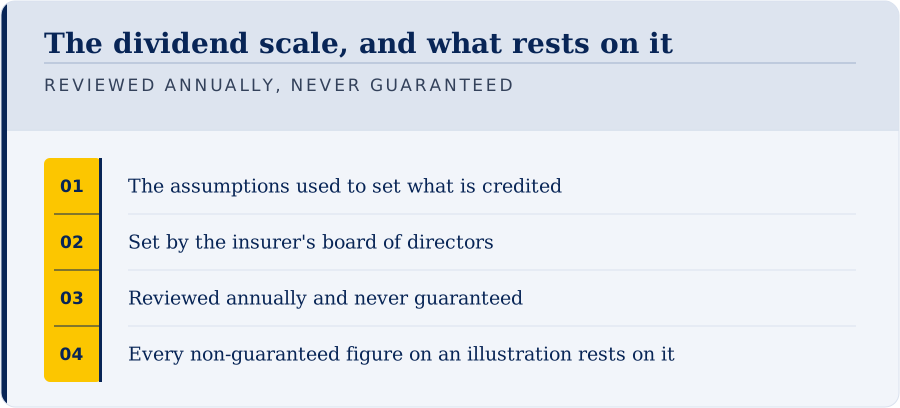
The question to ask: "What does my illustration show at a reduced dividend scale, and what does the guaranteed column show at years five, ten and twenty?"
The claim that you become a bank
You own an insurance contract with a regulated insurer, and the insurer administers it on its own terms. A policy is not a bank, a practice that arranges policies is not one, and the cash value is not a deposit.
The word matters in law, not only in accuracy. Section 983 of the Bank Act restricts a business in Canada from using it to describe itself or its services. That is why careful material in this field describes the approach in other terms, and why you should be wary of anyone who sells it to you with that word.
What stands behind your policy is also different from what stands behind a deposit. Deposit insurance does not apply. If a member insurer fails, Assuris protects the higher of $1,000,000 or 90% of the death benefit, and the higher of $100,000 or 90% of the cash value, calculated after any policy loans (Assuris). Assuris is funded by the industry; it is not a government guarantee.
What the approach actually describes is who performs the financing in a household and on whose terms, which is set out in private family capital. That is a narrower statement, and an accurate one.
"It is a tax-free retirement income strategy"
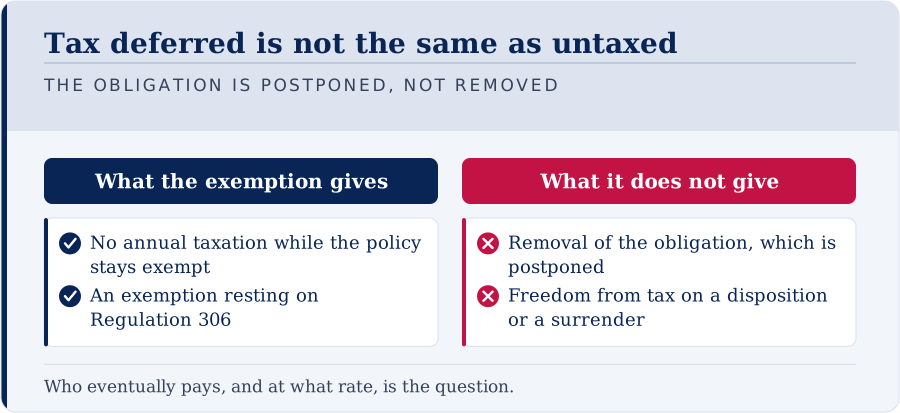
Wrong as stated, and the details are Canadian. A policy loan from the insurer is a disposition under section 148 of the Income Tax Act. The part of the loan above your policy's adjusted cost basis is included in your income in the year you receive it, and it is taxed as ordinary income.
The adjusted cost basis tends to rise in the early years and fall later, as the cost of insurance overtakes new premiums. Each loan also reduces it. So a loan that is tax free in year ten can be partly taxable in year thirty, which is exactly when a retirement plan would lean on it.
Illustrative example. Assume your policy statement shows an adjusted cost basis of $40,000, and you take a policy loan of $55,000. The $15,000 above the basis is included in your income for that year. If you later repay the loan, you can generally deduct up to that $15,000 under paragraph 60(s) of the Income Tax Act. The figures are assumptions for the arithmetic. Ask your insurer for your own adjusted cost basis in writing before any large loan, and confirm the tax result with a tax professional.
A loan from a third-party lender that takes your policy as collateral is different. Assigning a policy as security for a debt is not a disposition, so the loan itself is not taxed. It is still a debt, with interest set by the lender, terms the lender can enforce, and repayment out of the death benefit if it is still outstanding at death.
The largest risk is an ending nobody planned. If the policy lapses or is surrendered with a loan outstanding, the gain above the adjusted cost basis can become taxable in a single year, sometimes a year with no cash to pay the bill. The mechanism is set out further in the Canadian retirement planning material.
"It earns a guaranteed rate of return"
one payment doing three jobs
Where a permanent premium goes
- 01Part meets the cost of the insurance itself
- 02Part covers the insurer's expense and the premium tax
- 03Part builds the contractual value of the policy
- 04The split is not itemised on an illustration
- 05Base premiums follow the contract's own terms
A participating policy guarantees a schedule of amounts, year by year, not a rate. Turning the schedule into a percentage produces a number the contract never promised, and it invites a comparison with investments that the policy is not built to win.
If you want a return figure you can trust, ask for one calculated the honest way: the internal rate of return on the cash surrender value at years 10, 20 and 30, on the guaranteed column and on the current dividend scale. That figure counts what the policy actually gives back against every premium paid, including the part of each premium that buys the death benefit.
Read those numbers for what they are. The guaranteed column is a floor you can rely on. The dividend column is a projection built on today's scale, and it will be wrong in one direction or the other. A policy is life insurance, and its value to you includes the death benefit that an investment return does not measure.
The question to ask: "What is the internal rate of return on the cash surrender value at years 10, 20 and 30, guaranteed and projected?"
"You can reach your money immediately"
Not in the early years, and not instantly in any year. The cost of putting a permanent policy in force falls heaviest at the start, so the cash value you can borrow against is small in the first year or two and can be nil.
Once value exists, a policy loan is an administrative request rather than a credit decision. Insurers generally take days, not minutes, to process one, and each has its own service standards. Ask for the actual turnaround before you rely on it for anything time-sensitive.
That is why a policy is a poor emergency fund in its first years, and treating it as one misreads both the timing and the purpose. Keep emergency money in cash. Use the policy for purchases you can see coming.
Claims that a policy lets a family create money, or step outside the financial system, belong to the same family of errors. They are examined against the Canadian position in the money-creation claims and in the money principles material.
Four more you may hear
These come up less often, and each is wrong in the same way: a real event described with a word that promises too much.
- "The insurance is free." Said of a policy whose dividends have grown large enough to pay the premium. The cost of insurance is still charged inside the policy every year; the dividend is simply paying it instead of you.
- "You can never lose money." A policy surrendered in its early years returns less than was paid in, a lapse can lose most of what was paid, and a lapse with a loan outstanding can add a tax bill. The guaranteed schedule does not fall, which is a narrower promise.
- "It is completely private." The insurer holds the contract, the Canada Revenue Agency receives reporting on dispositions, and creditors can reach policy values in some circumstances. Protection from creditors exists in some situations and depends on your province, the beneficiary designation and the timing.
- "The strategy is proprietary to us." The policy is an ordinary regulated contract offered by several Canadian insurers, and the method was published in a book anyone can buy. An advisor contributes design and service, which are real, but not a proprietary product.
If you hear one of these, ask the same question as for the ten above: which document says so?
Where do these claims come from?
five situations it tends to suit
Who this method suits
- 01Households with durable surplus income, not one good year
- 02People who already think about money in decades
- 03People who want the permanent coverage in its own right
- 04Owners and professionals who can fund premiums through uneven years
- 05Families arranging capital across more than one generation
Most are compressions of something true. "You are borrowing your own money" is a shortened form of "you are borrowing against value you own, which stays in the policy." The short version is easier to remember, and it is wrong in a way the long version is not. A description simplified until it becomes false is the most common failure in this field, and it usually happened long before it reached the person repeating it.
Many come from the United States, where the tax law, the product rules and the regulatory language are different. Repeated in Canada without adaptation, they warn about rules that do not apply here and miss the ones that do: the exempt test under Regulation 306, the taxation of policy loans above the adjusted cost basis, and the Canadian treatment of a death benefit.
Some are honest enthusiasm. An advisor who has watched the approach work for families describes it in the words that convinced them, which are rarely the precise ones. And some are sales technique: a claim that removes an objection sells better than one that answers it, so the commercial pull runs toward the inaccurate version.
None of that excuses repeating them. An advisor licensed to advise you is responsible for the accuracy of what they say, whoever taught it to them.
How can you test a claim in five minutes?
You do not need to be an expert. Five questions settle almost every claim on this list.
- Ask for it in writing. A claim nobody will write down has already answered your question.
- Ask which document supports it. The policy, the Income Tax Act, or a regulator's published position. A claim supported by none of the three is a claim about nothing.
- Ask for the guaranteed column. Put it beside your cumulative premiums at years three, five and ten, and read the numbers rather than a percentage made from them.
- Ask who is paid, and by whom. In this field the advisor is usually paid by commission from the insurer when a policy is issued, and you should hear that plainly.
- Ask who should not do this. The answer, or its absence, tells you what kind of conversation you are in.
One more test is worth keeping: would the person repeat the claim in front of someone with the policy open on the table? Every claim on this page fails that test, which is how you know it is wrong.
What should you do if you were told one of these?
You have not necessarily been harmed. A poor description of a policy that suits you is a communication failure, not a loss. Start by finding out exactly what you own.
Ask the insurer directly for a policy summary: the guaranteed values, the current cash value, any loan outstanding, the dividend option in force and the beneficiary designations. Then compare what the policy has actually done with what you were shown, using the guaranteed column at years three, five and ten.
Name the specific claim to the person who made it and ask for the correct version. An advisor who says "that was a shortcut, here is the accurate version" is doing the job. One who repeats the claim more firmly has told you something important.
Get a second opinion from someone who did not arrange the policy, and do it soon if the arrangement is large or if a third-party lender holds an assignment over the policy. And if the policy still suits you, keep it. Surrendering in reaction can turn a bad explanation into a permanent loss, make any gain above the adjusted cost basis taxable and end the coverage. The remedy for bad information is better information.
What does an accurate description sound like?
For comparison, here is the approach in five sentences, none of them dramatic.
- A specially designed, high-cash-value, participating whole life insurance policy builds a cash value on a schedule written into the contract, and may receive dividends that are never guaranteed.
- You can take a policy loan from the insurer against that value; the insurer charges interest and reduces the death benefit by the balance while it stands.
- Repaying the loan restores the room to borrow again, and nothing forces you to repay, which is both the appeal and the risk.
- It suits people with a durable surplus, a horizon of decades and a real need for permanent coverage.
- The advisor is paid by commission from the insurer when a policy is issued.
If a presentation cannot survive being reduced to those five sentences, the presentation was doing the work, not the policy. And if you hear those five and still want to continue, you are deciding on the right basis.
The method Nelson Nash named The Infinite Banking Concept® is a registered trademark of Infinite Banking Concepts, LLC. Neither this practice nor its author is affiliated with, sponsored by or endorsed by that company or the Nelson Nash Institute. The approach is set out in full on the page on what Nelson Nash called Infinite Banking, and the serious arguments against it are on objections and risks.
A thirty-minute discovery meeting
A first conversation establishes whether this fits. No illustration is prepared and nothing is arranged.
Often the answer is no, and you will hear it during the call rather than in a proposal afterwards.
This form reaches Canadian Wealth Creation Centre Inc. Any meeting, any advice and any insurance product is provided by Canadian Wealth Creation Centre Inc., through its representatives who are licensed in the client's province. IBC Financial is the company's educational website: it distributes no product and no financial service, and it gives no individualised advice.
Common questions
Am I borrowing my own money?
Do I pay the interest to myself?
Does a policy loan affect my policy?
Does this replace my RRSP or TFSA?
Am I operating a financial institution of my own?
Is this a tax-free retirement income strategy?
Does the cash value grow the same with or without a loan?
Are the dividends guaranteed?
Is the growth rate guaranteed?
Can I reach my money immediately?
Is the insurance free once dividends pay the premium?
Can I lose money in one of these policies?
Is the strategy proprietary to one practice or one insurer?
What should I do if I was told one of these claims?
What does an accurate description sound like?
Sources
- Income Tax Act s.148 and paragraph 60(s), Justice Laws Canada, verified 2026-08-21
- Income Tax Regulations, Regulation 306, Justice Laws Canada, verified 2026-08-21
- Bank Act s.983, Justice Laws Canada, verified 2026-09-23
- Assuris, Whole Life protection, net of policy loans, verified 2026-09-23
About the author

Jose Salloum is a Financial Security Advisor (conseiller en sécurité financière) certified by the Autorité des marchés financiers in Quebec, a Life and Accident & Sickness Insurance Agent licensed by the Financial Services Regulatory Authority of Ontario, and a Life Insurance Agent licensed by the Insurance Council of British Columbia. Licensed since 2001.
He has practised Infinite Banking since 2015 and founded Canadian Wealth Creation Centre Inc. in 2016. From 2020 to 2024 he was an IBC (Infinite Banking Concepts™) Authorized Practitioner of the Nelson Nash Institute, a private certification rather than a regulatory licence.
IBC Financial is the educational website of Canadian Wealth Creation Centre Inc., open to all Canadians. Services come only from Canadian Wealth Creation Centre Inc. Its representatives hold a licence in each province served: Quebec, Ontario, Alberta, British Columbia, Manitoba and New Brunswick. Jose Salloum's own licences cover Quebec, Ontario and British Columbia. This page is general education and not advice on any individual file.
Last reviewed 2026-09-26. By Jose Salloum, Financial Security Advisor in Quebec. In Ontario, Life and Accident & Sickness Insurance Agent. In British Columbia, Life Insurance Agent.