

Life Insurance Is Not an Investment
As a way to grow money, participating whole life insurance is usually not a good investment, and in law it is not an investment: it is life insurance. Part of every premium buys a death benefit a portfolio does not provide, so on growth alone a portfolio usually wins over decades. What the policy offers is permanent coverage, a guaranteed cash value schedule and access to that value through a policy loan. It fits people with a durable surplus, a long horizon and a permanent insurance need.
As a way to grow money, life insurance is usually not a good investment, and in law it is not an investment at all. A specially designed, high-cash-value, participating whole life insurance policy is a life insurance contract, regulated as insurance, and part of every premium you pay buys a death benefit that a portfolio does not provide. Judge it only by how much money it grows, and a low-cost portfolio will usually come out ahead over decades.
That is not the end of the answer, because growth is not what the policy is for. What it gives you is coverage that never expires, a cash value that grows on a schedule the insurer guarantees in writing, and a way to use that value during your life through a policy loan. For someone with a durable surplus, a horizon of decades and a real need for permanent coverage, that combination can be worth a great deal. For someone who wants growth alone, it is the wrong tool.
This page sets out both halves plainly: why the policy is not an investment, how it compares with one, what return it really earns, the Canadian tax rules that decide what the value is worth to you, and the questions to ask before you sign.
Why is life insurance not an investment?
A life insurance policy is a contract with an insurer to pay a death benefit when the insured person dies. It is governed by provincial insurance law and supervised by insurance regulators: the Autorité des marchés financiers in Quebec, the Financial Services Regulatory Authority of Ontario, the Insurance Council of British Columbia and their counterparts elsewhere. It is not a security, and securities regulators do not supervise it. The approach Nelson Nash built on such a policy is a way of thinking about financing, with the policy as its tool.
It is sold under an insurance licence. This practice holds one. Investment products require separate registration with a securities regulator, which this practice does not hold, and that is not a technicality. The licence decides what may lawfully be said, to whom and about what.
The policy does have a value that grows, on a schedule set out in the contract, and it may receive dividends. Those are features of an insurance contract. A feature that resembles something else does not change what the thing is, in the same way that a house with a garden is still a house.
Why does this matter to you? Because the category sets the yardstick. Measured as a way to grow money, the policy usually compares poorly, and it should. Measured as permanent coverage with a guaranteed value and a way to use it, it is a different question with different answers.
Why do people call it an investment anyway?
There are four reasons, and the first three are honest mistakes. The first is that value accumulates. Something grows, and growth sounds like investing, but a contractual schedule is not a market return and is not exposed to a market.
The second is the word dividend. It is borrowed from corporate finance and means something different here. A participating policy dividend is a distribution from a pooled insurance account to policyholders who own no shares, and whose vote at a policyholder meeting, where the law gives one, carries no right to a particular dividend. The third is comparison itself. Setting a policy beside a portfolio suggests they belong to the same category, and that suggestion is often the first error rather than the conclusion.
The fourth reason is not a mistake: it sells better. Framing insurance as an investment produces more sales, and how a policy is presented is exactly where a regulator has acted. On 22 December 2022 the Financial Services Regulatory Authority of Ontario (FSRA) announced a compliance order, made with Greatway's consent, against Greatway Financial Inc., a managing general agency, over allegations about what agents it trained might tell consumers (FSRA announcement). The case is set out further down.
A practice that describes its product as an investment has described it wrongly, whatever it believes privately. You deserve the accurate description, because it is the one that will still hold in year ten.
What does the policy actually give you?
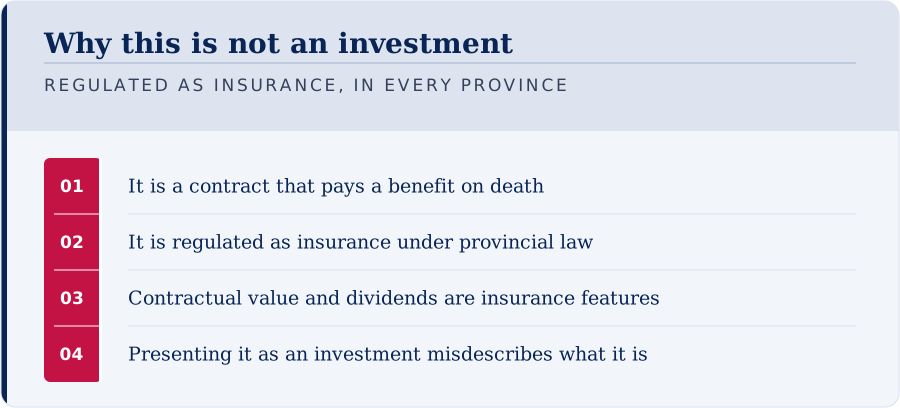
regulated as insurance under provincial law
Why this is not an investment
- It is a contract that pays a benefit on death
- It is regulated as insurance under provincial law
- Contractual value and dividends are insurance features
- Judge it as insurance: coverage, cost, access
Four things, stated precisely, because this is where overstatement usually creeps in. The first is a death benefit, payable whenever death occurs, generally received free of income tax by a named beneficiary and paid outside the estate.
The second is a guaranteed schedule of cash values, set out in the policy for each year. That schedule does not decrease. It is a contractual obligation of the insurer that issued it, dependent on the insurer's solvency and not backed by any government.
The third is dividends, which lift the values above the schedule when they are declared. They are declared each year at the discretion of the insurer's board, they are not guaranteed, and the scale has moved in both directions over time. The schedule is guaranteed; what sits above it is not. A presentation that blends the two under one heading has promised something the contract never says.
The fourth is access to the value during your life, through a policy loan from the insurer, with its own cost and its own tax consequences. How that works year by year is on how a participating policy works.
If a member insurer fails, Assuris protects the higher of $1,000,000 or 90% of the death benefit, and the higher of $100,000 or 90% of the cash value, calculated after any policy loans (Assuris, whole life). Assuris is funded by the industry. It is not a government guarantee and it is not deposit insurance, and on a large policy the 90% matters.
Why is the cash value below the premiums in the early years?
Because the cost of putting a permanent policy in force falls mostly at the start. In the first years your premiums pay for the insurer's underwriting and administration, the advisor's first-year commission, the cost of the insurance itself and the reserves the insurer must hold. The insurer recovers those costs through lower cash values in the early years, and the policy schedule shows exactly how much lower, year by year, before you sign.
The size of the gap depends on the design. Part of each premium can go to a paid-up additions rider, which buys small amounts of additional paid-up insurance that carry their own cash value from the day they are bought. A design weighted toward that rider makes value reachable sooner; a design weighted toward the base coverage builds a larger death benefit and takes longer to pass the premiums paid. Both are legitimate, for different purposes.
What the gap is not is a hidden fee or an investment loss. It is the price of coverage the insurer cannot cancel for as long as the premiums are paid, and of a value schedule the insurer is bound by for the rest of your life. It only becomes a loss if you leave early, which is why the early years are the ones to plan for.
The practical rule follows directly. Money you might need back within a few years belongs somewhere you can reach it without cost. Money you can leave in place for decades is the money a policy is built for, and the one number worth knowing in advance is the year the guaranteed cash value first passes the premiums you will have paid.
How does it compare with a portfolio?
Refusing to compare would be its own kind of evasion. The comparison is fair once both sides are described accurately, and the shape of the answer is not in serious dispute.
| Question | A diversified portfolio | A specially designed, high-cash-value, participating whole life insurance policy |
|---|---|---|
| What it is for | Growth of capital | Coverage that never expires, with a guaranteed value |
| Value in the first years | The amount contributed, less fees, moving with the market | Below the premiums paid, often far below in year one |
| A floor in writing | None | A guaranteed cash value schedule, set at issue |
| Paid if the holder dies in year six | The account balance | The full death benefit, generally free of income tax |
| Growth over thirty years, on growth alone | Usually more | Usually less, because part of every premium buys coverage |
| Tax while it grows | Depends on the account: sheltered inside registered plans, taxable outside them | Not taxed each year while the policy stays exempt |
| Reaching the money | Sell, at whatever the market pays that day | A policy loan from the insurer, or a loan from another lender secured by the policy |
| Protection if the institution fails | Investor protection funds, within their own limits | Assuris, within the limits above |
The honest reading of that table has two halves, and both are true. On growth alone, a low-cost portfolio will very probably produce more money over thirty years. A portfolio also does not pay a death benefit in year six, does not carry a floor in writing, and may be down just when you need to sell.
Which of those matters more depends on what you are trying to do. How much of your money belongs in registered plans or securities is a question for someone registered to advise on them; this practice is licensed for insurance and does not rank a policy against securities products. What it can do is show you the policy's side of the table in figures you can check.
What return does a participating policy really earn?
The contract guarantees amounts, not a rate, so any single percentage quoted for a policy has been calculated by someone, from assumptions. Two figures are worth asking for, and one is worth ignoring.
The first is the internal rate of return on the cash surrender value at years 10, 20 and 30, on the guaranteed column. It tells you the floor, after every cost, measured against every premium paid. The second is the same figure on the current dividend scale, which tells you what today's assumptions would produce if nothing changed for thirty years, which is itself an assumption.
The figure to ignore, as a measure of your return, is the dividend scale interest rate. It is one assumption an insurer uses to set its dividend scale: the rate it credits, in its own calculations, on the assets backing participating policies. Your return is lower, because your premium also pays for the cost of insurance, expenses, taxes and the early cost of putting the policy in force.
Illustrative example. Assume you pay $10,000 at the start of each year for ten years, $100,000 in all. If the cash surrender value at the end of year ten were $95,000, your internal rate of return to that point would be negative. If it were $120,000, the rate would be about 3.3% a year. The values are assumptions for the arithmetic, not any insurer's illustration, and they leave out the death benefit that was in force the whole time. Your own illustration will give you the real figures, on both columns.
Read the result for what it is. The guaranteed figure is a floor you can rely on. The projected figure will be wrong in one direction or the other. And neither counts the protection your family had from the first day, which is the reason the policy exists.
How do you read an illustration without being misled?
the discipline, not the product
What a household actually does differently
- 01A capital purchase arrives, a vehicle or a renovation
- 02The advance is taken against the contract instead
- 03A repayment schedule the household sets and keeps
- 04Later payments go in as premiums, within limits
- 05The money is not free, and interest accrues to the insurer
An illustration is the insurer's projection of a policy year by year, and most decisions are made on it. It is also the document most often misread, because the projected columns are easier to look at than the guaranteed ones.
Read it in this order:
- the premium you will pay each year, and for how many years;
- the guaranteed cash value and guaranteed death benefit in each year, which the insurer is bound by;
- the projected cash value and death benefit on the current dividend scale, which the insurer is not bound by;
- the same projection on a reduced scale, which you should ask for if it is not included;
- the total of premiums paid to date, set beside each of those columns.
Then find three years: the year the guaranteed cash value first passes the premiums paid, the same year on the current scale, and the same year on the reduced scale. The distance between them tells you how much of the plan rests on dividends. A plan that only works on today's scale is not a plan; it is a hope.
Finally, read the notes. Every illustration explains the assumptions behind its projected columns, and the notes are where you learn whether loans, withdrawals or a change of dividend option have been built into the numbers in front of you.
Which Canadian tax rules decide what the value is worth to you?
The category is settled by statute, and so is almost everything you will want to know about using the value during life. Most of what is published online on this subject describes American law, which does not apply here. These are the Canadian rules.
Growth is not taxed each year while the policy stays exempt. The test is in section 306 of the Income Tax Regulations. It compares the policy with a notional benchmark policy, and for policies issued after 2016 that benchmark is an endowment at age 90 paid over eight years. The insurer monitors it. The practical effect is that a Canadian policy cannot be funded without limit, and a policy that fails the test has its growth taxed every year.
A policy loan is a disposition. Under section 148 of the Income Tax Act, the part of a policy loan above the policy's adjusted cost basis is included in your income in the year you receive it, as ordinary income. This is the largest difference from the American material, which describes policy loans as tax free. In Canada they are tax free only while the adjusted cost basis is larger than the loan.
The adjusted cost basis moves, and it usually falls in the later years. It rises with premiums and falls by the net cost of pure insurance, by policy loans and by dividends taken in cash. So loans are usually tax free early, when there is little value to draw on, and can be partly taxable later, when there is a great deal. A presentation that shows decades of tax-free loans without modelling the adjusted cost basis year by year is showing a picture the Act does not support.
Illustrative example. Assume your statement shows an adjusted cost basis of $60,000 and you take a policy loan of $40,000. The loan is below the basis, so nothing is included in your income, and the basis falls to $20,000. The next year you take another $30,000. That loan is $10,000 above the $20,000 that remains, so $10,000 is included in your income for that year. The figures are assumptions for the arithmetic, and they ignore anything else that moves the basis during the year; ask the insurer for your own figure in writing before any large loan.
Repaying a taxed loan gives some of it back. If part of a loan was included in your income, repaying it later generally gives you a deduction under paragraph 60(s) of the Income Tax Act, up to the amount that was taxed, and the repayment rebuilds the adjusted cost basis.
A loan from a third-party lender, secured by the policy, is not a disposition. Assigning a policy as security for a debt is excluded, so nothing is included in income when you borrow. The trade is a credit decision by the lender, a rate that moves, the lender's conditions, and repayment from the death benefit if the loan is still outstanding at death.
The death benefit reaches a named beneficiary free of income tax. It is paid directly, outside the estate, less any policy loan still outstanding. Canada has no estate tax, but it does tax the deemed disposition of your capital property at death, and that is where the death benefit often does its most useful work.
None of these rules turns the policy into an investment. They decide what the policy is worth to the person holding it, which is why they belong on this page rather than in a footnote. The tax result on your own facts belongs with a tax professional.
What changes when a corporation owns the policy?
For an owner of a Canadian-controlled private corporation with retained earnings, the question changes, for reasons that come from corporate tax rather than from the policy. Passive income earned inside the corporation is taxed at high rates. And under subsection 125(5.1) of the Income Tax Act, adjusted aggregate investment income above $50,000 reduces the small business limit by $5 for every $1, so the limit is gone at $150,000.
Illustrative example. Assume your corporation has $90,000 of adjusted aggregate investment income in a year. That is $40,000 above the $50,000 threshold, so the federal small business limit falls by $200,000, from $500,000 to $300,000, and business income above the reduced limit is taxed at the general rate. The figures are assumptions for the arithmetic; the provinces apply their own rules to their share of the tax, so the combined result belongs with your accountant.
Growth inside an exempt policy is not taxed each year, so it does not add to that investment income while it stays inside the policy. That is the reason corporate owners look at participating policies, and it is a reason about tax structure, not about returns.
At death, the corporation receives the death benefit, and its capital dividend account is credited with the death benefit minus the policy's adjusted cost basis, under the definition in subsection 89(1) of the Income Tax Act. That credit can then generally be paid to shareholders as a tax-free capital dividend. On a heavily funded policy the adjusted cost basis can be large, so the credit is smaller than the death benefit.
Corporate ownership adds choices that are hard to reverse: who owns the policy, who is insured, who is the beneficiary, and how any loan is arranged. Those belong in a room with your accountant and your lawyer looking at the same facts.
What does "investment" mean as a legal category?
and what stays federal
What changes from one province to another
- 01The regulator that licenses the agent
- 02The titles an advisor may lawfully use
- 03The cost of settling an estate
- 04Beneficiary and contract rules, notably in Quebec
- 05Federal income tax rules apply in every province
It is not a matter of opinion about what a product feels like. Provincial securities laws define what a security is and list the instruments: shares, bonds, units of a fund, investment contracts and others. Selling or advising on them requires registration with a securities regulator, coordinated through the Canadian Securities Administrators, with CIRO as the self-regulatory body.
Insurance law defines a policy of life insurance, and selling or advising on one requires a licence from a provincial insurance regulator. In Quebec that is the AMF, in Ontario FSRA, and in British Columbia the Insurance Council of British Columbia.
Quebec deserves a word of its own. There a single regulator, the Autorité des marchés financiers, supervises both insurance and securities, yet the licences stay separate: an insurance licence does not permit advice on securities, and a securities registration does not permit the sale of insurance. One regulator does not make one category.
These are separate statutes, separate regulators, separate licences and separate protections for the consumer. A person may hold one, both or neither, and what they may lawfully tell you depends entirely on which.
Segregated funds sit at the boundary and show how the line is drawn. Their value tracks an underlying fund, yet they are insurance contracts, sold under an insurance licence and regulated as insurance. The category follows the legal form of the contract, not what it resembles. A specially designed, high-cash-value, participating whole life insurance policy is not near that boundary at all.
What did FSRA allege in the Greatway case?
On 22 December 2022 the Financial Services Regulatory Authority of Ontario (FSRA) announced a compliance order against Greatway Financial Inc. Greatway is a licensed insurance agent that life insurers contract as a managing general agency, and it consented to the order (FSRA announcement). Under the order, Greatway would deliver revised training to its contracted agents. It would send existing holders of universal life policies sold by its agents information to help them assess whether the policy was appropriate for their circumstances. It would also support policyholders who raised concerns with their insurer.
FSRA had earlier issued a notice of proposal alleging acts that could amount to an unfair or deceptive act or practice under Ontario's Insurance Act. Its allegation was that agents trained by Greatway might give consumers inappropriate, inaccurate or misleading information and advice. That advice concerned the terms, benefits or advantages of certain policies. These included universal life policies sold under an insured retirement plan strategy. These are allegations, resolved by an order Greatway consented to. The announcement does not present them as findings.
The allegations were not a ruling about participating whole life insurance, and the product named was universal life. What they concerned was how policies were presented and whether they suited the people buying them. That is the lesson for any reader: the same policy can be described accurately or misleadingly, and the description is what you are relying on when you sign.
It is also why this page says plainly that a participating policy is insurance. The regulator's record is public, and you can read it yourself in a few minutes.

Which comparisons mislead, and which one is fair?
Comparison is not forbidden. Most people arrive already holding one, and refusing to talk about it helps nobody. What makes a comparison misleading is that its two sides are measured differently:
- after-fee values on one side and before-fee returns on the other;
- guaranteed values on one side and hoped-for averages on the other;
- a start and end date chosen to make one side win;
- the death benefit left out, when it is the main thing the policy buys;
- an idealised investor on one side, rather than what you would actually have done.
The fair comparison names what each product is for, treats fees the same way on both sides, shows the guaranteed column beside the projected one, and puts a value on the death benefit instead of ignoring it.
Done that way, it usually shows that insurance is more expensive as a way to grow money and that it provides something a portfolio does not. Both halves are true, and a comparison that offers only one of them is advocacy, not analysis.
What happens when a policy is bought as an investment?
It produces a predictable sequence. In year one the cash value is far below the premiums paid, and someone expecting an investment reads that as a loss. Through the next several years the gap narrows but stays negative, and every statement repeats the impression.
Then a strong market year arrives, and the comparison with a portfolio looks worse, on the one measure the policy was never built to win. The policy is surrendered in its early years, when it returns least. The loss is real, and it happened because the expectation was wrong, not because the policy failed at what it was for. Sometimes a taxable gain is created on the way out as well.
Every step follows from the framing, not from the contract. Someone told they were buying permanent coverage with a slowly building guaranteed value, and shown the guaranteed column at year three before signing, does not live through any of it.

What does the approach built on the policy actually do?
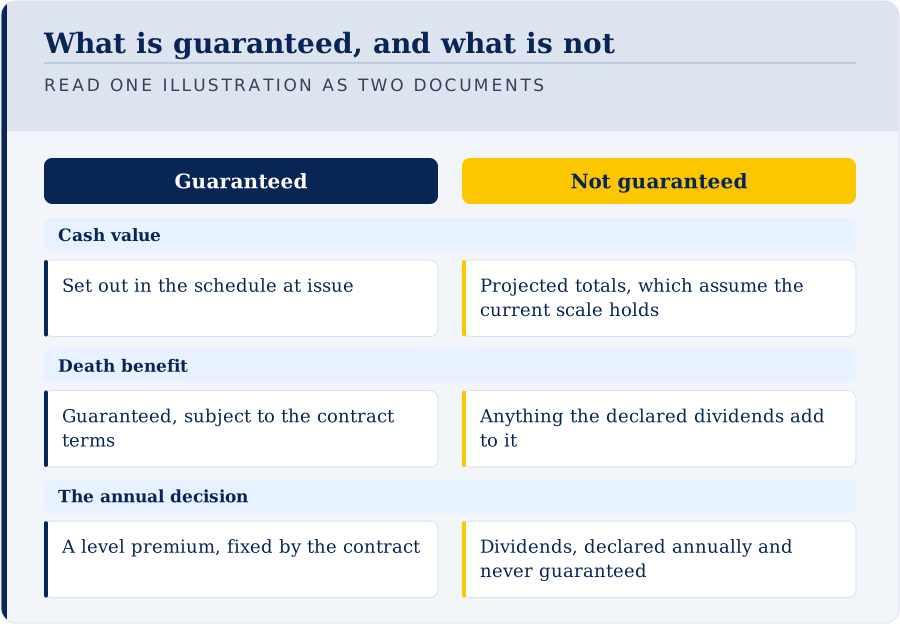
read one illustration as two documents
What is guaranteed, and what is not
- 01Cash valueGuaranteed: Set out in the schedule at issue. Not guaranteed: Projected totals, which assume the current scale holds.
- 02Death benefitGuaranteed: Guaranteed, subject to the contract terms. Not guaranteed: Anything the declared dividends add to it.
- 03The annual decisionGuaranteed: A level premium, fixed by the contract. Not guaranteed: Dividends, declared annually and never guaranteed.
Practitioners describe an approach called The Infinite Banking Concept®, set out by Nelson Nash and a registered trademark of Infinite Banking Concepts, LLC. Neither this practice nor its author is affiliated with, sponsored by or endorsed by that company or the Nelson Nash Institute. Neither this practice nor any insurance policy is a bank, and a policy is not a deposit.
Nothing is invested in a policy under this approach. Premiums buy an insurance contract, and the approach concerns how its accessible value is used: a policy loan from the insurer when something needs paying for, repaid on a schedule you keep. The case for it is about discipline and control over the terms, not about the policy earning a better return. How it works in practice is on the guide to the method.
The approach is often explained with four roles, which are simply a plain way to describe what happens to money whenever something is financed. The Saver supplies capital. The Borrower uses capital now and pays for it. The Participant shares in the results of a pooled account. The Administrator decides who is financed, on what terms and when.
In a participating policy you can hold three of them, each with a limit. As the Saver, your premium is not a deposit. As the Borrower, the interest on a policy loan is a real cost paid to the insurer. As the Administrator, the decisions are yours, which makes it a job rather than a perk. The Participant's share comes through dividends that are declared, not guaranteed. The approach is disputed on grounds that are partly right, set out in objections and risks, and it is worth reading those first.
Who does it suit, and who does it not?
The category question decides how to judge the policy. This one decides whether to hold it at all, and the honest answer rules out many people. It can suit you if you have:
- a surplus that survives an ordinary year, not only a good one;
- a horizon measured in decades;
- a real and permanent reason to hold life insurance;
- the discipline to repay a policy loan that nobody will chase;
- or a Canadian corporation with retained earnings and a permanent insurance need, for the corporate reasons above.
It does not suit you if:
- you may need the money within about five years;
- your income cannot carry a long premium commitment through a bad year;
- you are still carrying expensive consumer debt;
- you want growth alone and do not want the death benefit;
- you cannot say, in one sentence, what the policy would be for.
If one of the second list describes you, the answer is no for now, and finding that out before an application costs you nothing. A description of any product that fits everybody describes nobody.
What should you ask before you sign?
These questions separate a description from a sales pitch, and none of them needs technical knowledge.
- Is this an insurance product or an investment product? The answer is insurance, and hesitation tells you something.
- Which regulator supervises it, and under what licence are you advising me?
- What is guaranteed in writing, and what is not?
- What does the guaranteed column show at years one, five and ten, against the premiums I will have paid, and in which year does it first pass them?
- What does the same illustration show with the dividend scale reduced?
- What is the internal rate of return on the cash surrender value at years 10, 20 and 30, guaranteed and projected?
- How would I reach the money, how is that route taxed, and who should not buy this?
Take the answers to an accountant before signing, because the tax consequences on your own facts belong with a tax professional, not with an insurance licence. And if the answer is no, that is a result, not a failure.
One sentence to take away
A specially designed, high-cash-value, participating whole life insurance policy is an insurance contract that builds a guaranteed value. It is not an investment that happens to carry a death benefit. Both descriptions point at the same document, and they lead to very different expectations. The first is accurate, and if you hold it, nothing the policy does over the next thirty years will surprise you.
Start with the case against the approach at what the critics get right, then read how the product works at whole life insurance in Canada and how the approach uses it across these pages. Everything here is written by someone paid by commission from an insurer when a policy is issued, as stated on the author page.
A thirty-minute discovery meeting
A first conversation establishes whether this fits. No illustration is prepared and nothing is arranged.
Often the answer is no, and you will hear it during the call rather than in a proposal afterwards.
This form reaches Canadian Wealth Creation Centre Inc. Any meeting, any advice and any insurance product is provided by Canadian Wealth Creation Centre Inc., through its representatives who are licensed in the client's province. IBC Financial is the company's educational website: it distributes no product and no financial service, and it gives no individualised advice.
Common questions
Is life insurance a good investment?
If it is not an investment, why does the value grow?
Does this practice sell investments?
What return does a participating policy produce?
What is the dividend scale interest rate, and why is it not my return?
What are the four roles?
Why do people surrender these policies in the early years?
Is the cash value an account I can withdraw from?
How are policy loans taxed in Canada?
What is the exempt test?
Is the death benefit taxable?
Does this make sense inside a corporation?
Is a participating policy a security?
Why is a policy dividend not the same as a share dividend?
What did the Greatway Financial case decide?
Who should not buy a specially designed, high-cash-value, participating whole life insurance policy?
Can I lose money in a participating policy?
What questions tell me whether I am being sold an investment?
Sources
- Financial Services Regulatory Authority of Ontario, FSRA issues compliance order against Greatway Financial Inc., announcement of 22 December 2022, verified 2026-09-29
- Income Tax Regulations, Regulation 306, Justice Laws Canada, verified 2026-08-21
- Income Tax Act s.148, paragraph 60(s), subsections 89(1) and 125(5.1), Justice Laws Canada, verified 2026-09-24
- Assuris, Whole Life protection, net of policy loans, verified 2026-09-23
About the author

Jose Salloum is a Financial Security Advisor (conseiller en sécurité financière) certified by the Autorité des marchés financiers in Quebec, a Life and Accident & Sickness Insurance Agent licensed by the Financial Services Regulatory Authority of Ontario, and a Life Insurance Agent licensed by the Insurance Council of British Columbia. Licensed since 2001.
He has practised Infinite Banking since 2015 and founded Canadian Wealth Creation Centre Inc. in 2016. From 2020 to 2024 he was an IBC (Infinite Banking Concepts™) Authorized Practitioner of the Nelson Nash Institute, a private certification rather than a regulatory licence.
IBC Financial is the educational website of Canadian Wealth Creation Centre Inc., open to all Canadians. Services come only from Canadian Wealth Creation Centre Inc. Its representatives hold a licence in each province served: Quebec, Ontario, Alberta, British Columbia, Manitoba and New Brunswick. Jose Salloum's own licences cover Quebec, Ontario and British Columbia. This page is general education and not advice on any individual file.
Last reviewed 2026-09-26. By Jose Salloum, Financial Security Advisor in Quebec. In Ontario, Life and Accident & Sickness Insurance Agent. In British Columbia, Life Insurance Agent.