


Corporate-Owned Life Insurance or COLI, is a type of life insurance policy a company buys on its employees. Corporate-Owned Life Insurance is also bought for managers, large investors, and key shareholders. According to a report by Statista, the Canadian life insurance market is all set to reach $34.69 billion in 2025.
Clearly, the Canadian market is thriving with demand for both family-bought and corporate-owned life insurance. In the case of COLI, the business is the policyholder and the life insurance beneficiary. Hence, it pays premiums and receives death benefits when a covered employee dies.
There are various reasons for companies to use life insurance as part of their overall strategy. Now, we’ll discuss the finer details of corporate ownership of life insurance and understand how it works. In case you need professional legal advice on life insurance in Canada, contact the IBC Financial team now.
Corporate-Owned Life Insurance (COLI) is a policy that an organization purchases for its key employees, managers, or shareholders. COLI helps protect against the loss of valuable workers by paying death benefits if the insured person passes away and serving as a vehicle for financing employee benefits, retirement programs, and deferred compensation.
Here are the multiple strategic reasons why companies purchase COLI:
Key Person Insurance: Insurance purchased by an employer to protect against unforeseen Revenue loss and financial damage to the health of the business in the event of a key employee or manager dying.
Succession Planning: Arranging for liquidity for shareholder buyouts, debt repayment, and business acquisition. It can also help with other financial liabilities in case of an untimely exit of an executive.
Deferred Compensation Financing: Helping finance executive compensation and retirement benefits. This also includes non-qualified deferred compensation programs.
Tax Benefits: The tax-deferred growth of cash values and the tax-free death benefits are possible under a well-structured COLI policy that minimizes taxes and taxation burdens.
In a nutshell, it’s a strategic financing vehicle for managing the risk of loss of critical talent. Also, it aids in financing a wide array of corporate financial obligations while enhancing shareholder value. To structure efficient company-owned life insurance policies through a proper contract with an experienced insurer, contact the IBC Financial experts.
Corporate-Owned Life Insurance works by identifying key employees, managers, and shareholders as a starting point. COLI policies work when firms pay life insurance premiums to the insurer.
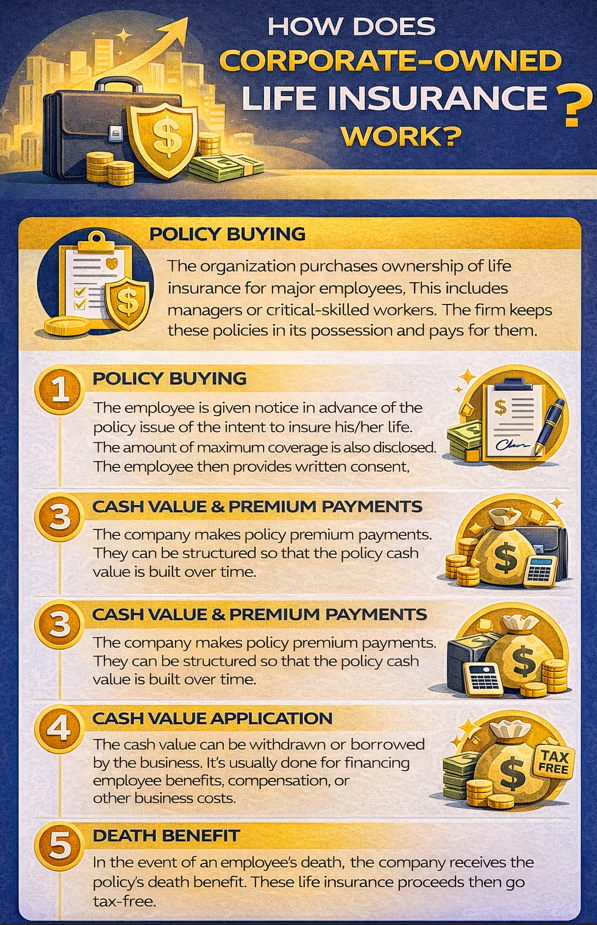
As per an article by Joelle Hall in Financial Post, titled “From liability to asset: Tapping the potential of insurance to maximize wealth,” life insurance for key people is a great way for Canadian business owners to mitigate risk. Take a look at how the policy actually operates:
Policy Buying: The organization purchases ownership of life insurance for major employees, managers, shareholders, or critical-skilled workers. The firm keeps these policies as corporate investments and pays premiums paid to maintain coverage.
Notice and Consent: The employee is given notice in advance of the policy issuance regarding the intent to insure his/her life under the contract. The amount of maximum coverage is also disclosed. The employee then provides written consent through the underwriting process, assuring his/her agreement on the arrangement.
Cash Value and Premium Payments: After that, the employer makes policy premium payments that appear on the balance sheet. They can be structured through careful policy design so that the policy cash value is built over time with the cost basis tracked appropriately.
Cash Value Application: Please note that the cash value can be withdrawn or borrowed by the business through loans. It’s usually done for financing employee benefits, retirement programs, compensation, or other business costs without being taxed at the time of borrowing.
Death Benefit: In the event of an employee’s death, the company receives the policy’s death benefits. These life insurance proceeds then pass tax-free under Income Tax rules.
The proceeds can be used for the following needs:
The policy transactions must be handled carefully since loans can reduce the policy’s death benefits. Moreover, they also have tax implications related to taxation even though premiums paid are not tax-deductible deductions. With the guidance of IBC Financial experts, risk management is more accessible than ever.
Corporate-Owned Life Insurance (COLI) has two major types of life insurance: Permanent and Term Life Insurance. The two types of Corporate Owned Life Insurance are for different corporate purposes, financial goals, and strategy implementation.
According to an article by Andrew Feindel for The Globe and Mail, titled “How owning insurance in a corporation can address changes to the capital gains inclusion rate” corporate-owned permanent life insurance helps in building wealth, estate planning, and enhancing shareholder value.
Overall, the Canadian life and non-life insurance market is forecasted at $143.74 billion by 2029. That is indeed pretty lucrative. Let’s delve deeper into the types of company-owned life insurance:
Term life insurance policies
This policy pays death benefits for a specified term, say, 10, 20, or 30 years. If the employee dies, the business as policyholder is paid the death benefit by the insurer. Term life is typically lower in cost than permanent coverage. However, it won’t build cash value or accrue interest as corporate investments. The premiums paid are not deductible under Income Tax regulations.
Permanent life insurance policies
Just like the name suggests, this policy is permanent in its coverage through proper policy design. Additionally, it includes a cash value component, which is earned over time with interest and grows without being taxed. The cash values are corporate assets appearing on the balance sheet, serving as a source of liquidity for corporate purposes including retirement funding and business acquisition.
A permanent life insurance policy is typically more expensive than a term policy. That’s because it includes other financial advantages, such as tax-deferred cash growth that benefits shareholders and enhances the overall health of the company’s investments.
The tax benefits of corporate-owned life insurance are tax-deferred growth of cash values and favorable treatment under Income Tax rules. Another one of the tax advantages of COLI is the tax-free business death benefits. According to an article by LifeBuzz.ca, titled “Corporate-Owned Life Insurance in Canada,” tax-deferred growth supplements corporate retained earnings.
Also, there’s cost-effective financing of employee benefit costs and retirement programs. In addition, it creates tax-helpful active business income. It delivers tax-free capital dividends to shareholders. They can enhance corporate financial planning and asset aggregation strategies while reducing taxation obligations and taxes, even though the premiums paid are not tax-deductible deductions from Revenue.
Corporate-Owned Life Insurance is advantageous in various ways for private corporations. The key advantages of Corporate-Owned Life Insurance include business continuity in the event of the loss of a major employee or shareholder.
According to an article by Roxanne Arnal for Eye Care Business Canada, titled “6 Reasons to Consider Business-Owned Life Insurance as an Investment,” these policies allow business owners to leverage life insurance as both protection and an investment component that appears on the balance sheet.
Since the policy cash value is tax-deferred and not taxed until withdrawn, it can be used for various corporate purposes. Take a look at the major pros:
Reduced tax cost of life insurance premiums
It is tax-efficient since the cash value grows without being taxed currently. That, in turn, keeps the total tax expenses minimal even though premiums paid to the insurer are not deductible. The cash value of a policy is also tax-deferred, improving the cost basis of corporate investments.
Also, the death benefits over the deceased shareholder or employee typically pass tax-free under Income Tax rules. Thus, COLI is a cost-effective vehicle for financing employee benefit expenses, retirement programs, and reducing taxation burdens while enhancing shareholder value.
Equitable distribution of premium payments
The equitable division of premiums in COLI allows for a balanced spread of costs among stakeholders, shareholders, and investors based on the policy design and underwriting results.
Allocations can be made based on:
This keeps costs in balance and achieves maximum tax savings. It also aids cost-effective financing of benefits for key executives while managing liabilities on the balance sheet.
Control of premium payments
The payment of premiums is managed by the employer as the corporate policyholder working with the insurer. It also decides on payment periods and modes. The premiums paid can thus be tailored for tax optimization and cash flow planning as part of the overall strategy.
With sufficient planning and legal advice, COLI can continue to be a corporate asset delivering benefits and supporting shareholder value creation.
Streamlined management
It also simplifies management by providing tax-advantageous cash growth that isn’t taxed until withdrawn. COLI funds executive compensation, retirement planning, and business continuation strategies.
Thus keeping financial security intact and risk in check while managing taxes and liabilities. Overall, it improves efficiency by providing streamlined corporate asset planning. The insurer provides ongoing support based on their experience. For more on this, contact IBC Financial’s team of insurance advisors.
The disadvantages of corporate-owned life insurance include high costs and ethical considerations. Another disadvantage is that premiums paid are not tax-deductible under Income Tax rules.
According to an article by Ashlyn Brooks in Bankrate, titled “Drawbacks of corporate-owned life insurance” COLI is also called “Dead Peasant Insurance” due to its historical use. That’s because it was purchased for low-wage workers without informing them in the 1980’s.
Here are some drawbacks of COLI:
Costly: Permanent COLI policies can be more expensive than individual policies, with premiums paid representing significant expenses that aren’t deductible deductions from Revenue.
Tax Implications: Inappropriate policy design can lead to negative tax implications and increased taxation. Policy loans may be taxed under certain circumstances, creating unexpected liabilities.
Employee Relations: Unauthorized insuring of workers can pose ethical dilemmas. It may also appear as though the employer is making profits off employee deaths, harming workplace health and morale.
Regulatory Compliance: Corporate-owned policies have stringent regulations. Thus necessitating careful observance of Canadian Income Tax laws, proper underwriting procedures, and reporting requirements. The policy issuance process requires legal advice to ensure proper compliance.
Non-Deductible Premiums: Since premiums paid are not tax-deductible, the after-tax cost can be substantial for the policyholder, even though death benefits and dividends to shareholders receive favorable tax treatment.
Impact on Balance Sheet: Policy loans against cash value can create liabilities and affect the cost basis calculations for investments, requiring careful management of taxes.
The best practices for implementing COLI include policy alignment with corporate objectives and strategy. The best practice for implementing COLI is obtaining informed consent through proper legal advice and underwriting procedures.
As per the report by M Benefit Solutions “A Primer on Corporate-Owned Life Insurance (COLI),” the firm must inform the employee in writing and seek consent through a proper contract before policy issuance.
Choosing the right insurance provider
To select the best corporate insurer, look for the following aspects:
Financial Stability and High Ratings: Ensures the insurer can pay death benefits and maintain policy values that appear on the balance sheet.
Expertise in COLI: Experience with corporate-owned policies, shareholder agreements, and understanding how to maximize shareholder value.
Product Versatility: Flexible policy design options for different purposes including retirement funding, business acquisition, and managing taxes.
Regulatory Compliance: Deep knowledge of Income Tax regulations, how premiums paid are treated, and how death benefits and dividends to shareholders are taxed.
Competitive Pricing: Fair premiums even though they aren’t tax-deductible deductions, balanced against the value of tax-free death benefits.
Following these parameters can help your business achieve its strategic and financial objectives while managing liabilities and enhancing investments.
Structuring the policy effectively
To structure a Corporate-Owned Life Insurance policy well, it must be aligned with business goals and the overall strategy. It must also be well-funded for key stakeholders, shareholders, and investors based on proper underwriting and policy design. Moreover, compliance with current tax regulations and taxation requirements is essential.
Consider these elements:
For a well-structured plan that maximizes benefits through tax-free dividends, proper Revenue protection, and business acquisition support, it’s best to rely on a financial advisor with experience in COLI. IBC Financial has the best-in-class resources available, so get in touch now.

Take the First Step to Financial Freedom!
We use cookies for analytics & functionality. Manage preferences.
Manage your cookie preferences below:
Essential cookies enable basic functions and are necessary for the proper function of the website.
Google reCAPTCHA helps protect websites from spam and abuse by verifying user interactions through challenges.
Statistics cookies collect information anonymously. This information helps us understand how visitors use our website.
Google Analytics is a powerful tool that tracks and analyzes website traffic for informed marketing decisions.
Service URL: policies.google.com (opens in a new window)
Marketing cookies are used to follow visitors to websites. The intention is to show ads that are relevant and engaging to the individual user.
Google Maps is a web mapping service providing satellite imagery, real-time navigation, and location-based information.
Service URL: policies.google.com (opens in a new window)
You can find more information in our Cookie Policy and Privacy Policy.