


Physicians dedicate decades to healing others, yet many neglect their own financial wellness. Retirement planning demands attention beyond medical practice, requiring strategic asset allocation and disciplined savings habits. Canadian doctors face unique challenges—incorporation complexities, variable income streams, and delayed wealth accumulation from extended training periods including medical school debt and years of student debt that delay early saving. While traditional retirement vehicles like RRSPs, TFSAs, and defined benefit pension plans have long been the default, a growing number of Canadian physicians are discovering that Infinite Banking—a strategy built around participating whole life insurance policies—offers a more flexible, tax-efficient, and control-oriented path to retirement security. This comprehensive guide addresses critical questions about doctor retirement plans, empowering medical professionals across Ontario, British Columbia, Alberta, Nova Scotia, Prince Edward Island, and Newfoundland and Labrador to make informed decisions about their long-term financial security and professional transitions.
A doctor retirement plan is a structured savings vehicle designed to accumulate wealth for physicians’ post-career income needs through tax-advantaged accounts.
Doctor retirement plans encompass various registered and non-registered investment accounts tailored to medical professionals’ unique circumstances. These include RRSPs, Tax-Free Savings Accounts (TFSAs), corporate investment accounts for incorporated physicians, and specialized vehicles like the Medicus Pension Plan. According to the MD Physician Retirement Readiness Study, 40% of Canadian physicians report difficulty saving for retirement due to competing expenses and lifestyle costs. While these conventional tools provide a foundation, they come with rigid contribution limits, government-controlled rules, and limited liquidity—constraints that can frustrate high-earning physicians who need both flexibility and confidence in their financial future.
This is where Infinite Banking presents a compelling alternative. By using a participating whole life insurance policy as a personal financial engine, Canadian physicians can build a tax-sheltered pool of capital—known as the policy’s cash value—that grows at a guaranteed rate, is accessible at any time through policy loans, and is not subject to CRA contribution limits. The plans provide systematic wealth accumulation through disciplined contributions, investment growth, and strategic tax deferral. Incorporated physicians operating through a medicine professional corporation can hold whole life policies both personally and corporately, adding another layer of tax efficiency. Effective retirement planning balances current lifestyle needs with future security requirements, and Infinite Banking addresses both simultaneously—giving physicians the peace of mind that comes from a sound, predictable retirement income strategy.
Doctor retirement plans work by channeling regular contributions into tax-advantaged accounts that grow through compound investment returns over time.
The mechanics of traditional plans involve establishing eligible retirement accounts, making systematic contributions, selecting appropriate investments, and allowing assets to accumulate tax-deferred or tax-free growth. Per the American College of Physicians Report, approximately 55% of advanced-career physicians maintain investment assets between $500,000 and $2,000,000. However, these accounts are subject to market volatility, government withdrawal rules, and mandatory conversion timelines—all factors that limit a physician’s control over their own wealth and ability to retire on their own terms.
Infinite Banking works differently. A physician funds a participating whole life policy with premium payments, a portion of which builds cash value guaranteed to grow every year regardless of stock market conditions. This cash value can be accessed through policy loans—tax-free—to fund anything from private investment opportunities to practice expenses to a predictable retirement income stream. Incorporated physicians can fund corporate-owned whole life policies, allowing after-tax corporate dollars to grow inside a vehicle that largely bypasses passive income restrictions that plague traditional corporate investment accounts. Physicians must still coordinate government benefits including Canada Pension Plan and Old Age Security with private savings, but Infinite Banking functions as a powerful, private, and parallel system that operates entirely under the physician’s control—one that a financial advisor specializing in wealth management and estate planning can help structure from the start.
Contribution limits for doctor retirement plans are determined by Income Tax Act regulations, with RRSPs capped at 18% of earned income to annual maximums.
Canadian physicians face specific contribution thresholds for registered accounts. RRSP contribution room accrues at 18% of previous year’s earned income, subject to annual dollar limits set by government. As stated by Canada Revenue Agency guidelines, the 2024 RRSP limit reached $31,560. Tax-Free Savings Accounts follow separate annual limits, accumulating unused room from age 18. According to Fidelity analysis, physicians average 14.9% salary savings rates—below optimal replacement targets. Maximizing these registered options is an important step, but for physicians focused on long-term wealth management, contribution caps create a ceiling that limits true financial security.
For high-income physicians, these caps are a significant bottleneck. A physician earning $500,000 annually can only shelter a fraction of their income inside registered accounts—leaving the majority exposed to the highest marginal tax rates in Canada. Infinite Banking sidesteps this limitation entirely. There are no government-imposed contribution limits on participating whole life policies. A physician can deposit as much as the policy design allows, building substantial cash value year after year without worrying about over-contribution penalties or CRA clawbacks. Coordinating registered accounts with an Infinite Banking strategy—with independent investment counsel where appropriate—allows physicians to maximize tax efficiency on all fronts, not just within the narrow confines of RRSP and TFSA room. The result is more money working harder, for longer, on the physician’s terms.
Yes, doctor retirement plans can include catch-up contributions through increased savings rates and utilization of accumulated unused contribution room.
Physicians who start saving late or interrupted contributions possess opportunities to accelerate retirement funding. RRSP rules permit catch-up contributions using unused room carried forward from previous years. Based on surgical resident research published in 2023, 56% of residents maintain no retirement savings—often due to the cost of living during training and the weight of student debt accumulated through medical school. Late-career physicians approaching their retirement date benefit from higher earnings capacity and reduced debt service, enabling aggressive contribution strategies.
Infinite Banking is particularly well-suited for physician catch-up scenarios. Unlike RRSPs—where deferred contributions simply sit as unused room—a whole life policy can be structured with paid-up additions (PUAs) that allow physicians to significantly accelerate cash value growth in a compressed timeframe. A physician in their 40s or 50s who has underinvested in retirement can design a policy that rapidly builds a substantial, accessible pool of capital. Lump-sum contributions from practice sales, inheritance, or asset liquidation can be deployed into a whole life policy efficiently. Strategic tax planning coordinates contribution timing with high-income years, and the tax-exempt nature of whole life policy growth means the compounding works harder than in a taxable corporate account. With the right plan designed around a physician’s specific goals, even a late start can result in a secure and predictable retirement.
Vesting schedules work by establishing time-based ownership rights for employer pension contributions, with immediate or graduated vesting depending on plan design.
Vesting determines when employees gain legal ownership of employer-contributed retirement funds. Per TIAA healthcare sector analyses, physician employer-based defined benefit pension plans typically offer matching contributions reaching 6-10% of salary when fully utilized. Graduated vesting schedules require continued employment before full ownership transfers, often spanning three to five years. Physicians changing practice settings must understand vesting implications before departure to avoid forfeiting unvested employer contributions. For physicians joining a multi-employer pension option, portability features become a key consideration in wealth planning.
One of the most underappreciated advantages of Infinite Banking is that there are no vesting schedules—ever. From the moment premiums are paid, the cash value inside a participating whole life policy belongs entirely to the physician. There is no employer dependency, no waiting period, and no risk of forfeiture. For physicians who move between hospitals, transition from employed to incorporated models, or serve community medicine in different provinces, this is a meaningful distinction. The policy travels with the physician throughout their entire career and into retirement, completely unaffected by employment changes and free from the anxiety of vesting timelines.
Yes, doctor retirement plans allow phased retirement through flexible withdrawal strategies, part-time practice transitions, and graduated pension benefit commencement.
Phased retirement enables physicians to reduce clinical hours while maintaining income streams and professional engagement. Canadian pension regulations permit gradual benefit commencement while continuing part-time employment in many arrangements. As noted by Doctors of BC guidance materials, fee-for-service physicians can reduce practice scope while drawing registered account income. Physicians must coordinate Canada Pension Plan and Old Age Security applications with their retirement date to optimize government benefit calculations. Inflation protection and cost of living adjustments are important features to consider when evaluating any pension option at retirement.
Infinite Banking is arguably the most phased-retirement-friendly tool available to Canadian physicians. Because policy loans are not considered taxable income, a physician can begin drawing on their whole life policy’s cash value at any point—whether at age 50, 55, or 65—without triggering mandatory minimum withdrawals, OAS clawbacks, or marginal rate complications. This creates a private, physician-controlled monthly income stream that can be turned on gradually as clinical hours are reduced. Unlike RRIFs, which force minimum withdrawals at age 71 regardless of income needs, a whole life policy has no government-mandated draw-down schedule. Tax planning during phased retirement becomes far more elegant when one income source is entirely tax-free, delivering the lifetime income certainty and longevity protection that every physician deserves when they are ready to retire.
Tax-deferred growth works by sheltering investment returns from annual taxation until funds are withdrawn, accelerating wealth accumulation through compound returns.
Registered retirement accounts delay taxation on contributions, investment income, and capital gains until retirement withdrawals commence. RRSPs provide upfront tax-deductible contributions while deferring taxation until withdrawal, ideally at lower retirement marginal rates. Incorporated physicians benefit from deferral within professional corporations, though passive income exceeding $50,000 triggers small business deduction clawbacks. Dividends and interest inside corporate investment portfolios are also subject to taxation, eroding the compounding effect over time. Converting RRSPs to RRIFs by age 71 triggers mandatory minimum withdrawals regardless of income needs, which can result in unnecessary taxes and reduced estate planning flexibility.
Infinite Banking takes the concept of tax-advantaged growth further. The cash value inside a participating whole life policy grows on a tax-exempt basis under the Income Tax Act—not merely tax-deferred, but tax-exempt. There is no future tax bill waiting at withdrawal, no clawback risk, and no mandatory conversion timeline. For incorporated physicians, a corporate-owned whole life policy also benefits from the Capital Dividend Account (CDA) upon death of the life insured—allowing the death benefit proceeds to flow to beneficiaries tax-free, making it a powerful estate planning tool. This is a compounding advantage that registered accounts simply cannot replicate. When combined with RRSP and TFSA strategies, Infinite Banking—structured with the help of a qualified investment advisor or private wealth management team—creates a third tax bucket that is completely outside the government’s reach and immune to economies of scale concerns that affect group pension plans.
Self-employment status impacts physician retirement plans by eliminating employer pension access while enabling professional corporation tax advantages and flexible contribution timing.
Canadian physicians predominantly practice as self-employed professionals or through incorporated medicine professional corporations. As reported by the Canadian Medical Association, roughly 30% remain self-employed while 65% incorporate practices. Self-employed doctors lack employer matching contributions and automatic payroll deductions, requiring disciplined personal savings habits. Incorporation provides significant tax planning advantages—income splitting with family members, dividend distribution strategies, and corporate investment accounts. Self-employed physicians must personally manage CPP contributions and maximize contribution room through proper income characterization. For physicians who are incorporated, working with a financial advisor experienced in private wealth and investment management is essential to navigate the full range of planning needs.
For self-employed and incorporated physicians alike, Infinite Banking fills a critical gap. Because most Canadian physicians are essentially running their own financial lives without an employer defined benefit pension safety net, the need for a private, reliable wealth-building system is acute. A participating whole life policy functions as that system—providing guaranteed growth, accessible capital, and a permanent death benefit regardless of practice structure. Incorporated physicians can hold corporate-owned policies funded with after-tax corporate dollars at the lower corporate tax rate, and then access those funds through the CDA or policy loans in retirement. This makes Infinite Banking one of the most tax-efficient uses of retained corporate earnings available to Canadian physician corporations today—offering longevity protection, disability considerations, and estate planning benefits that registered accounts alone simply cannot provide.
Succession planning impacts retirement plans for physicians by determining practice sale proceeds, transition timing, and continuity of patient care during retirement phasing.
Practice succession establishes retirement funding through goodwill valuation, patient roster transfers, and equipment liquidation. These proceeds can represent a significant one-time capital injection into a physician’s retirement picture—but they are also unpredictable, often taxable, and dependent on finding a qualified buyer at the right time. A sound estate plan, developed in coordination with independent investment counsel and a private wealth management team, is essential to ensure the proceeds of a practice sale are structured and protected appropriately.
Infinite Banking provides a succession-proof retirement foundation. Because the cash value inside a whole life policy grows independently of the practice’s value, physicians are not solely reliant on a successful sale to fund retirement. The policy can also serve as a buy-sell funding vehicle—used to finance the purchase of a departing partner’s share of a medicine professional corporation without requiring bank financing or Scotiabank-style commercial lending. This dual role as both a retirement asset and a business continuity tool makes Infinite Banking uniquely valuable in succession planning scenarios. Physicians who integrate whole life policies early in their careers arrive at succession not just with a practice to sell, but with a mature, tax-advantaged pool of capital that has been compounding quietly in the background for decades—delivering the confidence, security, and peace of mind that every physician has earned.
================================================================
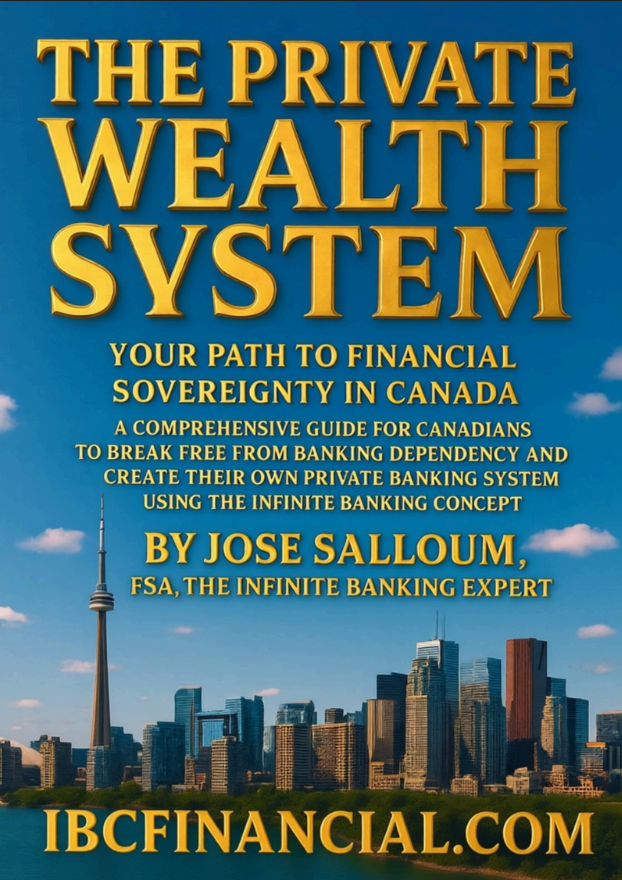
Take the First Step to Financial Freedom!
We use cookies for analytics & functionality. Manage preferences.
Manage your cookie preferences below:
Essential cookies enable basic functions and are necessary for the proper function of the website.
Google reCAPTCHA helps protect websites from spam and abuse by verifying user interactions through challenges.
Statistics cookies collect information anonymously. This information helps us understand how visitors use our website.
Google Analytics is a powerful tool that tracks and analyzes website traffic for informed marketing decisions.
Service URL: policies.google.com (opens in a new window)
Marketing cookies are used to follow visitors to websites. The intention is to show ads that are relevant and engaging to the individual user.
Google Maps is a web mapping service providing satellite imagery, real-time navigation, and location-based information.
Service URL: policies.google.com (opens in a new window)
You can find more information in our Cookie Policy and Privacy Policy.