
Insurance and Capital for Canadian Business Owners
For an incorporated owner the analysis turns on facts that do not exist personally: corporate tax rates on surplus held inside the company, the Capital Dividend Account credit that arises when a corporation receives a death benefit, and the ownership and beneficiary structure, which is where the expensive errors happen.
The corporate analysis is not the personal analysis with a company attached. It turns on facts that do not exist personally, and the most expensive mistakes in this field are made by treating the two as the same problem.
This page is the framework. The mechanics of a contract belong to policy basics, and the specific arrangements have their own pages.
Why the corporate case genuinely differs
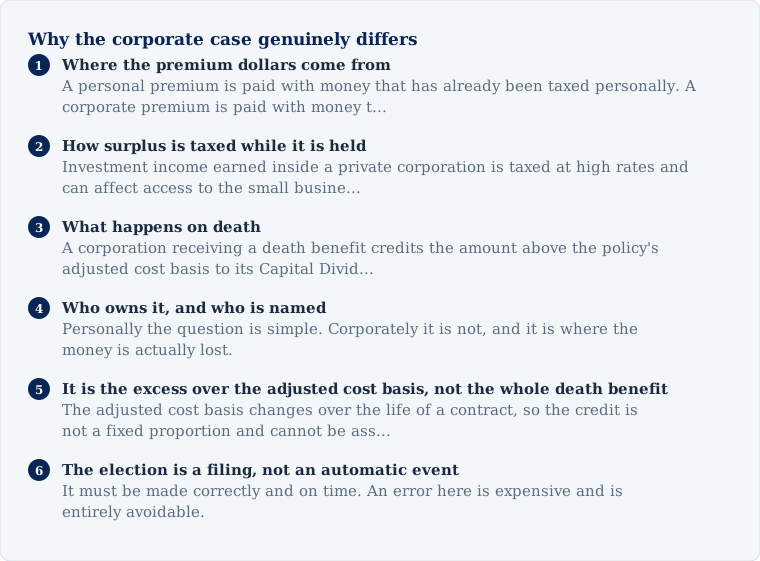
Four things change, and each changes the arithmetic rather than the emphasis.
Where the premium dollars come from. A personal premium is paid with money that has already been taxed personally. A corporate premium is paid with money taxed at corporate rates, which for active business income up to the small business limit are materially lower. That difference is the starting point of every corporate conversation, and it is also why the conversation is not simply about the product.
How surplus is taxed while it is held. Investment income earned inside a private corporation is taxed at high rates and can affect access to the small business rate. Where surplus accumulates faster than it is deployed, the question of where to hold it becomes a live one, and permanent insurance is one of the places it can sit.
What happens on death. A corporation receiving a death benefit credits the amount above the policy's adjusted cost basis to its Capital Dividend Account under ITA s.89(1), and may then pay a capital dividend to shareholders free of tax. This has no equivalent anywhere in United States law, which is why American material on corporate life insurance is not merely inapplicable here but actively misleading.
Who owns it, and who is named. Personally the question is simple. Corporately it is not, and it is where the money is actually lost.
The Capital Dividend Account, in outline
The strongest uniquely Canadian argument in this whole subject, and the one most often stated imprecisely.
A death benefit received by a corporation is not taxable to the corporation. The amount in excess of the policy's adjusted cost basis is credited to a notional account, and the corporation may elect to pay a capital dividend from that account to its shareholders without tax in their hands.
Three qualifications belong with that and are frequently omitted.
It is the excess over the adjusted cost basis, not the whole death benefit. The adjusted cost basis changes over the life of a contract, so the credit is not a fixed proportion and cannot be assumed.
The election is a filing, not an automatic event. It must be made correctly and on time. An error here is expensive and is entirely avoidable.
The account is notional and shared. Other transactions add to and subtract from it. A plan assuming a clean balance on the day it is needed has assumed something about the company's whole history.
This is an outline. The detail belongs to your accountant, and the purpose of stating it here is so that you know what to ask.
For owners outside Quebec, Ontario and British Columbia, coverage is arranged through the firm and Michael Salloum holds licensing in further provinces.
Where the money is actually lost
Not in the product. In the structure, and almost always discovered at a death or a sale, which are the two worst moments to discover anything.
The wrong owner. A holding company, an operating company, or the individual. Each produces a different result on death, on a sale, and on a reorganisation.
The wrong beneficiary. Where an operating company pays premiums but a holding company is named, or the reverse, a shareholder benefit can arise. This is a technical trap and it does not announce itself.
A structure that no longer matches the company. A contract arranged for a company that has since been reorganised, amalgamated, or had shareholders join or leave. The contract does not know, and nobody checks.
Cash value affecting a share sale. Passive assets inside an operating company can affect whether shares qualify for the capital gains exemption on a sale. A contract accumulating value for fifteen years can quietly change the answer, and the time to look at that is years before a transaction rather than during one.
Premiums paid by the wrong entity. Deductibility, shareholder benefit, and the Capital Dividend Account credit all depend on who paid and who owns.
None of these is a product failure. All of them are structuring failures, and they are the reason a corporate file needs an accountant and a legal advisor rather than an insurance conversation alone.
What corporate coverage is usually for
Four purposes, and being clear which one applies changes the design.
Key person coverage. The company loses someone whose departure damages revenue, financing or continuity. Proceeds stabilise the business rather than enrich anyone.
Buy-sell funding. Surviving shareholders need to acquire the shares of one who has died, and the estate needs to be paid. Without funding, the surviving owners are in business with an estate, and the estate holds an asset it cannot sell. The structure here is intricate and the tax outcomes differ substantially between arrangements.
Estate liquidity for the shareholder. A deemed disposition arises on the shares at death whether or not there is cash. Coverage arrives when the liability does, which is treated more fully in estate planning.
Holding capital. Corporate surplus that would otherwise be taxed as investment income each year, held inside an exempt contract instead, subject to the contract remaining exempt under Regulation 306, Income Tax Regulations.
Where the strategy conversation fits
Where a corporation holds a contract with accumulated value, that value can be accessed by an advance from the insurer, and the mechanics are the same as they are personally, set out on how a policy loan actually works.
One difference matters and it is routinely skipped. The advance is made to the corporation, not to the shareholder. Moving money from the corporation to the individual is a separate transaction with its own tax consequences. A plan that treats corporate capital as personally available has omitted a step, and it is not a small one.
The strategy itself, including where the case for it is weakest, is set out on the strategy pillar and in objections and risks.
The professions
An incorporated professional faces a version of this with its own features: income that varies across a career, contribution room affected by how they pay themselves, a practice that may or may not be saleable, and in some professions restrictions on who may hold shares.
Those specifics have their own pages rather than a paragraph here, because a dentist selling a practice and a physician who cannot sell one are facing different problems.
What to establish before any product conversation
Five questions, all answerable from documents you already have.
What does the corporate structure actually look like today? Not what it looked like when it was set up.
What is the corporate surplus, and what is it earning? That determines whether holding capital is a live question at all.
Is a sale contemplated, and on what horizon? It changes the ownership answer.
Does a shareholders' agreement exist, and what does it say about death? Many do not address it, and many that do are not funded.
Who is your accountant, and have they done this before? The interaction between insurance and the corporate tax framework is specialised. Many capable accountants have never had cause to learn it, which is not a criticism, and the right response is to establish the position rather than assume it.
The passive income rule, which catches successful owners
The provision that penalises the thing incorporation was supposed to enable, and the one owners are least often told about.
Active business income up to the small business limit is taxed at a low rate, which is what makes retaining earnings attractive in the first place.
Investment income earned inside the corporation reduces access to that low rate, on a sliding scale beyond a threshold, until it is eliminated entirely.
So a company that retained profits successfully, and invested them, can find the tax on its operating income rising as a result. The better the accumulation has gone, the sharper the effect.
Three ordinary responses, each with a trade-off an accountant should price.
Distribute more personally and invest outside the company, accepting the personal tax now.
Use a holding company, which addresses creditor exposure and does not by itself solve this.
Hold assets whose growth is not passive investment income, which is the technical basis on which corporate-owned exempt insurance is proposed. A narrow point rather than a general argument, and it belongs with an accountant who has done it before.
Model it before the balance is large enough to matter. By the time the effect is visible on a corporate return, the options have narrowed.
Salary, dividends, and what each builds
Treated as a tax question and equally a retirement and coverage question.
Salary creates RRSP room, at eighteen percent of earned income. It is where that room comes from, and room forgone in a year cannot be recovered later.
Salary builds CPP entitlement, with the corporation and the owner paying both portions.
Salary is deductible to the company, reducing corporate income.
Dividends avoid the payroll contributions and are paid from after-tax corporate income.
Integration sits underneath both. Canadian tax is designed so income earned through a company and distributed approximates what it would have borne personally. The mix changes timing and rarely changes the destination.
The consequence for coverage. Disability insurance is underwritten against earned income. An owner paying only dividends may find the coverage they can obtain is far smaller than their actual income supports, and they discover it at application rather than at claim.
Insuring the business itself
Distinct from insuring the owner personally, and frequently confused.
Key person coverage protects the company against the loss of someone whose absence would materially damage it. The company owns it, pays it, and is the beneficiary. Sizing is a business question: what the disruption would cost, what replacement would cost, what lenders would require.
Buy-sell funding provides the money for surviving owners to acquire a deceased owner's shares under a shareholders' agreement. The agreement and the funding have to match. A well-drafted agreement with no funding produces a dispute at the worst possible moment, and funding without an agreement produces money with no mechanism.
Loan protection, where a lender requires coverage assigned as security. The assignment is registered against the policy and affects what the owner can do with it.
Overhead expense coverage, which continues fixed business costs if the owner is disabled. Rarely discussed and directly relevant to any owner-dependent business.
Each has a different owner, payer and beneficiary, and getting that structure wrong is where the shareholder benefit problems arise.
The shareholder benefit problem
The commonest expensive error in corporate insurance files, and it arises from a structure that looks sensible.
Where a corporation pays a premium on a policy that benefits the shareholder personally, the Canada Revenue Agency can treat the premium as a taxable benefit to that shareholder. The company has paid, the shareholder has received something, and tax follows.
The trigger is a mismatch between who owns the policy, who pays the premium, and who is named as beneficiary. A corporation paying for coverage owned by the shareholder, or naming the shareholder's family, is the classic case.
It is often discovered years later, on audit or on a sale, when the arrangement is examined for the first time and the assessment covers several years at once.
It is avoidable at the outset and expensive to unwind. Transferring ownership of a policy is itself a disposition, so the correction can trigger its own tax.
The rule for any corporate file. Owner, payer and beneficiary are decided together, in writing, by an accountant before the application is signed. Not after the policy is issued, and not by an insurance advisor working alone.
How an owner's retirement actually assembles, and the three assets it usually rests on, are on the business owner's retirement plan.
Creditor exposure, and what a corporation does not fix
Incorporation limits liability for business obligations. It does not help where a personal guarantee was given, which is most small business lending.
Director liability survives it. Unremitted source deductions, GST or HST, and unpaid wages attach to directors personally.
Professional liability survives it. An incorporated professional remains personally liable for their own acts.
And formalities matter. Separate accounts, current minute books, arms-length dealing, adequate capitalisation, and no mixing of personal and corporate money. Where those are not kept, a court can disregard the structure, at which point the incorporation bought nothing.
Insurance defends where a structure merely obstructs. A liability policy provides a lawyer and pays a judgment. A corporate structure does neither, and the wider position is on asset protection.
Getting the shares to qualify
Relevant to any owner who may sell, and it is decided years before the sale.
The lifetime capital gains exemption applies to qualifying small business corporation shares. The conditions concern what the company's assets are used for, tested over the period before a sale.
A balance sheet full of investments can disqualify shares that would otherwise have qualified. This is the point at which corporate accumulation and exit planning collide, and owners frequently discover it at the offer stage.
Purification takes time. Removing non-active assets to restore qualification is a planned exercise with its own tax consequences, not a month-end adjustment.
Which makes accumulation and exit one conversation rather than two. An owner retaining and investing successfully, without testing qualification periodically, may be building a balance sheet that costs them the exemption.
None of this is tax advice, and every sentence in it belongs to an accountant who has the company's actual figures.
The shareholders' agreement, which does more than any policy
An agreement decides what happens. Insurance decides whether there is money to do it with. A business needs both and most have neither current.
What it should settle. What happens on a death, on a departure, on a disability, and on a dispute. How shares are valued, and whether that method still reflects the business. Who may buy, in what order, and on what timetable.
Valuation is the clause that ages worst. A formula agreed when the business was young frequently produces a number nobody accepts a decade later, and the disagreement arrives at the moment least suited to resolving it.
Disability is the gap. Most agreements address death carefully and departure adequately, and say little about an owner who is alive, unable to work, and still holding shares. That situation lasts longer and is harder than a death.
Review it when the business changes, not on a schedule. A new owner, a material change in value, a change in what the business does.
And match the funding to it. An agreement requiring a buyout with no funding produces a forced sale or a dispute, and funding with no agreement produces money and no mechanism.
Succession, which is not the same as exit
An exit is a transaction. Sale, wind-down, transfer.
Succession is a transition, usually measured in years, in which someone else learns to run the business while the owner is still there.
Most owners plan the first and assume the second, and the assumption is what fails. A business that cannot operate without its founder is worth materially less, and frequently is not saleable at all.
What makes a business transferable: documented processes, a management team, customer relationships that belong to the company rather than to one person, and financials that survive diligence.
Every item takes years. An owner beginning when a buyer appears has left the value on the table, and the fuller treatment is on the succession planning process.
The seven questions before any product
Seven, and none is about insurance.
Is the corporate structure current, and does it match what the business now does?
Is there a shareholders' agreement, and when was it last read?
What is the passive investment income position against the threshold?
Would the shares qualify for the exemption today?
What personal guarantees exist, and against what?
Who runs this if the owner cannot, starting tomorrow?
What does the owner need personally, separate from the business?
A practice that reaches for a product before these are answered is guessing, and an owner who can answer them can evaluate anything they are subsequently shown.
Why this section leads with structure rather than coverage
An owner's largest exposures are usually not insurable ones.
A shareholders' agreement that no longer matches the business. A balance sheet that has quietly disqualified the shares. Passive income raising the tax on operating profit. A business nobody else can run. None of those is solved by a policy, and each costs more than most policies would.
Coverage matters where it matters: funding an agreement, protecting against the loss of a key person, securing a lender, replacing an owner's income. Those are specific jobs, and each is sized against a number the structure work produces.
Which is the order. Structure first, because it determines what the coverage is for. An owner who buys coverage before the structure is settled has insured an arrangement that may not survive contact with an accountant.
And the structure work generates no commission, which is worth stating on a page published by a practice compensated when a contract is issued. The compensation position appears on the author page and at the foot of every page here, and an owner who completes the seven questions above has done work this practice does not charge for and does not earn from.
The documents that should exist and usually do not
Four, and an owner can establish in an afternoon whether each is current.
A shareholders' agreement, read within the last three years.
An up-to-date corporate minute book, because the structure fails without the formalities.
A written statement of what happens if the owner cannot work tomorrow, naming who signs, who banks and who decides.
A schedule of personal guarantees, listing what has been given, to whom, and against what. Most owners cannot produce this from memory, and it is the document that determines what incorporation is actually protecting.
Two mistakes that cost more than any product decision
Assuming the business is the retirement plan. Most businesses that go to market do not sell at the price or the timing the owner expected, and a substantial proportion do not sell at all. A retirement resting on one uncertain transaction is a hope with a spreadsheet attached.
Assuming incorporation protects personally. It does not where a personal guarantee was given, which is most small business lending, and it does not against director liability for source deductions, GST or HST, or unpaid wages.
Both are ordinary assumptions rather than errors of judgement, and both are correctable years in advance and not at all afterwards.
The order that holds for owners
Structure, then documents, then coverage.
The structure decides what is possible. The documents decide what happens. The coverage funds what the documents require. Reversing that order produces a policy sized against nothing, and it is the commonest sequence in this industry because only the last step generates a commission.
What an owner should take from this section
That the largest exposures are usually not insurable ones. An agreement that no longer matches the business, shares quietly disqualified, passive income raising the tax on operating profit, and a business nobody else can run.
Each is correctable years in advance and not afterwards, and none is solved by a policy. The coverage matters where it matters, and it is sized against numbers the structure work produces rather than against a general sense of prudence.
What this section owns, and what it does not
Here. Anything specific to a corporation: ownership structures, the Capital Dividend Account, corporate tax treatment, buy-sell and key person arrangements, succession, and the professions.
In policy basics. The mechanics of the contract, and personal tax treatment. The taxpayer decides which section owns a tax question.
In estate planning. Treatment at death, including the deemed disposition on shares.
In objections and risks. Any comparison against a non-insurance alternative, and any question asked adversarially.
Participating whole life insurance is an insurance product and it is not an investment. In a corporate file that distinction matters more than it does personally, because the alternative use of corporate surplus is usually a portfolio, and a comparison presented as though the two do the same job has misdescribed both.
A thirty-minute discovery meeting
A first conversation establishes whether this fits. No illustration is prepared and nothing is arranged.
Often the answer is no, and you will hear it during the call rather than in a proposal afterwards.
This form reaches Canadian Wealth Creation Centre Inc. Any meeting, any advice and any insurance product is provided by Canadian Wealth Creation Centre Inc., through its representatives certified by the Autorité des marchés financiers. IBC Financial is the company's education platform: it distributes no product and no financial service, and it gives no individualised advice.
Important disclosure
Everything in Business Owners
- Corporate-Owned Life Insurance (COLI)How corporate-owned life insurance works in Canada: who owns it, who is named, how the Capital Dividend Account operates, and where structuring goes wrong.
- What Is the Succession Planning Process?Succession planning covers two questions: who leads the business next, and who owns it next. Most plans answer the first and leave the second undecided.
Common questions
Should my corporation own the policy, or should I own it personally?
What is the Capital Dividend Account?
Does a corporate owned policy affect the sale of my business?
Why is the corporate case treated separately from the personal one?
Is a corporate owned policy an investment for my company?
What is the passive income rule and does it affect my corporation?
Should I pay myself salary or dividends?
What is key person insurance?
What is buy-sell funding and why does the agreement have to match it?
What is the shareholder benefit problem in a corporate insurance file?
Will my shares qualify for the lifetime capital gains exemption?
What should a shareholders agreement say about death and disability?
Can I use the money in a corporate owned policy personally?
Can I treat my business as my retirement plan?
What is the difference between succession and an exit?
Sources
- Income Tax Act s.89(1), Capital Dividend Account, Justice Laws Canada, verified 2026-08-21
- Income Tax Regulations, Regulation 306, Justice Laws Canada, verified 2026-08-21
Last reviewed 2026-08-21. By Jose Salloum, Financial Security Advisor.