
The Infinite Banking Concept® in Canada
The Infinite Banking Concept® is a method of thinking about who performs the financing function in a household, and only secondarily a contract. The thinking is most of it: what happens to a dollar after it leaves, whether capital returns or is gone, and whether the household decides or applies. A participating whole life contract designed for the purpose supplies the capacity. It requires durable surplus cash flow, a horizon measured in decades, and the discipline to repay what is drawn.
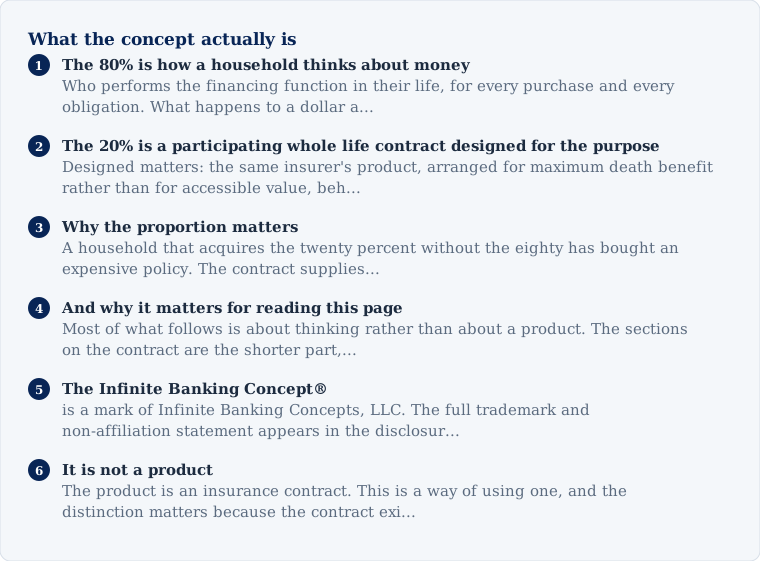
Infinite Financial Sovereignty®, built on the method Nelson Nash named The Infinite Banking Concept®, is roughly this:
80%
Concept and thinking
20%
The participating contract
That proportion is this practice's own characterisation rather than a measured figure, and it is the most useful thing to understand before anything else on this page.
The 80% is how a household thinks about money. Who performs the financing function in their life, for every purchase and every obligation. What happens to a dollar after it leaves. Whether capital returns or is simply gone. Whether the household is deciding or applying. None of that requires a contract, and a household can improve most of it before buying anything.
The 20% is a participating whole life contract designed for the purpose. Designed matters: the same insurer's product, arranged for maximum death benefit rather than for accessible value, behaves differently and largely cannot be redesigned afterwards. It is an ordinary regulated insurance product and there is nothing proprietary about it. What differs is the design, and design follows from purpose.
Why the proportion matters. A household that acquires the twenty percent without the eighty has bought an expensive policy. The contract supplies capacity. It does not supply the thinking, and nothing sold can. That is why this practice assesses whether a household can sustain and operate the method before any contract is discussed.
And why it matters for reading this page. Most of what follows is about thinking rather than about a product. The sections on the contract are the shorter part, deliberately.
The idea has a name, a book behind it, and a great deal of marketing on top of it. This page tries to separate the three.
Why a participating policy is an insurance product rather than an investment, and why people describe it as one anyway, is on life insurance is not an investment.
What the concept actually is
A way of using a participating whole life insurance contract as the place where a household or a business holds capital, and as the place it goes when capital is needed.
The mechanics of an advance are set out on how a policy loan actually works.
The contract accumulates value. When money is required, the owner requests an advance from the insurer secured against that value, uses it, and repays on a schedule they set rather than one a lender imposes. The value in the contract continues to be administered under the contract's terms while the advance is outstanding.
The idea was set out by Nelson Nash, an American forestry consultant, in a book published in 2000. He was describing something insurance contracts had permitted for a century; the contribution was the framing, not the mechanism.
The Infinite Banking Concept® is a mark of Infinite Banking Concepts, LLC. The full trademark and non-affiliation statement appears in the disclosures at the foot of every page on this site.
What it is not
It is not a product. The product is an insurance contract. This is a way of using one, and the distinction matters because the contract exists, is regulated and can be evaluated, while a strategy cannot be bought.
It is not an investment. A participating contract is an insurance product. Judged as a way to grow money against a market portfolio it usually compares poorly, which is precisely why judging it that way is the wrong test and why selling it that way produces the disappointment most of the criticism describes.
It is not independence from the financial system. The owner holds a contract with an insurer, administered by that insurer under its terms. A good deal of the language in this field implies something larger, and the narrower description is the accurate one.
It is not a way of lending to yourself. The insurer advances its own funds, charges interest, and receives that interest. Nothing circular occurs, and any presentation depending on the circular version is describing something that does not happen.
The four things it requires
If any one is missing, the answer is no, and finding that out now costs nothing.
Durable surplus cash flow. Not a good year. A normal year, sustained, with room to spare. The structure punishes interruption and interruption is what happens to people whose income is not stable.
A horizon measured in decades. Costs fall heaviest in the first years. A contract entered and abandoned inside a few years returns materially less than was paid into it, and that loss is permanent.
A place in the household's wider position. Registered plans keep their purpose and their contributions, funded from within the flow rather than in competition with it. A presentation treating this as a replacement for them has misdescribed it, and one adding it to a household that cannot sustain the funding has misread the household.
A clear purpose. A contract designed for maximum death benefit behaves differently from one designed to make value accessible early. The decision is made at issue and cannot be revisited later without cost, so a buyer who cannot say what the contract is for cannot be sold a correctly designed one.
Where the case for this is weakest
Stated here rather than at the end, because a pillar that saves its concessions for the bottom is not conceding anything.
The comparison usually offered is against the wrong alternative. The argument is typically made by setting an advance against borrowing from an outside lender and concluding the owner keeps interest that would otherwise have left. For most households the honest alternative was never borrowing at all. It was paying from savings, which costs no interest. Measured that way, the advantage is far smaller than the usual presentation suggests, and sometimes it disappears.
That argument is correct. It has its own page: the comparison question.
The costs are not itemised. A fund publishes an expense ratio. A participating contract publishes nothing equivalent, and the charges are absorbed inside the contract rather than shown to the buyer as a line item.
People are sold this who should not be. Compensation is paid at issue and the product requires decades of stable cash flow. Those two facts sit together uncomfortably and pretending otherwise would be dishonest.
The full set of arguments, with a verdict on each, is in the objections section, which is the recommended starting point for anyone new to the subject.
The Canadian frame
Most published material about this concept is American and reasons from American tax rules. Those rules have no Canadian counterpart, and a Canadian reader taking that material at face value is being warned about rules that do not apply and reassured about none of the rules that do.
The Canadian tests are different. A contract must remain exempt under Regulation 306, Income Tax Regulations for growth inside it to avoid annual taxation. An advance is a disposition under ITA s.148(9), and amounts above the adjusted cost basis can be taxable. The adjusted cost basis declines over time, which changes how a strategy behaves in later decades.
The corporate case is genuinely Canadian and genuinely different. For an incorporated owner the analysis involves how corporate surplus is taxed while held and how a death benefit is credited to the Capital Dividend Account, which has no American equivalent at all. That is a separate question with different inputs rather than the personal case with a company attached.
What it is for
The positive statement, which belongs before any list of who it fits.
Building a pool of capital you own and control. Not held for you, not administered on terms somebody else sets, not subject to a lending decision made by a committee that has never met you. Capital in a place where the decision about what happens to it is yours.
A vault rather than a queue. Most households hold their money where somebody else decides the terms on which they may use it, and reapply for permission each time they want it. The purpose here is to stop reapplying.
Financing the things a life actually requires, through that pool, rather than around it. A vehicle, a renovation, an equipment purchase, an opportunity that appears on short notice. The money leaves and returns, and the capacity rebuilds because the flow was repaid.
Coverage that does not expire, underneath all of it, paying whenever death occurs.
And control that transfers. The pool, and the practice of managing it, can pass to the next generation as a working arrangement rather than as a lump sum somebody spends.
This practice describes the outcome as Infinite Financial Sovereignty®, a registered trademark of Jose Salloum. Sovereignty here means the decisions are yours, not that any outcome is assured: the guarantees are contractual obligations of the issuing insurer, dependent on its solvency, and dividends are never guaranteed.
Who it is for
People who want to stop asking permission. The households that take to this are usually the ones already uncomfortable with how much of their financial life is decided elsewhere, and who would rather own the decision than optimise within somebody else's.
People with a long view. Not because the arrangement is slow, though it is, but because they are already thinking in decades: about children, about a business, about what outlives them.
People who want permanent coverage in its own right. The death benefit is wanted, not tolerated as the cost of something else.
Business owners and incorporated professionals, whose income arrives unevenly and for whom a repayment schedule they set themselves is worth something a salaried household may not value.
Families thinking across generations, where the point is a structure that continues rather than a payout that ends.
People who want what is usually called financial freedom and are prepared to find out what it costs in discipline. The wanting is common. The discipline is what distinguishes the households this works for.
Who it does not suit
A household whose cash flow cannot carry the funding through an ordinary decade. Not a strong year. A normal one, sustained, with room to spare. This is the single commonest reason it fails.
Anyone who may need that capital within the first several years. Early years build slowly, and exiting early returns less than was paid in.
Anyone who will not repay what they draw. Nothing external enforces it. No lender calls, no credit consequence follows. That freedom is the entire appeal and it is the entire failure mode, and a household that knows it will not repay should not begin.
Anyone who does not actually want permanent coverage. If the death benefit is unwanted, this is a financing structure wearing an insurance policy, and there are cheaper ways to finance things.
Anyone who cannot say what it is for. The design is largely fixed at issue and follows from the purpose. Without a purpose there is nothing to design toward.
Anyone whose household cannot have a direct conversation about money. The arrangement requires agreement sustained over decades, and one that only one partner understands does not survive.
And anyone being told it suits everybody. That is the clearest available signal that the person explaining has stopped explaining. Most households should not do this, and any description that fits all of them describes none of them.
The claims that should never be made about this approach, with the correct versions, are at claims that should never be made.
A note on the language in this field
The vocabulary consistently implies more control than a contract confers. Phrases suggesting the owner operates an institution, or stands outside the financial system, describe something that does not exist. What exists is a contract with terms, administered by an insurer.
That matters beyond pedantry. Most of the disappointment in this area, and a fair share of the criticism it attracts, begins with a word doing more work than it should. This site uses narrower language deliberately, and where a familiar phrase is absent, that is the reason.
What actually happens over thirty years
Descriptions of this approach jump from the idea to the outcome. The sequence is where the understanding sits, and it is also where the difficulty is visible.
Years one to five. Premiums are paid, heavily, usually well above what coverage alone would cost. Accumulated value is materially below total premiums paid. Nothing about this period feels like progress, and it is where most people who abandon the approach abandon it.
Years five to ten. The gap narrows. Accessible value becomes large enough to be useful for a real purpose: a vehicle, an equipment purchase, a short-term business need. This is the first point at which the approach does anything at all, and the first genuine test of the discipline it requires, because the question becomes whether the advance is repaid.
Years ten to twenty. Contractual value exceeds cumulative premiums at some point in this window, and the exact year is the number worth asking for. Advances and repayments become routine. The contract is supporting activity rather than merely existing.
Beyond twenty. The compounding within the contract is doing more than new premium is. Death benefit has grown without further underwriting. Households that reach here generally report that the early years were harder than described to them.
Nothing in that sequence is fast, and no part of it is automatic. The approach depends on behaviour sustained for decades, which is a harder requirement than any product feature.
Where the arrangement extends beyond one household, private family capital covers what changes when more than one generation participates.
What makes it fail
Distinct from arguments against it. These are the ways a reasonable attempt goes wrong.
Funding sized to a good year. The commonest failure. A premium commitment set during a strong period becomes unsustainable in an ordinary one, and reducing it is possible only where the contract was designed with that flexibility.
Advances taken and not repaid. The interest capitalises against a value growing on its own schedule, and the two curves eventually meet. An approach built on discipline fails when the discipline is absent, and the product does not supply it.
Treating it as a source of convenient money. The absence of an approval process removes a friction that exists for a purpose.
The wrong design at issue. The rider, the funding room and the base coverage are largely fixed when the contract is written, and cannot be revisited cheaply.
Starting too late for the arithmetic to work. The approach needs a long horizon, and beginning at sixty with a fifteen-year outlook is using a mechanism against its grain.
An orphaned contract. No servicing, no review, an option set once and never revisited. Undramatic, common, and it quietly costs more than any of the above.
What it requires of you rather than of the product
Worth separating, because product features are discussed constantly and these are not.
Cash flow that survives a bad decade, not a good year.
A twenty-year view at minimum, and preferably longer.
The discipline to repay advances when nobody requires it. There is no lender calling, no credit consequence, and no external pressure of any kind. That freedom is the appeal and it is also the failure mode.
A willingness to read one statement a year. Four figures.
And a genuine want for permanent coverage. If the death benefit is not wanted for its own sake, the arrangement is a financing structure wearing an insurance policy, and there are cheaper ways to finance things.
The question the concept actually asks
Not which product to buy, and not which account to fill first.
Who is performing the banking function in your life?
Every household finances everything it owns. A car, a roof, a business opportunity, an education. It is financed either by paying cash, which forgoes what that capital would otherwise have done, or by borrowing, which pays somebody else for the use of theirs. There is no third option, and most households never notice they are choosing.
Nelson Nash's argument was that this function is performed by somebody for every dollar that moves through a household over a lifetime, and that the question worth asking is who. The contract is the tool that makes it possible to perform it yourself. It is not the point, and it is not what is being bought.
Which is why the conventional sequence does not apply here. A hierarchy that fills registered accounts first, then considers everything else, assumes the objective is accumulating in the most tax-efficient container. That is a different objective, and evaluating this concept against it answers a question the concept does not ask.
What follows from the concept's own logic is that capital is built in a place you control, and the things you need are then financed through it rather than around it, with the flow repaid so the capacity rebuilds. Registered plans still exist, still receive their contributions, and are funded from within that flow rather than in competition with it.
None of that is a recommendation to you. Whether it fits depends on facts this page does not have, which is what the assessment below exists to establish.
What this practice assesses before anything is arranged
Nash's teaching is a concept, and a concept applied to a household that cannot sustain it fails the household. The assessment is therefore about the household rather than about the product.
Whether the flow can be sustained through an ordinary decade, not a strong one. A commitment sized to a good year is the commonest reason this fails.
What happens if income stops through disability. This is examined directly, because a system that depends on continued funding needs to survive the event that stops it.
What happens on a critical illness diagnosis, for the same reason.
What happens on a job loss or a business downturn.
Whether permanent coverage is wanted for its own sake. If the death benefit is not wanted, the arrangement is a financing structure wearing a policy.
Whether the household will actually repay what it draws. Nothing external enforces it: no lender calls, no credit consequence follows. That freedom is the whole appeal and it is the whole failure mode.
A household that does not survive that assessment should not proceed, and saying so is the point of conducting it.
What to ask, and what to ask it about
Who performs the banking function in my household today, for each thing I have financed? The answer is usually a lender, a leasing company, and the household itself paying cash. Naming them is where the understanding starts.
What does the guaranteed column show at years three, five and ten? Not because a break-even year settles anything, but because it is the contractual floor and you are entitled to see it.
What happens if I cannot fund this for two years?
What does your assessment cover? Disability, critical illness, job loss, business interruption. If those are not examined, the assessment is a sales qualification rather than a suitability review.
Who should not do this? An honest answer arrives quickly and names categories. A description that fits everybody describes nothing.
What are you paid, and when?
The four roles, examined
The framework underneath the approach, and the part most worth understanding because it describes what a household already does rather than what a product provides.
The Saver. Sets money aside and forgoes its use meanwhile. The structural limit is that saved capital is either working or available, rarely both. Money committed to growth is not there for an opportunity; money held for an opportunity is not growing.
The Borrower. Obtains the use of capital now and pays for it. The limit is that somebody else sets the cost and the terms, and both can change at renewal, in a rate cycle, or when circumstances make you a worse credit than you were.
The Participant. Shares in the results of a pooled arrangement. The limit is that the capital producing those results is held by someone else, so the participation can be adjusted, reduced or ended by a decision that is not yours.
The Administrator. Decides where capital goes, in what order, and on what terms. This is the only one of the four carrying no structural limit, and the only one that transfers to a family as a whole rather than to an individual.
The point of naming them. Every household performs the first three constantly, usually without deliberation. The fourth is available to all of them and is exercised by very few. The difficulty with it is behavioural rather than structural, and saying that plainly is more useful than any product description.
What the contract contributes is a place where the first and second roles can be performed against the same capital, which is a real feature and is not the same as removing the limits.
Canadian rules, and what does not transfer
Much of the material a Canadian reader meets was written for the United States, and the differences are not cosmetic: the exempt test, disposition taxation, no estate tax, and Assuris rather than a state guaranty association. The detail is on is life insurance taxable in Canada.
What a household actually does differently
The practical question, and the one least often answered concretely.
A capital purchase arrives, a vehicle, equipment, a renovation. The ordinary route is a commercial loan or paying cash. The approach's route is an advance against the contract, with a repayment schedule the household sets and keeps.
The difference is not that the money is free. Interest accrues to the insurer at the contract's rate. The difference is who sets the terms, and whether the repayment continues after the debt would ordinarily have ended.
That last part is the whole discipline. A household that repays an advance and then keeps making the payment is rebuilding the capacity it used. A household that stops when the balance clears has performed an ordinary loan at an ordinary cost, through a more expensive instrument.
And a household that never repays has drawn down a contract and will meet the consequence later.
Which is why this is described as a practice rather than a product. The contract makes it possible. Nothing about the contract makes it happen, and the behaviour cannot be bought.
Honest expectations
Six statements a reader can hold, each of which this site will stand behind.
The first five years will not feel like progress, and the contract will be worth less than what has been paid into it.
The guaranteed column is a real number available before signing, and the contractual floor is later and lower than most people expect.
Dividends will move, in both directions, and projections showing a constant scale are showing an assumption.
Nothing about this outperforms a low-cost portfolio as a way to grow money, and it is not intended to.
The coverage is real and pays regardless of when death occurs, which is what is actually being bought.
Most households should not do this, and the ones that should generally want permanent coverage for its own sake and can sustain the funding through a poor decade.
A reader who accepts all six will not be surprised by anything the arrangement does over thirty years. That is the standard, and any description that cannot meet it is selling rather than explaining.
Thinking that costs nothing to start
Most of this method requires no contract, and a household can begin the eighty percent this week.
List what you have financed in the last five years. Vehicles, renovations, education, equipment, a tax bill. For each one, name who performed the financing function: a lender, a leasing company, or the household paying cash and forgoing what that money would otherwise have done.
For each, name what it cost. Not the price. What left and did not come back: interest paid to somebody else, or the earnings the cash would have produced. Both are real and only one of them appears on a statement.
Notice what you will finance in the next five years. The list is rarely empty, and knowing it is what separates a plan from a reaction.
Ask who decides. For each future item, whether the household will be deciding or applying, and what happens if the answer that comes back is no.
Then ask what would change if that capital sat somewhere the household set the terms of its use.
That exercise is the method. It costs an evening, it involves no product, and a household that does it honestly has learned more about its own position than any illustration will show them. Many who complete it conclude they do not need a contract, and that is a legitimate outcome of doing it properly.
Where households lose money without noticing
The four losses the thinking is aimed at, none of which appears as a line on any statement.
Interest paid outward. Every commercial financing arrangement transfers money permanently. It is visible, it is accepted as the cost of doing business, and across a lifetime it is the largest of the four.
Earnings forgone on cash spent. Paying cash avoids interest and removes the capital that was producing something. The saving is visible and the cost is not, which is why paying cash feels free and is not.
Capital held idle for access. Money kept reachable earns little, and money earning well is usually not reachable. Most households resolve this by holding too much of one and not enough of the other.
Permission not granted. The opportunity that required a lending decision that went the other way, or arrived too late. It leaves no record at all, and for a business owner it is frequently the costliest of the four.
The method addresses the same four losses in one arrangement, and whether it does so at an acceptable cost is the honest question, examined at objections and risks.
A thirty-minute discovery meeting
A first conversation establishes whether this fits. No illustration is prepared and nothing is arranged.
Often the answer is no, and you will hear it during the call rather than in a proposal afterwards.
This form reaches Canadian Wealth Creation Centre Inc. Any meeting, any advice and any insurance product is provided by Canadian Wealth Creation Centre Inc., through its representatives certified by the Autorité des marchés financiers. IBC Financial is the company's education platform: it distributes no product and no financial service, and it gives no individualised advice.
Important disclosure
Everything in Infinite Banking
- Capital Held Within a FamilyWhat practitioners call a private family bank: how capital is held and lent within a family, where it fails, and what the vocabulary overstates.
- Claims That Should Never Be Made About This ApproachTen claims commonly made about this approach that are inaccurate, each with the technically correct version, so a reader can tell a description from a pitch.
- How a Household Finances Its Own Life, Step by StepInfinite banking in practice: where the capital sits, how it is drawn, how it is put back, and what the method asks of a Canadian household.
- Life Insurance Is Not an InvestmentWhy participating whole life is an insurance product rather than an investment, why people describe it as one anyway, and what the distinction protects.
Common questions
Is this a product I can buy?
How much of this is the concept and how much is the contract?
Does it require a special kind of policy?
How long before it does anything useful?
What is the strongest argument against it?
Does the American material about this apply in Canada?
Who is actually financing the things I buy?
What does the term Infinite Banking actually refer to?
Do I need a large income to make this work?
What happens if I cannot pay the premium in a bad year?
Can I get my money back if I change my mind after two years?
Does this make me independent of the financial system?
Can a corporation or a business use the same approach?
At what age is it too late to start?
What do I actually do differently once the contract is in place?
What should I ask before signing anything?
Sources
- Income Tax Regulations, Regulation 306, Justice Laws Canada, verified 2026-08-21
- Income Tax Act s.148(9), Justice Laws Canada, verified 2026-08-21
Last reviewed 2026-08-21. By Jose Salloum, Financial Security Advisor.