
How a Participating Policy Works, Year by Year
A participating whole life contract accumulates a guaranteed cash value set out in the policy schedule at issue, and may receive dividends declared annually by the insurer, commonly used to purchase additional paid-up coverage. Value can be accessed through an advance from the insurer, and the tax treatment depends on the contract remaining exempt under the Canadian rules.
This section is the reference layer for the whole site. Where another page mentions a mechanism in passing, it links here for the explanation, and one page here owns each concept rather than several explaining it slightly differently.
If you want the strategy that can be built on top of a contract, that is a different section. This one covers what the contract does on its own, whether or not anyone is running a strategy with it.
How dividends buy additional fully paid coverage inside a contract is set out on paid-up additions.
What a premium is actually made of, what drives the price, and what happens when one is missed, is on insurance premium.
The two jobs a contract does at once
It pays a death benefit. This is the primary purpose and the reason the product is insurance rather than anything else. It is why the mortality charge exists and why the contract must be underwritten.
It accumulates a value. A guaranteed cash value, set out in a schedule inside the policy document at issue, which grows over the life of the contract.
Almost every misunderstanding in this field comes from treating one of those as the real purpose and the other as a bonus. Both are contractual, both cost something, and a contract designed to emphasise one will do the other less well.
Where the premium goes
A premium is not a deposit. It is consideration for a contract, and it is consumed by several things at once.
The mortality charge. The cost of the insurance. On a permanent contract this is levelled across the life of the policy rather than rising annually as it does on renewable term, which is why an early premium buys less accumulated value than intuition suggests and a later one buys more.
Acquisition expense and compensation. Weighted heavily to the first year.
Policy and administration charges. Contract-level, generally modest.
Provincial premium tax. A real cost, varying by province, and rarely mentioned by anyone.
What remains contributes to the value that accumulates within the contract.
The consequence is the early-year shape of the contract: for the first several years, cash value is well below total premium paid. That is not a defect and it is not hidden. It is the cost structure, and it is examined in full on the real costs.
On holding more than one contract, and what limits total coverage, see how many policies you can have.
The guaranteed cash value
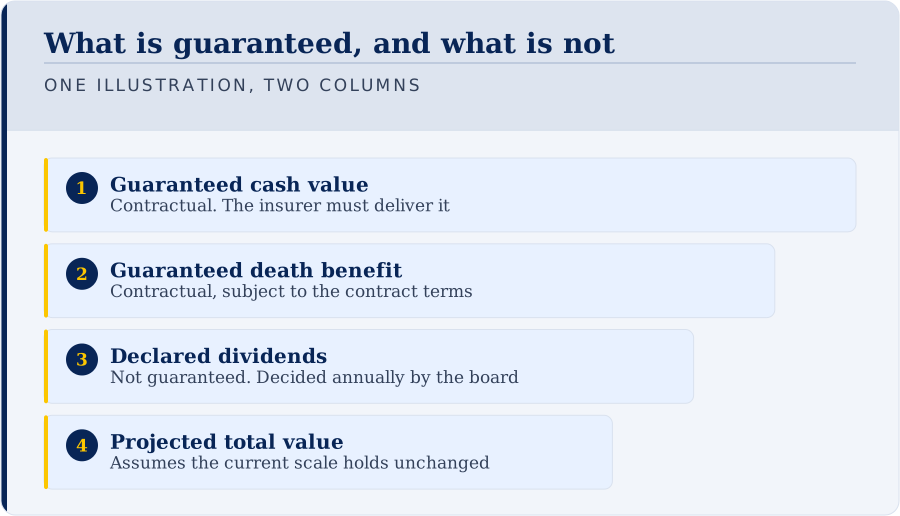
The schedule inside the policy document states a cash value for each year of the contract. Those figures are contractual. They do not depend on the insurer's investment performance, on a dividend being declared, or on any assumption anybody made at the point of sale.
This is the floor, and it is the number worth anchoring to. When an illustration is shown, ask for the guaranteed column and read that one first. A presentation that shows only the illustrated column has removed the information you actually need.
Two things the guaranteed column assumes, and it is worth being precise about them. It assumes premiums are paid as contracted. And it assumes nothing is withdrawn and no advance is outstanding.
Dividends
Where a contract is participating, it may receive a dividend.
Who decides. The insurer's board of directors, annually. Not an advisor, not a formula in the contract, and not the policyowner.
What it is based on. The performance of the participating account: the investment results, the claims experience, and the expenses of that block of business.
What it is not. It is not interest. It is not a share dividend. It is not guaranteed, and past declarations do not indicate future ones. A dividend scale can move down as well as up, and it has done both.
What can be done with it. Commonly, purchasing additional paid-up coverage, which increases both the death benefit and the cash value and is itself participating. Other options generally exist: taking it in cash, reducing premium, or leaving it on deposit. Which is appropriate depends entirely on what the contract is for.
Paid-up additions
An addition purchased with a dividend is paid up: no further premium is due on it, and it carries its own death benefit and its own cash value.
This is the mechanism behind most of the growth people find surprising in a mature contract. Each year's additions participate in the following year's dividend, so the base on which the next declaration is calculated is larger than the last.
It is also the mechanism most commonly adjusted at design time. A contract weighted toward additional deposits builds accessible value faster and starts with a smaller death benefit for the same outlay. A contract weighted toward base coverage does the reverse. Both are legitimate. Neither performs well at the other's job, and the decision is made at issue.
Accessing value
Three routes, and they are not interchangeable.
An advance from the insurer, secured against the contract. The value stays in the contract, interest accrues, and the outstanding balance reduces the death benefit until repaid. This is the route most discussed in this field and the one most often described incorrectly, so it has its own page: how a policy loan actually works.
A withdrawal, sometimes called a partial surrender. Value is removed permanently. Cash value falls, death benefit is usually reduced, and it cannot be undone by paying money back.
A surrender. The contract ends and the surrender value is paid.
The tax treatment differs across all three, and so does the effect on the death benefit. A plan that says "access the cash value" without naming the route is not yet a plan.
The adjusted cost basis
Every contract has an adjusted cost basis, broadly premiums paid less certain amounts, and it changes over the life of the contract.
It matters because amounts arising above it can be taxable. Two contracts with identical cash values can produce different tax outcomes on the same transaction, and the difference is here.
The behaviour that surprises people: it does not simply rise with premiums paid. It declines over time, for reasons built into how it is calculated. A strategy producing no taxable amount in early years may not behave the same way decades later, which is an argument for reviewing a contract periodically rather than setting it and forgetting it.
The insurer can state the current figure. Ask for it.
The exempt test
Canadian tax rules limit how much value may accumulate inside a policy relative to its death benefit. A contract staying within that limit is exempt, and growth inside it is not taxed annually the way interest in a non-registered savings account is.
The test is set out in Regulation 306, Income Tax Regulations. Insurers administer contracts to keep them within it, and where a contract would exceed the limit the insurer takes action rather than allowing exempt status to be lost quietly.
Two points worth holding. The favourable treatment is conditional, not an inherent property of insurance. And this is the Canadian test. Arguments imported from the United States reason from a different rule entirely, which is one of the more common ways a Canadian reader is misled by otherwise competent material.
Tax on accessing value
An advance under a policy is a disposition under ITA s.148(9). That does not mean it is taxed on receipt. It means the transaction sits inside the tax framework rather than outside it, and amounts above the adjusted cost basis can be taxable.
The outcome that does real damage is a contract lapsing or being surrendered while an advance is outstanding: a gain can become taxable in that year, arriving at the moment there is no cash to pay it, because running short of cash is usually what caused the lapse.
This page cannot give tax advice and no page can. What it can do is make clear which questions belong to an accountant, because someone who does not know an advance is a disposition will not know to ask.
Underwriting
A contract is priced at issue on the health of the person insured at issue.
That cuts two ways and both should be said. It is the strongest argument for acquiring permanent coverage while healthy, because a change in health later can make a contract irreplaceable. It is also why a contract entered lightly is difficult to leave: the option to replace it may not exist when you want it.
Acceptance is not automatic. An application can be accepted as applied for, accepted with a rating, accepted with an exclusion, postponed, or declined, and the decision belongs to the insurer.
Beneficiary designation
Who receives the death benefit, and on what terms.
Revocable designations can be changed by the owner. Irrevocable designations restrict what the owner may do with the contract, including requesting an advance against it, because the person named has an interest to protect.
Quebec treats the naming of a married or civil union spouse differently from the rest of the country, which catches people who assume the treatment is uniform.
A designation made years earlier, for sound reasons, in different family circumstances, is the most common avoidable error in this whole field. It costs nothing to check and it is checked at annual review.
Reading your annual statement
Three figures tell you almost everything.
Cash value. What has accumulated. Compare it with the guaranteed column rather than with the illustration you were shown at purchase.
Loan balance. Any advance plus capitalised interest. If it is larger this year than last and nothing was taken, interest is compounding unpaid.
Net cash value. The difference, and the figure that determines what remains available.
An owner who reads those three once a year, and asks about any movement they did not expect, avoids nearly every failure this site describes.
The provision that keeps a contract alive if the income funding it stops is set out on waiver of premium.
How a dividend is determined and what the options do is on dividend-paying life insurance.
Terms used across this site are defined in the glossary, which covers the adjusted cost basis, the exempt test, the dividend scale and the Capital Dividend Account.
The contract itself, and reading it
The document everything on this site describes, and the one almost nobody opens.
The policy contract governs in all cases. Not the illustration, not the brochure, not what was said in the meeting. Where they differ, the contract wins, and it is the only one of the four that is enforceable.
Five things worth locating in your own contract.
The schedule page, carrying the sum insured, the premium, the premium period and the guaranteed cash values year by year.
The non-forfeiture provisions, which set out what happens if premiums stop: reduced paid-up, extended term, surrender.
The advance provisions, including the rate, how interest is charged, and the proportion of value available.
The grace period and reinstatement terms.
The beneficiary designation, and whether it is revocable.
Ask the insurer for a policy summary if the contract is not to hand. Any owner may request one at any time, it is free, and it answers most questions definitively.
The free look, and the contestability period
Two provisions that matter at opposite ends of a contract's life.
A rescission period follows delivery, commonly ten days, during which the contract can be cancelled and premiums returned. It exists so a purchase made under pressure can be undone, and it is short.
The contestability period runs from issue, generally two years. Within it, an insurer may contest a claim on the basis of a material misstatement in the application. After it, the contract is generally incontestable except for fraud.
Which is why the application matters more than people assume. Everything disclosed, including what seems unimportant, protects the claim. Something omitted to obtain a better rate is a defect sitting in the file for two years, and the consequence lands at the worst possible moment on people who did not fill in the form.
Suicide exclusions typically run for the same initial period and are stated in the contract.
When the insurer says no, and what to do
Uncommon, and worth knowing before it happens.
A declined application. Insurers differ in appetite, so a decline by one is not a decline by all. A rating or decline based on a condition since resolved can be reconsidered on request, and very few people ask.
A rated offer. Coverage offered at a higher premium because of health, occupation or pursuits. It can be accepted, shopped, or revisited later.
A disputed claim. Where a claim is denied, the insurer must give reasons. The first step is the insurer's own complaints process, which every Canadian insurer maintains and which is free.
Then the OmbudService for Life and Health Insurance, an independent complaints service for Canadian consumers, also free.
Then the provincial regulator: the AMF in Quebec, FSRA in Ontario, the Insurance Council in British Columbia.
None of that requires a lawyer to begin, and a beneficiary is entitled to know the escalation path exists.
What happens at a claim
The moment the contract exists for, and it is described less often than any other part of it.
A named beneficiary claims directly. Proof of death, a claim form, and the insurer pays. It does not pass through the estate, it avoids probate where the province charges it, and it is beyond the reach of the deceased's creditors.
Timing is usually weeks rather than months, which is the practical difference from an estate distribution and the strongest argument for naming somebody.
Any outstanding advance is deducted before payment, and the remainder goes to the beneficiary.
Where the estate is the beneficiary, or nobody is, all three advantages are lost: it enters the estate, becomes available to creditors, and may attract probate.
The benefit is generally received free of income tax by a named beneficiary, which is the largest tax advantage in the product and the one most often stated without its condition.
And somebody has to know the contract exists. A policy nobody knows about is a policy nobody claims. Where it is, which insurer issued it, and who to contact.
What Assuris does and does not cover
The backstop behind every guarantee described on this site, and it is routinely described loosely.
It is not deposit insurance. CDIC covers deposits at banks. Assuris covers policyholders of member life insurance companies, and the two are different schemes with different limits and different mechanisms.
It is not a government guarantee. Assuris is funded by the industry.
Coverage is within published limits, which apply per company and per type of benefit, and the current figures should be read from Assuris directly rather than from any advisor's page.
Membership is compulsory for federally regulated Canadian life insurers.
What it means in practice. A contractual guarantee depends on the insurer's solvency, and Assuris sits behind that within limits. Both halves belong in any honest description, and a description offering only the second has overstated the protection.
Servicing, and what an owner should expect
A contract of this kind runs for decades and outlives most advisory relationships.
Once a year, four figures. Guaranteed value, total value, any outstanding advance, and the dividend applied. That is the whole of what servicing requires from an owner.
Every few years, three checks. Is the beneficiary designation still right. Is the dividend option still appropriate. Does the coverage still match the need.
After any life event, immediately. Marriage, separation, birth, death, a move between provinces.
And know who services it now. An advisor who has left is a servicing problem rather than a contract problem, and it is the commonest reason a sound contract underperforms its own design. The insurer will reassign a contract on request.
The six questions these pages exist to let you ask
What does the guaranteed column show at years three, five and ten, beside cumulative premiums paid?
What is guaranteed in writing, and what depends on a dividend?
What happens if I stop paying in year four?
What does it cost to reach the value, and what is the tax consequence?
Who is named as beneficiary right now, primary and contingent?
Who should not buy this?
None requires technical knowledge and every one is answerable from the contract. A reader who can ask them can evaluate anything they are shown, including by this practice.
Why the mechanics matter more than the projection
Every section above describes how something works rather than what it will be worth.
That ordering is deliberate. A household that understands the mechanics can evaluate any projection it is shown. One that has only seen a projection has nothing to check it against.
And the mechanics are knowable now. How a dividend is determined, what an advance costs, what the exempt test constrains, when a designation matters. None depends on an assumption about the next thirty years.
The projection depends on all of them and on a dividend scale nobody can promise. Read in that order, a projection is informative. Read first, it is persuasion.
The four documents in a contract's life
The application, which records what was disclosed and governs contestability for the first two years.
The illustration, which is a projection prepared before anything exists and is not a contract.
The policy, which is the contract and governs in all cases.
The annual statement, which reports what actually happened and is the only one of the four most owners will ever see again.
Households remember the second and file the third. The reverse is the useful habit.
What none of these mechanics decide
Whether any of it suits you.
The mechanics are the same for every household in Canada. What differs is the purpose, the cash flow and the horizon, and those decide the answer. A page explaining how something works has not told you whether to buy it, and this section does not try to.
A note on order
Read the mechanics before any illustration you are shown. That order is the whole of the advice this section offers.
What belongs in this section, and what does not
The boundary is worth stating, because it explains where to find things.
Here. Anything true of the contract regardless of whether a strategy is being run. If the sentence survives removing every reference to the strategy, it belongs here.
In the strategy section. Anything that only holds for someone running the strategy: funding design for that purpose, repayment discipline, sequencing.
In objections. Anything asked adversarially. "How does an advance affect the death benefit" is answered here. "Do policy loans really reduce my death benefit" is a challenge and is answered where challenges are answered, because a concession is a different page from an explanation.
Personal tax treatment here. Corporate tax treatment with business owners. The taxpayer decides which section owns the question.
A thirty-minute discovery meeting
A first conversation establishes whether this fits. No illustration is prepared and nothing is arranged.
Often the answer is no, and you will hear it during the call rather than in a proposal afterwards.
This form reaches Canadian Wealth Creation Centre Inc. Any meeting, any advice and any insurance product is provided by Canadian Wealth Creation Centre Inc., through its representatives certified by the Autorité des marchés financiers. IBC Financial is the company's education platform: it distributes no product and no financial service, and it gives no individualised advice.
Important disclosure
Everything in Policy Basics
- Cash Surrender ValueWhat cash surrender value is, how it differs from cash value, what surrender charges do, how a surrender is taxed, and what to weigh before ending a contract.
- Contingent BeneficiaryWhat a contingent beneficiary is, when the designation takes effect, how it differs from a primary designation, and the errors that send proceeds to an estate.
- Dividend-Paying Life InsuranceWhat a life insurance dividend actually is, how the insurer determines it, the five ways it can be used, why it is not a return, and why it is never guaranteed.
- How Many Life Insurance Policies Can You Have?There is no legal limit on how many life insurance policies you can own in Canada. What limits you is financial underwriting, and how insurers assess coverage.
- Insurance PremiumWhat a premium actually buys, the components inside it, what drives the price, payment modes and what they cost, and what happens when a payment is missed.
- Is Life Insurance Taxable in Canada?How life insurance is taxed in Canada: the death benefit, premiums, policy loans, dividends, ownership transfers, corporate ownership and how Quebec differs.
- Paid-Up AdditionsWhat paid-up additions are, how a PUA rider works, what they do to cash value and death benefit, what they cost, and where they stop being useful.
- Policy Loans in CanadaA policy loan is an advance from the insurer secured against the cash value. How the amount is set, how interest accrues, and how it is taxed in Canada.
- Tax-Deferred GrowthWhat tax deferral actually is, where it exists in Canada, the difference between deferred, exempt and tax-free, and why deferral is not forgiveness.
- Waiver of Premium RiderWhat a waiver of premium rider does, how the definition of disability decides whether it ever pays, the waiting period, exclusions, cost and who it suits.
- What Is a Policyholder?Who owns a life insurance contract, how the owner differs from the insured and the beneficiary, and why the distinction matters at the time of a claim.
Common questions
What is the difference between the guaranteed and the illustrated column?
Does the cash value belong to me?
Why is the cash value so low in the early years?
What makes a policy exempt, and why does it matter?
Who decides the dividend?
What is the adjusted cost basis and why does it fall over time?
What is the difference between a withdrawal and a surrender?
What should I look for on my annual policy statement?
What is the contestability period on a Canadian life insurance policy?
Can I cancel a life insurance policy right after I sign it?
What happens to my policy if the insurance company fails?
What can the insurer do with my application besides approving it?
What is the difference between a revocable and an irrevocable beneficiary?
What do I do if the insurer denies a claim?
Which document wins if the illustration and the policy disagree?
How often should a permanent policy be reviewed once it is in force?
Which parts of my own contract should I actually locate and read?
Sources
- Income Tax Regulations, Regulation 306, Justice Laws Canada, verified 2026-08-21
- Income Tax Act s.148(9), Justice Laws Canada, verified 2026-08-21
- Assuris, published protection limits, verified 2026-08-21
Last reviewed 2026-08-21. By Jose Salloum, Financial Security Advisor.