
Money Principles
These are the ideas underneath financial decisions rather than the products used to act on them: what a choice costs by excluding its alternative, how growth compounds and where that arithmetic gets oversold, why recovering capital matters more than earning on it, and what liquidity is actually worth.
This section covers the ideas underneath financial decisions rather than the products used to act on them.
Nothing here recommends anything. That is deliberate: these pages should be useful to a reader who never becomes a client, and a section that turned every general concept into an argument for a product would be a sales funnel wearing an education label.
Opportunity cost
The value of what you gave up in order to do the thing you did.
It is the only significant cost that never appears on a statement, which is why it is so consistently ignored. Money spent on one thing is not available for another, and the second thing had a value too. A decision that looks free because no fee was charged may have been the most expensive one available.
Two implications matter more than the definition.
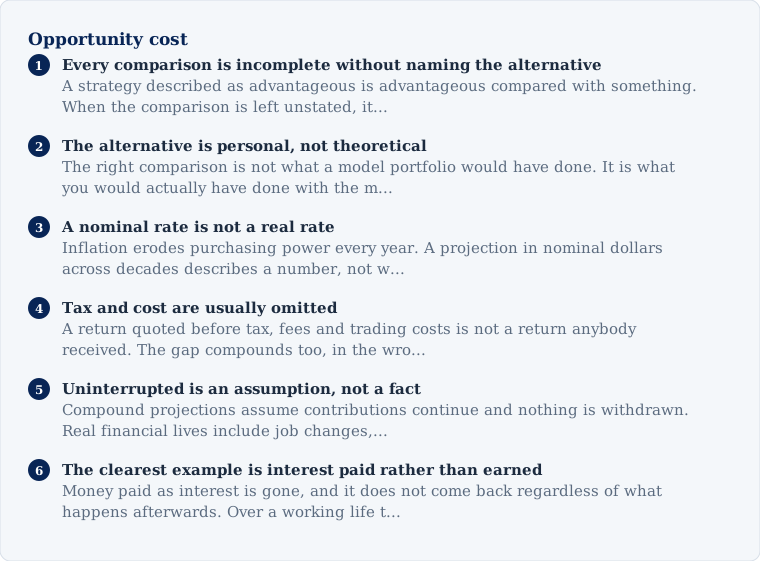
Every comparison is incomplete without naming the alternative. A strategy described as advantageous is advantageous compared with something. When the comparison is left unstated, it is usually because the honest comparison is less flattering. This site applies that test to its own subject in the comparison question.
The alternative is personal, not theoretical. The right comparison is not what a model portfolio would have done. It is what you would actually have done with the money, which is frequently different and occasionally nothing at all.
Compound growth, and where it is oversold
Growth calculated on an amount that already includes previous growth. The arithmetic is real and it is the reason time matters more than rate for most people.
It is also routinely overstated, in three specific ways worth recognising.
A nominal rate is not a real rate. Inflation erodes purchasing power every year. A projection in nominal dollars across decades describes a number, not what it buys.
Tax and cost are usually omitted. A return quoted before tax, fees and trading costs is not a return anybody received. The gap compounds too, in the wrong direction.
Uninterrupted is an assumption, not a fact. Compound projections assume contributions continue and nothing is withdrawn. Real financial lives include job changes, illnesses, and years when contributions stop. A projection that never accounts for interruption describes a life nobody has.
None of that makes compounding untrue. It makes a presentation of compounding worth reading carefully, and it makes the guaranteed portion of any arrangement more interesting than the projected portion.
Capital recovery
Getting your money back so it can be used again, rather than earning a return on money that has gone.
This is a different question from rate of return and for most households it is the more important one. A purchase that consumes capital permanently has a different lifetime effect from one that returns it, even where the stated cost is identical.
The clearest example is interest paid rather than earned. Money paid as interest is gone, and it does not come back regardless of what happens afterwards. Over a working life the total is frequently larger than people expect and is rarely calculated.
Recovery is not a rate. It is a structural property of how a decision is arranged. Two people can pay the same amount for the same thing and end up in materially different positions depending on whether the capital was consumed or recovered.
Liquidity
The ability to convert something into usable money, quickly, without loss.
It has a value, and that value only becomes visible when it is absent. An asset that cannot be accessed when it is needed forces the problem to be solved another way, and the other way normally involves borrowing at a rate nobody chose.
Three dimensions, and they are not the same. Speed, meaning how long it takes. Certainty, meaning whether the amount is known. Cost, meaning what it takes to convert. An asset can be strong on one and weak on another.
Liquidity is the reason a plan optimised purely for return can fail. A portfolio that must be sold at a bad moment has been sold at a bad moment regardless of its long-run average.
The cost of waiting
Deferring a decision is a decision, and it has a price.
Where something compounds, delay costs the compounding that would have occurred. Where something is priced on age or health, delay costs the pricing that was available. Where a contribution room accumulates, delay does not lose the room, which is why the cost of waiting differs by instrument rather than being a single rule.
This is not an argument for urgency. A decision measured in decades does not improve for being made this week, and anyone using the cost of waiting to manufacture pressure has inverted the point. The cost of waiting is a fact to weigh, not a reason to hurry.
Tax deferred is not tax free
Two things that are frequently spoken of as one.
Deferred means the tax is paid later, potentially at a different rate, potentially by someone else, and potentially all at once. Deferral has real value, because money that has not left keeps working, and it is not the same as never paying.
Free means no tax arises. Genuine tax-free treatment in Canada is narrow, and where it exists it is usually conditional on rules being met.
The practical consequence is that a comparison between a deferred arrangement and a taxed one is not complete until the eventual tax is accounted for, and a comparison ignoring that overstates the deferred side.
Risk is not volatility
Volatility is how much a value moves. Risk is the chance of not meeting the objective.
They are related and they are not the same. An asset that never moves can be extremely risky if it fails to keep pace with what it is meant to fund. An asset that moves a great deal may carry little risk against a long objective.
The risk that matters is defined by the goal, which means it cannot be described without knowing the goal. A conversation about risk that never establishes what the money is for is measuring the wrong thing.
The behaviour question
Most financial outcomes are decided by what people actually do rather than by what an arrangement theoretically produces.
A plan requiring monthly discipline for thirty years is a plan carrying a behavioural assumption. A structure where the correct action is automatic outperforms one where it must be chosen repeatedly, even where the second looks better on paper.
This cuts both ways and both should be said. It is an argument for arrangements that enforce a discipline. It is also a warning about arrangements that punish an interruption, because interruption is a normal feature of a life rather than a failure of character.
The velocity of money
The principle underneath most of these pages, and the one least often named.
A dollar is not defined by what it earns. It is defined by how many jobs it does. A dollar sitting in an account earns whatever it earns and does one job. The same dollar deployed, recovered and deployed again has done several.
This is why the order of operations matters more than the rate. Two households with identical income and identical returns finish decades apart because one recovered capital and redeployed it while the other spent it and started again.
And it is where interest paid outward hurts most. Money transferred to a lender does not merely cost the interest; it removes the dollar from the household's own circulation permanently, and every job that dollar would have done afterwards is gone with it.
The honest caution. Velocity is a description of how money moves, not a guarantee that moving it faster produces more. A dollar deployed badly several times is worse than a dollar left alone, and any argument for velocity that skips this has stopped being a principle and started being a pitch.
Where money leaves a household without appearing on a statement
Four losses. None is a line item, and none appears on any statement.
Interest paid outward. Visible, accepted as the cost of doing business, and across a lifetime the largest of the four.
Earnings forgone on cash spent. Paying cash avoids interest and removes the capital that was producing something. The saving is visible and the cost is not, which is why paying cash feels free and is not.
Capital held idle for access. Money kept reachable earns little; money earning well is usually not reachable. Most households resolve this by holding too much of one and not enough of the other.
Permission not granted. The opportunity that needed a lending decision that went the other way, or arrived too late. It leaves no record at all, and for a business owner it is frequently the costliest of the four.
Naming them is the point. A household that can see all four is deciding. One that can see only the first is optimising a single line while three others run unattended.
Fees, and why the arithmetic is worse than it looks
A percentage of assets is not a percentage of returns. A fee of one percent on a portfolio returning six percent has taken roughly a sixth of the return, not one percent of it.
It compounds against you. The fee is charged on a base that would otherwise have grown, so the loss is not the fee itself but the fee plus everything it would have earned.
And it is charged in bad years too. A percentage of assets is levied whether performance was good, flat or negative.
None of that makes fees illegitimate. Advice, administration and management have real costs, and a fee openly stated is preferable to a cost buried elsewhere. What matters is knowing the number, which is examined on what a wealth manager charges.
The comparison worth making is between a fee you can see and a cost you cannot. An insurance contract publishes no expense ratio, which is a genuine disadvantage against a fund and is stated as one throughout this site.
Inflation, and what it does to a plan
The variable most often left out of a projection, and the one that quietly decides whether it worked.
A level amount buys less every year. At three percent, purchasing power roughly halves over twenty-four years. A projection in nominal dollars showing a large number in year forty has not said what that number will buy.
It affects the products on this site unevenly. A level annuity payment erodes across a long retirement. A level death benefit buys less by the time it is paid. A contract whose values grow may or may not outpace it, and the guaranteed schedule does not adjust for it.
Ask for a projection in today's dollars, or at least ask what inflation assumption sits behind the one you were shown. Frequently the answer is none.
The reverse is also true and less often said. Inflation erodes fixed debts as well as fixed assets. A mortgage repaid over twenty-five years is repaid in progressively cheaper dollars, which is part of why long fixed borrowing has suited households historically.
Where a claim rests on how money is created, the mechanism is set out on the money multiplier, including why the textbook version does not describe Canadian lending.
For a reader starting from the beginning, why personal finance matters sets out the five habits that outperform every principle on these pages.
The cost of being wrong, and why it is asymmetric
Most financial decisions are compared by expected outcome. The more useful comparison is what happens when the assumption fails.
Some errors are recoverable. Holding too much cash for a few years costs growth and nothing else. A portfolio that underperforms can be left alone.
Some are not. Insurance not bought while insurable cannot be bought after health changes. A contract surrendered in year four cannot be restored at the original age. A conversion window that closed does not reopen.
Weight the decision accordingly. Where the downside is recoverable, the expected outcome is the right guide. Where it is not, the question is what happens if you are wrong, and the cheap protection against an unrecoverable error is usually worth more than its expected value suggests.
This is why convertibility, disability coverage and insurability generally matter more than their price implies. They are inexpensive protections against errors that cannot be undone.
Comparing anything to anything else
Four conditions. A comparison missing any of them is advocacy.
Same time period. Any two things can be made to win by choosing when to start and stop.
Same fee treatment. After-fee against after-fee, or before against before. Mixing them produces a false gap in whichever direction was chosen.
Same certainty. A contractual floor and a projected average are not the same quantity, and setting them side by side implies they are.
Everything each provides. If one includes a death benefit and the other does not, that is part of the comparison rather than a footnote to it.
Applied honestly, most comparisons in this field produce a mixed result, which is why they are so often presented dishonestly. A comparison producing a clean win for whatever the presenter sells has usually failed one of the four.
Sequence risk, which averages conceal
An average return over thirty years says nothing about the order the years arrived in, and the order decides the outcome for anyone drawing money.
During accumulation the order barely matters. Money left alone reaches roughly the same place whether the good years came first or last.
During withdrawal it decides everything. Poor returns in the first years of drawing, while withdrawals continue, remove capital that is never available to recover. The same average with the poor years later produces a materially different result.
This is why a projection using an average return flatters a retirement plan. It assumes a smooth path that no market provides.
It is also the honest argument for a contractual floor, and it should be stated as narrowly as it is true: a guaranteed schedule does not fall in a poor year, so income drawn against it does not compound a market decline. That is a real property. It is not a claim that the arrangement outperforms, and any version that slides into one has overstated it.
Debt, and the distinction worth keeping
Not all debt is equivalent, and treating it as one category produces poor decisions in both directions.
Rate matters. High-rate consumer credit compounds against a household faster than almost any asset compounds for it. Clearing it is rarely the wrong answer.
Term matters. A long fixed obligation is repaid in progressively cheaper dollars.
Purpose matters. Borrowing for something that produces income is a different proposition from borrowing for something that does not, whatever the rate.
And what it does to flexibility matters most. A household servicing large fixed obligations has fewer choices in a bad year, and fewer choices is how ordinary difficulties become serious ones.
What this site will not do is tell you that borrowing is always wrong or that a particular structure makes it right. Both claims are sold, and neither survives contact with a specific household's numbers.
Why these principles come before any product
Every page here can be applied without buying anything.
Opportunity cost, velocity, sequence risk, fees, inflation, the four hidden losses. A household that understands them makes better decisions about mortgages, savings, timing and debt, none of which involves this practice.
That is deliberate. A practice that leads with a product and reaches for principles afterwards has used the principles as justification. The order here is the reverse, and it is the order that lets a reader evaluate anything they are later shown, including by this practice.
And it is checkable. Nothing on these pages requires a contract, and this practice earns nothing from any of it.
The one habit that outperforms every principle here
Stated plainly because it is true and because it is not what a financial site usually leads with.
Spending less than you earn, consistently, over a long period, does more than any product decision available. No structure, no contract and no strategy on this site substitutes for it, and every one of them assumes it.
The corollary matters as much. A household with a durable surplus has options. A household without one is choosing between products it cannot sustain, and the sustaining is what decides outcomes rather than the choosing.
Which is why this practice assesses cash flow before anything else, and why a common outcome of a first conversation is that nothing should be arranged yet.
Where to start if you read nothing else here
Find out what you actually spend. Not what you intend to spend. Three months of statements answers it, and most households are wrong about the number by a material margin.
Then find the surplus, if there is one. That figure decides what is possible and it is the input every page on this site assumes.
Then name what you will finance in the next five years, and who will perform that financing.
Three questions, an evening, no product. A household that can answer them can evaluate anything it is subsequently shown, including by this practice, and one that cannot is choosing between options it has no basis to compare.
Why none of this is a formula
Every principle here describes a relationship rather than producing a number.
Opportunity cost tells you to price the alternative, not which alternative to choose. Velocity tells you to count the jobs a dollar does, not how many is enough. Sequence risk tells you order matters when drawing, not what order will arrive.
Which is deliberate. A formula answers a question. A principle lets you ask better ones, and the questions are what these pages are for.
And it is why nothing here can be sold. A principle applied to your own figures belongs to you, and a practice that packaged one has packaged something it does not own.
The principle that governs the rest
Money has a cost whether or not anyone charges you for it.
Interest paid outward has a visible cost. Capital spent has an invisible one. Capital held idle has a third. Permission not granted has a fourth, and it leaves no record at all.
Every page here is a way of seeing one of those costs. Opportunity cost prices the second. Velocity describes the third. Capital recovery addresses the first and second together.
A household that sees only the visible cost is optimising one line while three others run unattended, and that is the whole argument for principles before products.
One line to leave with
Every dollar is doing a job, and most households have never asked which.
What this section refuses to do
It does not turn a principle into a product recommendation. Opportunity cost is a concept, not an argument for insurance. Compound growth is arithmetic, not a sales point. A page that explained a principle and then arrived at a solution would be doing the thing this section exists to avoid.
It does not use figures it cannot source. Where a number would help, the principle is explained without it rather than illustrated with an invented one.
It does not manufacture urgency from the cost of waiting. See above.
What belongs here, and what does not
Here. Ideas that hold regardless of product: opportunity cost, compound growth, capital recovery, liquidity, the cost of waiting, deferral, risk, and behaviour.
In policy basics. Anything specific to how an insurance contract works.
In the strategy section. Anything that only holds for someone running a particular strategy.
In objections and risks. Any comparison against a non-insurance alternative, and any question asked adversarially.
If a page in this section cannot be read usefully by someone who will never buy anything, it is in the wrong section.
A thirty-minute discovery meeting
A first conversation establishes whether this fits. No illustration is prepared and nothing is arranged.
Often the answer is no, and you will hear it during the call rather than in a proposal afterwards.
This form reaches Canadian Wealth Creation Centre Inc. Any meeting, any advice and any insurance product is provided by Canadian Wealth Creation Centre Inc., through its representatives certified by the Autorité des marchés financiers. IBC Financial is the company's education platform: it distributes no product and no financial service, and it gives no individualised advice.
Important disclosure
Everything in Money Principles
- Capital RecoveryWhat capital recovery means, the capital recovery factor, and how depreciation and the Canadian capital cost allowance relate to it.
- Compound InterestHow compound interest works, the formula and what each term means, why frequency matters, the rule of 72, and the three ways the arithmetic is overstated.
- Opportunity CostWhat opportunity cost means, how it is calculated, explicit and implicit costs, how it differs from sunk cost, and why the alternative must be named.
- The Money MultiplierWhat the money multiplier is, how it is calculated, what the reserve ratio does, and why the textbook version does not describe Canadian banking.
- What Are the Fees for a Wealth Manager?How wealth management is charged in Canada: percentage of assets, hourly, flat and retainer structures, management expense ratios, and embedded costs.
- Why Is Personal Finance Important?What personal finance covers, where the field came from, the five areas it spans, the order they matter in, and what changes when someone understands it.
Common questions
Why is there a section with no products in it?
What is opportunity cost, in one sentence?
Is compound growth really as powerful as people say?
What does capital recovery mean?
Why does liquidity matter if the money is growing?
What is the velocity of money in personal finance?
Is tax deferred the same as tax free?
Is risk the same thing as volatility?
What is sequence risk and when does it actually matter?
Why is a one percent fee worse than it sounds?
What does it cost to wait before making a decision about money?
Is all debt bad?
How do I compare two options fairly?
Where does money leave a household without showing up on a statement?
What single habit matters more than any product decision?
Last reviewed 2026-08-21. By Jose Salloum, Financial Security Advisor.