

Opportunity Cost
Opportunity cost is the value of the next most valuable alternative you gave up in order to do what you did. It is the only significant cost that never appears on a statement, and it is the reason a comparison is incomplete until the alternative is named.
Opportunity cost is the value of what you gave up in order to do the thing you did.
It is the only significant cost that never appears on a statement, which is why it is so consistently ignored, and it is the reason a decision that looks free can be the most expensive one available.
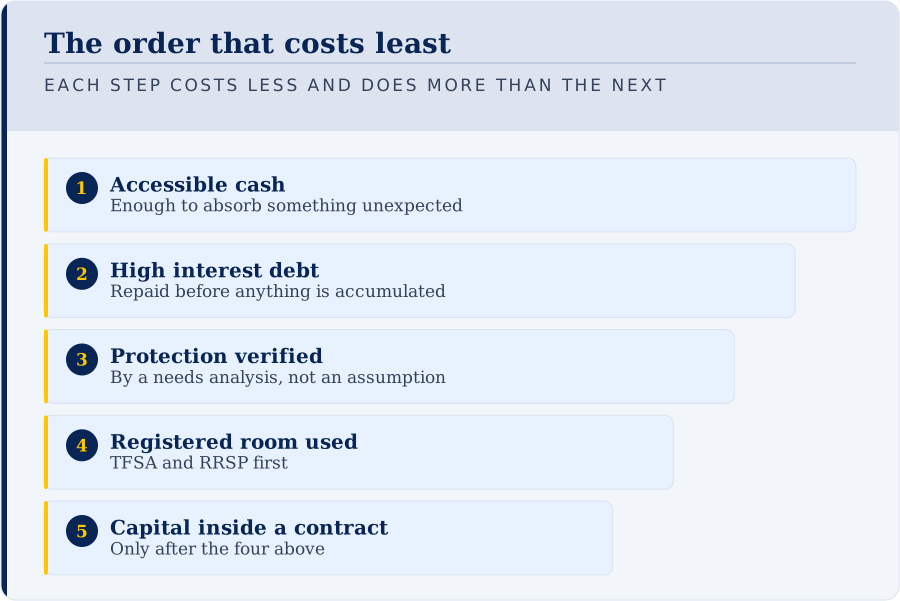
What is the meaning of opportunity cost?
The value forgone by choosing one alternative over another.
It is not always about money. Time has an opportunity cost, so does attention, and so does flexibility: a commitment that closes options has cost you those options whether or not any money moved.
Economists define it as the next most valuable alternative forgone, which is the phrase worth holding onto. Not every alternative. The next most valuable one.
A worked illustration, using round numbers rather than any actual figures. If $10,000 is committed to something expected to return six percent, and an alternative would have returned nine percent, the opportunity cost is three percentage points, or roughly $300 in the first year. The arithmetic is straightforward. Identifying the correct alternative is not.
What is the opportunity cost formula?
The return of the option not taken, less the return of the option taken.
Three points about it are worth more than the formula itself.
It is an economic cost, not an accounting one. It appears in no ledger and no financial statement. No money moves. It is nonetheless real, and businesses that ignore it allocate capital badly.
It applies to non-financial decisions. Time spent on one project is time not spent on another, and the formula holds with the units changed.
It is only as good as the alternative chosen. Comparing against an unrealistic alternative produces a number that flatters or damns the decision at will, which is the failure mode this whole concept is prone to.
What are the types of opportunity costs?
Two, and the second is where the interesting analysis lives.
Explicit costs
Costs involving an actual payment. Wages, rent, materials, interest. They appear in the accounts and they are straightforward to identify because somebody invoiced you.
Implicit costs
Costs involving no payment at all. The salary a founder gives up by working in their own business. The rent not collected on a property used rather than let. The return not earned on capital tied up in equipment.
Implicit costs are where most opportunity cost hides, and they are the reason an operation showing an accounting profit can be destroying economic value. If the capital committed would have earned more elsewhere and the owner would have earned more elsewhere, the business is profitable on paper and costly in fact.
What is the importance of opportunity cost?
Four things, and the first is the one that matters on this website.
Every comparison is incomplete until the alternative is named. A strategy described as advantageous is advantageous compared with something. Where the comparison is left unstated, it is usually because the honest comparison is less flattering. This site applies that test to its own subject in the honest case against its own product, and the conclusion there is that the usual comparison in that field is against the wrong alternative.
The alternative is personal rather than theoretical. The right comparison is not what a model portfolio would have returned. It is what you would actually have done with the money, which is frequently different, occasionally nothing at all, and known only to you.
It prices commitment as well as cost. Two arrangements with identical cost differ if one ties capital up for a decade and the other does not. The length of the commitment is the size of the opportunity cost.
It exposes what a decision closes. Options forgone are rarely counted and frequently the largest part of what was given up.
Is opportunity cost also called real cost?
The terms are used interchangeably, and both point at the same distinction: between what an accountant records and what a decision actually costs.
The label matters less than the discipline. Whatever it is called, the question is what the money or the time would otherwise have done.
What is the opposite of opportunity cost?
Opportunity benefit: the gain from the choice actually made, rather than the value of the one forgone.
It is the same comparison read from the other end, and it is the less useful frame. Counting what you gained invites you to stop there. Naming what you gave up forces the comparison to be completed.
What is a real-life example of an opportunity cost?
Three, in increasing order of how often they are overlooked.
Paying cash for a vehicle. The money is gone from wherever it was, and whatever it was doing there is the opportunity cost. This is visible and people generally see it.
Carrying a mortgage while holding savings. The savings earn one rate, the mortgage costs another, and the difference is a cost being paid every month for liquidity. Whether that is worth paying depends entirely on the household, and most never calculate it.
Leaving registered contribution room unused. Room does not disappear, but the sheltered growth that would have accrued in the intervening years does. That is an opportunity cost with no transaction attached and no statement recording it, which is why it goes unnoticed for decades.
What is the difference between opportunity cost and sunk cost?
The most useful distinction in this whole subject, and the one most consistently inverted.
| Aspect | Opportunity cost | Sunk cost |
|---|---|---|
| Meaning | The value of what you give up by choosing one option over another | Money or resources already spent that cannot be recovered |
| Focus | Future choices and what they forgo | Past expenditure |
| In a decision | Should be considered, because the choice determines it | Should be ignored, because it is unchanged by the choice |
| Recoverable | Not a payment, so nothing to recover | Gone regardless of what happens next |
| Common error | Ignoring it, and comparing against no alternative at all | Honouring it, and staying in a losing position because of what was already spent |
Opportunity cost looks forward. What do I give up by choosing this?
Sunk cost looks backward. What have I already spent that I cannot recover?
Sunk cost should be ignored in a decision. Money already gone is gone regardless of what you choose next, so it is irrelevant to the choice.
Opportunity cost should not be ignored, because it is precisely what the choice determines.
People do the reverse. They stay in a losing position because of what they have already put in, and they ignore what staying costs them going forward. That is one sentence and it explains a great deal of financial behaviour.
Where this concept meets the language of this field
Practitioners in the United States frequently describe an approach as becoming your own banker, a phrase taken from the title of Nelson Nash's book and a registered trademark of Infinite Banking Concepts, LLC. Much of the case made under that name is an opportunity cost argument: that interest paid to an outside lender is value permanently forgone.
The observation about interest is sound. Interest paid leaves and does not return, and over a working life the cumulative total is larger than most people ever calculate.
The comparison usually attached to it is not. The argument compares borrowing from an outside lender against borrowing against a policy, when for most households the honest alternative was never borrowing at all. It was paying from savings, which costs no interest. Against that alternative the advantage shrinks considerably.
That is opportunity cost applied to the argument itself, which is the correct use of the concept and the reason it belongs in a principles section rather than in a sales one. It is taken up again with the rest of the case against this product.
The alternative nobody names
The weakest point in almost every opportunity cost argument is the alternative chosen for comparison, and it is chosen by whoever is making the argument.
Against a savings account, almost anything looks good. Against a diversified portfolio at long-run averages, almost nothing does. The same decision can be made to appear excellent or dreadful purely by selecting the comparator, and no arithmetic in the calculation prevents this.
Three tests for whether an alternative is honest.
Would you actually have done it? Not could have. Would have. A comparison against an investment you would never have made is a comparison against a fiction.
Was it available to you? Alternatives requiring capital you did not have, or access you do not have, are not alternatives.
Does it carry the same risk and the same liquidity? Comparing a guaranteed outcome against an uncertain one, without adjusting for the difference, is comparing two things that are not comparable. So is comparing something you can reach tomorrow against something locked for a decade.
An argument that fails any of the three is using opportunity cost as rhetoric rather than as analysis.
Time, which is the version people underweight
The financial version is easier to calculate and the temporal one is usually larger.
Deferral has an opportunity cost. Where something compounds, delay costs the compounding that would have occurred, and no transaction records it. Where something is priced on age or health, delay costs the pricing that was available.
This is not an argument for urgency, and anyone using it that way has inverted the concept. A decision measured in decades does not improve for being made this week. The cost of waiting is a fact to weigh against the cost of deciding badly, and deciding badly is frequently the more expensive error.
Attention has one too. A household spending months optimising a small decision while a large one goes unexamined has paid an opportunity cost in attention, and it is a common pattern: the visible decision gets the effort and the consequential one gets a default.
How to use this in practice
Four questions, applicable to any financial decision and none of them requiring a professional.
What is the alternative, named specifically? Not "something else". The actual thing you would otherwise do.
What would that alternative have produced, on assumptions you would defend to someone sceptical?
What does this option close off, and for how long? Commitment is a cost even where it is not a payment.
What am I ignoring because I have already spent it? The sunk cost question, asked deliberately, because it will not surface on its own.
Answering those four converts a decision made on feel into one made on comparison, which is the entire contribution of this concept and the reason it is worth understanding whether or not you ever buy anything.
Where the concept is misused
Three patterns worth recognising, because opportunity cost is the concept most often borrowed to make a weak argument look rigorous.
The unstated alternative. A claim that something "costs you" a return, without naming what would have produced that return. The number looks like analysis and rests on an assumption nobody has examined.
The historical average applied to a single life. Long-run market averages describe a long run. A household investing across thirty years experiences a particular sequence, not an average, and a comparison using the average overstates what the alternative would actually have delivered for that household.
The one-sided adjustment. Fees, tax and liquidity accounted for on one side of the comparison and not the other. This is the commonest defect in product comparisons generally, and it is almost always the comparator that gets the unfavourable treatment.
Each of these produces a number. None of them produces an answer.
A note on why this sits in a principles section
Because it is useful to somebody who never buys anything.
A reader who takes only one thing from this page should take the habit of asking what the alternative is, every time, including when this website makes a claim. That habit is worth more than any specific figure on any page here, and it is the reason the concept is explained without a product attached to the end of it.
It also cuts in an uncomfortable direction for a website written by an insurance practice, which is the point of including it. Applied honestly, the question of what the alternative is will sometimes produce the answer that the alternative was better. A site unwilling to publish a concept that can be turned against its own subject is not publishing education, and a reader who cannot turn the concepts back on the author has not been given anything useful.
The opportunity cost nobody prices
The examples above compare one use of a dollar against another. There is a third comparison, and it is the one this practice exists to raise.
Money that sits where somebody else sets the terms has an opportunity cost that does not appear in any statement. Not a rate of return forgone, but the cost of applying for permission: a lending decision that may go the other way, terms that change at renewal, and capital that is either working or available but rarely both.
That is the cost the approach behind Infinite Financial Sovereignty® is aimed at, a registered trademark of Jose Salloum. The argument is not that the contract earns more. It is that capital held where the household controls it can be used without asking, and the flow repaid so the capacity rebuilds.
Whether that is worth its own cost is a genuine question, and the answers against it are set out at objections and risks. It belongs on this page because a comparison that prices every alternative except who controls the capital has left out a term.
The version worth remembering
Every choice about money is a choice against something else, and the something else is rarely written down.
Naming it before deciding is the whole of the discipline. A decision compared against nothing has not been compared.
And the alternative worth pricing is the one you would realistically take, not an idealised version of it. A comparison against a behaviour that does not occur has compared against a spreadsheet.
Naming it costs nothing and changes what you decide.
What this page will not do
It will not turn a principle into a product recommendation.
Opportunity cost is a way of thinking about decisions. It is not an argument for insurance, for property, for securities, or for anything else. Any page that explains it and then arrives at a solution has used a concept as a runway.
The other ideas underneath financial decisions, explained the same way and without a product attached, are in money principles.
Figures on this page are illustrative round numbers rather than projections of any actual arrangement. All amounts are Canadian dollars.
A thirty-minute discovery meeting
A first conversation establishes whether this fits. No illustration is prepared and nothing is arranged.
Often the answer is no, and you will hear it during the call rather than in a proposal afterwards.
This form reaches Canadian Wealth Creation Centre Inc. Any meeting, any advice and any insurance product is provided by Canadian Wealth Creation Centre Inc., through its representatives certified by the Autorité des marchés financiers. IBC Financial is the company's education platform: it distributes no product and no financial service, and it gives no individualised advice.
Important disclosure
Common questions
What is the opportunity cost formula?
Is opportunity cost the same as real cost?
How is it different from sunk cost?
Does it apply to things other than money?
What is the opposite of opportunity cost?
What does the next most valuable alternative forgone mean?
What is the difference between explicit and implicit costs?
Why does the length of a commitment matter?
What is the opportunity cost of paying cash for a car?
What does it cost to hold savings while carrying a mortgage?
Does unused registered contribution room cost me anything?
How do I know whether a comparison is using an honest alternative?
Is the cost of waiting an opportunity cost?
Does opportunity cost apply to the arguments made for insurance?
How do I apply this to my own decisions?
Last reviewed 2026-08-21. By Jose Salloum, Financial Security Advisor.