
Whole Life Insurance in Canada
Whole life insurance is permanent coverage with a level premium and a guaranteed cash value set out at issue. A participating contract may also receive dividends declared annually by the insurer. It differs from universal life, where the owner carries more of the investment decision, and from term, which covers a defined period and accumulates nothing.
This section covers the products themselves: what exists, how each behaves, and how they compare with one another.
Comparisons between insurance products live here. Comparisons between insurance and something that is not insurance, such as a registered account or a market portfolio, live in objections and risks, because a versus-alternative page is an argument rather than a description and carries a heavier disclosure.
The product this practice works with, how its participating account operates and what it costs, is set out on participating life insurance.
Temporary coverage, what it costs against permanent, and when it is the right answer, is on term insurance.
Insurance against living too long, which is the mirror of what the rest of this section covers, is on life annuities.
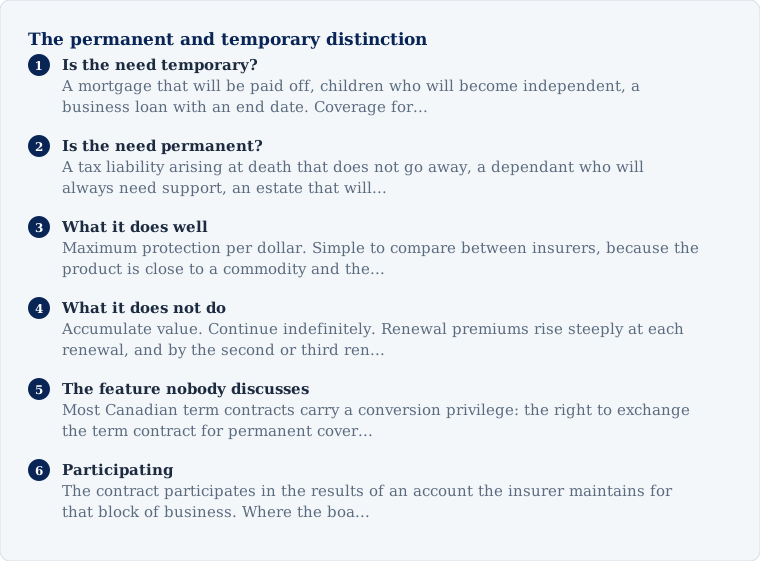
The permanent and temporary distinction
Every life insurance contract answers one of two questions.
Is the need temporary? A mortgage that will be paid off, children who will become independent, a business loan with an end date. Coverage for a defined period, at the lowest cost for the amount of protection, and nothing accumulates. That is term insurance and it is the right answer far more often than this industry admits.
Is the need permanent? A tax liability arising at death that does not go away, a dependant who will always need support, an estate that will require liquidity, a corporation that will owe something whenever the shareholder dies. Coverage that does not expire, priced accordingly, accumulating a value along the way.
Getting this question wrong is the most expensive error available, in both directions. Permanent coverage bought for a temporary need costs far more than it needed to. Term coverage bought for a permanent need expires, usually at the age when replacing it is most difficult.
Term insurance
Coverage for a stated period, typically ten or twenty years, renewable and convertible under the contract's terms.
What it does well. Maximum protection per dollar. Simple to compare between insurers, because the product is close to a commodity and the guarantees are straightforward.
What it does not do. Accumulate value. Continue indefinitely. Renewal premiums rise steeply at each renewal, and by the second or third renewal the cost is frequently prohibitive.
The feature nobody discusses. Most Canadian term contracts carry a conversion privilege: the right to exchange the term contract for permanent coverage, without new medical evidence, up to an age stated in the contract. That right is valuable precisely when health has changed, and it expires quietly. Anyone holding term coverage should know their conversion deadline, and most do not.
Whole life insurance
Permanent coverage with a level premium and a guaranteed cash value set out in a schedule at issue.
The insurer carries the pricing and investment decisions. The guarantees in the contract are the insurer's contractual obligations, and they do not depend on investment results, on a dividend, or on any assumption made at the point of sale.
Participating. The contract participates in the results of an account the insurer maintains for that block of business. Where the board declares a dividend, participating contracts share in it, commonly by purchasing additional paid-up coverage. Dividends are not guaranteed.
Non-participating. No dividend. What the contract guarantees is what the contract does, and it is priced on that basis.
Neither is better in the abstract. A participating contract offers the possibility of growth beyond the guarantees and charges for the structure that makes it possible. A non-participating contract offers certainty and less upside.
The mechanics of what happens inside a participating contract, year by year, are covered in policy basics, which is the reference layer for this whole site.
Universal life
Permanent coverage in which the cost of insurance and the accumulating value are separated and visible, and the owner selects among investment options the insurer offers.
The real difference from whole life is not the returns. It is who carries the decision. In whole life the insurer decides how the underlying assets are managed and guarantees an outcome. In universal life the owner selects, and the outcome follows from that selection.
Where it fits. An owner who wants transparency of charges, flexibility of funding, and control over investment selection, and who is comfortable carrying the consequences of that control.
Where it goes wrong. A contract funded on optimistic assumptions that do not materialise can require substantially higher deposits later, or lapse. The flexibility that is a feature in a good decade is an exposure in a poor one.
Life annuities
The reverse arrangement: capital is exchanged for an income that continues for life.
It belongs in this section because it is an insurance contract and because it answers a question permanent insurance does not: not what happens at death, but what happens if you live longer than your money.
The two are frequently discussed as alternatives when they address opposite risks. A household concerned about both may need both, and a comparison treating them as competitors has misunderstood the question.
How to compare two contracts fairly
The commonest error in this market is comparing illustrated values from two insurers, which compares two sets of assumptions rather than two contracts.
Start with the guaranteed columns. They are contractual. If one contract guarantees more for the same premium, that is a real difference.
Then look at what each assumes. The illustrated column adds an assumed dividend scale. Two insurers assuming different scales will produce different illustrated values from identical contracts. That tells you about the assumptions.
Ask about the current scale and its history. A scale that has moved is ordinary. A presentation that does not mention scales move is not.
Compare the design, not only the product. Two contracts from the same insurer funded identically can produce materially different accessible value in year five depending on how they were structured. The one that looks worse at year five may be the better contract for its purpose.
Ask what happens if premiums stop in year two, year five, year ten. The answer at each point tells you more about the contract than any projection.
What stands behind the guarantees
Contractual guarantees are obligations of the issuing insurer and depend on that insurer remaining solvent. They are not backed by any government.
Canadian life insurers are subject to federal solvency supervision. Where an insurer fails, Assuris provides protection to policyholders within published limits. That is meaningful, and it is not the same thing as deposit protection at a chartered institution. Read the limits rather than a summary of them.
The tax frame
Growth inside a permanent contract is not taxed annually provided the contract remains exempt under Regulation 306, Income Tax Regulations. That treatment is conditional rather than automatic, and insurers administer contracts to keep them within the test.
A death benefit paid to a named beneficiary passes outside the estate, which matters for both tax and liquidity and is covered in estate planning.
Where a corporation owns the contract the analysis changes substantially, and that is treated separately with business owners.
What usually goes wrong
Not with the products. With the match between product and need.
Permanent coverage sold where term was correct. Expensive, and the buyer frequently discovers it when cash flow tightens.
Term coverage held where the need turned out to be permanent, with the conversion privilege allowed to expire.
A contract designed for one purpose used for another. Maximum death benefit and early accessible value are different designs and neither performs well at the other's job.
Illustrations treated as forecasts. A projection is arithmetic under assumptions, and a presentation showing only the illustrated column has removed what you needed.
Choosing between them, in the order the decision actually happens
Product comparison is where most people start and it is the third question, not the first.
What is the need, and does it end? A mortgage ends. Children become independent. A business loan is repaid. A need with an end date is a term need, and buying permanent coverage for it means paying for something the household will not use.
How long must it last? If the answer is "until I die, whenever that is", the need is permanent: estate liquidity, a dependant requiring lifelong support, a business obligation that does not expire.
What can be sustained? Not in a strong year. In an ordinary one, through a poor decade. A large term policy that stays in force protects a family better than a small permanent one that lapses, and this is the calculation households get wrong most often.
Then, and only then, which product. The order matters because reversing it produces the commonest bad outcome in this industry: a product chosen first and a need constructed to justify it.
And often the answer is both. A large term policy across the years of highest obligation, with a smaller permanent policy underneath it for the part that never ends. That shape suits more households than either extreme, and it is proposed less often because it is less decisive.
Convertibility, the cheapest decision in the subject
Named separately because it costs almost nothing and is the option people most regret not having.
A convertible term policy can become permanent coverage without new medical evidence, within a window the contract states and usually before a stated age.
Health is the one input nobody controls. A household that intends to buy permanent coverage "later" may find that later has arrived and they no longer qualify. Convertibility removes that risk.
Check both limits now. The conversion window frequently closes years before the term itself expires, and nobody sends a reminder.
It cannot be added afterwards. Like most of the consequential decisions in these contracts, it is made at issue or not at all.
What each product actually costs you
Not premiums. What you give up by choosing it.
Term costs the premiums and nothing else, and gives back nothing if you survive it. That is not a defect; it is the product, and it is why it is cheap.
Participating whole life costs substantially more for the same death benefit, and it is unforgiving of early exit: leaving in the first several years returns less than was paid in.
Universal life costs the flexibility it grants. You direct the investment component, which means you carry the consequences: poor performance can require higher premiums later or put the coverage at risk.
An annuity costs the capital itself, irreversibly, in exchange for income that cannot run out.
Each trade is real and none is hidden. A description of any of these products that does not name what it costs you has described half of it.
Questions that separate a description from a pitch
Which of these products does not suit me, and why? The answer should arrive quickly and name categories.
What does term cost for the same death benefit? Ask even when permanent is being proposed. The difference is the price of permanence, and you are entitled to see it.
What does the guaranteed column show at years three, five and ten, beside cumulative premiums?
What happens if I stop paying in year four?
Is this convertible, and until when?
What are you paid on this, and what would you be paid on the alternative?
The last question is the informative one, and the reaction to it tells you as much as the answer.
How much coverage, before which product
The amount is a larger decision than the type, and it is decided with arithmetic rather than preference.
What debt would remain, including the mortgage.
What income would need replacing, and for how many years. Until the youngest child is independent, or until a surviving partner reaches retirement. Those two answers produce very different numbers.
What specific obligations exist: education, a dependant needing lifelong support, a buy-sell commitment.
What already exists. Group coverage through work, which ends when the job does, and any individual policies in force.
What would be available: savings, a surviving partner's income, survivor benefits.
The remainder is the gap. Round it up. At term prices the cost of a little extra is small, and the cost of being short falls on somebody else.
And insure the partner who is not paid. Their work would have to be replaced or absorbed, and the household's finances change materially either way. The right figure is not nil, which is what most households implicitly choose.
Underwriting, and why two people pay differently
The step that sets the price on every product here except an annuity, where it works in reverse.
What the insurer is estimating is the probability of a claim within the period being priced. Everything asked serves that.
What moves it most: age, then smoking status, then health established at underwriting, then family history. Two of those are fixed by the time anyone applies and one is behavioural.
Rate classes differ substantially. Preferred against standard on identical coverage is a material difference in premium, decided on facts largely outside anyone's control at that moment.
Understating anything is worse than the rating it avoids. A material misstatement can void a contract within the contestability period, and the claim is refused at the moment it is needed. Disclose everything, including what seems unimportant.
A rating is not always permanent. Where it was applied for a condition since resolved or now controlled, many insurers will reconsider on request. Very few people ask.
On an annuity it runs the other way. Impaired health can produce a higher payment, because the expected payment period is shorter, and that is worth asking about rather than concealing.
What usually goes wrong with the product decision
Six patterns, each ordinary.
Buying permanent coverage for a temporary need, which is paying for something the household will not use.
Buying too little because premium was the only number compared. An underinsured family with a permanent policy is worse off than a well-insured one with term.
Skipping convertibility to save a small amount, and losing the option that mattered.
Letting group coverage stand in for a plan. It usually ends with the job, at exactly the moment a household is most exposed.
Committing to funding that a normal year cannot sustain. Failing partway is worse than never starting.
Choosing the product before naming the need, which is the error the other five descend from.
Riders, and which ones matter
Riders attach to a base contract and are elected at issue. Most are cheap. Two change what the contract can do.
Convertibility on a term policy, covered above and the most consequential of them.
A paid-up additions rider on a participating contract, which is the only route to depositing more than the scheduled premium. Without it there is generally no way to add money, and adding the provision later is either impossible or requires new underwriting. Set out on paid-up additions.
Waiver of premium, which continues the contract if the insured becomes disabled. Inexpensive relative to what it prevents, and it addresses the commonest cause of a policy lapsing: the income that funded it stopped.
A term rider on a permanent contract, raising the death benefit during years of highest need at term prices, and expiring when those years end. On an ordinary illustration this is why the death benefit steps down partway through.
Guaranteed insurability, allowing coverage to be increased later without medical evidence.
Child riders and accidental death riders are frequently sold and rarely material. Neither addresses a risk of the size the base contract addresses.
The rule with all of them. Elected at issue or usually not at all, so the question is asked once. Ask what each costs annually and what it prevents, and decline the ones that fail that comparison.
What stands behind every product on this page
The obligation is the insurer's and depends on its financial strength. It is not backed by any government.
Assuris protects Canadian policyholders within published limits, which is meaningful and is not deposit insurance. Guaranteed values in a participating contract are contractual. Dividends are declared annually at the discretion of the insurer's board and are never guaranteed.
Check the insurer's financial strength rating before relying on a guarantee that runs for fifty years, and understand that the rating is an opinion about the future rather than a promise about it.
Reviewing what you already own
Most readers of this page hold coverage already, and the useful work is checking it rather than choosing something new.
Find out what you have. Type, amount, and whether it expires. A surprising number of people cannot answer the third, and it is the one that decides everything else.
If it is term, find the expiry and the conversion deadline. They are different dates and the conversion window usually closes first.
Check the beneficiary designation, primary and contingent. A named beneficiary receives the proceeds directly, in weeks, outside the estate and beyond the reach of creditors. Where the estate is named, or nobody is, all three advantages are lost. It is free to change and it resolves more estate problems than anything else available.
Check whether group coverage is doing work you think it is. It usually ends with the job.
On a permanent contract, read one statement a year. Guaranteed value, total value, any outstanding advance, and the dividend applied. Four figures, once a year, and it is the whole of what servicing requires from an owner.
Ask who services it now. A contract of this kind outlives most advisory relationships, and an unserviced contract is where most disappointment starts.
Tell somebody it exists. A contract nobody knows about is a contract nobody claims.
Six checks, an hour, no purchase. A household that does them has improved its position more than most product decisions would, and this practice earns nothing from any of it. The commonest finding is a beneficiary designation that reflects a family which no longer exists, and correcting it costs a phone call, takes less time than reading this page, and is the single highest-value hour available anywhere in this subject.
Where the products overlap, and where they do not
Term and permanent both pay a death benefit. That is the whole overlap.
Only permanent accumulates a contractual value that can be reached during life.
Only an annuity pays while you are alive and stops at death, which makes it the mirror of everything else here.
And only term expires, which is its defining feature rather than a defect.
Households conflate them because the word insurance covers all four. Naming what each does, and what only it does, resolves most of the confusion before any comparison begins.
What the insurer is actually promising
On term, to pay a stated amount if death occurs within a stated period.
On permanent, to pay a stated amount whenever death occurs, and to hold a schedule of guaranteed values in the meantime.
On participating, all of the above plus a share in an account, distributed at the board's discretion and never promised.
On an annuity, to pay a stated amount for as long as the annuitant lives, however long that is.
Each promise depends on the insurer's solvency and none is backed by any government, with Assuris behind them within published limits.
The question that precedes all of them
Does the need end?
If it does, the answer is term and this site will say so. If it does not, the answer is permanent coverage of some kind. The question is not a formality and it is not answered by a form: it is answered by looking at what the money is actually protecting, and at whether that obligation has an end date written into it or does not. If nobody has asked you that question, no product recommendation you have received rests on anything.
What belongs in this section
Here. Product definitions, how each behaves, and comparisons between insurance products.
In policy basics. The mechanics inside a contract: cash value, dividends, advances, the adjusted cost basis, underwriting, beneficiary designation.
In objections and risks. Comparisons against anything that is not insurance, and any question asked adversarially.
In the strategy section. Anything that only holds for someone running a strategy on top of a contract.
A thirty-minute discovery meeting
A first conversation establishes whether this fits. No illustration is prepared and nothing is arranged.
Often the answer is no, and you will hear it during the call rather than in a proposal afterwards.
This form reaches Canadian Wealth Creation Centre Inc. Any meeting, any advice and any insurance product is provided by Canadian Wealth Creation Centre Inc., through its representatives certified by the Autorité des marchés financiers. IBC Financial is the company's education platform: it distributes no product and no financial service, and it gives no individualised advice.
Important disclosure
Everything in Whole Life Insurance
- Life AnnuitiesWhat a life annuity is, the main types, how Canadian taxation differs between prescribed and accrual treatment, and what is irreversible about it.
- Participating Life InsuranceWhat participating life insurance is, how the participating account works, how dividends are declared and used, what it costs, and who it does not suit.
- Term InsuranceWhat term insurance is, the four common types, how underwriting works, what drives the premium, how much coverage to hold, and when term is the right answer.
Common questions
What is the difference between whole life and universal life?
Is term insurance a worse product than permanent insurance?
What is the difference between participating and non-participating whole life?
Can I convert a term policy to permanent coverage later?
How do I compare two insurance contracts fairly?
Should I buy term or whole life?
Is an annuity an alternative to life insurance?
What is the difference between the guaranteed column and the illustrated column?
What happens if I stop paying the premiums?
Why do two people pay different premiums for the same coverage?
Should I disclose a health condition on my insurance application?
Which insurance riders are actually worth having?
What should I check on the life insurance I already own?
What is Assuris and does it protect my policy?
Can I have both term and permanent coverage at the same time?
Is whole life insurance worth it?
Sources
- Income Tax Regulations, Regulation 306, Justice Laws Canada, verified 2026-08-21
- Assuris, published protection limits, verified 2026-08-21
Last reviewed 2026-08-21. By Jose Salloum, Financial Security Advisor.