
The Honest Case Against, and What It Gets Right
The strongest arguments against this approach are that early cash value is low relative to premium paid, that the commitment is long and costly to abandon, that most Canadians should fund registered accounts first, and that the comparison usually offered by its supporters is the wrong comparison. Each of those is correct.
Most sites in this field treat criticism as something to be handled. This one treats it as the fastest way to understand what is actually being discussed.
If you are new to the subject, start here rather than with a product page. The arguments below are the real ones, made by people who understand the contract, and several of them are correct. A reader who understands the objections understands the product. A reader who has only seen the case in favour does not.
What the critics get right
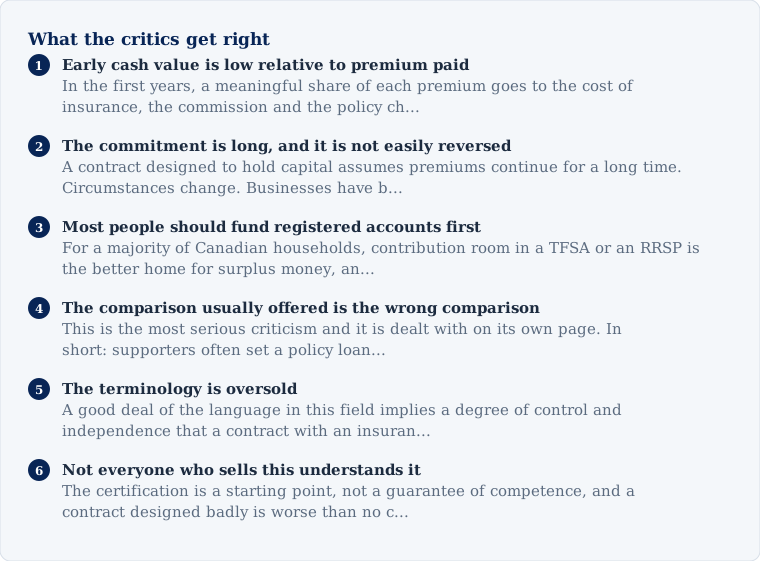
Early cash value is low relative to premium paid. In the first years, a meaningful share of each premium goes to the cost of insurance, the commission and the policy charges. A contract funded in year one and surrendered in year three returns materially less than was put in. Supporters of the strategy sometimes present this as a temporary inconvenience. It is not an inconvenience. It is a real and permanent loss for anyone who exits early, and it is the single most common way people are disappointed by this product.
The commitment is long, and it is not easily reversed. A contract designed to hold capital assumes premiums continue for a long time. Circumstances change. Businesses have bad years. People lose income. A structure that works over twenty-five years can fail over five, and the failure is expensive.
Most people should fund registered accounts first. For a majority of Canadian households, contribution room in a TFSA or an RRSP is the better home for surplus money, and it should be used before anyone considers a permanent insurance contract for the purpose described here. Any presentation that skips past that ordering is not giving you the full picture.
The comparison usually offered is the wrong comparison. This is the most serious criticism and it is dealt with on its own page. In short: supporters often set a policy loan against a loan from an outside lender, and conclude that the policyowner captures interest that would otherwise have left. The fair comparison for most people is not an outside loan at all. It is simply drawing on savings. Measured against that, the advantage is much smaller than the usual presentation suggests, and sometimes it disappears.
The terminology is oversold. A good deal of the language in this field implies a degree of control and independence that a contract with an insurance company does not confer. The reader is not operating an institution. The reader owns a contract with terms, and the insurer administers it.
Not everyone who sells this understands it. The certification is a starting point, not a guarantee of competence, and a contract designed badly is worse than no contract at all.
What the phrases actually mean
Readers arriving here have usually searched for "infinite banking", "become your own banker" or "be your own banker". Those terms come from Nelson Nash and are marks of Infinite Banking Concepts, LLC. They name a body of literature rather than anything a Canadian licensed advisor offers, and the language overstates what a contract confers: what is owned is a contract with an insurer, administered by the insurer under its terms. Nobody becomes an institution.
Technical terms used in these arguments are defined in the glossary.
What the criticism gets wrong, or leaves out
Conceding those points is not the same as conceding the subject.
Two criticisms are frequently made in the United States and simply do not apply in Canada, because they describe a different tax code. Arguments built on the American modified endowment contract rules, or on section 7702 of the US Internal Revenue Code, have no Canadian counterpart. The Canadian test is different: a contract must remain exempt under Regulation 306, Income Tax Regulations, and a policy loan is a disposition under ITA s.148(9). A Canadian reader taking an American critique at face value is being warned about rules that do not govern their contract, and reassured about none of the rules that do.
The second omission is the corporate case. A large share of the criticism is written for a personal buyer, and the arithmetic for an incorporated business owner is genuinely different, because it involves how corporate surplus is taxed while it is held and how a death benefit is credited under ITA s.89(1). That does not make it suitable. It makes it a different question, and it deserves to be argued on its own facts rather than by importing a conclusion reached about a personal buyer.
The risks nobody disputes
Lapse. If the contract lapses while a loan is outstanding, a gain can become taxable in that year, at a moment when there is no cash to pay it. This is the worst outcome available in the product and it is entirely avoidable with attention.
Dividends are not guaranteed. The illustration you are shown assumes a dividend scale. Scales move. An illustration is a projection under stated assumptions, and it is not a forecast.
Insurer solvency. The guarantees in the contract are the insurer's contractual obligations, not a government guarantee. Assuris provides protection within published limits. That is meaningful and it is not the same thing as a federal guarantee on a deposit.
Opportunity cost. Money placed here is not somewhere else. Whether that trade is worth making depends entirely on what the alternative would have been for you specifically, which is a question this page cannot answer and should not pretend to.
How this section is organised
Each argument gets a page, and each page states the argument at its strongest before responding to it. Where the argument holds, the page says so.
Who the criticism comes from, and what that tells you
Not all of it comes from the same place, and the source affects how much weight it deserves.
Fee-only planners and low-cost investing advocates. Their objection is usually cost: permanent insurance is expensive as a growth vehicle, and for a household whose need is temporary, term plus investing does the same job for less. This criticism is largely correct and this site does not dispute it.
Consumer advocates and journalists. Their objection is usually the sales process: a complex product, compensation weighted to the first year, and buyers who cannot evaluate what they are being shown. Also largely correct, and it is a criticism of distribution rather than of contracts.
Regulators. Their concern is framing. What has attracted findings in Canada is describing insurance as an investment, not the product itself.
Competing advisors. Some criticism is competitive rather than analytical, and it is recognisable by what it omits: no mention of what permanent coverage provides that a portfolio does not.
American commentators. A substantial share of what a Canadian reader encounters describes United States tax law, which is a different regime. Arguments built on the modified endowment contract rules or on section 7702 do not transfer.
And practitioners who oversell it. The strongest case against this product is frequently made by people selling it badly, and that is worth conceding.
The three questions underneath all of it
Most objections reduce to one of three, and separating them makes the whole subject tractable.
Is the product what it is described as? A question of accuracy, and the answer is that it is an insurance contract. Where it has been described as an investment, the criticism that follows is deserved.
Does it cost more than the alternative? A question of arithmetic. As a growth vehicle it usually does. Whether that matters depends on whether growth is what is being bought.
Is it suitable for this household? A question about the reader rather than the product, and the one that actually decides anything. Most disputes about this product are really disputes about suitability conducted as though they were disputes about the product.
What a fair evaluation requires
Six things, and any assessment missing them is incomplete in a direction.
The guaranteed column, not only the projection.
Symmetrical fee treatment. After-fee against after-fee, or before against before. Mixing them produces a false gap in whichever direction was chosen.
The death benefit priced, since one of the two products provides one.
A realistic alternative. What the household would actually have done, not an idealised portfolio held perfectly for thirty years.
The early years shown. Year three matters more than year thirty to anyone who might not last thirty years.
And the failure cases named. Lapse, surrender, an advance outstanding at death.
A comparison meeting all six usually shows the same thing: permanent insurance is expensive as a way to grow money and provides something a portfolio does not. Both halves are true, and any presentation offering one half is advocacy rather than analysis.

How to use this section
Start with what critics get right, because the strongest objections are the ones most worth understanding first.
Then the real costs, which is the arithmetic underneath the strongest criticism.
Then the comparison question, which is where most arguments go wrong.
Then risks and failure modes, which is what actually happens when it does not work.
And legitimacy last, because it is the question people ask first and the least useful of the five.
A reader who works through all five and decides against the product has been served correctly. A section that cannot produce that outcome is marketing with a sceptical tone.
The objections, stated in full and answered plainly
Each is stated as a critic would state it, then answered without evasion. Where the objection stands, that is said.
"It is a terrible investment"
The objection. Compared against a low-cost equity portfolio over decades, the internal return on a participating contract is materially lower.
The answer. Correct, and it is the wrong test. The contract provides a death benefit that the portfolio does not, and the cost of that benefit is inside the figure being criticised. Judged as a growth vehicle it loses, and anyone told otherwise has been told something false. Judged as permanent coverage carrying a contractual value, it is a different question.
What remains true. Anyone who does not want or need permanent coverage should not buy this to grow money.
"The fees are hidden"
The objection. A fund publishes a management expense ratio. A participating contract publishes nothing equivalent.
The answer. The objection stands. Costs are absorbed inside the participating account and the contract's own charges, and there is no comparable figure to place beside a fund's.
What is available instead is the guaranteed schedule, which prices the whole structure in numbers you can read. It is a worse tool for comparison and a better one for knowing what you own, and offering it does not answer the criticism entirely.
"You lose money in the early years"
The objection. Surrender in year three and you receive materially less than you paid.
The answer. Correct. Acquisition cost is weighted to the first year, and the contract is unforgiving of a change of mind. The illustration disclosed it in a column nobody drew attention to.
What follows. The product suits a household that can leave the money alone for a long time and suits nobody else, which is a suitability conclusion rather than a defence.
"It is sold to people it does not suit"
The objection. Compensation weighted to the first year, a product complex enough to be hard to evaluate, and buyers who cannot assess what they are shown.
The answer. Correct, and it is the most serious of the criticisms. It is an objection to distribution rather than to contracts, which does not make it less serious for a household that was mis-sold.
What a reader can do about it is ask who should not buy it, ask for the guaranteed column, and ask what the advisor is paid. The answers, and the reaction to the questions, are informative.
"The dividends are not guaranteed"
The objection. Projections rest on a scale the insurer can change.
The answer. Correct, and it is stated on every page here. The guaranteed schedule is contractual. Everything above it depends on a discretionary declaration.
What is overstated is the implication that the scale is arbitrary. It reflects investment results, claims experience and expenses, insurers smooth it deliberately, and the record is long. A record is evidence, not a commitment, and both halves of that matter.
"The insurance company keeps your cash value when you die"
The objection. The death benefit is paid and the accumulated value is not paid in addition.
The answer. This one is inaccurate, and it is the most repeated criticism in the subject. The accumulated value is not a separate account beside the contract; it is a value within it, and the death benefit in an ordinary contract exceeds it. Nothing is confiscated.
And the contract answers it directly. A whole life policy written to age 100 endows at 100: premiums end and the accumulated value equals the amount payable. In the guaranteed column of an ordinary illustration, the cash value and the death benefit at age 100 are the same figure. They converge because they were always converging on the same thing. Nothing is kept because there were never two pools.
Why it matters that this criticism is wrong. It is repeated often enough that it makes the five accurate criticisms above easier to dismiss, which serves nobody. Ask to see the age 100 row on any illustration. Two identical numbers settle the argument in one line, and an illustration truncated before maturity cannot.
"It is a scheme, or it is not legitimate"
The objection. Usually arrives as suspicion rather than argument.
The answer. Participating whole life is an ordinary regulated insurance product sold in Canada for well over a century by companies supervised federally and provincially. Legitimacy is not the useful question, and a product can be entirely legitimate and entirely wrong for a particular household.
The inaccurate claims made in favour of the approach, and the correct versions, are listed at claims that should never be made.
What this section is not
Not a defence. Five of the seven objections above stand, in whole or in part, and are recorded as standing.
Not neutral. It is published by a practice compensated when a contract is issued, which is stated on every page.
Not a substitute for advice. Nothing here knows your circumstances.
What it is is the argument against the product, set out as well as the practice can state it, in one place, so a reader does not have to assemble it from people with the opposite interest.
The failure modes, named before you meet them
Distinct from the objections. An objection says the product is a poor choice. A failure mode is what happens when a reasonable choice goes wrong.
Lapse. Premiums stop, accumulated value is insufficient to carry the contract, and the coverage ends. Everything paid is gone. This is the commonest failure and it is usually administrative rather than a decision: a payment missed, a notice sent to an old address.
Surrender in the early years. The contract ends when it returns least, and a gain above the adjusted cost basis can be taxable on the way out.
Lapse with an advance outstanding. The worst of them. The contract collapses, the outstanding balance is treated as received, and a tax bill arrives at the moment there is no cash and no coverage.
Overfunding to the point of failing the exempt test, after which growth is taxed annually.
A design that cannot be revisited. The rider and the funding room are largely fixed at issue. A contract designed for the wrong purpose cannot be corrected without a new contract at a new age.
An orphaned contract. The advisor has left, nobody services it, the dividend option was never reviewed and the beneficiary designation is a decade out of date. This is not dramatic and it is extremely common, and it is why the servicing question matters as much as the product question.
Each is examined in risks and failure modes.
What would make this product wrong for you
A short list, and any one of them is sufficient.
The need is temporary. A mortgage, children who will become independent, a loan that will be repaid. Term does that job for a fraction of the cost.
Registered room is unused. TFSA and RRSP room carried forward is more efficient for most Canadian households and should be used first.
The money might be needed within a decade.
The funding depends on a good year. A commitment sized to an exceptional year fails in a normal one, and failing partway is worse than never starting.
High-rate debt is outstanding.
You do not want permanent coverage in its own right. If the death benefit is not wanted, the contract is a financing arrangement wearing an insurance policy.
You cannot get a straight answer to what the guaranteed column shows at year three. That is a fact about the advisor rather than the product, and it is sufficient on its own.
Why a practice publishes the case against its own product
The obvious question, and it deserves a direct answer rather than a modest one.
Because the objections are true. Five of the seven above stand. A site omitting them would be inaccurate by silence, which is the same failure as inaccuracy by statement and harder to detect.
Because a reader will find them anyway, usually from someone with the opposite commercial interest, presented at their strongest and without the two that are wrong separated out. Finding them here first is better for the reader, and a practice unwilling to state them has told you what its description is worth.
Because the product is unsuitable for most people, and saying so is how a reader can tell whether they are among the minority it fits. A description that fits everybody describes nothing.
Because complaints begin with expectations rather than contracts. Almost every dispute about permanent insurance traces to a household that expected something the contract never provided. The objections above are, read carefully, a list of the expectations that cause that.
And because it is the test any description should meet. A reader who accepts what this section says will not be surprised by anything the contract does over the next thirty years. That is the whole standard, and a page that cannot meet it is advertising regardless of its tone.
What a regulator has actually acted on
Useful because it separates the objections that carry legal weight from those that are arguments about value.
Framing insurance as an investment. The finding that matters most in Canada, and it concerned how a product was described rather than the product itself.
Suppressing risk disclosure. Materials directing that risks be de-emphasised.
Comparison without adequate disclosure, where insurance was positioned as superior to conventional alternatives without the differences stated.
Note what is absent from that list. Cost, complexity and early-year values are criticisms of the product and are not what regulators have acted on. The enforcement risk in this field is about description, which is why the framing sections on this site are longer than the product sections.
What this page will not do
It will not size a risk and then present a product as the answer.
That pattern is common in this field and it is worth naming: describe a problem until the reader feels it, then arrive with the solution. Everything on this site is written by someone who earns a commission when a policy is issued, which is stated plainly on the author page. The material is still worth reading. It is not worth reading uncritically, and a page about criticism would be a strange place to start asking you to.
Whole life insurance is an insurance product and it is not an investment. Judged as an investment it usually compares poorly, which is precisely why the comparison matters and why it has its own page.
A thirty-minute discovery meeting
A first conversation establishes whether this fits. No illustration is prepared and nothing is arranged.
Often the answer is no, and you will hear it during the call rather than in a proposal afterwards.
This form reaches Canadian Wealth Creation Centre Inc. Any meeting, any advice and any insurance product is provided by Canadian Wealth Creation Centre Inc., through its representatives certified by the Autorité des marchés financiers. IBC Financial is the company's education platform: it distributes no product and no financial service, and it gives no individualised advice.
Important disclosure
Everything in Objections and Risks
- Is It Legitimate?Readers asking whether infinite banking is legit are asking three questions at once. The contract is regulated insurance; the selling is what is criticised.
- Risks and Failure ModesThe ways a participating contract goes wrong in practice: early surrender, lapse with a loan outstanding, overfunding, wrong design, and loss of exempt status.
- The Comparison QuestionThe case for what practitioners call becoming your own banker rests on a comparison against an outside lender. For most people the honest comparison is savings.
- The Real CostsWhat a participating whole life contract costs, why the costs are not itemised the way a fund's fees are, and how to measure them anyway.
- What Critics Get RightNine arguments made against using participating whole life insurance to hold capital, each stated at its strongest, and each given a plain verdict.
Common questions
Is this a scam?
Do critics of this approach have a point?
Who should not do this?
What is the single biggest risk?
Does the insurance company keep my cash value when I die?
Should I fill my TFSA and RRSP first?
Why is the early cash value so much lower than the premiums paid?
Is my money safe if the insurer becomes insolvent?
Does opportunity cost make this a bad choice?
Why would a practice publish the arguments against its own product?
What has a Canadian regulator actually acted on?
Are the criticisms about the contract or about how it is sold?
Is the language used in this field overstated?
Where should a sceptical reader start?
Sources
- Income Tax Act s.148(9), Justice Laws Canada, verified 2026-08-21
- Income Tax Regulations, Regulation 306, Justice Laws Canada, verified 2026-08-21
- Assuris, published protection limits, verified 2026-08-21
Last reviewed 2026-08-21. By Jose Salloum, Financial Security Advisor.