
Risks and Failure Modes
The dominant failure is early surrender, because costs fall heaviest in the first years. The most damaging is lapse while a policy loan is outstanding, which can create a taxable gain at the exact moment there is no cash to pay it. Both are avoidable, and both come from a decision made before the contract was issued rather than from the contract itself.
Most writing about what goes wrong in this field is either dismissive or alarmist. What follows is neither. These are the failure modes that actually occur, ordered by how often they do.
Almost all of them share a feature worth noticing at the start: the failure is usually decided before the contract is issued. By the time the problem appears, the mistake is years old.
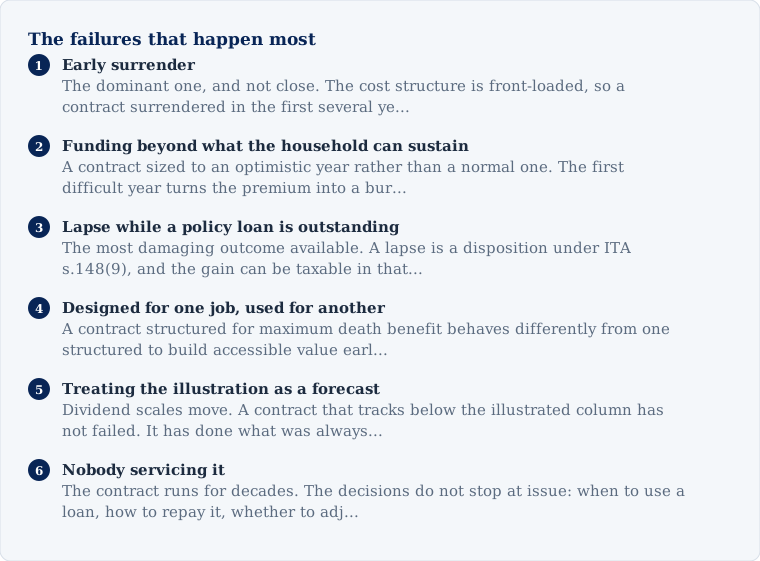
The failures that happen most
Early surrender. The dominant one, and not close. The cost structure is front-loaded, so a contract surrendered in the first several years returns materially less than was paid in. Nothing malfunctioned. The buyer met a structure they were not suited to, and the structure did what it does. The real costs sets out where that money went.
Funding beyond what the household can sustain. A contract sized to an optimistic year rather than a normal one. The first difficult year turns the premium into a burden, and the options at that point are all worse than the options that existed before signing.
Lapse while a policy loan is outstanding. The most damaging outcome available. A lapse is a disposition under ITA s.148(9), and the gain can be taxable in that year. It arrives with no cash to pay it, because running short of cash is usually what caused the lapse. A disappointing result becomes a damaging one, and the tax bill is real money owed to a government that did not cause the problem.
Designed for one job, used for another. A contract structured for maximum death benefit behaves differently from one structured to build accessible value early. Both are legitimate. Neither performs well at the other's job, and a buyer who was not asked which one they wanted has a contract that will disappoint them for reasons they will attribute to the product.
Treating the illustration as a forecast. Dividend scales move. A contract that tracks below the illustrated column has not failed. It has done what was always possible, and the disappointment was manufactured at the point of sale by showing a projection as an expectation.
Nobody servicing it. The contract runs for decades. The decisions do not stop at issue: when to use a loan, how to repay it, whether to adjust funding, what to do when circumstances change. A contract with nobody attending to it drifts, and drift is expensive in a structure this long.
The failures that are rarer and worse
Loss of exempt status. A contract must remain exempt under Regulation 306, Income Tax Regulations for its growth to avoid annual taxation. Contracts are administered to stay within the test, and insurers monitor it. But a contract that loses exempt status changes character entirely, and the reason for holding it largely goes with it.
A health change that removes the exit. Insurance is priced at issue on health at issue. If health deteriorates, the contract in force may be irreplaceable. That cuts both ways: it is the strongest argument for permanent coverage acquired while healthy, and it is the reason a contract entered lightly becomes difficult to leave.
Corporate ownership errors. In a corporate file the ways to get it wrong multiply: the wrong owner, the wrong beneficiary, a shareholder benefit created by accident, a structure that no longer matches a company reorganised years later. These are not product failures. They are structuring failures, and they are usually discovered at a death or a sale, which is the worst time to discover anything.
Access assumed rather than confirmed. A policy loan is a contractual feature with terms, limits and interest that is paid to the insurer. It is not a line of credit, and it is not instant. Anyone planning around access to capital should read how a participating policy works, year by year before relying on it.
Who carries the most risk
Stated plainly, because vagueness here is the failure.
Anyone whose surplus income is not durable. Variable earnings, a young business, commission income, a household already at the edge of its budget. The structure punishes interruption, and interruption is what happens to people whose income is not stable.
Anyone who may need the capital within the first several years.
Anyone with unused registered contribution room that has not been considered first.
Anyone who cannot articulate what the contract is for. If the purpose is not clear at the outset, no design can be correct, because there is nothing to design against.
What reduces the risk
Not a product feature. Three decisions, all made before signing.
Fund it below capacity. A contract sized to a normal year rather than a good one survives the bad ones.
Know the break-even year before you sign, not after. It is the number that tells you how long the commitment really is.
Establish who services it in ten years. Not who sells it now.
The failure sequence, stage by stage
Failures here are slow. Setting out the stages shows how much warning there is, and how consistently it goes unread.
Stage one. The contract is placed at the wrong size. Funded from an optimistic year rather than a normal one. Nothing appears wrong; the first premium is paid without difficulty.
Stage two. A year is harder than expected. Income falls, a business has a bad quarter, an expense arrives. The premium is still paid, from savings rather than from surplus. This is the first genuine warning and almost nobody treats it as one.
Stage three. An advance is taken to cover the premium. The contract funds itself. This is the point at which the arrangement has stopped working and it frequently feels like the feature working as designed.
Stage four. Interest capitalises. The balance grows each year, and it grows faster each year because the interest is calculated on a larger figure. Nothing is being repaid.
Stage five. The insurer writes. The balance is approaching the value securing it. The letter states what is required and by when.
Stage six. The options are all worse than the ones that existed at stage two. Repay part of the balance, resume premiums, reduce the coverage, or let the contract terminate.
Between stage two and stage five there are usually years. Every stage appears on an annual statement. The failure is not that the information was hidden; it is that nobody was reading it, which is why an unserviced contract is a materially different proposition from a serviced one.
What a warning actually looks like
Five signals, in the order they typically appear.
The premium is being paid from savings rather than surplus. The single earliest indicator and the one most easily rationalised.
The loan balance is larger this year than last, with no advance taken. Interest is compounding unpaid.
The net cash value has stopped growing. The balance is now growing at least as fast as the value securing it.
The annual statement has gone unopened for two years. A behavioural signal rather than a financial one, and a reliable predictor.
A premium notice has been paid late. Twice is a pattern.
Any one of these is a reason to have a conversation. Three together is a reason to have it this month.
The failures that are not the product
Worth separating, because attributing a structural failure to the contract produces the wrong correction.
An advisor who left. The contract continues; the servicing does not, unless the practice has succession. Nothing about the contract failed.
A designation never updated. The contract paid exactly what it was instructed to pay, to the person named years earlier.
A family disagreement about a loan. No contract governs an understanding between relatives.
Expectations set by an illustration. A projection under assumptions is not a forecast, and a contract tracking below an illustrated column has not malfunctioned.
In each case the arrangement around the contract failed. That distinction matters because the correction is different: better servicing, current designations, a written agreement, or a more honest presentation at the outset.
The failures caused by not reading the annual statement
Undramatic, common, and cumulatively the largest source of disappointment in this product.
A dividend option nobody chose. It was set at issue and never revisited. A contract intended for accumulation with dividends taken in cash has been quietly working against its own purpose for years, and the statement said so every time.
A beneficiary designation that reflects a family which no longer exists. After a separation, a death, a birth. The insurer pays whoever is named, not whoever was intended, and nobody discovers it until a claim.
An advance accruing quietly. Interest capitalising against the value securing it, on a balance the owner has stopped thinking about. The statement shows it every year.
A contract tracking below the projection, which is usually normal because the scale moved, and occasionally is not. Tracking below the guaranteed column would mean something is genuinely wrong, and only somebody reading the statement would know.
A lapse notice sent to an old address. More policies are lost this way than to any decision.
Four figures once a year prevents all five. Guaranteed value, total value, any outstanding balance, and the dividend applied. It is the whole of what servicing requires from an owner, and it is skipped almost universally.
What happens when the advisor leaves
Not a contract failure and it produces contract failures, so it belongs here.
A contract of this kind outlives most advisory relationships. Retirement, a change of career, a move, a death. Over thirty years the probability is high.
The contract itself is unaffected. The insurer's obligations are unchanged and nothing lapses because a person left.
What is lost is the servicing. No annual review, nobody explaining a scale reduction, nobody prompting a designation update, nobody available when a household needs an advance and does not know how to request one.
An unserviced contract underperforms its own design, and the shortfall is attributed to the product rather than to the absence.
What to do. The insurer will reassign a contract on request, and an owner may ask at any time. Ask who services it now before you need to know, and confirm the address on file while you are asking.
When the household stops agreeing
A failure mode that is not financial and ends more arrangements than markets do.
An arrangement one partner understands does not survive. It requires funding sustained across decades and repayment nobody external enforces, and a partner who never agreed to either will eventually decline to continue.
Separation is the sharpest version. Ownership, beneficiary designation, and any obligation in a separation agreement to maintain coverage. A policy one spouse owns on the other continues unchanged unless somebody changes it, and in Quebec a designation in favour of a married spouse is irrevocable unless stated otherwise.
Death of the funding partner where the other did not know the arrangement existed. A contract nobody knows about is a contract nobody claims.
Which is why a household that cannot have a direct conversation about money should not begin. That is a suitability finding rather than a moral one, and it is one this practice screens for.
The pattern underneath all of them
Read together, the failures on this page share a shape.
Almost none is caused by the contract. The insurer meets its obligations, the guaranteed schedule performs, and the mechanics work as written.
Almost all are caused by a gap between what the household expected and what the arrangement is. Funding sized to a year that did not repeat. A mechanism nobody explained. A document nobody read. An advisor nobody replaced.
Which is why the expectations matter more than the product. A household that knows the early years build slowly, that dividends move, that repayment is enforced by nobody, and that one statement a year requires reading, encounters almost none of what is described above.
And it is the standard any description should be held to. Not whether it is accurate sentence by sentence, but whether a reader who accepts it will be surprised by anything the arrangement does over thirty years.
The two-year window nobody mentions
A contract is contestable for roughly two years from issue. Within it, an insurer may contest a claim on the basis of a material misstatement in the application.
Which makes the application the document that matters most, and it is completed quickly, often by somebody else typing while the applicant answers.
Read it before signing. What was recorded about health, occupation, travel, pursuits and other coverage.
Disclose what seems unimportant. The consequence of an omission does not fall on the person who made it. It falls on a beneficiary, years later, at the worst moment, with no way to correct it.
After the period, the contract is generally incontestable except for fraud, which is why the first two years carry a risk the following fifty do not.
The five practices that prevent these failures
Funding sized to an ordinary year, with room to spare.
A design that matches the purpose, decided before the contract is written.
Reading one statement a year.
Knowing who services it, and confirming the address on file.
And a household where more than one person understands the arrangement.
None of that is a product feature. All of it is available to anybody, and it removes most of what appears above.
The pattern, in one line
Expectations fail more often than contracts do.
Which is the useful news. Expectations are adjustable and contracts are not, so the part a household can control is the part that decides the outcome.
A household that reads this page and changes one expectation has already avoided most of what is on it. That is a cheaper outcome than any product feature, and it is available to anybody who got this far down the page.
One expectation, changed today, is worth more than any feature added later. The list above is long, and almost every item on it dissolves once a household knows what it actually agreed to.
Almost none of it requires spending anything at all.
What this page will not do
It will not size these risks and then present a product as the answer to them.
Every risk above is a risk of this product, described by someone who is paid a commission when this product is issued, which is stated on the author page. The appropriate conclusion is not that a better contract solves them. It is that a contract entered without stable cash flow, a clear purpose and a long horizon is likely to disappoint, and that for a great many people the correct decision is not to enter one at all.
A thirty-minute discovery meeting
A first conversation establishes whether this fits. No illustration is prepared and nothing is arranged.
Often the answer is no, and you will hear it during the call rather than in a proposal afterwards.
This form reaches Canadian Wealth Creation Centre Inc. Any meeting, any advice and any insurance product is provided by Canadian Wealth Creation Centre Inc., through its representatives certified by the Autorité des marchés financiers. IBC Financial is the company's education platform: it distributes no product and no financial service, and it gives no individualised advice.
Important disclosure
Common questions
What is the worst thing that can happen?
Can a policy fail even if I keep paying?
What happens if my advisor retires or leaves the business?
Who is most at risk?
What are the warning signs that a contract is going wrong?
What actually happens when a policy lapses?
What is the contestability period?
What should I check on the annual statement?
Can a contract lose its exempt status?
What goes wrong with corporately owned policies?
What happens if my health changes after the contract is issued?
What reduces the risk before I sign?
What happens if my partner and I stop agreeing about it?
Sources
- Income Tax Act s.148(9), Justice Laws Canada, verified 2026-08-21
- Income Tax Regulations, Regulation 306, Justice Laws Canada, verified 2026-08-21
Last reviewed 2026-08-21. By Jose Salloum, Financial Security Advisor.