
The Real Costs
The costs are the mortality charge, the commission, policy and administration fees, provincial premium tax, and loan interest if capital is accessed. They are not disclosed line by line the way a fund's management expense ratio is, which is a fair criticism. They can still be measured, by comparing total premium paid against guaranteed cash value year by year.
Ask what this costs and you will often get an answer about value instead. That substitution is worth noticing, and this page tries not to make it.
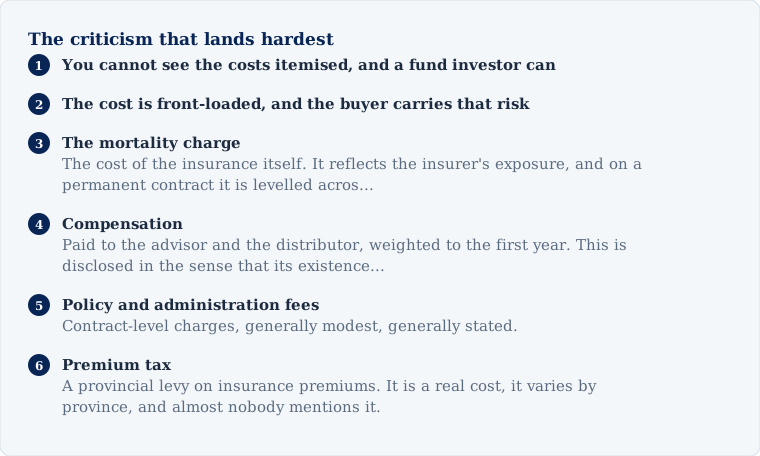
The criticism that lands hardest
You cannot see the costs itemised, and a fund investor can.
A mutual fund or an exchange-traded fund publishes a management expense ratio. It is a single number, it is standardised, and it lets a buyer compare one product with another in seconds. A participating whole life contract publishes nothing equivalent. The mortality charge, the expense loading, the compensation and the margin the insurer retains are absorbed inside the contract and inside the participating account. They are real, they are substantial, and they are not presented to you as a line item.
This is the strongest cost criticism in the field and it is correct. Anyone who answers it by saying the costs are built into the guaranteed values is describing the problem, not solving it.
The cost is front-loaded, and the buyer carries that risk.
Compensation on a permanent contract is weighted heavily toward the first year. So is the acquisition expense. A contract funded and then surrendered early returns materially less than was paid into it, and the shortfall is at its worst precisely when a buyer is most likely to change their mind. The structure transfers the risk of an early exit onto the person least able to price it.
"It is not a fee, it is a transfer of value" is a rhetorical move, not an answer.
It is sometimes said that the cost of insurance is not a cost because it buys a death benefit. That is true and it is also beside the point. Money leaves. The question is how much and against what, and the answer should be a figure rather than a reframing.
What is actually being paid for
Five things, and they behave differently.
The mortality charge. The cost of the insurance itself. It reflects the insurer's exposure, and on a permanent contract it is levelled across the life of the policy rather than rising each year as it does on renewable term. This is the largest single component and it is the one that buys the death benefit.
Compensation. Paid to the advisor and the distributor, weighted to the first year. This is disclosed in the sense that its existence is disclosed. Its quantum usually is not, unless you ask.
Policy and administration fees. Contract-level charges, generally modest, generally stated.
Premium tax. A provincial levy on insurance premiums. It is a real cost, it varies by province, and almost nobody mentions it.
Loan interest, if capital is accessed. Charged by the insurer on any policy loan, accruing while the loan is outstanding. It is a cost of access, not a cost of ownership, and it applies only if you use the feature. It is also the component most often misdescribed. Interest on a policy loan is paid to the insurer and does not return to the policyowner, which is dealt with in full on the comparison question.
What a published fee looks like on the other side of the comparison is taken up with the principles this site measures money by.
How to measure the cost anyway
The absence of a published ratio does not make the cost unmeasurable. It makes it measurable by outcome rather than by disclosure.
Find the break-even year. On the illustration you were shown, locate the year in which guaranteed cash value first equals total premium paid. Use the guaranteed column, not the illustrated one. That single year is the most honest summary of the cost structure available to you, and it is already in the document.
Compare the guaranteed column with the illustrated column. The gap between them is what depends on assumptions rather than on contract. A presentation that shows only the illustrated column has removed the information you need.
Ask what happens if premiums stop in year two, year five, year ten. The answer at each point tells you where the cost sits. An advisor who has not run that scenario has not tested the recommendation.
Ask how the advisor is compensated on this contract. Not whether. How.
The cost nobody puts on an illustration
Opportunity cost. Money placed here is not somewhere else, and the alternative would have done something.
No illustration shows this, because the alternative depends entirely on you: your marginal rate, your unused registered contribution room, what you would actually have done with the money rather than what you might have. That is not a defect in the illustration. It is a limit on what an illustration can tell you, and it means the document in front of you is answering a narrower question than the one you are asking.

Where the cost is defensible
Two situations, stated without enthusiasm.
Where permanent coverage is genuinely required, the mortality charge is not overhead. It is the purchase. Comparing the total cost of permanent coverage against a portfolio that provides no death benefit compares two things that do different jobs.
Where a contract is held long enough for the front-loaded costs to be absorbed, and the owner has the surplus cash flow to keep funding it without strain, the early-year shortfall becomes a historical fact rather than a live risk. That is a real answer, and it depends on a condition, and the condition is not met by most people who are shown this product.
Comparing the cost against something, honestly
A cost is only assessable against an alternative, and the alternative is where these comparisons are usually rigged.
Against a term policy. Term costs far less for the same death benefit and accumulates nothing. If the need is temporary, term wins on cost and it is not close. The comparison is only fair where the need is genuinely permanent.
Against a low-cost investment. For growth alone, an index fund's published expense ratio is a fraction of what a permanent contract absorbs, and it is disclosed. On that comparison the contract loses, and the honest response is that the two do different jobs rather than that the comparison is unfair.
Against doing nothing. Frequently the real alternative, and the one nobody models. Money not committed to a contract is not automatically invested well; for many households it is spent. That is not an argument for the contract, and it is a reason the theoretical comparison overstates what the alternative delivers.
The test for whether a comparison is honest. Does it adjust both sides for tax, cost and liquidity? Does it use an alternative you would actually have chosen? Does it account for the death benefit on one side and its absence on the other? A comparison failing any of the three is an argument rather than an analysis.
What the cost buys, stated without enthusiasm
Four things, and naming them is not a defence of the price.
A death benefit that does not expire, priced at the health you had when it was issued.
Contractual values that do not depend on market conditions on the day you need them.
Access without a credit decision, on terms fixed by the contract.
Growth not taxed annually, conditional on the contract remaining exempt.
Whether those four are worth what they cost depends entirely on whether you need them. For a household that does not need permanent coverage, they are features being paid for and not used, which is the most common way this product is mis-sold.
The cost of leaving, at each stage
The figure that matters most is not the annual cost. It is what exiting costs at the moment you might want to.
Year one to three. Most of what was paid is not recoverable. Surrender charges apply and accumulated value is minimal.
Year four to ten. The charge reduces each year and value accumulates. Exiting still returns less than was paid in for most of this period.
After the break-even year. Value equals or exceeds premiums paid, and the question changes from what you lose to what you give up.
The number to ask for is the guaranteed cash value at each of years one, three, five and ten, alongside cumulative premiums paid. Four pairs of figures, all in the illustration you were shown, and almost never presented together.
What an illustration actually reveals about cost
The document already contains the answer. It is simply never presented as the headline.
The guaranteed column against cumulative premiums is the cost, expressed as an outcome. At year three, at year five, at year ten. Three pairs of numbers, all on the page you were shown.
On a typical accumulation design the year one gap is severe. Guaranteed cash value in the low thousands against a five-figure first-year deposit is ordinary rather than exceptional, and it is the clearest statement of the cost structure available anywhere.
The gap closes and the rate at which it closes is the cost. A design where guaranteed value reaches cumulative premiums sooner is cheaper than one where it takes longer, whatever either illustration projects.
Ask which year the guaranteed column first equals total premiums paid. Not as a test of whether the arrangement is worthwhile, which it is not, but because it prices the whole structure in a single figure.
And ask what proportion of a deposit becomes value in year one. Where the contract is funded through a rider, the insurer discloses its administration charge. On a typical Canadian participating contract that charge is a stated percentage of every deposit, applied before anything is purchased.
The costs that are real and are not the insurer's
Worth separating, because the criticism sometimes attaches to the wrong thing.
Premium tax is a provincial charge on insurance premiums. It is collected by the insurer and it is not the insurer's revenue.
Underwriting and issue are one-time costs incurred whether or not the contract persists.
Distribution is the advisor's compensation, weighted heavily to the first year, and it is the largest single component of the early gap.
Administration continues for decades on a contract that may run seventy years.
The reserve behind the guarantees is the part least discussed and arguably the most defensible. A promise of guaranteed values for a lifetime has to be priced so it survives poor conditions, and that conservatism is paid by everyone whether poor conditions arrive or not.
Naming them separately matters because "the fees are hidden" is accurate about disclosure and inaccurate about purpose. The costs are real, ordinary and mostly unavoidable in a product of this kind. What is missing is a published figure, not a justification.
What would make the cost criticism go away
Stated because it is the fair test, and because nothing on this site meets it.
A published expense ratio, calculated on a consistent basis across insurers, would let a household compare a contract against a fund in seconds.
It does not exist, and the structural reason is that a participating contract does not separate its costs the way a fund does: mortality, expense and investment results are pooled and distributed through a dividend rather than itemised.
That is an explanation and not a defence. A household evaluating two products where one publishes a number and the other does not is being asked to accept a harder task, and the industry benefits from the difficulty.
Until it changes, the guaranteed column is the substitute, and it is a worse tool for comparison and a better one for knowing what you own.
What the cost buys, priced separately
The criticism is about disclosure. The response is not that the costs are small, but that they purchase specific things a household can decide it wants or does not.
A death benefit payable whenever death occurs, which no portfolio provides and which is the largest single component of the price.
A guaranteed schedule that does not fall in a poor year. Guarantees are expensive to provide because the insurer must reserve against them conservatively.
Access to value during life through an advance, without an approval process or a credit assessment.
Underwriting once, after which the coverage is priced for life regardless of what happens to health.
And administration for a contract that may run seventy years.
A household that wants none of these is paying for all of them, which is the suitability point rather than a cost point, and it is why "expensive" and "wrong for you" are different findings.
How the cost changes across the contract
The figure people quote is a snapshot, and the picture moves.
Early, the cost is severe relative to value. Acquisition is front-loaded and the guaranteed schedule is low.
In the middle years the proportion falls. Acquisition is behind, the accumulated base earns on itself, and each year's charges are smaller relative to the total.
Late, it is small relative to the contract. A long-held contract is inexpensive to administer against the value it carries.
Which is why a cost criticism has to state a period. "Expensive" is accurate about the first decade and increasingly inaccurate afterwards, and a presentation using either half alone has chosen its conclusion.
The single most useful cost question
What proportion of my first-year deposit exists as guaranteed cash value at the end of year one?
It is answerable from the illustration, it requires no interpretation, and it states the cost structure more plainly than any percentage. A presentation unwilling to put that number in front of you has told you something about itself.
What this page is not arguing
Not that the costs are low. They are not, relative to a fund.
Not that they are unjustified. They purchase specific things, listed above.
And not that the disclosure is adequate. It is not, and that criticism stands unqualified throughout this site.
What it argues is that a household should know the figures before deciding, and that the figures exist on a document it has already been shown.
Ask for year one, year five and year ten, and read them beside what was paid in. Three pairs of numbers, and the cost structure is no longer a matter of opinion.
Ask for it in writing.
What this page will not do
It will not conclude by explaining why the cost is worth it.
A participating whole life contract is an insurance product and it is not an investment. Judged as a way to grow money, its cost structure compares poorly with alternatives that do only that job. Whether the trade is worth making depends on facts about you that this page does not have, and a page that sized the cost and then answered its own question would be doing the thing this section exists to criticise.
A thirty-minute discovery meeting
A first conversation establishes whether this fits. No illustration is prepared and nothing is arranged.
Often the answer is no, and you will hear it during the call rather than in a proposal afterwards.
This form reaches Canadian Wealth Creation Centre Inc. Any meeting, any advice and any insurance product is provided by Canadian Wealth Creation Centre Inc., through its representatives certified by the Autorité des marchés financiers. IBC Financial is the company's education platform: it distributes no product and no financial service, and it gives no individualised advice.
Important disclosure
Common questions
What is the management expense ratio on a whole life policy?
How is the advisor paid, and when?
When does the contract break even?
Is the cost worth it?
What am I actually paying for?
Is there a provincial premium tax on life insurance?
How much of my first-year deposit becomes guaranteed cash value?
What does it cost to get out in year three?
Does the cost stay the same across the life of the contract?
Does interest on a policy loan count as a cost of the contract?
How do I compare this cost against a fund fairly?
Are all these charges the insurer's revenue?
What would make the cost criticism go away?
Sources
- Income Tax Act s.148(9), Justice Laws Canada, verified 2026-08-21
Last reviewed 2026-08-21. By Jose Salloum, Financial Security Advisor.