

What Are the Fees for a Wealth Manager?
Wealth management in Canada is charged mainly as a percentage of assets under management, commonly in the range of half a percent to two percent annually, with hourly, flat-fee and retainer structures also available. Separate from that, funds held carry their own management expense ratio, which is why the total cost is frequently higher than the advisory fee alone.
Wealth management in Canada is charged in several ways, and the headline percentage is rarely the whole cost.
This page sets out the structures, what they typically cost, what sits underneath them, and how a commission-paid practice differs. It names no firm and recommends nothing.
Types of wealth management fees
Percentage of assets under management. The most common structure. The advisor charges an annual percentage of the value they manage, usually billed quarterly, and the percentage generally falls as the account grows.
Hourly. A rate for time. Suits someone wanting a specific question answered without transferring assets to be managed.
Project-based or flat fee. A stated amount for a defined piece of work, such as a plan produced once. Predictable, and it does not scale with the account.
Retainer. A fixed periodic amount for ongoing access. Sits between hourly and percentage arrangements.
Performance-based. A share of returns above a benchmark. Less common in Canadian retail advice, tightly regulated where it appears, and it carries an incentive structure worth understanding before agreeing to it.
Commission. Paid by a product provider rather than by the client. This is how insurance is compensated, and it is discussed separately below.
How much do wealth managers charge?
Indicative ranges rather than quotations, because they vary by firm, by service and by account size.
Percentage of assets commonly falls between roughly half a percent and two percent annually. Smaller accounts sit at the higher end; larger accounts negotiate downward, and at higher values the percentage frequently declines in tiers.
A one percent fee on a $1 million account is $10,000 a year. Expressing a percentage in dollars is the single most useful thing anyone can do when evaluating it, because a percentage sounds small and a dollar figure does not.
These ranges are indicative and are not current quotations from any firm. Ask for a written fee schedule, which any firm will provide.
Are the fees expensive?
That depends on what is included and on what the alternative is, which is the same question this site applies to its own subject on opportunity cost.
Compare like with like. A percentage covering budgeting, tax coordination, estate work and ongoing service is not comparable to one covering portfolio management alone.
Express it in dollars, annually and cumulatively. A fee compounds against a portfolio the way returns compound for it. Over twenty-five years the cumulative figure surprises most people.
Ask what happens in a poor year. A percentage of assets falls when the account falls, which aligns the advisor with the client to a degree. A flat fee does not.
What is the average fee?
Commonly quoted as between roughly half a percent and one percent for accounts above $1 million, and higher below that.
Averages are the least useful figure available here, because the service varies so widely. What matters is the schedule you would actually be charged, in writing, with everything included.
What are typical AUM fees?
Assets under management pricing usually operates in tiers. A first tranche at one percentage, a further tranche at a lower one, and so on.
Ask whether the tiers are marginal or blended. Marginal tiers apply each rate only to the portion in that band. A blended rate applies one rate to everything once a threshold is crossed. The difference is real money at the boundaries.
Ask what counts toward the total. Household accounts combined, or each separately. Combining frequently reaches a lower tier.
How are the fees calculated?
Percentage arrangements are typically calculated on the value at a stated date, or on an average across the period, and billed quarterly. Which method applies affects what you pay in a volatile year.
Where fees are deducted matters. Paid from a registered account, the payment reduces sheltered capital. Paid from a non-registered one, it may have different tax consequences. This is worth asking about, and the answer belongs to an accountant.
Are the fees worth it?
The honest answer is that it depends on what you would otherwise do, and that no page can tell you.
Where the value tends to be real. Coordination between tax, estate and investment decisions. Preventing the behavioural errors that cost more than fees: selling in a decline, chasing performance, leaving registered room unused. Handling complexity a household cannot reasonably manage alone.
Where it tends not to be. Where the service is portfolio management alone and the client would otherwise have held a simple, low-cost arrangement. Where the account is small enough that the percentage is high and the service limited.
The comparison must include the alternative honestly. Not what a perfect self-directed investor would have achieved, but what you would actually have done, which for many people includes doing nothing for several years.
Are the fees negotiable?
Frequently, particularly above certain account sizes.
Asking is normal and is not treated as rude. A firm that will not discuss its schedule, or will not put it in writing, has told you something useful before you have committed anything.
That expectation belongs to this side of the fence and not to the other. A wealth manager charges you a fee, so a written schedule is the ordinary standard. An insurance advisor charges you nothing: the commission is paid by the insurer when a contract is issued, and Canadian life insurance is not sold under a fee-disclosure regime. Expecting an itemised commission figure is importing an investment-industry norm into a place it does not apply. What is owed there, and what this practice states on every page, is that the advisor is paid by commission and is therefore not a neutral party.
Are the fees tax deductible?
It depends, on the type of fee and the type of account, and the rules are narrower than people assume.
Fees relating to registered accounts are generally treated differently from fees on non-registered accounts, and the treatment has changed in ways that catch people out. This is a question for an accountant on your own facts.
This practice does not provide tax advice, which is a licence rather than a preference.
What are the hidden costs?
Not hidden in the sense of concealed. Hidden in the sense that they sit below the number people compare.
The management expense ratio of any fund held, charged by the fund rather than by the advisor, and deducted before the return you see.
Trading costs within the account.
Account administration and transfer fees, including the cost of moving assets away, which is worth knowing before you need to.
Embedded commissions, where they still apply to a product held.
Currency conversion, on foreign holdings, which is frequently the largest unnoticed cost in an account holding United States securities.
Add them together. An advisory fee plus a fund MER plus trading costs is a materially different figure from the advisory fee alone, and only the total tells you what you are paying.
What is a management expense ratio?
The annual cost of running a fund, expressed as a percentage of its assets and deducted from the fund's return before it reaches you.
It is charged by the fund, not by the advisor, which is why it sits outside the advisory fee and why totals matter.
It is not optional and not negotiable by an individual investor.
It is disclosed, in the fund's documents, and the figure is comparable across funds, which makes it one of the more transparent costs in the field.
The contrast worth noting. A participating whole life insurance contract publishes no equivalent figure. Its costs are absorbed inside the contract rather than itemised, which is the strongest cost criticism of that product and sits among the objections this site takes seriously. A fund's transparency here is a genuine advantage over an insurance contract, and this page says so plainly.
When should you engage one?
Some indicators, none of them a rule.
Complexity a household cannot reasonably manage alone: a business, multiple jurisdictions, a blended family, a significant estate.
A decision with consequences longer than the household's experience of them.
Behaviour that has cost money before, since the value of advice is often behavioural rather than analytical.
And where you probably do not need one yet. Where the foundations are incomplete: no emergency liquidity, high-rate debt outstanding, registered room unused. Those are addressed without paying anyone, and they matter more than optimising what sits above them.
What the fee is actually buying
Worth separating, because "one percent" describes a price and not a service.
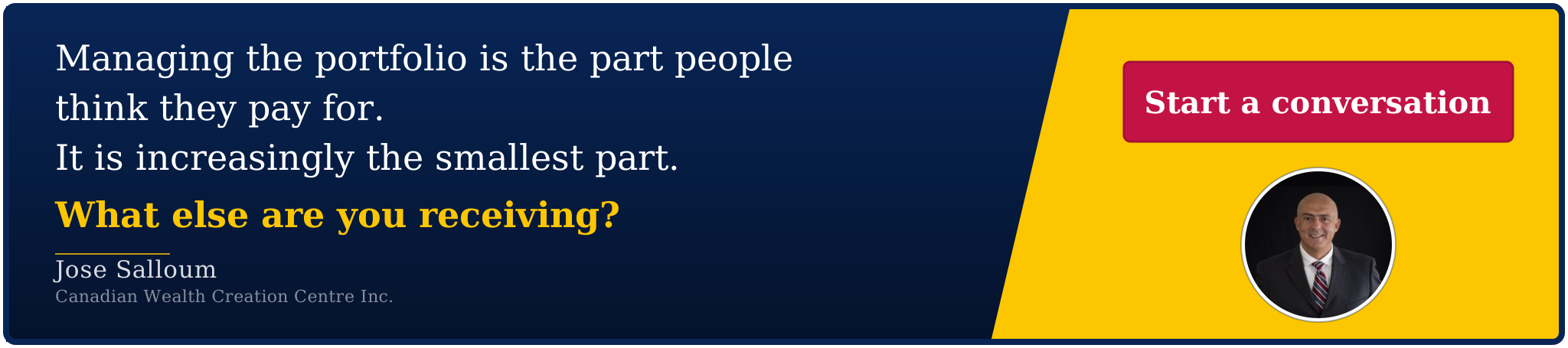
Portfolio management, which is the part most people think they are paying for and is increasingly the smallest.
Planning, which is where the value usually sits: tax sequencing, withdrawal order, timing of government benefits, and coordination with an accountant.
Behaviour. An advisor who prevents one panicked sale in a downturn has frequently justified years of fees, and this is real and impossible to price in advance.
Administration and access, which are ordinary and necessary.
A household paying for the first and receiving only the first is paying too much, because low-cost alternatives do that part well. A household receiving the second and third may be paying reasonably, and the way to find out is to ask what is included rather than what it costs.
The arithmetic, stated plainly
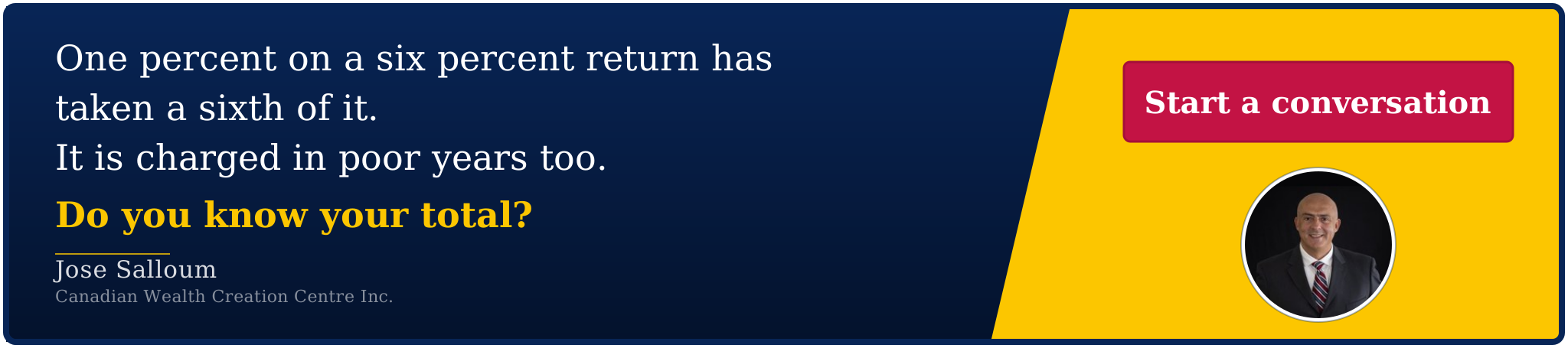
A percentage of assets is not a percentage of return. One percent on a portfolio returning six percent has taken roughly a sixth of the return.
It is charged in poor years too, on a base that fell.
It compounds against you, because the amount taken would otherwise have remained invested, so the cost is the fee plus everything it would have earned.
Over decades the cumulative effect is large, and it is the honest core of the low-cost argument.
None of that makes fees illegitimate. It makes them worth knowing, and a fee openly stated is preferable to a cost buried somewhere it cannot be compared.
How this compares to an insurance contract
Directly relevant, because this practice sells the other one.
A wealth manager publishes a fee. You can compare it against another and decide.
A participating insurance contract publishes nothing equivalent. Costs are absorbed inside the participating account and inside the contract's own charges, and there is no figure to place beside a fund's.
That is a genuine disadvantage of the insurance product and this site says so throughout. What is available instead is the guaranteed schedule, which prices the structure in a set of numbers you can read.
It is a worse tool for comparison and a better one for knowing what you own, and a household evaluating both should understand that it is being asked to do harder work on one side.
Questions worth asking a wealth manager
What is the total annual cost, including the management fee, any fund-level fees, and anything charged separately?
What is included beyond managing the portfolio?
How are you compensated, and does it change depending on what I hold?
What happens to the fee if the portfolio falls?
And who else is paid from anything I buy through you?
All five are ordinary questions, and a firm that answers them plainly has already told you something useful about how it operates.
Fee models, and what each rewards
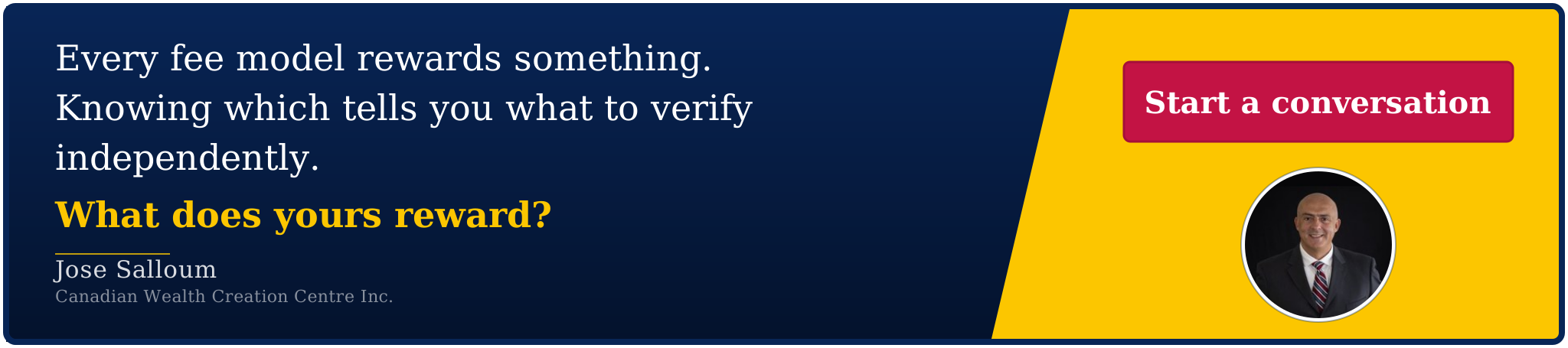
A percentage of assets. The most common. It rises as the portfolio rises, falls in poor years, and rewards gathering assets. It does not reward advice that reduces the assets under management, which includes paying off a mortgage or buying an annuity.
A flat or hourly fee. Paid directly, unaffected by what you hold, and it rewards nothing except the work done. Less common because it is harder to sell.
Commission. Paid by a product provider on a transaction. It rewards the transaction, which is the model this practice operates under and states on every page.
A salary at an institution, usually with targets attached, which reward whatever the institution is measuring.
None is free of conflict and none is disqualifying. What matters is knowing which model applies and what it rewards, because that tells you which advice you should verify independently.
What to compare, and what not to
Compare total cost against total cost. Management fee, fund-level fees, and anything charged separately.
Compare what is delivered, not only what is charged. Two firms at the same price can deliver very different work.
Do not compare a stated fee against a cost you cannot see and conclude the second is lower. An absent number is not a small one, which is the point this site makes against its own product.
The question that settles it
What is the total, in dollars, that leaves my account in a year?
Not a percentage. A number, and a firm that cannot produce one quickly has answered a different question.
Then ask what you receive for it. The number alone decides nothing; the number beside the work does.
A firm that answers both plainly has told you how it operates, and that is usually more informative than the figures themselves. The reluctance, where it appears, is the finding.
A number, and the work beside it. Ask for both, and notice which one arrives faster and which arrives reluctantly.
The gap between the two answers is the finding.
Do these fees cover insurance premiums?
No. They are separate arrangements with separate compensation.
How an insurance practice is paid, stated plainly. By commission from the insurer, when a policy is issued and put in force. Not by a fee from the client.
Neither structure is neutral, and that is the point. A percentage of assets rewards gathering and retaining assets. An hourly fee rewards time spent. A commission rewards a policy being placed. Each aligns the person you are speaking with in a particular direction, and none of them is disinterested.
The useful question is not which structure is honest. It is which one applies to whoever is in front of you, and what that structure rewards. Anyone unwilling to answer that has answered it.
This practice is paid by commission, which is stated on the author page and in the disclosure at the foot of every page here. This page names no firm, criticises no profession, and recommends nothing, because the purpose of understanding a fee structure is to evaluate whoever is charging it, including the author of the page you are reading.
Figures on this page are indicative ranges rather than quotations from any firm. All amounts are Canadian dollars. This page is general information and is not investment or tax advice.
A thirty-minute discovery meeting
A first conversation establishes whether this fits. No illustration is prepared and nothing is arranged.
Often the answer is no, and you will hear it during the call rather than in a proposal afterwards.
This form reaches Canadian Wealth Creation Centre Inc. Any meeting, any advice and any insurance product is provided by Canadian Wealth Creation Centre Inc., through its representatives certified by the Autorité des marchés financiers. IBC Financial is the company's education platform: it distributes no product and no financial service, and it gives no individualised advice.
Important disclosure
Common questions
What does a wealth manager typically charge?
Is the advisory fee the whole cost?
Are the fees negotiable?
Are advisory fees tax deductible in Canada?
How is an insurance practice paid differently?
What does a one percent fee cost in dollars?
What is a management expense ratio?
Are fee tiers marginal or blended, and why does it matter?
What happens to the fee in a bad year?
Are wealth management fees worth paying?
What is the fee actually buying?
When do I not need a wealth manager yet?
What should I ask a wealth manager before signing?
What does each compensation model reward?
Why is there no published fee schedule for life insurance advice?
Can I compare the cost of an insurance contract with the cost of a fund?
Last reviewed 2026-08-21. By Jose Salloum, Financial Security Advisor.